The website features that matter most for B2B lead generation
Conversion
•
X min
•
Published on
07.08.2026
•
Updated on
25.08.2026
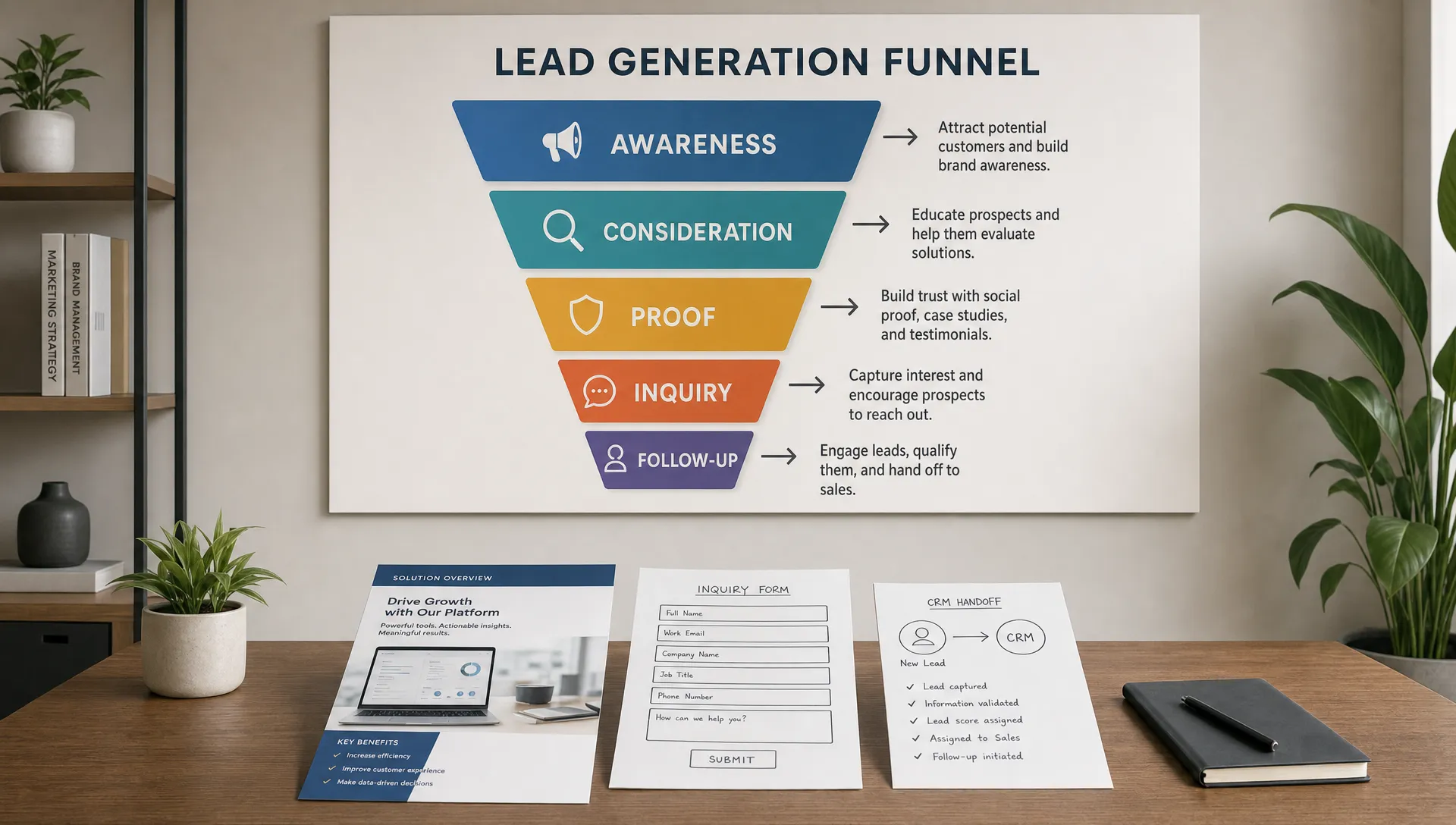
A B2B website should not be judged by how many features it has. It should be judged by whether the right buyers can understand the offer, trust the company, and take the next step with enough context.
That is where many lead-generation websites fail. They add animations, chat widgets, resource libraries, and forms before clarifying the buying journey. The result is often a polished site that looks active but does not create enough qualified conversations.
This guide explains which website features matter most for B2B lead generation, how to prioritize them, and what to avoid when redesigning or improving your site.
Website features are the functional, content, and technical elements that help a visitor move from interest to action.
For B2B lead generation, a feature is not valuable because it is modern or common. It is valuable when it reduces friction in the buyer journey. A clear service page, a relevant proof section, a fast-loading landing page, and a form connected to the CRM are all features if they help turn demand into qualified pipeline.
A lead-generation website needs to support different levels of intent. Some visitors are comparing vendors. Others are trying to understand a problem. Some are returning after a sales conversation. Your website should help each group progress without forcing every visitor into the same generic contact form.
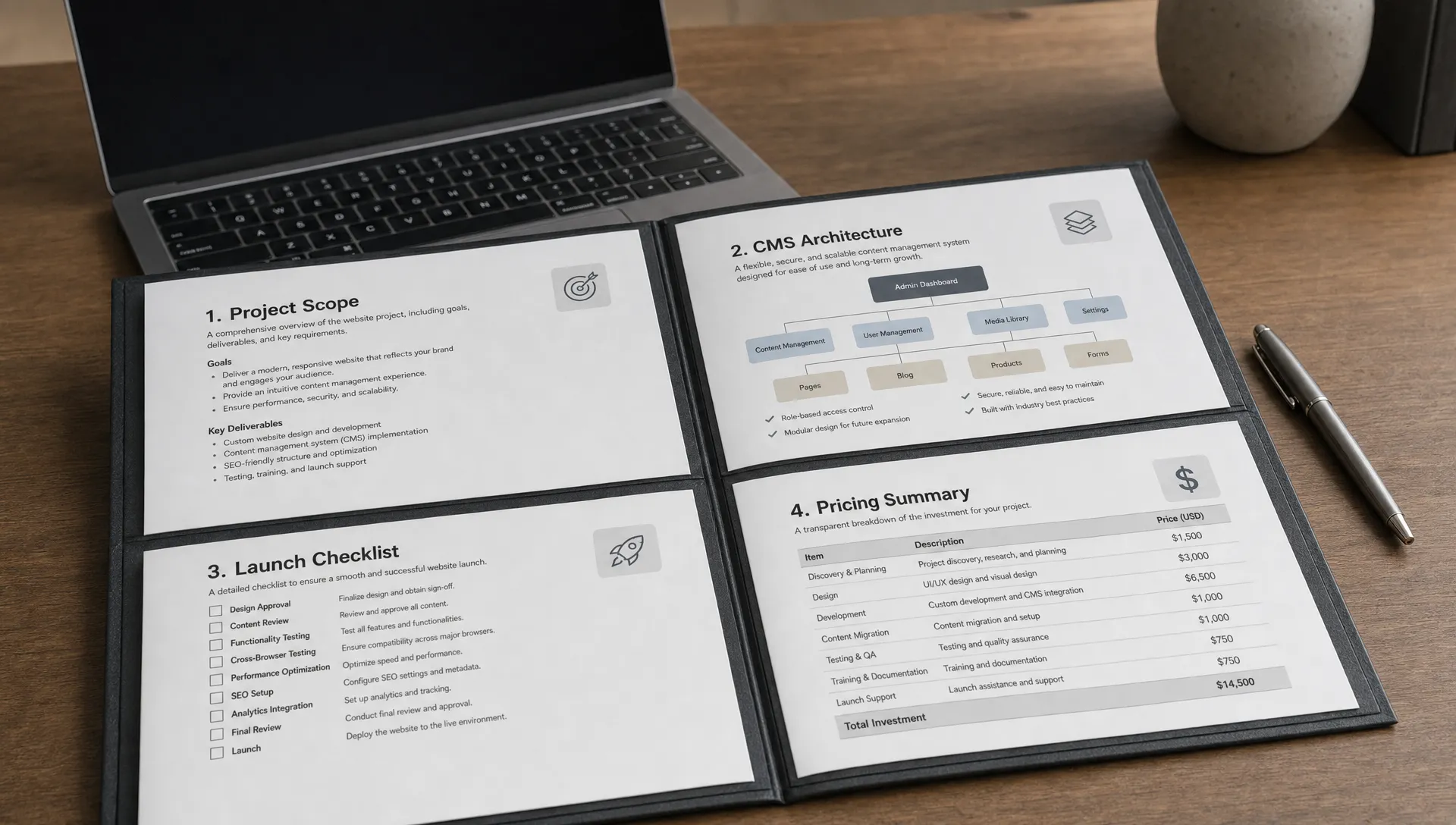
If you are planning a larger rebuild, it helps to align feature decisions with broader website design and development priorities, especially buyer journey alignment, CMS usability, SEO foundations, and conversion paths.
Use a simple framework before approving any new feature.
The framework is: intent, trust, action, measurement, and operations. A feature should support at least one of these areas. If it supports none, it is likely cosmetic or premature.
This framework keeps discussions practical. Instead of asking whether a feature is nice to have, ask which buyer behavior it supports and how the team will maintain it after launch.
| Feature area | Lead-generation role | Build when |
|---|---|---|
| Messaging and positioning | Helps visitors understand who the offer is for and why it matters | Always, before design polish |
| Conversion paths | Guides visitors toward demos, audits, calls, downloads, or assessments | When the offer and buyer intent are clear |
| Proof and trust assets | Reduces risk through examples, results, process clarity, and expertise | When buyers need confidence before contacting sales |
| Technical SEO and performance | Improves discoverability, usability, and crawlability | Before launch and during ongoing optimization |
| CRM and automation integrations | Ensures leads are routed, tracked, and followed up properly | When marketing and sales need reliable handoff |
The features below matter because they connect visitor intent to business action.
The first screen should answer three questions quickly: what you do, who it is for, and what outcome you help create. This is not only a copywriting issue. It affects layout, hierarchy, navigation, and CTA placement.
Avoid vague hero sections that could fit any company in the category. B2B buyers often scan before they read. If your page requires too much interpretation, qualified visitors may leave before reaching your proof or offer details.
Good positioning does not need to say everything. It needs to make the visitor confident they are in the right place.
Navigation should reflect how buyers evaluate you, not how your internal team is organized.
For a B2B lead-generation site, common navigation paths include solutions, services, industries, resources, pricing or approach, company, and contact. The exact structure depends on the offer, but the goal is consistent: reduce decision effort.
If your site has multiple audiences or use cases, segment them clearly. Do not force every visitor through a generic services page if their problem is specific.
A strong B2B service page does more than describe capabilities. It should explain the problem, show the approach, handle objections, and provide a relevant next step.
Each important offer should have its own page when search intent, sales conversations, or campaign traffic justify it. Combining too many services into one page usually weakens both SEO and conversion.
For teams comparing website scope, the distinction matters. A simple online presence may be enough for some companies, but a brochure website should not be treated as a full lead-generation system unless it includes clear paths, proof, and follow-up logic.
Campaign traffic should rarely be sent to a generic homepage. Paid search, paid social, outbound, partner campaigns, and event follow-ups often need dedicated landing pages.
A landing page lets you match the message to the source, remove distractions, and measure performance more clearly. It can also support a narrower CTA, such as booking a consultation, requesting an audit, or downloading a relevant resource.
If your team invests in acquisition, review how landing pages help campaigns convert before sending traffic to broad pages.
Forms are one of the most important website features for B2B lead generation because they define the handoff from website to sales.
A short form can increase completion, but it may create low-quality leads. A long form can improve qualification, but it may reduce submissions. The right balance depends on the offer, average deal size, buyer urgency, and sales capacity.
For most B2B sites, the form should collect enough information to route and prepare the follow-up. It should not ask for information that sales can easily learn later unless that information is needed to qualify the request.
The table below summarizes how form length typically shifts with deal profile. Use it as a starting point, then adjust based on actual sales feedback.
| Deal profile | Recommended form length | Fields to prioritize |
|---|---|---|
| Low-cost, high-volume offer | 2 to 3 fields | Email, company name, and one qualifying question |
| Mid-market service or subscription | 4 to 6 fields | Email, company, role, use case, and timeline |
| Complex or high-value engagement | 6 to 9 fields | Company size, budget range, current stack, timeline, and decision process |
| High-urgency, bottom-of-funnel request | As short as possible | Contact details plus one field that helps routing |
B2B buyers need confidence before they give up their time. Proof can include case studies, client logos, testimonials, process explanations, certifications, security notes, examples of work, or detailed service methodology.
The right proof depends on the risk buyers perceive. A technical buyer may need integration details. A founder may need confidence in speed and execution. A CMO may need assurance that the website can support acquisition and brand credibility.
Do not place proof only on a separate page. Put relevant proof near the point of decision, especially on service pages, landing pages, and contact sections. The table below maps common personas to the proof that tends to reduce their perceived risk.
| Buyer persona | Primary concern | Proof that reduces risk |
|---|---|---|
| Technical buyer | Integration, security, and reliability | API documentation, architecture notes, security certifications, uptime data |
| Founder or small-business owner | Speed, cost, and execution risk | Case studies with timelines, clear pricing, direct examples of past work |
| Marketing or growth lead | Impact on pipeline and campaigns | Conversion benchmarks, campaign results, before-and-after metrics |
| Executive sponsor (CMO, CEO) | Strategic fit and brand credibility | Client logos, testimonials, high-level outcomes, analyst or press mentions |
Performance is a lead-generation feature because slow or unstable pages create friction before the visitor reaches the message.
Core technical elements include page speed, responsive layouts, clean structure, accessible forms, optimized images, indexable content, and correct metadata. Google's documentation on Core Web Vitals is a useful reference for understanding user experience signals, and the BeBranded Core Web Vitals guide covers how to prioritize fixes in practice.
Performance should not be treated as a final check. It affects design decisions, CMS structure, scripts, integrations, and media handling from the start.
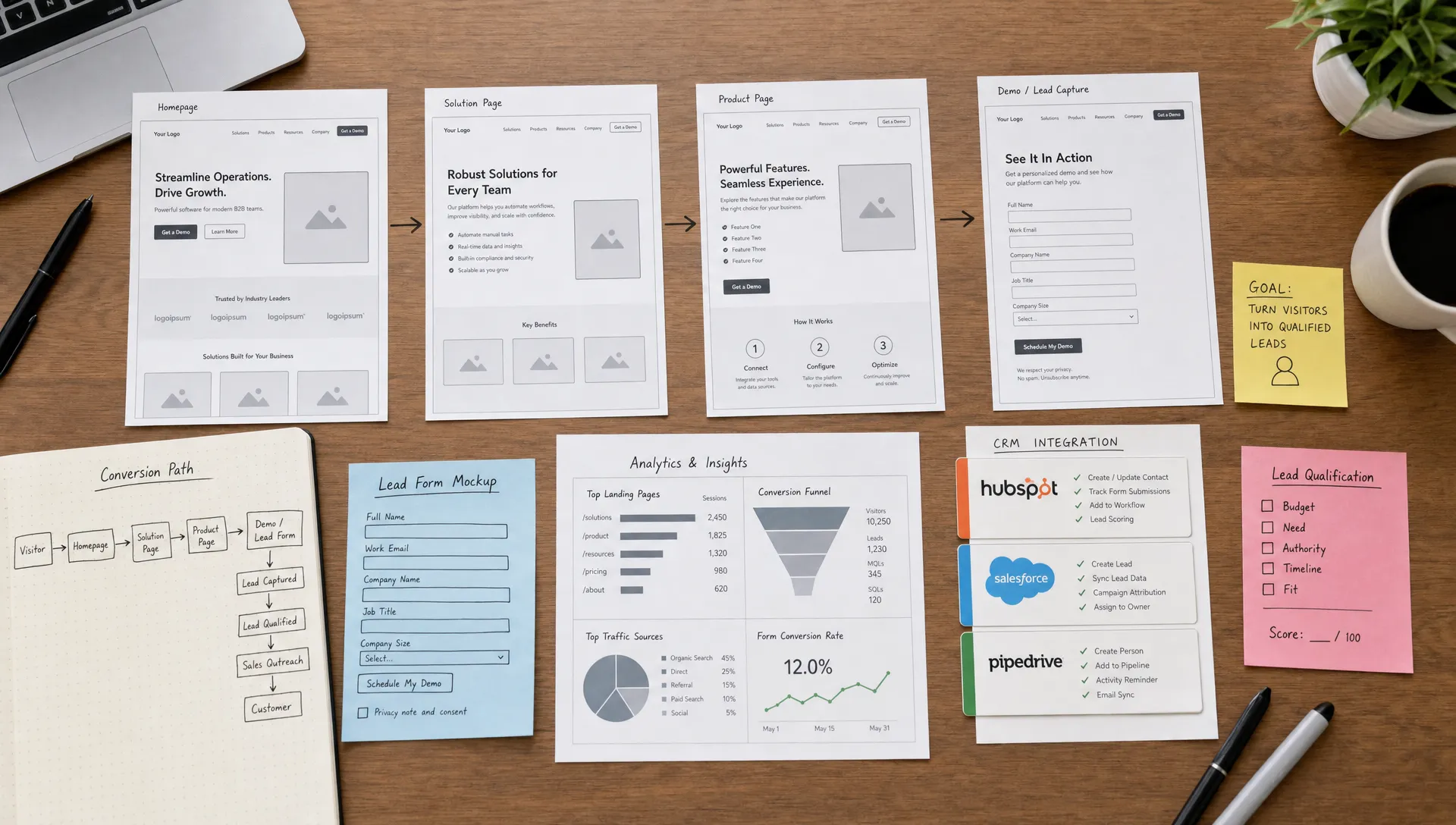
A lead-generation website needs a CMS that marketing can use without depending on developers for every update.
This matters for publishing blog posts, landing pages, case studies, team pages, resources, and industry pages. If the CMS is hard to update, the website will slowly drift away from the actual go-to-market strategy.
A good CMS setup includes reusable content models, clear page templates, structured metadata, and controlled flexibility. It gives marketing enough autonomy without making the site inconsistent.
Lead generation does not end when a form is submitted. The website should connect to the systems that manage follow-up, attribution, and reporting.
At minimum, teams usually need reliable form tracking, event tracking, CRM capture, spam protection, and notification logic. More mature teams may add lead scoring, enrichment, routing, and marketing automation, particularly when the site is built around a system such as HubSpot. The BeBranded guide on HubSpot web design that connects campaigns, content, and CRM covers this in more depth.
This is where development scope matters. If you are defining a project, make sure integrations and launch support are included in what website development and design services should include, not treated as afterthoughts.
The table below distinguishes the integration components most B2B sites need from the ones that only mature teams tend to justify.
| Component | Essential (most B2B sites) | Advanced (mature teams) |
|---|---|---|
| Lead capture | Form tracking and CRM sync | Progressive profiling and dynamic fields |
| Qualification | Manual review or basic routing rules | Automated lead scoring and enrichment |
| Notification | Email alert to sales on submission | Real-time Slack or CRM task creation |
| Attribution | UTM tracking and a source field | Multi-touch attribution across the funnel |
| Spam protection | CAPTCHA or honeypot fields | Server-side validation and rate limiting |
Form completions are only one signal. A B2B website produces engagement and intent data long before a form is submitted, and reviewing only submission counts can hide real problems or real wins.
Effective measurement follows the buyer journey instead of a single event. Organic visibility shows whether the right audience finds the site. Engagement shows whether content answers real questions. Conversion shows whether the path to action works. Sales handoff shows whether marketing and sales stay aligned. Revenue impact confirms the website contributes to pipeline, not just traffic.
| Funnel stage | What to measure | Why it matters |
|---|---|---|
| Awareness and organic reach | Organic sessions, impressions, ranking pages | Confirms the site is found by the right audience |
| Engagement | Time on service pages, scroll depth, return visits | Shows whether content answers buyer questions |
| Conversion | Form completion rate, cost per lead, landing page conversion rate | Measures how efficiently traffic turns into leads |
| Sales handoff | Lead-to-opportunity rate, speed to first contact | Confirms leads are followed up on consistently |
| Revenue impact | Marketing-sourced pipeline, deal velocity, win rate by source | Connects website performance to business outcomes |
Reviewing these metrics together, rather than in isolation, makes it easier to diagnose where a page underperforms. A service page with strong organic traffic but low form completion has a conversion problem, not a visibility problem. A landing page with high conversion but weak sales follow-up has an operations problem, not a website problem. For teams running paid or partner traffic, a closer look at landing page structure built for conversion is often the fastest way to improve this stage of the funnel.
Not every feature should be built at once.
Prioritization should follow buyer impact and team capacity. A complex feature that nobody can maintain will not help. A simple conversion path that sales can follow up on quickly may create more value than a larger feature that takes months to use properly.
Use this decision order:
This sequence is practical because it removes the biggest blockers first. It also prevents the team from masking strategic issues with visual or technical complexity.
For a broader view of how growing teams should approach structure, speed, and maintainability, the principles behind website development in 2026 are useful when planning beyond the first launch. If the underlying issue is not a missing feature but an aging structure, review the guide on how to plan a website redesign before committing to a rebuild.
Most lead-generation issues come from misalignment, not from missing trendy tools.
If conversion and SEO are both priorities, review which web design services improve conversion and SEO before defining your next scope.
Use this checklist to evaluate your current site or prepare a redesign brief. It is organized by category, with a priority level to help teams sequence the work instead of tackling everything at once.
| Category | What to check | Priority |
|---|---|---|
| Foundation | The homepage clearly states who you help, what you do, and what next step to take | High |
| Foundation | Primary navigation matches buyer intent, not internal departments | High |
| Conversion | Each core service or solution has a dedicated page when it supports search, sales, or campaigns | High |
| Conversion | CTAs are specific and placed near decision points | High |
| Conversion | Forms collect enough information for follow-up without unnecessary questions | Medium |
| Conversion | Proof appears on key pages, not only on a separate testimonial or case study page | Medium |
| Conversion | Landing pages exist for important paid, outbound, partner, or event campaigns | Medium |
| Technical | Pages load quickly on mobile and desktop, with compressed media and controlled scripts | High |
| Technical | Metadata, headings, internal links, and indexation basics are handled before launch | High |
| Operations | The CMS lets marketing publish and update content without breaking layouts | Medium |
| Operations | Forms, analytics, CRM capture, and notifications are tested before campaigns start | High |
| Operations | There is a monthly review process for conversions, page performance, content gaps, and lead quality | Medium |
A good checklist does not replace strategy. It helps the team see where the website is blocking revenue work and where improvement is mostly cosmetic.
What are the most important website features for B2B lead generation? The most important features are clear positioning, buyer-focused navigation, strong service pages, relevant CTAs, well-designed forms, trust signals, fast performance, CMS structure, and CRM or analytics integrations.
Does every B2B website need landing pages? Not every website needs many landing pages, but campaign traffic usually performs better when it lands on a page built for that specific audience, message, and next step.
How long should a B2B lead form be? A lead form should be as short as possible while still collecting the information needed to qualify, route, and prepare the follow-up. The right length depends on the offer and sales process.
Which website features should come before visual design? Positioning, information architecture, conversion paths, content structure, and technical requirements should be defined before visual design. Design works better when it supports clear decisions.
How do you know if a website feature is worth building? A feature is worth building when it supports buyer intent, trust, action, measurement, or operations. If the team cannot explain the behavior it should improve, it is probably not a priority.
How often should a B2B website be reviewed after launch? Most teams benefit from a monthly check on conversion and form data, plus a deeper quarterly review of content gaps, page performance, and whether tracked KPIs still match business goals.
The website features that matter most for B2B lead generation are usually not the flashiest ones. They are the features that help buyers understand the offer, reduce risk, take action, and enter a reliable follow-up process.
Before adding new functionality, audit the basics: positioning, pages, CTAs, forms, proof, performance, CMS, and integrations. If those foundations are weak, more features will only add complexity.
One clear next step: use the checklist above to review your website, then prioritize the three fixes most likely to improve qualified lead flow. If you want an external review, start with a focused website audit with BeBranded.