Which web design services actually improve conversion and SEO
Conversion
•
X min
•
Published on
08.06.2026
•
Updated on
21.08.2026
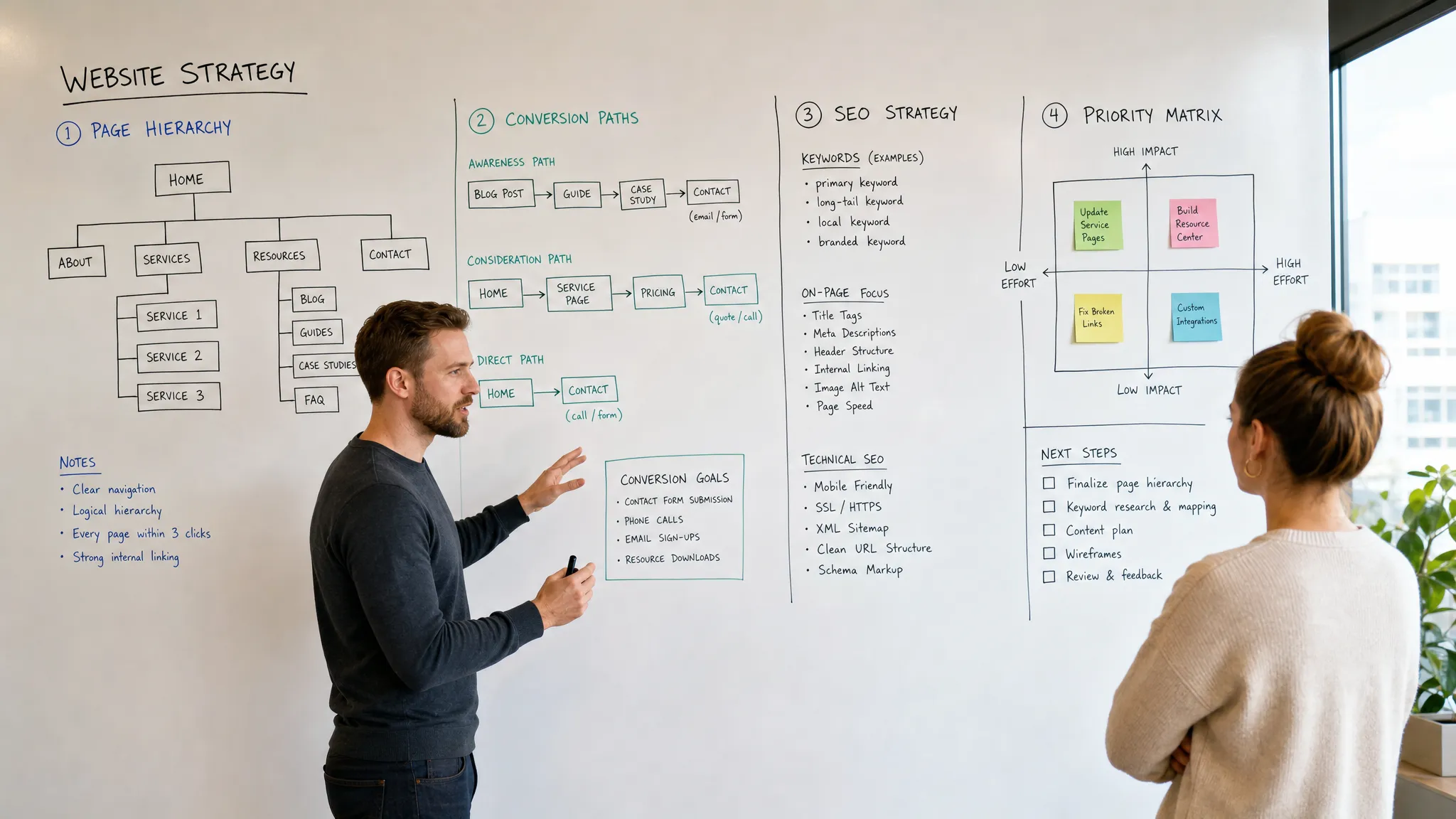
Many website projects start with a visual brief and end with a better-looking site that still does not generate qualified leads. The issue is rarely design quality alone. It is usually a mismatch between what the business needs, how visitors search, how pages are structured, and how clearly the site asks people to act.
The useful question is not “Which web design services look impressive?” It is “Which web design services remove friction from discovery, trust, decision-making, and conversion?”
This guide gives you a practical way to decide what to include in a website project, what to avoid, and how to brief an agency without overspending on cosmetic work.
Web design services should cover more than interface design when the website is expected to support growth.
A performance-focused website project combines strategy, UX, content, SEO, technical setup, responsive development, integrations, and measurement. Visual design still matters, but it works best when it supports a clear commercial and search strategy.
Conversion-focused web design means designing pages so qualified visitors understand the offer, trust the company, and take the next logical step. SEO web design means structuring and building the site so search engines can crawl, understand, index, and rank relevant pages.
When these two goals are handled together, the site becomes easier to find and easier to use. When they are handled separately, you often get attractive pages that are hard to rank, or SEO pages that attract traffic but fail to convert.
A simple framework helps you decide which services matter for your website.
Every service in a web design scope should improve at least one of five gates: find, understand, trust, act, or measure. If a service does not improve any of them, it may still be nice to have, but it should not be treated as a growth priority.
This framework is useful because it keeps the project grounded. A new animation may improve attention, but if the page cannot be found or the offer is unclear, it will not fix the business problem.
The table below summarizes which services usually have a direct impact on conversion, SEO, or both.
| Service | Conversion impact | SEO impact | Priority level |
|---|---|---|---|
| Strategy and positioning | Clarifies the offer and target audience | Helps align pages with search intent | High |
| Information architecture | Makes navigation and journeys clearer | Improves crawl paths and topical structure | High |
| UX wireframes and page layouts | Guides attention toward the next action | Supports logical headings and content hierarchy | High |
| SEO content planning | Brings more qualified visitors to relevant pages | Targets queries, metadata, and internal linking | High |
| Technical SEO and performance | Reduces friction, especially on mobile | Improves crawlability, indexation, and page experience | High |
| Responsive design | Improves usability across devices | Supports mobile-first indexing and accessible content | High |
| Forms and integrations | Reduces lead capture friction and improves routing | Indirect impact through better UX and measurement | Medium to high |
| Advanced animations | Can improve engagement when used with restraint | No direct benefit and can hurt performance if overused | Conditional |
Some services consistently improve both search visibility and business performance when executed properly.
A strong website starts with deciding what each page is supposed to do. The homepage, service pages, landing pages, pricing pages, blog posts, and comparison pages should not all carry the same message or CTA.
For conversion, strategy defines the visitor’s problem, the offer, the objections, and the proof needed to move forward. For SEO, it defines which topics deserve dedicated pages and how those pages connect to each other.
This is closely related to CRO. If you need a deeper process for diagnosing friction and prioritizing experiments, BeBranded’s guide to CRO methodology on Webflow explains how to move from opinion-based changes to structured optimization.
Landing pages matter because they remove unnecessary choices. A focused page can match one campaign, one audience, one offer, and one next step.
For paid campaigns, events, product launches, or specific service offers, landing pages often outperform generic service pages because they reduce cognitive load. For SEO, landing pages can also work when they target a clear search intent and include enough depth to deserve organic visibility.
The key is structure. A useful landing page usually includes a clear headline, a problem statement, benefits, proof, objection handling, a concise CTA, and a form or booking path. BeBranded’s guide to building a Webflow landing page that converts gives a more detailed structure.
SEO should be planned before the visual mockup is approved. If SEO starts after development, the team may need to rework headings, page templates, CMS fields, internal links, URLs, and content sections.
Google’s SEO starter guide is clear on the fundamentals: help search engines understand your content, make pages useful for users, and avoid technical barriers. In practical web design work, this means planning the sitemap, page intent, title tags, meta descriptions, headings, schema opportunities, and internal links before build.
If your site is built in Webflow, technical setup is usually manageable, but it still needs deliberate configuration. BeBranded’s SEO Webflow guide covers the settings and on-page checks that should be included before launch.
Wireframes are not just rough layouts. They are the decision model for each page.
A good wireframe answers practical questions: What does the visitor need to understand first? Which objections appear before the CTA? Where should proof appear? Which sections are unnecessary? What is the mobile order of content?
Copy should be written alongside the wireframe, not added after design. Placeholder text hides weak positioning and often leads to pages that look polished but say very little. For conversion and SEO, page copy needs specificity, search relevance, proof, and clear next steps.
Technical SEO is the part of web design that helps search engines access, interpret, and index the site correctly. It includes clean HTML structure, canonical tags, sitemap generation, redirects, robots directives, structured data, image alt text, and page performance.
Speed also affects user experience. A page that loads slowly can reduce engagement before the visitor reads the message. Google’s Core Web Vitals provide practical metrics for loading, interactivity, and layout stability, but the goal is not to chase scores in isolation. The goal is to make the site fast and stable enough for real users.
For a more practical breakdown of LCP, INP, and CLS, BeBranded’s guide to Core Web Vitals optimization explains what to measure and how to prioritize fixes.
Responsive design is not the act of shrinking a desktop layout to fit a phone. It is the process of designing the experience for different devices, input types, screen sizes, and contexts.
For conversion, mobile issues often appear around navigation, sticky CTAs, forms, modals, tap targets, and long sections. For SEO, responsive design supports mobile-first indexing and avoids fragmented content experiences.
If your site has complex sections, animations, or CMS templates, responsiveness should be tested early and not left to the final QA pass. BeBranded’s responsive design guide explains how to approach breakpoints, layout systems, and mobile-first decisions.
A CMS is not just for blogs. It is the structure that lets your team publish and maintain scalable content without rebuilding pages manually.
For SEO, CMS architecture matters because it affects URL patterns, template fields, dynamic metadata, internal links, category structures, and editorial consistency. For conversion, it helps teams publish service pages, case studies, team pages, resources, and landing pages with consistent proof and CTAs.
This is especially important for Webflow projects where collections, templates, and fields need to be planned before build. BeBranded’s Webflow CMS guide explains how collections work and how to avoid rigid content structures.
A website can attract the right audience and still lose leads through weak forms, unclear routing, or missing tracking.
Form design affects conversion directly. Long forms, vague labels, unnecessary required fields, and poor mobile behavior create friction. Routing also matters. A high-intent lead should not sit in an inbox without context, especially if your sales process depends on speed or qualification.
If you use Webflow and need more advanced forms, conditional logic, or better lead capture flows, BeBranded’s guide to Tally.so and Webflow forms is a useful starting point.
This is where many attractive websites fail. They look credible, but there is no reliable path from search intent to enquiry, no clear proof, and no measurement. SEO Bridge makes a similar point in its practical article on a good-looking site that still fails to generate leads, especially around indexation, trust, and conversion paths.
Most underperforming website projects fail for predictable reasons.
The common thread is simple: websites fail when design is treated as a surface layer rather than a business system.
Not every business needs every web design service at the same time.
Use a constraint-first approach. Identify the main bottleneck in the current website, then buy the services that remove that bottleneck. This avoids large redesign scopes that look complete but do not address the reason the site is underperforming.
This approach also helps you compare agency proposals. A serious proposal should explain which constraint it solves and what deliverables support that outcome.
A clear scope is one of the strongest indicators that a web design project will improve conversion and SEO.
At minimum, the scope should clarify what happens before design, during design, during development, before launch, and after launch. If the proposal only lists page counts and visual deliverables, ask how strategy, SEO, content, performance, tracking, and QA are handled. It also helps to compare web design packages beyond the page count so you judge scope, not surface volume.
For a Webflow or Framer project, a strong scope usually includes discovery, sitemap planning, wireframes, custom design, responsive development, technical SEO setup, CMS configuration where needed, form and integration setup, analytics checks, launch QA, and handover.
A fast delivery timeline can still work when decisions are organized. For many SMB and scale-up websites, a two to four week build is realistic when the offer is clear, content ownership is defined, feedback is consolidated, and the team focuses on pages that affect revenue.
Use this checklist before signing a proposal or starting a redesign
If an agency can answer these points clearly, the project is more likely to produce a useful business asset rather than a cosmetic refresh.
The web design services that improve conversion and SEO are the ones connected to how people find, understand, trust, and act on your website.
Start with strategy, page architecture, SEO planning, UX, copy, technical foundations, responsive design, CMS structure, forms, and measurement. Treat visual design as part of that system, not as a separate layer.
If you are planning a Webflow or Framer website and want a clear view of what to prioritize, request a focused website audit from BeBranded.