Website Development in 2026: What Growing Teams Need
Development
•
X min
•
Published on
05.06.2026
•
Updated on
21.08.2026

AI can now generate a decent first draft of a page in minutes. That does not mean website development has become simpler for growing companies. It means the baseline has moved.
In 2026, buyers expect fast pages, clear positioning, credible proof, accessible mobile experiences, and content that can be discovered through Google, AI assistants, social referrals, and sales conversations. For CEOs and CMOs, the real question is no longer, can we launch a website? The question is, can our website keep up with growth?
A growing team needs more than a polished homepage. It needs a web system that supports campaigns, captures demand, scales content, integrates with operations, and improves over time. That is where modern website development becomes strategic.
For years, many companies treated their website like a digital brochure. The goal was to look credible, explain the offer, and provide a contact form. That is no longer enough for competitive SMBs and scale-ups.
Your website now sits at the center of the buying journey. Prospects visit it before taking a sales call. Investors use it to understand your positioning. Candidates use it to judge your culture. AI tools may use your pages to summarize your company. Marketing teams depend on it to launch campaigns quickly.
That makes website development a business decision, not just a design or technical project. The best sites in 2026 are built around four outcomes: visibility, trust, conversion, and operational speed.
This does not always require a heavy custom code build. In many cases, platforms like Webflow and Framer can deliver the speed, design quality, CMS flexibility, and maintainability that growing teams need. The key is not choosing the trendiest tool. It is building the right system for your team, your content, and your revenue model.
A common mistake is to start website development by asking how many pages are needed. A better starting point is understanding how buyers make decisions.
A CEO may care about credibility, differentiation, and whether the company looks ready for the next stage. A CMO may care about campaign velocity, SEO, conversion paths, and content governance. A sales leader may need pages that answer objections before calls. A customer may need proof that the company understands their industry.
Your website architecture should reflect those journeys. Instead of simply creating a homepage, about page, services page, blog, and contact page, think in terms of intent. What does a first-time visitor need to understand in 10 seconds? What proof does a skeptical buyer need before booking a call? What content should support people comparing options? What should return visitors see when they are closer to converting?
This is why strong website development starts with strategy, messaging, and information architecture before visual design. A beautiful site with unclear positioning still loses attention. A technically perfect site with weak conversion paths still leaks pipeline.
The speed of production has changed dramatically. AI tools can support research, wireframing, content outlines, testing, and code snippets. No-code platforms can turn design into production faster than traditional development stacks. For a focused marketing website, a 2-4 week delivery window can be realistic when the scope is clear and stakeholders are aligned.
But fast does not mean rushed. The danger in 2026 is that teams launch quickly with a site that looks good on day one but becomes painful to manage three months later. Pages are duplicated without structure. Classes become inconsistent. CMS collections are improvised. Design components are not reusable. Nobody knows how to safely add new content.
Good website development balances delivery speed with maintainability. That means building reusable sections, defining typography and spacing rules, planning CMS structures early, and setting up clear naming conventions. When a project does need custom scripts, it helps to scope custom Webflow code without creating maintenance debt so those additions stay easy to maintain. If your marketing team has to ask a developer for every small update, the site is not really supporting growth.
If your workflow starts in Figma, the handoff also matters. A structured design file is easier to translate into a clean Webflow or Framer build. For production websites, a careful rebuild is often more reliable than blindly exporting design layers. If this is part of your process, the Figma to Webflow workflow is worth understanding before the project starts.
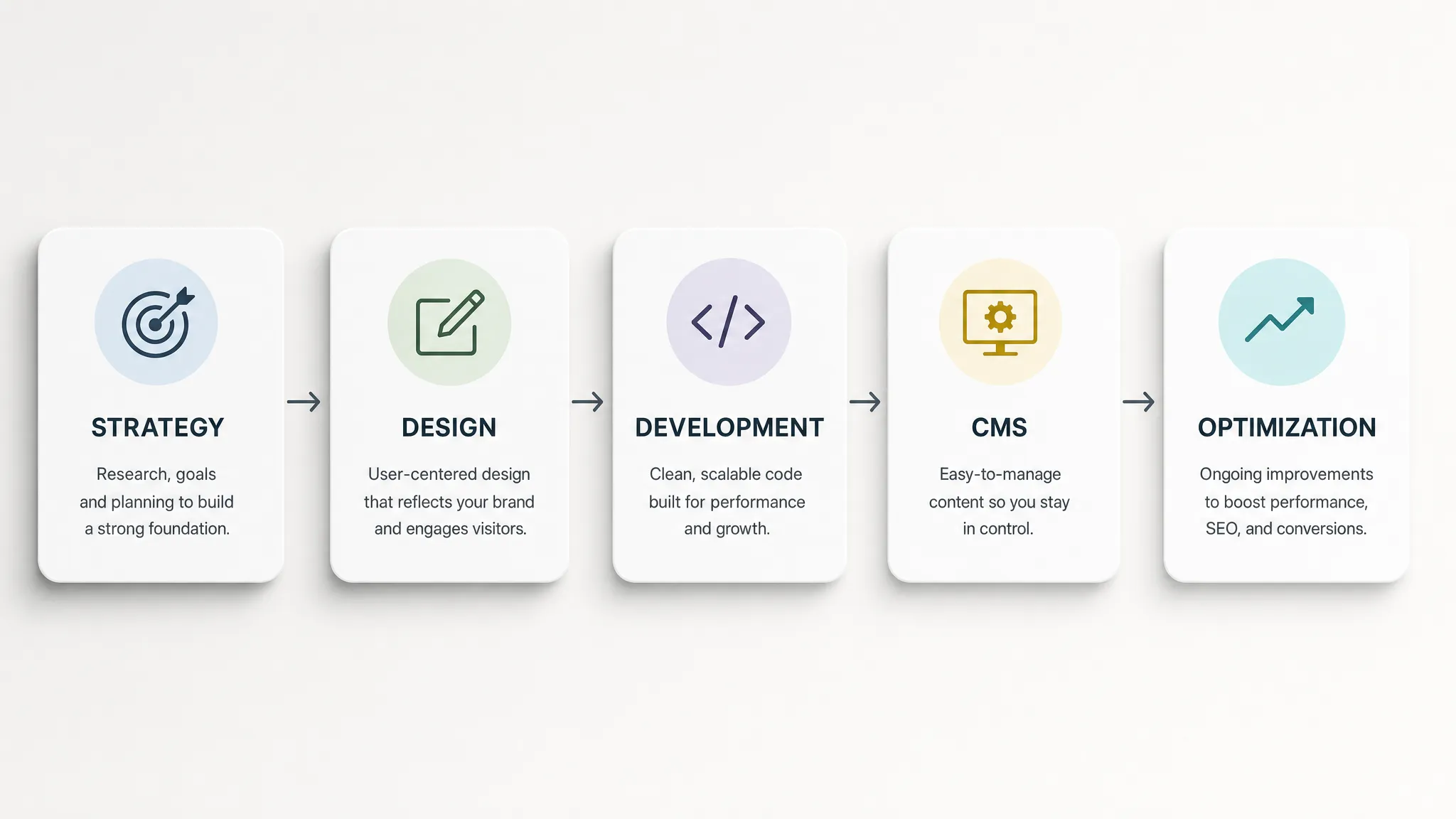
For growing teams, the CMS is often the difference between a website that scales and a website that blocks momentum.
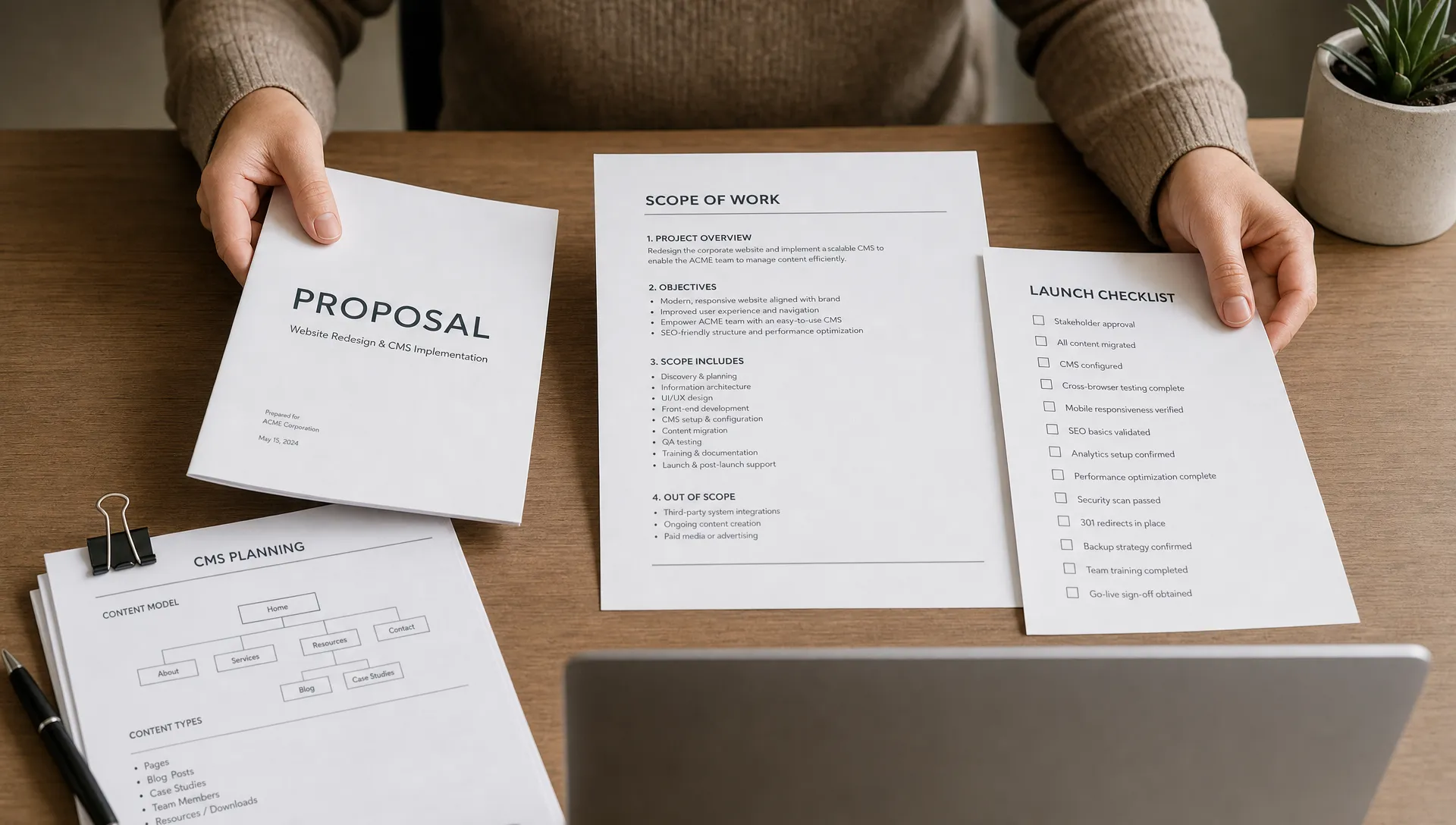
A good CMS is not just a blog database. It should make recurring content easy to publish, update, and reuse. Case studies, insights, customer stories, team profiles, integrations, locations, webinars, resources, and landing page modules can all become structured content if planned correctly.
A strong CMS setup helps your team move faster because editors do not need to rebuild layouts from scratch. They can add a new case study, update a service page, publish an article, or create a resource page from predefined fields and templates.
For a marketing team, this matters because content velocity compounds. The easier it is to publish high-quality content, the more consistently you can support SEO, sales enablement, product launches, and campaigns.
A scalable CMS should usually define:
Webflow is especially strong here when the content model is planned before development. If your team expects to publish regularly, it is worth learning how collections work through a dedicated Webflow CMS guide.
In 2026, a website should not only inform. It should move the right visitors toward the right next step.
That does not mean every page needs aggressive sales language. Conversion depends on intent. Someone reading a top-of-funnel article may not be ready to book a call, but they may be ready to subscribe, download a resource, or visit a related service page. Someone on a pricing, service, or landing page may be ready for a demo, audit, quote, or consultation.
The best conversion-focused websites make the next step obvious without making the experience feel forced. They reduce uncertainty with proof, clarify who the offer is for, answer objections, and make forms easy to complete.
For CEOs and CMOs, conversion rate optimization is not a design detail. It is a budget multiplier. If your traffic stays the same but the percentage of qualified visitors who contact you improves, your acquisition economics improve without increasing media spend.
Key conversion elements include a clear above-the-fold message, benefit-led sections, specific social proof, relevant case studies, strong calls to action, low-friction forms, and page structures that match buyer intent. If you want a deeper framework, BeBranded has a practical guide to CRO on Webflow.
Performance is not optional. Slow pages reduce trust, hurt user experience, and can affect organic visibility. Google’s Core Web Vitals documentation focuses on three key experience signals: Largest Contentful Paint, Interaction to Next Paint, and Cumulative Layout Shift. In plain terms, your site should load quickly, respond quickly, and stay visually stable as it loads.
This is especially important for growing teams because websites tend to get heavier over time. New scripts are added. Images are uploaded without compression. Videos are embedded carelessly. Fonts multiply. Analytics, chat tools, pixels, and embeds accumulate.
Performance should be part of website development from the beginning. That means optimizing images, using video carefully, keeping third-party scripts under control, setting responsive image behavior properly, and testing real pages before launch. If you want to go deeper, read the guide to Core Web Vitals optimization.
Accessibility also deserves more attention in 2026. The WCAG 2.2 standard gives teams a recognized framework for making websites more usable for people with disabilities. Accessible websites are usually better websites for everyone because they improve contrast, navigation, form clarity, keyboard usability, and content structure.
For a CMO, accessibility is not only about compliance. It expands usability, reduces friction, and signals professionalism. For a CEO, it reduces avoidable risk and shows that the brand takes digital experience seriously.
SEO still matters, but discovery is broader than classic search rankings. Buyers now find companies through Google results, AI-generated summaries, LinkedIn posts, comparison content, communities, podcasts, newsletters, and direct recommendations. Your website needs to be understandable across that entire ecosystem.
The fundamentals remain important: crawlable pages, strong metadata, clean headings, internal links, fast performance, schema where relevant, and content that answers real questions. But in 2026, content also needs to be clear enough for AI systems to parse and summarize accurately.
That means avoiding vague marketing copy, publishing specific proof, structuring pages logically, and making expertise visible. A generic service page that says your team delivers innovative solutions will not help search engines, AI assistants, or human buyers understand why you are credible. A page with clear use cases, industries, outcomes, process, FAQs, and examples has a better chance of being useful and discoverable.
This is where SEO and generative engine optimization overlap. GEO is not a replacement for SEO. It is a reminder that clear, structured, trustworthy content performs better in both human and machine-mediated discovery. For a practical explanation, see BeBranded’s guide to GEO vs SEO in 2026.
A growing team cannot afford a website that operates in isolation. Leads, content, analytics, and campaign data need to move between tools reliably.
Modern website development should consider integrations early, not as a last-minute technical task. Contact forms may need to send data to a CRM. Landing pages may need to capture UTM parameters. Newsletter forms may need to connect to email tools. Applications may need to route to a hiring workflow. Gated content may need automation. Analytics events may need to be tracked consistently.
The exact stack depends on your business, but the principle is the same: your website should reduce manual work, not create it.
Common integration needs include:
This is one reason no-code website development has become attractive for SMBs and scale-ups. When implemented properly, tools like Webflow, Framer, Tally, Make, Zapier, Airtable, HubSpot, and other systems can create efficient workflows without the overhead of a fully custom engineering project.
Most websites do not break all at once. They become messy gradually.
A campaign needs a quick landing page. A new hire adds a section without checking spacing. A designer changes a button style for one page. A marketer duplicates an old page with outdated SEO tags. A script is added for one experiment and never removed. Six months later, the website feels inconsistent and nobody is sure what is safe to edit.
Governance prevents this. It does not need to be bureaucratic, but it does need to be intentional.
A scalable website should have a simple design system, reusable components, clear CMS rules, documented editing guidance, and a defined process for launching new pages. This keeps the site consistent while still allowing marketing to move quickly.
A good design system is especially valuable for growing teams because it creates a shared language between leadership, marketing, design, and development. It reduces subjective debates and speeds up production. If your current site feels inconsistent, start with the principles in this design system guide.
The launch is not the finish line. It is the start of measurement.
A high-performing website improves through iteration. After launch, your team should monitor conversions, traffic quality, technical issues, form submissions, page speed, ranking changes, and content performance. You should also review qualitative signals: What do sales calls reveal? Which objections keep coming back? Which pages are prospects mentioning? Which offers are unclear?
This matters because the first version of a website is built from assumptions. The best post-launch process turns those assumptions into learning. Over time, you can improve hero messages, calls to action, page structure, case studies, forms, and internal links based on actual user behavior.
Maintenance is part of this process. It includes technical checks, content updates, SEO improvements, redirect management, performance monitoring, and small conversion improvements. If you are budgeting for the full lifecycle, the guide to website maintenance pricing can help you understand what is usually included.
There is no universal best way to build a website. The right model depends on your team, timeline, budget, technical needs, and growth goals.
A template or AI website builder can work for early validation, small internal projects, or very simple websites. The tradeoff is that brand differentiation, scalability, SEO control, and integration depth may be limited.
A freelancer can be a good fit for a narrow scope, especially if you already have strategy, copy, design direction, and internal project management. The risk is relying on one person for strategy, UX, design, build, SEO, analytics, and maintenance.
An in-house team makes sense when your website is a constant growth engine and you have enough ongoing work to justify dedicated roles. This works best when processes and ownership are clear.
A specialized no-code agency is often a strong fit for SMBs and scale-ups that need a custom marketing website, fast delivery, SEO foundations, CMS structure, responsive design, integrations, and ongoing support without building a full internal web team. This is especially relevant when marketing needs speed but leadership still expects a polished, scalable result.
If you are comparing platforms, Webflow and Framer are two of the most relevant options for modern marketing sites. Webflow is usually stronger for structured content, CMS-heavy sites, SEO control, and scalable website operations. Framer is often attractive for fast, design-led websites with lighter content requirements. For a detailed comparison, see Webflow vs Framer in 2026.
A strong brief saves time, reduces revision cycles, and leads to better strategic decisions. Before starting a project, align internally on what success looks like and what constraints matter.
Your brief should cover:
The more precise your brief, the easier it is for a development partner to recommend the right structure, platform, timeline, and scope. It also helps avoid one of the most common website problems: endless feedback because the project never had a clear definition of success.
A website should be measured against business outcomes, not just design preferences.
For a CEO, the important questions are strategic. Does the website make the company look credible for its next stage? Does it support sales conversations? Does it communicate positioning clearly? Does it create trust with buyers, partners, candidates, and investors?
For a CMO, the important questions are operational and performance-driven. Can the team publish without bottlenecks? Are campaigns easier to launch? Are organic pages bringing qualified traffic? Are forms converting? Are landing pages improving over time?
Useful metrics include qualified leads, conversion rate by page type, organic traffic quality, assisted pipeline, form completion rate, page speed, content publishing velocity, ranking growth, engagement on high-intent pages, and sales feedback on lead quality.
The most mature teams combine quantitative and qualitative signals. Analytics show what users do. Sales calls, customer interviews, and session recordings help explain why they do it. Together, they give your website development roadmap a much stronger foundation.
Website development in 2026 is not about adding more pages or chasing every new AI tool. It is about building a fast, clear, scalable web presence that supports how your buyers decide and how your team works.
BeBranded helps SMBs and scale-ups design, develop, and optimize high-performing Webflow and Framer websites with custom design, SEO foundations, CMS integration, automations, responsive development, and ongoing support.
If your current website is slowing down marketing or failing to convert the right visitors, get in touch with BeBranded and explore how a focused 2-4 week website project can turn your site into a stronger growth asset.