Website design and development: what growing teams should prioritize
Development
•
X min
•
Published on
12.06.2026
•
Updated on
21.08.2026
A growing team does not need a website that is only easier to admire. It needs a site that explains the offer, captures demand, supports campaigns, lets the team publish autonomously, and improves over time. The priority is not to include every feature at launch. The priority is to make the right decisions in the right order so the site supports growth instead of becoming another project that needs rebuilding in twelve months. This guide covers seven priorities, from buyer journey alignment to post-launch ownership, with a concrete checklist to use before any build or redesign.
Growing teams approach website projects differently from companies that simply need a digital presence. The site is not a brochure to publish and forget. It is an operational asset that needs to support lead generation, content publishing, campaign launches, hiring, and sales enablement, often simultaneously and with limited internal resources.
That changes what should be prioritized in website design and development. Most project failures do not come from poor design or bad code. They come from poor sequencing: too many features at launch, no content ownership, SEO treated as an afterthought, and a CMS nobody can use after the first month. This guide gives you a practical prioritization method, the areas to focus on first, the mistakes to avoid, and a checklist to use before starting a new build or redesign.
Website design and development is the process of planning, designing, building, launching, and improving a website so it supports business goals. For a growing team, that scope extends well beyond visual design and page production. It includes strategy, UX, content structure, technical implementation, SEO, integrations, performance, analytics, and post-launch operations.
The important point is that design and development are not separate concerns. A design decision affects conversion, page speed, CMS usability, SEO, and future maintenance. A development decision affects how quickly the marketing team can publish, test, and iterate. If you are comparing proposals, it helps to compare web design packages beyond the page count so the scope is clear across the full project lifecycle. Our breakdown of what website development and design services should include is a useful reference when different providers describe similar work in very different ways.
Before deciding on pages, tools, animations, or CMS collections, use a simple framework to separate what is essential from what is only nice to have. This keeps the project focused and prevents a growing team from turning the website into a collection of disconnected stakeholder requests.
Evaluate each website request through four filters: business impact (does this directly help pipeline, sales, hiring, retention, or trust?), dependency (does another important part of the site depend on this being done correctly?), maintainability (can the internal team manage it after launch without breaking the system?), and evidence (is this based on user feedback, analytics, sales objections, search demand, or a clear strategic need?).
| Filter | Question to ask | If the score is low |
|---|---|---|
| Business impact | Does this directly help pipeline, sales, hiring, retention, or trust? | Move to "later" unless it is a dependency for something else |
| Dependency | Does another critical part of the site depend on this being correct? | Can be built independently and added later |
| Maintainability | Can the internal team manage this after launch without external help? | Simplify the approach before building it |
| Evidence | Is this based on data, feedback, search demand, or a proven strategic need? | Test later with real usage data, not in the first launch |
Items that score high on impact and dependency should be handled early. Items that score low on maintainability need to be simplified before they are built. Items with weak evidence should be tested later, not forced into the first launch. A good external partner should help you prioritize, not simply execute every request. Our guide on how to choose a Webflow partner agency covers what to look for in that decision structure.
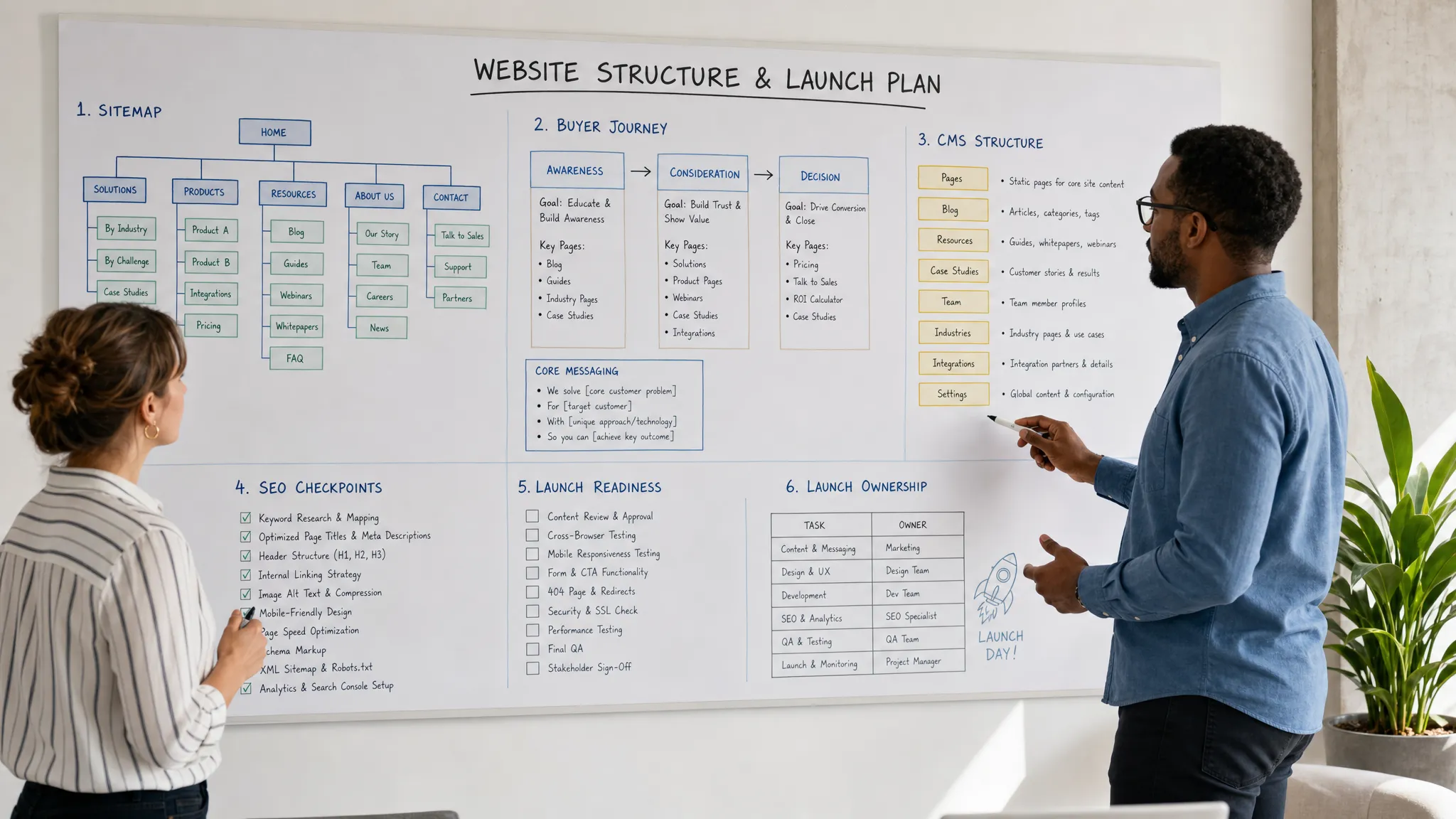
The first priority is not the homepage layout. It is the journey your target audience takes before they decide to contact you, request a demo, buy, apply, or subscribe. For CEOs, CMOs, founders, and marketing managers, this usually means clarifying how visitors move from problem awareness to trust, then to action. A homepage should orient the visitor quickly, but it should not carry the entire sales argument alone.
Each key page needs a specific job. A service page should explain fit, outcomes, process, and proof. A landing page should focus on one conversion. A comparison page should reduce decision friction. A blog or resource hub should answer questions before they reach sales. Before design starts, map your main audience segments, their questions, and the pages that should answer those questions. A proper website mockup process helps turn that thinking into structure before development begins.
A growing website usually fails slowly when the CMS is treated as an afterthought. The design may look clean at launch, but the team struggles to add new pages, publish resources, or update content without external help. This is one of the most common patterns we see in projects that come to us for a rebuild after twelve months.
Your CMS should reflect how the business publishes. A B2B team may need collections for blog posts, use cases, customer stories, team members, integrations, resources, and locations. But every collection adds complexity, so each one needs a clear owner and a real use case. The goal is not to create the most flexible CMS possible. The goal is to create a system that is structured enough to scale and simple enough for the team to use daily. If Webflow is part of your stack, our Webflow CMS guide explains how to think about content architecture without overcomplicating it.
Visual quality matters, but a growing team should not prioritize originality at the expense of clarity. A website needs to make the offer understandable, show credible proof, reduce anxiety, and make the next action obvious. Conversion-focused design is mostly about hierarchy: visitors should quickly understand who you help, what problem you solve, why your approach is credible, what they should do next, and what happens after they take action.
That requires consistent components, clear calls to action, readable sections, strong page rhythm, and well-placed proof. A practical design system helps keep that consistency as the site grows and more people contribute to it. Once the site is live, conversion should become an ongoing process. The right question is not "is this page finished?" but "what is the next bottleneck we need to remove?" Our guide on which web design services actually improve conversion and SEO covers how to structure that ongoing effort.
Platform choice should follow operating needs, not personal preference. A growing marketing site needs to support content updates, landing pages, SEO changes, integrations, responsive design, and stable maintenance without requiring a developer for every change.
For many SMBs and scale-ups, Webflow and Framer are strong options because they reduce dependency on traditional development cycles for marketing work. If the site is content-heavy, SEO-driven, or likely to become more structured over time, Webflow is often the better fit. If the project is lighter, more visual, and needs fast design-led production, Framer can be relevant. The right choice depends on CMS complexity, SEO requirements, design needs, localization, and how many people will manage the site.
Governance matters as much as the tool. Decide who can publish, who reviews SEO, who approves design changes, who manages forms, and who owns tracking. Without those rules, a good platform still becomes messy within a few months.
SEO should not be treated as a launch-day metadata task. It should influence architecture, page templates, internal linking, content structure, technical setup, and migration planning from the start. For growing teams, technical SEO starts with crawlable pages, clean URL structure, proper headings, indexation rules, canonical tags, redirects, image alt text, structured content, and CMS templates that generate unique titles and descriptions. Our SEO Webflow guide covers the setup points that should be handled before launch.
Performance also needs to be designed in. Heavy images, unnecessary animations, third-party scripts, oversized video files, and poor responsive behavior can damage user experience and make paid acquisition less efficient. Core Web Vitals are a reliable technical baseline because they focus on real user experience: loading speed, visual stability, and responsiveness. They should not become the only performance metric, but they are the right place to start.
Integrations should support the way your team works. They should not be added because they look sophisticated in a project scope. The most useful website integrations usually connect forms, CRM, analytics, email tools, scheduling, enrichment, live chat, and internal notifications. The right setup depends on what happens after a visitor converts. If leads disappear into a shared inbox or arrive without context, the website is not supporting growth properly.
The rule is simple: automate a clear workflow, not a vague ambition. If the process is not documented, automation usually adds complexity instead of removing it. Before development starts, clarify what should happen when a visitor submits a form. The answer may involve a CRM, email notification, lead scoring, newsletter list, calendar booking, or automation platform such as Zapier or Make. If the form is central to revenue, treat it as a conversion system, not as a small technical detail.
A website is not finished when it goes live. For a growing team, launch is the point where measurement and iteration should become more disciplined. Define who owns updates, who monitors analytics, who checks Search Console, who maintains forms, who reviews page speed, and who decides which pages get improved next. Without ownership, small issues accumulate until the site becomes hard to manage.
Maintenance does not need to be heavy, but it needs to be explicit. A practical maintenance plan should cover content edits, technical checks, SEO monitoring, performance reviews, integrations, and support for new campaign needs. The first 90 days after launch are especially important: that is when real usage data starts to reveal what works, what confuses visitors, and what needs adjustment.
Most website problems come from poor sequencing, unclear ownership, or decisions made too early without enough evidence. Here are the patterns that cause the most friction.
Starting with visual references before strategy. Visual direction is useful, but it should not replace positioning, audience definition, offer clarity, and page objectives. A website that looks great but says the wrong thing will not convert.
Treating the homepage as the whole website. A homepage can orient visitors, but service pages, landing pages, comparison pages, case studies, and content hubs often do more of the conversion work. Teams that spend 80 percent of their time on the homepage often neglect the pages that actually generate leads.
Adding CMS flexibility without editorial discipline. A complex CMS without owners, naming rules, and publishing workflows becomes hard to maintain. Within a few months, content becomes inconsistent, categories multiply, and nobody knows which fields are mandatory.
Designing for desktop approval only. Many stakeholders review websites on large screens, while many users arrive on mobile or smaller laptops. Responsive behavior must be checked during design and development, not after launch.
Pushing SEO to the end. If SEO is handled only before publishing, you risk weak architecture, missing redirects, duplicated templates, and content gaps that are expensive to fix later. SEO shapes structure, and structure is hard to change after the site is built.
Installing tools without governance. Analytics, chat, CRM, automation, and AI tools need owners and rules. Otherwise, they create noise, inconsistent data, and a growing stack of subscriptions nobody manages.
Measuring success by subjective feedback. "It looks better" is not a business metric. Define conversions, engagement signals, organic visibility, lead quality, and publishing speed before launch, so you have a baseline for improvement.
Growing teams often try to solve every future use case in the first version. That usually slows the project down and increases complexity before the site has real usage data. A better approach is to split the roadmap into now, next, and later.
Build now what is required for clarity, credibility, conversion, SEO, analytics, and team autonomy. Build next what supports upcoming campaigns or known content plans. Build later what depends on user data, larger traffic volume, or operational maturity. For example, a strong CMS, clear service pages, conversion tracking, and technical SEO should usually be part of the first version. Advanced personalization, complex animations, multi-step automation, and large content hubs can often wait until the team has validated the core structure. This sequencing keeps the first launch focused while making sure the site is not built into a dead end.
Use this checklist before signing a proposal, approving a scope, or starting production.
If several of these points are unclear, fix the strategy and structure before moving into design production.
Website design and development should give a growing team a clearer message, better conversion paths, a maintainable CMS, strong technical foundations, and a practical way to improve after launch. The priority is not to launch with everything. The priority is to launch with the right structure and the right ownership, so the site can grow with the business instead of falling behind it.
Review your current website or project scope against the checklist above. If several priorities are unclear, fix the strategy and structure before committing to design production. If you want an external perspective before starting a build or redesign, get in touch with BeBranded for a focused project review.