

Next.js & Payload agency in Paris & Barcelona.

Custom websites and web apps built on Next.js, React and Payload CMS. Two senior founders run your project from the first call to production, with AI tools at every step.
  • Next.js
  • React
  • Payload CMS
  • TypeScript
  • PostgreSQL
  • Vercel

5/5 on Google · 50+ companies

Why Next.js and Payload

Why we build on Next.js and Payload.

We spent years building Webflow sites, and we still do. But in November 2026 we moved our own site to Next.js and Payload. Here is why, and what it means for your project.

We left Webflow for our own site

Our site had grown to more than a thousand pages in two languages: services, case studies, a blog, a glossary, tool reviews and comparisons. On Webflow, every new idea ran into the platform. In November 2026 we rebuilt it on Next.js and Payload CMS, with the same method we use for clients, and kept every URL. The numbers are further down this page.

Where no-code platforms hit a ceiling

Webflow is excellent for a marketing site. The limits appear when a site grows: caps on CMS items and collections per plan, localization billed as an add-on per language, editor seats billed one by one, and no real way to build application features such as accounts, permissions or business rules. Each workaround adds a third-party tool and a monthly fee. We explain this in more detail in our article on when to choose another platform than Webflow.

AI made custom code affordable

Until recently, custom code meant a bigger team, a longer schedule and a bigger budget. AI changed the equation. We use it at full power to write, review and test code, so two senior founders deliver what used to take a larger team. The judgement stays human: we decide the architecture, read every change and own the result. We compared both approaches in Webflow vs Claude Code.

Owning your code and your data

With Next.js and Payload, the repository, the database and the hosting account are in your name. No platform can change its prices, its limits or its terms under your feet, and your content is never locked in a proprietary format. If you want to work with another developer one day, you hand over a standard React and TypeScript project. That freedom is the main reason we recommend this stack for sites and apps that matter to your business.

Roland and Maxime, the two founders of BeBranded, on a rooftop terrace overlooking the city
Roland and Maxime, the two founders who build your project.

Next.js development

What Next.js and Payload change in practice.

Next.js is the React framework that renders your pages. Payload is the open-source CMS and back office that stores your content. Together, they cover a marketing site and a business app in one codebase.

Pages that load fast

Next.js prepares pages on the server and serves them from a CDN close to your visitors, so they see content before any script runs. This is called server-side rendering, and it is why our own pages went from 3.7 MB to 1.0 MB on mobile. We only send the JavaScript a page actually needs, compress images automatically and keep third-party scripts in check. Fast pages help conversion, Core Web Vitals and crawling budgets, and they make the site pleasant on an average phone.

A back office built around your content

Payload CMS is a headless CMS that lives inside your project. We model collections around your real content: services, case studies, products, team members, job offers. Your team gets drafts, live previews, version history, roles and translations, in a clean admin with no plugin to update. Our own site runs on 21 Payload collections. Because the schema is code, it evolves with your business instead of forcing your content into a template.

Application features in the same codebase

A Next.js project is not limited to pages. Accounts, permissions, dashboards, quotes, invoices, file uploads, search, payments or a connection to your ERP live in the same repository as the marketing site. That is how we build business apps, internal tools and client portals. You avoid stacking a site builder, a membership plugin and a form tool that do not talk to each other, and every feature follows the same rules for security and data.

SEO, GEO and multilingual in the code

Metadata, structured data, sitemaps, hreflang tags and redirects are written in the codebase, versioned and reviewed like any other change. Languages are part of the data model, not a paid add-on, so adding a third language is a content task. Server-rendered HTML is also what AI assistants read best when they cite sources, which is why we treat GEO (visibility in AI answers) as a technical topic as much as an editorial one.

A stack any developer can take over

React, Next.js, TypeScript and PostgreSQL are among the most widely used tools on the web. We document the project, keep a staging environment for every change and leave the repository readable. You can keep working with us, hire an in-house developer or switch agency without starting again. It is the opposite of a proprietary platform where only certified partners know where things are.

How a Next.js and Payload project fits together: visitors reach cached pages on Vercel, Next.js renders them with content from Payload, stored in PostgreSQL. Your team edits through the Payload admin.Visitorsbrowsers, Google, AI assistantsVercel CDNpages cached close to visitorsNext.js + Reactserver rendering, routes, APIsPayload CMScontent, users, business rulesPostgreSQLyour database, your accountEditorsyour teamPayload admindrafts, previews
How a Next.js and Payload project fits together: visitors reach cached pages on Vercel, Next.js renders them with content from Payload, stored in PostgreSQL. Your team edits through the Payload admin.

Comparison

Next.js + Payload vs WordPress vs Webflow vs Framer.

An honest comparison of the four options we are asked about most. Each one is the right answer for some projects.

Comparison of Next.js with Payload, WordPress, Webflow and Framer
CriterionNext.js + Payload
OwnershipCode, database and hosting in your nameWordPressOpen source, but tied to themes and pluginsWebflowHosted platform, export is partialFramerHosted platform, no code export
PerformanceExcellent, fully under controlWordPressDepends on theme, plugins and hostingWebflowGood by defaultFramerGood by default
CMS limitsNone set by a platformWordPressFlexible, often through pluginsWebflowItem and collection caps per planFramerSimpler CMS, caps per plan
App featuresBuilt in: accounts, roles, business logicWordPressPossible with plugins, hard to maintainWebflowVery limited, third-party toolsFramerVery limited
MultilingualIn the data model, no extra feeWordPressThrough pluginsWebflowPaid add-on per languageFramerBuilt in, depends on plan
AI-friendlinessPlain code: AI tools read and edit itWordPressGood, but plugin code variesWebflowMostly through the visual editorFramerMostly through the visual editor
Who maintains itA developer for code, your team for contentWordPressA developer for updates and securityWebflowYour marketing team, mostly aloneFramerYour marketing team, alone

How to read this table

Next.js and Payload win on ownership, application features and freedom, at the cost of needing a developer for structural changes. Webflow and Framer win on autonomy for a marketing team. WordPress remains a reasonable choice when you already have a team that knows it well.

Going further

Our detailed comparisons cover Webflow vs Payload and Webflow vs WordPress. For the broader picture, read is Webflow still relevant in 2026.

An honest answer

When Next.js is not the right choice.

We build on four technologies, so we have no reason to push one. Here is when we will advise you against Next.js.

A small showcase site run by marketing

If you need a few pages that your marketing team edits and redesigns on its own, without ever calling a developer, a visual platform is simpler. Framer is ideal for fast, animated launches; Webflow for a larger marketing site with a structured CMS. Both are cheaper to run for this use case.

When a ready-made product fits

If an existing CRM, ERP or e-commerce platform covers 90% of your needs, configuring it and connecting it with n8n usually beats building from scratch. We build custom apps when your process is what makes you different, or when the tools on the market cost more in licences and workarounds than the app itself.

What we build with Next.js

From a marketing site to a full business app.

Four kinds of projects, each with its own service page.

Custom websites

Marketing sites designed in Figma, built in Next.js and edited by your team in Payload. Multilingual, fast and ready for SEO and AI search from the first day.

Website service

Migrations to custom code

From WordPress, Webflow, Wix or Framer to Next.js. We map every URL, move the content into Payload and redirect what changes, as we did for our own site.

Migration service

Business apps: ERP and CRM

Tools shaped around how your company works: quotes, orders, stock, planning, customer follow-up. Built in stages, with something usable at the end of each one.

Web app service

Client portals and internal tools

Private spaces with accounts, roles, documents and dashboards that replace spreadsheets and email threads, for your clients, partners or teams.

Web app service

Our own site

We moved bebranded.xyz from Webflow to Next.js and Payload.

Launched in November 2026, with the same method we use for clients.

We listed all 1,114 URLs of the old site, in English and French. 999 kept the same address. The other 115 were merged or renamed, and each one got a 301 redirect to its closest page, so no visitor and no search engine hits a dead end. The content moved into 21 Payload collections, from the blog to the tool reviews.

The real test came after launch. Because the site is now code, we shipped 113 changes in the four days that followed, from small fixes to new sections. That pace is what we want for our clients too. The full method is described in our guide to migrating a site without losing SEO.

1,114 URLs
999 kept, 115 redirected (301), 0 lost
1.0 MB
Per mobile page, down from 3.7 MB
21
Payload CMS collections
113
Changes shipped in the 4 days after launch

Our Next.js process

Six phases, visible at every step.

The duration of each phase depends on the scope: we write the schedule down at scoping, not before.

  1. 01

    Scoping

    A first call, then workshops on your users, data and rules. We write the scope, split it into stages and price each one.

  2. 02

    Design

    Figma screens for the key pages and journeys, desktop and mobile, validated with you before any development.

  3. 03

    Development

    Next.js and Payload, released stage by stage on a staging site you can test at any time.

  4. 04

    Content and migration

    Content import into Payload, URL mapping and redirects when you leave another site, then checks page by page.

  5. 05

    Launch

    Domain switch, performance and SEO checks, Search Console monitoring, and training for your team on the back office.

  6. 06

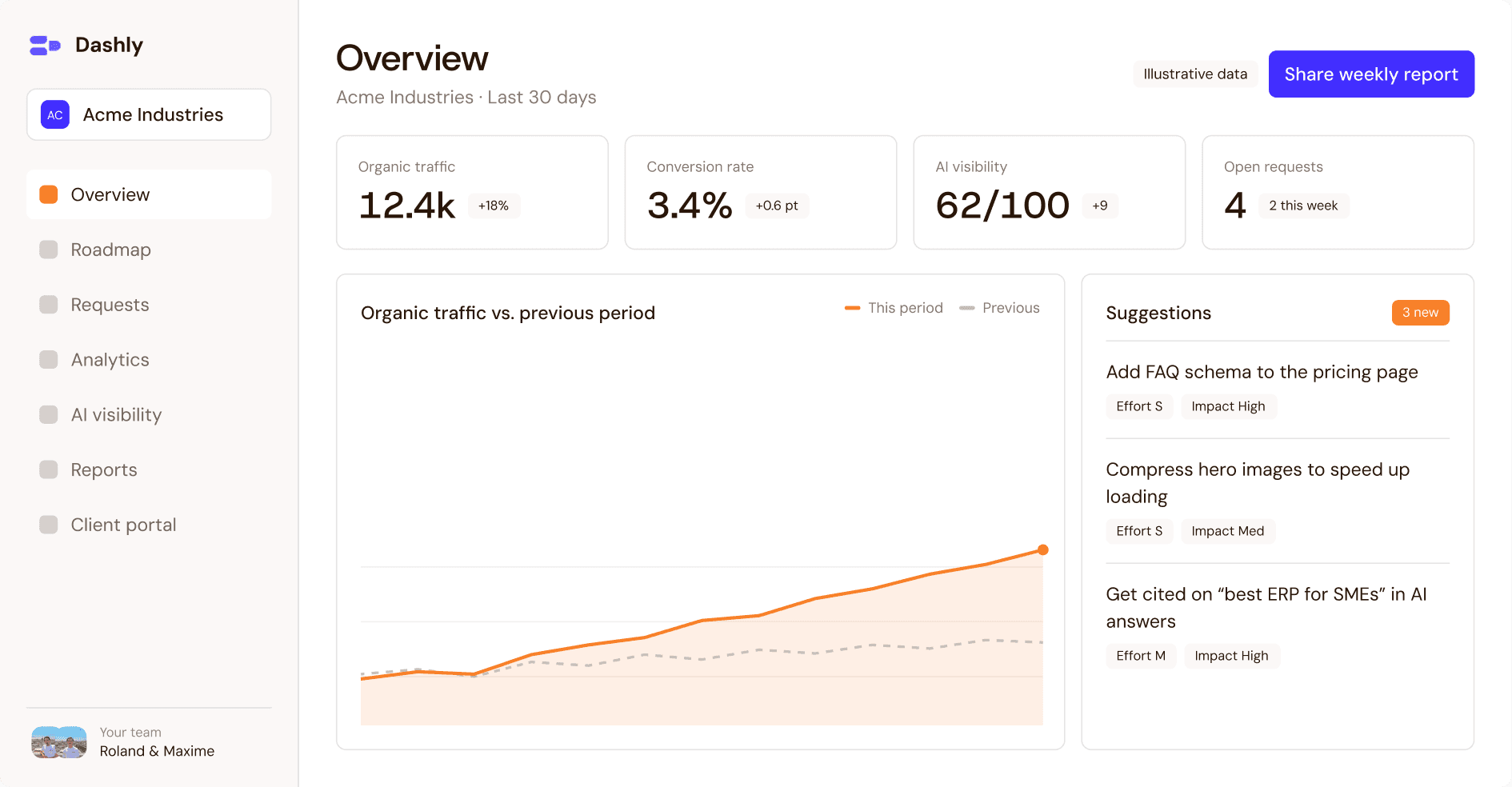
    Follow-up in Dashly

    Requests, roadmap and releases stay visible in Dashly, the platform we built for our clients, for as long as we work together.

Dashly overview screen for a client project, with organic traffic, conversion rate, AI visibility, open requests and suggested improvements
Dashly, where our clients follow their project (illustrative data).

Comparisons

Next.js compared with the alternatives.

Our detailed comparisons, criterion by criterion, to choose with the full picture.

Projects

Sites and apps we designed and built.

Boud’bOis logo over stacked wooden planks

Featured · Marketplace

Boud'bOis

An e-commerce marketplace for non-standard wood, built as a real web application on the brand’s own domain.

+344%

Google clicks in 3 months (France, Jul–Oct 2025)

47

serverless Edge Functions in production

×2

mobile loading speed after optimization

Read the case study

Web app · Next.js · Supabase
Cenareo logo on a dark blue background

Performance · SEO

Cenareo

Speed, SEO and mobile overhaul for a digital signage leader.

Read the case study

Result

+30% organic traffic

in six months, with speed and mobile fixed

Coudac logo on a dark background with a blue glow

Consulting · Design · Build

Coudac

An autonomous case-study system and a conversion funnel rebuilt across every page.

Read the case study

Result

100% autonomous case studies

and a monthly partnership for 6+ months

Crealo Webflow website

Design · Build · SEO

Crealo

A modular Webflow redesign for a SaaS that manages publishers' rights and royalties.

Read the case study

Result

From 1 to 15 top-3 keywords

one year on, organic traffic roughly doubled

XPLR logo on a white background with a blue and orange gradient

Design · Build

XPLR

A new site that boosts lead generation for a performance marketing agency.

Read the case study

Result

More qualified leads

with clearer journeys and simpler forms

And 50+ more companies

ElmutQolaigPowerchargeLhyfe
See all case studies

Pricing

Public packages for sites, a quote for apps.

A website follows a known path, so its price is public. An application depends on your rules and data, so we price it after we understand them.

Websites

From €3,250 excl. VAT

Three packages by number of pages, listed on our pricing page, with design, development, SEO and training included.

Web apps, ERP, CRM

On quote, after a call

After a first call and a scoping session, you get a written scope split into stages, with a fixed price for each stage.

Portrait of Thomas J., BeBranded clientPortrait of Paul M., BeBranded clientPortrait of Mohammed B., BeBranded client

5/5 on Google · 4.6/5 on La Fabrique du Net

What our clients say.

Portrait of Thomas J., BeBranded client

Thomas J.

CEO, XPLR

XPLR logo
“From the very first draft, they delivered a mock-up that perfectly matched the initial brief. Once approved, the website went live very quickly.”

Result

More qualified leads

Portrait of Paul M., BeBranded client

Paul M.

CEO, Coudac

Coudac logo
“Roland and his team have been incredibly efficient in helping us to quickly and easily develop our website. A reliable partner.”

Result

100% autonomous case studies

Portrait of Mohammed B., BeBranded client

Mohammed B.

CEO, Crealo

Crealo logo
“Even when there were emergencies to deal with quickly, you were always there to act, with a real drive to get things done.”

Result

+282% Google clicks

Hugo M.

CEO, Boud’bOis

“Very happy with Maxime and Roland’s work. They went well beyond what we asked of them. Sharp, highly skilled and friendly too. I recommend them without any hesitation!”

Result

+1498% visitors in one year

Portrait of Valentine F., BeBranded client

Valentine F.

Marketing, Qolaig

Qolaig logo
“Roland and Maxime were superb on the restructuring of our website. They answer quickly and keep supporting us even after the site was delivered. Very efficient, and always with good advice. I recommend them!”

Result

Website restructuring

Alexis C.

Head of Growth, Elmut

Elmut logo
“I recommend Roland and Maxime without hesitation. They understood our needs with real kindness, and their advice is always accurate and relevant. Their smooth, efficient way of working makes every collaboration a pleasure.”

Result

Landing pages for ad campaigns

Portrait of Apolline P., BeBranded client

Apolline P.

Marketing, Crealo

Crealo logo
“Without hesitation the best Webflow agency in Paris. We’ve worked with Roland and Maxime on the Crealo site for over a year and we’re delighted. The team is very responsive and always has ideas to improve our design. We see it in our traffic, which grows every month.”

Result

Traffic up every month

Adrien V.

CEO, Techlivery

“High-quality work and very efficient collaborations! Webflow know-how we really appreciate.”

Result

Webflow website

Portrait of Mahel F., BeBranded client

Mahel F.

Business owner · Google review

“Better than I imagined. I’m really happy I chose them to design my company’s website. They were great, on the design as much as on SEO and GEO tips. Highly responsive, professional and passionate. Thanks again!”

Result

Website, SEO & GEO

Léa & Simon

Founders, Foxtrotteurs

“Roland was super responsive and accommodating, and did exactly what we asked: cookie consent on our site and an updated privacy policy. A pleasure to work with, and we’ll definitely call on him again!”

Result

Cookie consent & privacy policy

Laure D.

CEO, La Pépite

“Roland ran a workshop with me on building landing pages! He brought real value to the participants and gave them concrete advice. His feedback during the workshop was precious. See you soon!”

Result

Landing page workshop

VanLuc N.

CEO, Vanluc

“A great interactive experience on a difficult subject. Patience and understanding from BeBranded, thank you. I recommend these talented young guys.”

Result

La Fabrique du Net

FAQ

Questions about Next.js.

Another question?

Write to us
How much does a Next.js website or app cost?
Websites follow our public packages, starting at €3,250 excl. VAT; the details are on our pricing page. Web apps, ERP, CRM and internal tools are on quote: after a call and a scoping session, you receive a written scope split into stages, each with a fixed price.
How long does a Next.js project take?
It depends on the scope. We write the schedule at scoping, once we know the pages, features and content involved. Apps are delivered in stages, so you can use part of the product before the whole project is finished. Progress is visible in Dashly at all times.
Why Next.js and Payload rather than WordPress or Webflow?
Next.js has no platform ceiling: accounts, business logic, APIs and fast pages live in one codebase you own, and Payload gives your team a clean back office without plugins to patch. Webflow remains a good choice for a marketing site your team edits alone, and we build those too.
What is Payload CMS?
Payload is an open-source CMS written in TypeScript that runs inside your Next.js project. It provides the admin where your team edits content, with drafts, previews, roles and translations, and an API the site reads from. Your content is stored in your own PostgreSQL database.
Can my team edit the site without a developer?
Yes, for content: pages, articles, case studies, images and translations are edited in Payload, with a preview before publishing. A developer is needed for structural changes, such as a new type of section or a new feature. We train your team at launch.
Can you migrate our current site without losing SEO?
Yes. We list every URL, keep the ones that work, redirect the others with 301s and check the result page by page. On our own migration from Webflow, 999 of 1,114 URLs were kept, 115 were redirected and none was lost.
Is Next.js good for SEO and AI search?
Yes. Pages are rendered on the server, so search engines and AI assistants receive complete HTML. Metadata, structured data, sitemaps and hreflang tags are handled in the code. Good rankings still depend on content and links, which we also work on.
Where is it hosted, and who owns the code?
You own it. The repository, the database and the hosting account are in your name. We usually deploy on Vercel with a PostgreSQL database, and can use another host if your company requires it. See our security page for access rules.
Do you use AI to write the code?
Yes, at full power, for code, tests, reviews and research. That is how a team of two delivers projects of this size. Every change is reviewed by one of the founders and tested on a staging site before it goes live. Our AI process page explains how.
Who maintains the site or app after launch?
Your team edits content on its own. For updates, fixes and new features, we offer ongoing maintenance tracked in Dashly. Because the code is standard React and TypeScript in your repository, another developer can also take over.

Web app articles

Custom development, explained by the people who build it.

Illustration for the article “Website design for SaaS sites with multiple products”
Development

Nov 14, 2026

Website design for SaaS sites with multiple products

A multi-product SaaS website works when buyers can see how your products relate and reach the right one fast. Here is a framework for structure, product pages, conversion paths and search.

Read the article
Illustration for the article “Should you create your own landing page for a webinar?”
Development

Nov 13, 2026

Should you create your own landing page for a webinar?

Building your own webinar landing page works when one person can own and test the whole registration journey. Here is how to decide, what to include and what to check before launch.

Read the article
Illustration for the article “What to check when building a webpage for gated downloads”
Development

Nov 12, 2026

What to check when building a webpage for gated downloads

Five checks for a gated content page: a clear offer, an accessible form with clear consent, the right file protection, clean CRM routing and honest conversion tracking.

Read the article

Let’s talk

Tell us what you want to build.

Thirty minutes with the people who will work on your project. You leave with a clear view of the scope, the timeline and the next steps.

What happens next

  1. 1A 30-minute callWe listen to your goals, your constraints and your context.
  2. 2A clear scopeWe map what is worth doing first, and what it takes.
  3. 3A costed proposalYou decide, with no commitment and no sales pitch.