How to choose a Webflow design agency for a B2B site
Development
•
X min
•
Published on
14.09.2026
•
Updated on
09.10.2026
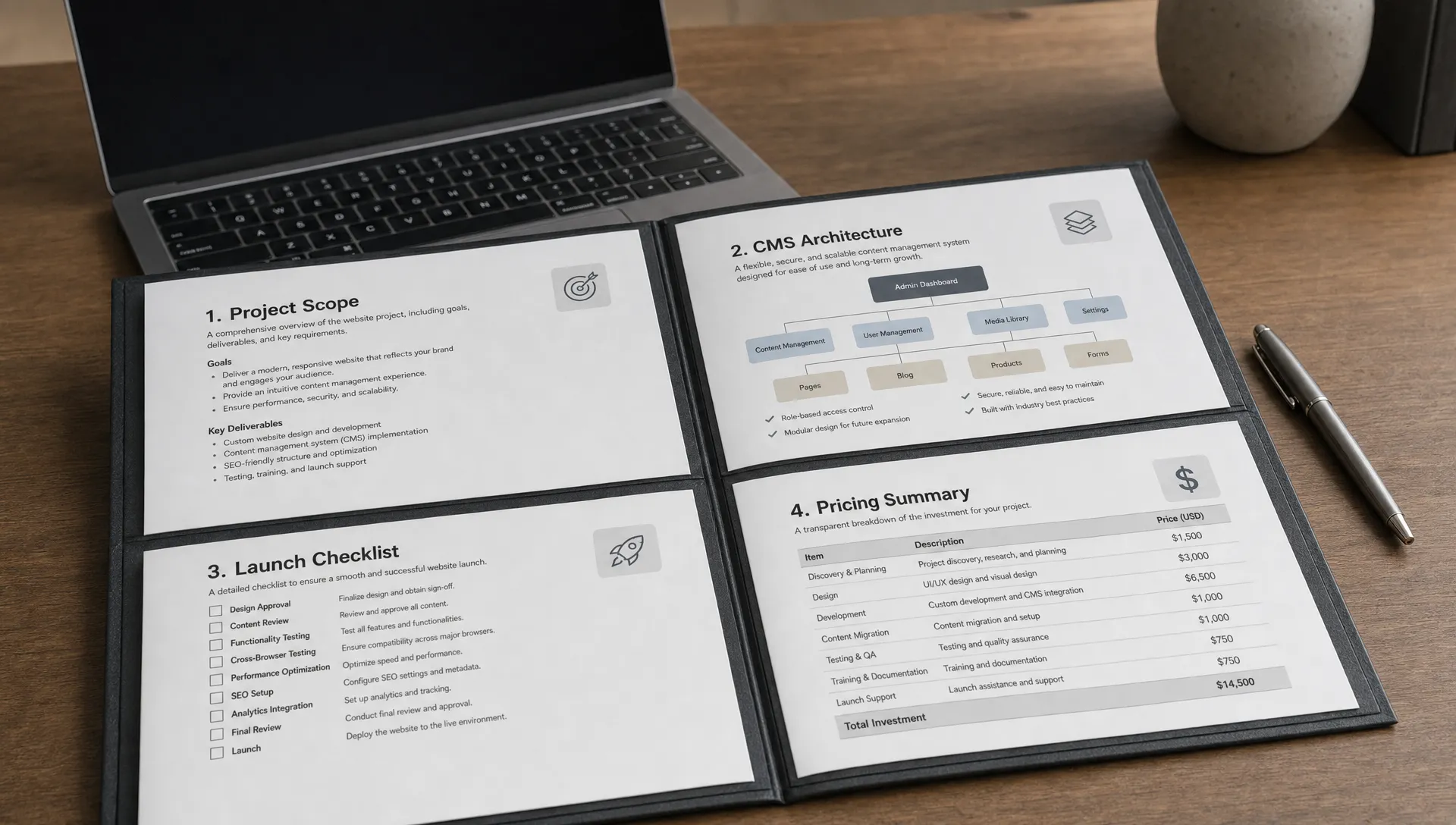
Choosing a Webflow design agency for a B2B site is not mainly about who has the most polished portfolio. It is about finding a team that can translate positioning, sales complexity, SEO requirements and internal workflow constraints into a site your marketing team can operate after launch.
For CEOs, CMOs, founders and marketing managers, the decision is usually made under pressure. The current site is slow to update, campaigns are blocked by development capacity or the brand no longer matches the sales conversation. A good selection process reduces risk before you sign the proposal.
This guide gives you a practical framework, evaluation criteria, mistakes to avoid and a checklist you can use when comparing agencies.
A B2B site has different demands than a simple brochure website.
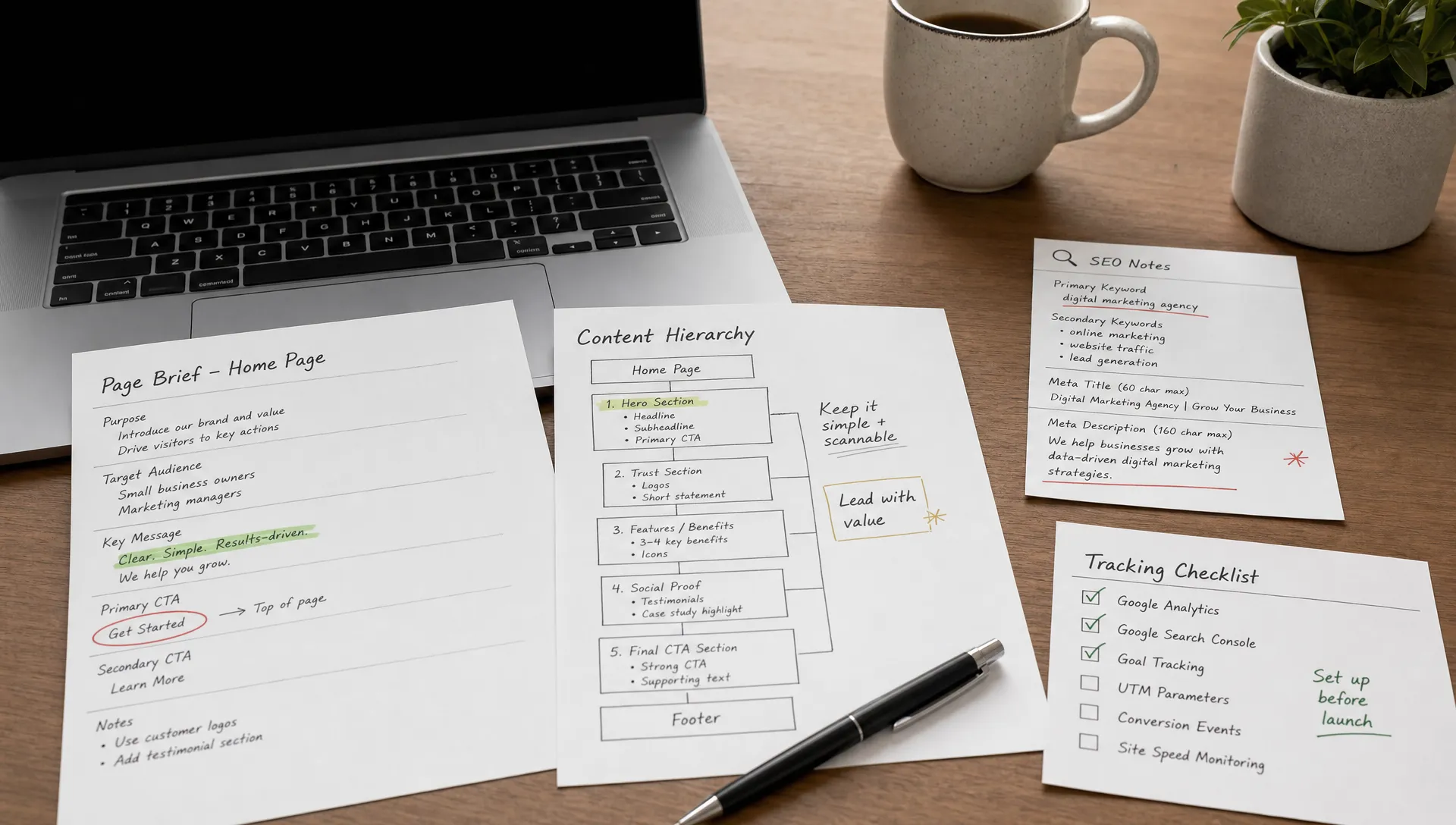
The site must help buyers understand the offer, compare options, trust the company and take a clear next step. That means the agency needs to think beyond visual design and page production. The work should connect brand, messaging, UX, CMS structure, technical SEO and conversion paths.
A Webflow design agency should be able to explain how each page supports a business goal. For example, a product page may need proof, use cases, feature clarity, objection handling and a strong path to demo booking. A resources section may need CMS collections, filtering logic and internal linking that supports search visibility.
If you are still deciding whether Webflow is the right platform, start with the platform fit before vendor selection. BeBranded’s guide on why companies choose Webflow for their website covers the situations where Webflow makes sense compared with other options.
A simple framework helps you evaluate the work behind the portfolio.
The 5P framework stands for positioning, pages, platform, process and post launch. It keeps the conversation focused on what affects revenue, maintainability and team autonomy rather than subjective taste.
Ask how the agency will clarify your message before design starts. B2B buyers need fast answers to basic questions: what you do, who it is for, why it is credible and what happens next.
The agency does not need to replace your marketing strategy team, but it should know how to structure website messaging. If every discussion starts with colors and motion effects, the project is already drifting away from the business problem.
A capable Webflow design agency will ask about sales objections, customer segments, competitors, buying committees and lead quality. Those inputs should shape the sitemap and page hierarchy.
B2B websites usually need more than a homepage and a contact page.
Your agency should be able to define the role of each page type: homepage, product page, solution page, industry page, case study, pricing page, resources index and landing pages. Each one needs a clear job.
This is where stage fit matters. A seed stage startup may need a sharper core narrative and fast launch. A scale up may need a larger CMS, localization planning and reusable page systems. If you want a broader view of this decision, read BeBranded’s article on choosing a web design agency by growth stage.
The agency should understand Webflow as a production system, not only a design canvas.
That includes class naming, component logic, CMS modeling, responsive behavior, accessibility basics, forms, tracking, integrations and editor handoff. A site that looks good but is hard to update will create new bottlenecks after launch.
For B2B teams comparing Webflow with other systems, the platform decision should include CMS needs, SEO requirements and internal ownership. BeBranded’s guide to choosing website development platforms for B2B growth is useful before you lock the scope.
A clear process is a risk control tool.
Before signing, ask how the agency moves from discovery to sitemap, wireframes, design, development, QA and launch. You should know who approves what, how feedback is handled and what happens if scope changes.
A Webflow design agency that works well with B2B teams will make decisions visible. You should not discover at the end that pages are missing metadata, forms are not tested or CMS fields do not match your content workflow.
The launch is not the end of the website’s role.
Ask what is included after launch: bug fixes, Webflow training, documentation, performance checks, analytics review or ongoing support. Some teams need a short handoff. Others need a retained partner for landing pages, SEO improvements and iteration.
The right model depends on your internal capacity. A marketing team with Webflow experience may only need a clean build and documentation. A lean team may need ongoing help to avoid returning to developer dependency. For a closer look at ongoing support models, read BeBranded’s website maintenance guide.
The five areas can be summarised in one view that you can keep open during sales calls. For each area, the table shows the question to ask and the kind of answer that signals a reliable team.
If an agency struggles to answer two or three of these questions clearly, dig deeper before you reach the proposal stage.
| Area | Question to ask | Strong answer |
|---|---|---|
| Positioning | How will you clarify our message before design starts? | Describes a messaging workshop or brief linked to buyer segments and objections |
| Pages | What is the role of each page type on our site? | Maps every page to a business goal and a next step for the visitor |
| Platform | How will the CMS and components be structured? | Explains collections, reusable components and editor permissions in plain language |
| Process | Who approves what, and when? | Shares stages, feedback rounds, QA steps and responsibilities on both sides |
| Post launch | What happens once the site is live? | Offers training, documentation and a clear support or maintenance option |

Good questions reveal how the agency thinks.
Do not wait for the proposal to test fit. Use the first sales conversations to understand whether the agency can connect strategy and execution.
Ask these questions in a structured way:
You are not looking for perfect wording. You are looking for a clear operating model. If the answer is vague, the delivery process may also be vague.
A Webflow design agency should also be comfortable explaining trade offs. For example, a highly custom interaction may be visually useful in some places, but unnecessary if it slows production or makes future edits harder.
A scorecard helps remove personal bias from the decision.
Use it after the first call and before final procurement. Score each agency from 1 to 5, then discuss the differences with your internal team. The goal is not to turn the decision into a spreadsheet exercise. The goal is to make risk visible.
| Evaluation area | What to look for | Warning sign |
|---|---|---|
| Business understanding | Asks about positioning, buyer journey, lead quality and sales objections | Focuses only on visual references |
| Webflow expertise | Explains CMS structure, components, responsiveness and editor usability | Cannot describe how the site will be maintained |
| SEO readiness | Plans metadata, headings, redirects, indexing and page speed basics | Treats SEO as something to add after launch |
| Project process | Defines stages, responsibilities, feedback cycles and QA steps | Promises speed without explaining dependencies |
| Post launch support | Clarifies training, documentation and maintenance options | No clear handoff or ownership plan |
Use the scorecard alongside the proposal, not instead of it. A lower cost can be reasonable if the scope is smaller and the team is strong. A higher cost can be reasonable if the project includes strategy, CMS architecture, SEO setup and support.
If you are comparing an agency with an individual developer, clarify the difference in responsibility. BeBranded’s guide on choosing a custom Webflow developer explains what to check when the project depends more heavily on one technical profile.
A portfolio should prove relevance, not only taste.
Look for projects with similar complexity to yours. A B2B SaaS site, consulting firm site or service company site has different needs from a personal portfolio or campaign microsite. The design language matters, but the underlying structure matters more.
Open the live sites when possible. Check whether pages load cleanly, navigation is clear, mobile layouts work and content feels easy to scan. You do not need a full technical audit at this stage, but you should see evidence of careful execution.
A Webflow design agency may also mention Webflow partner status. That can be useful context, but it should not be your only selection criterion. BeBranded’s article on what Webflow partner agency status really means explains what the badge indicates and what it does not guarantee.
CMS structure is one of the clearest signs of Webflow maturity.
Ask how the agency would model your resources, case studies, authors, categories, industries or product use cases. Poor CMS planning often creates duplicated pages, fragile templates and manual work for every update. BeBranded’s guide to Webflow CMS collections shows how to structure them cleanly.
Webflow’s own CMS course in Webflow University is a helpful reference if your team wants to understand the basics before evaluating proposals.
SEO cannot be treated as a final checklist.
For a B2B site, the agency should plan page purpose, heading structure, internal links, indexation, redirects, metadata and performance during the project. If you are migrating from another site, redirect planning is especially important. The complete SEO guide for Webflow lists the checks you should expect during the build.
Google’s SEO starter guide is a useful baseline for non technical stakeholders. It will help you separate basic SEO hygiene from inflated claims.
Most selection mistakes happen before the contract is signed.
The first mistake is choosing based only on visual style. A beautiful site that your team cannot edit, measure or expand will become a liability. Design quality matters, but B2B teams also need structure.
The second mistake is asking for a price before defining scope. A homepage redesign, a full website rebuild and a CMS based content system are different projects. If agencies are pricing different scopes, the comparison is not useful.
The third mistake is ignoring ownership after launch. Your team should know how to publish content, adjust pages, update forms and manage basic SEO fields. Without training or documentation, you remain dependent on the original builder.
The fourth mistake is treating speed as the only constraint. Fast delivery can be valuable, especially for campaign deadlines or funding announcements, but the agency should explain what is needed from your side to move quickly.
A Webflow design agency that promises a fast launch without clarifying content, feedback timing and technical dependencies is creating project risk. Speed should come from a focused process, not skipped decisions.
The mistakes above tend to repeat from one project to the next, and each one has a predictable cost. The table below pairs each mistake with its typical consequence and a simple way to avoid it.
Reviewing it with your internal team before the first agency call helps you set expectations early.
| Mistake | Typical consequence | How to avoid it |
|---|---|---|
| Choosing on visual style alone | A site your team cannot edit, measure or expand | Ask for a walkthrough of the CMS and editor experience |
| Asking for a price before defining scope | Proposals that cannot be compared | Share a written brief so every agency prices the same scope |
| Ignoring ownership after launch | Ongoing dependency on the original builder | Require training and documentation in the proposal |
| Treating speed as the only constraint | Skipped decisions, rework and missed QA | Ask what the agency needs from you to move quickly |
Use this checklist when you are close to choosing.
It works best after you have shortlisted two or three agencies. Share it with your team and resolve unclear points before approving the proposal.
If several boxes remain unclear, do not rely on optimism. Ask for clarification in writing before you commit.
For teams that want an agency model rather than a pure freelance build, BeBranded focuses on Webflow and Framer websites for B2B companies, with strategy, design, development, SEO setup and support handled in one process.
The right partner depends on the shape of the project.
A freelance developer can be a good fit if you already have strategy, design, content and SEO covered internally. In that case, the main need may be clean Webflow implementation.
An agency is usually a better fit when the project requires several decisions at once: repositioning, visual identity, page architecture, CMS setup, copy direction, SEO migration, integrations and launch management. The agency is accountable for the whole system, not only the build.
The choice between an agency and a freelance developer depends on how many disciplines the project needs. The table below compares the two models on the points that most often change the outcome.
Neither option is better in every case. The right one is the model that covers the gaps your internal team cannot fill.
| Criteria | Freelance developer | Agency |
|---|---|---|
| Scope covered | Mainly implementation | Strategy, design, development, SEO and QA |
| Accountability | One person for the build | A team accountable for the whole system |
| Best suited to | Teams with strategy, design and content ready | Projects with several decisions to make at once |
| Continuity | Depends on one person’s availability | Shared knowledge across several people |
| Post launch support | Varies, often ad hoc | Can be structured as training or a retainer |
If you want to understand the technical role in more depth, BeBranded’s guide to the Webflow developer role, skills and pricing can help you decide whether you need one specialist or a broader team.
A Webflow design agency makes the most sense when your website is part of your growth infrastructure. That means the site must support campaigns, sales conversations, content publishing and iteration after launch.
The agency you choose will influence how your B2B site performs and how easily your team can improve it later.
A strong selection process should test business understanding, Webflow expertise, CMS thinking, SEO readiness, project process and post launch ownership. The portfolio matters, but it is only one signal.
Use the 5P framework, ask direct questions and compare agencies with the scorecard before signing. If you want a focused review of your current site and Webflow project scope, the next step is to book a website audit with BeBranded and identify what should be rebuilt, kept or improved.
How long does it take to build a B2B website in Webflow? Timeline depends on scope, content readiness, stakeholder availability and technical complexity. A focused marketing site can move quickly when decisions are clear, while larger CMS or migration projects need more planning.
Should a Webflow agency handle SEO too? Yes, at least the technical and on page foundations. The agency should plan headings, metadata, redirects, internal links, indexation and performance basics during the build, not after launch.
Is Webflow suitable for a growing B2B company? Webflow can be suitable when the marketing team needs design control, CMS flexibility and faster publishing without relying on developers for every change. The decision should still consider integrations, governance and internal skills.
What should I prepare before contacting a Webflow agency? Prepare your goals, current site issues, target audiences, must have pages, content status, technical constraints, examples you like and any launch deadline. Clear inputs help the agency define a realistic scope.
How do I know if an agency understands B2B websites? Look at the questions they ask. A B2B focused agency should ask about buyer segments, sales objections, lead quality, conversion paths, CMS needs and how the site will support marketing after launch.