Why choose Webflow for your website in 2026?
Webflow
•
X min
•
Published on
01.03.2026
•
Updated on
18.08.2026
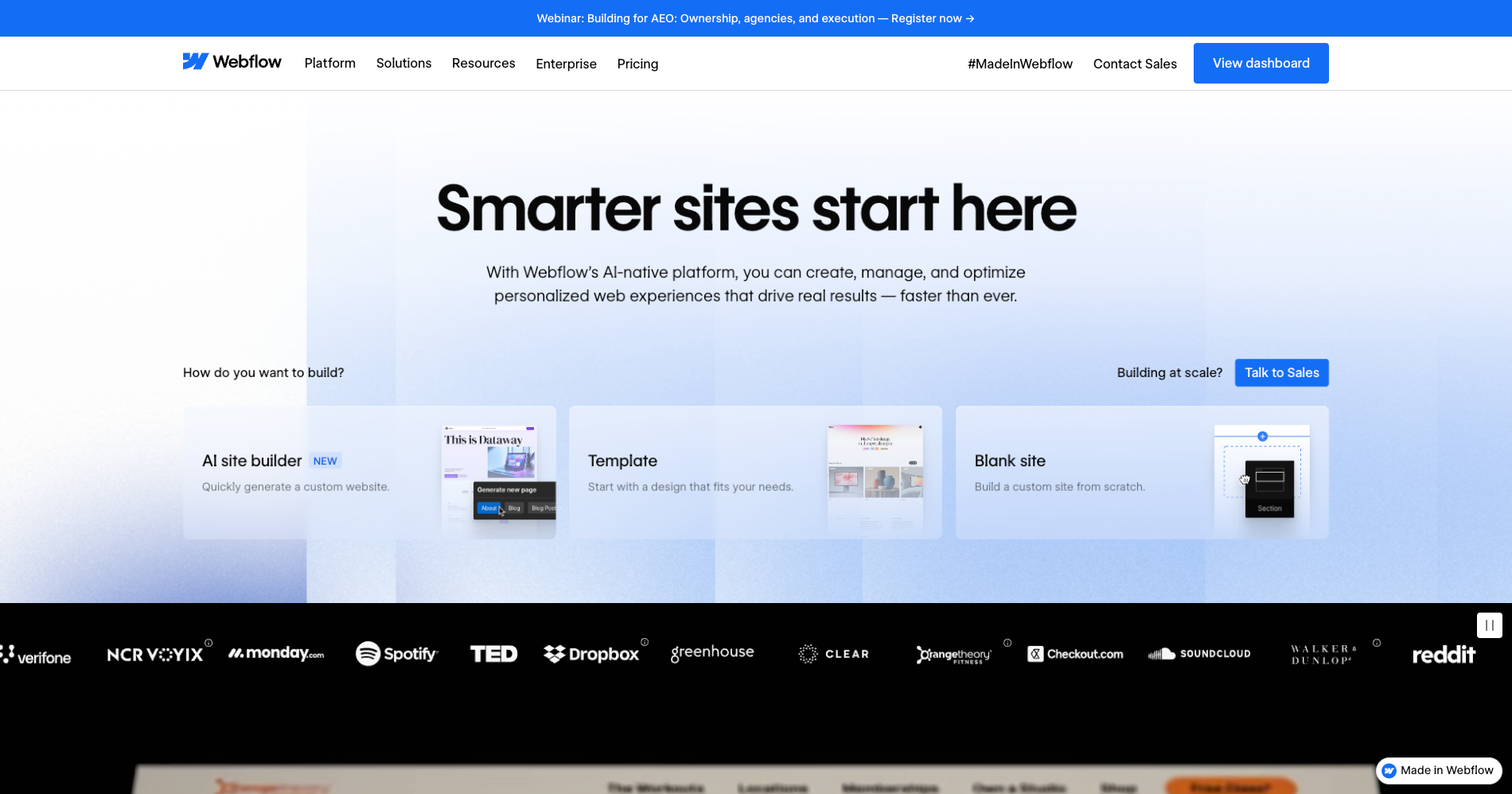
The question comes up in most briefs we receive: should you go with Webflow, stick with WordPress, or try an alternative like Framer or Wix? The answer depends on your context, not a generic ranking.
In 2026, marketing teams want to publish fast, iterate without relying on a developer, keep control over SEO, and get a site that performs well on Core Web Vitals. Search engines (including AI-powered answer engines) reward sites that are fast, well-structured, and regularly updated. Your choice of platform has a direct impact on all of this.
This article gives you a clear framework to decide whether Webflow is the right fit for your project. We cover where it excels, where it falls short, an honest comparison with alternatives, budget expectations, and the migration process.
In short. Webflow is a visual development platform that combines custom design, a flexible CMS, built-in hosting, and native SEO tools. It's the best current option for marketing teams that want a high-performing, autonomous, and scalable website without depending on a technical provider for every change. But it's not the right choice for every project: heavy e-commerce, business applications, or ultra-simple sites with no SEO stakes have better alternatives.
Webflow is a no-code visual development platform. In practical terms, it lets you design, build, and host a professional website without writing code, while keeping full control over HTML, CSS, and interactions.
The platform includes a CMS (to manage dynamic content like blog posts, case studies, or a product catalog), high-performance hosting on AWS with a global CDN, native on-page SEO tools (meta tags, sitemap, redirects, Open Graph), a reusable component system, and multi-user collaboration features with role management.
What Webflow is not: it's not a full-stack framework for building complex business applications. It's not an e-commerce marketplace with advanced inventory management and promotional rules. And it's not a basic drag-and-drop builder; there's a real learning curve to get the most out of it.
Webflow covers a wide range of web projects, but it's particularly well-suited to certain use cases.
This is Webflow's natural territory. A brochure site for an SMB, a corporate site for a scale-up, a marketing hub for a B2B SaaS: the combination of custom design, CMS, and performance makes Webflow hard to beat. The marketing team can publish pages, edit content, and launch campaigns without a technical ticket.
Speed of production is a tangible advantage. Creating an optimized landing page for a paid campaign, an event, or a product launch takes hours, not weeks. Teams looking to iterate quickly find Webflow well-suited to that pace.
Webflow's CMS lets you structure a blog with categories, authors, tags, and related articles. Combined with native SEO tools, it provides a solid foundation for a content strategy. This is what makes the difference for teams that produce content regularly and want to keep control over the technical structure.
Webflow has a native localization system for managing multiple language versions of the same site. For companies operating across several markets, it's a significant time-saver compared to third-party translation tools.
If visual quality is a non-negotiable criterion (portfolio, agency, premium brand), Webflow offers a level of design freedom that most alternatives can't match. No template lock-in: every pixel is controllable.
For a limited catalog (fewer than 100 products) with a strong emphasis on storytelling and brand identity, Webflow E-commerce works well. However, if your business relies on a large catalog, complex discount rules, or an advanced e-commerce back office, Shopify remains the better fit.
Webflow's CMS works with collections. Each collection is a content type (blog post, project, team member, product) with custom fields. Unlike WordPress, where content is organized around "posts" and "pages" with plugins for everything else, Webflow lets you model any content structure natively.
This is a concrete advantage for sites managing multiple content types simultaneously, and for teams looking to optimize their site's bandwidth while keeping a clean and lightweight CMS.
In Webflow, design isn't constrained by a theme or template. Every element is built visually with full CSS control. This means a Webflow site can evolve without ever hitting "template limits", a common issue on WordPress, Wix, or Squarespace.
Webflow hosts sites on AWS with a global CDN, automatic SSL, backups, and managed infrastructure. No caching plugin to configure, no server updates, no security vulnerabilities from third-party plugins. Well-built Webflow sites achieve strong Core Web Vitals scores without any special technical intervention.
Customizable title and meta tags per page and per CMS item, clean URLs, auto-generated sitemap, 301 redirects, Open Graph tags, image alt attributes, canonical tags: everything is handled natively. To go further, our technical SEO guide for Webflow covers 15 checks to complete before publishing.
Webflow lets you invite collaborators with different access levels: content editor (CMS-only access), designer (visual builder access), admin. This is well-suited to marketing teams that want to publish content without risking breaking the design or site structure.
The localization feature lets you manage translations directly in Webflow, without third-party tools. Each language version shares the same structure but can have distinct content and SEO settings.
Webflow connects easily to most marketing tools: CRM (HubSpot, Salesforce), analytics (GA4, Plausible), A/B testing tools (VWO, Convert), advanced forms (Tally, Typeform), and automation platforms (Zapier, Make). The site isn't a silo; it fits into a broader ecosystem.
The most decisive factor often isn't design or performance: it's autonomy. How long does it take to publish a new page? To fix a typo? To add a section to the homepage?
On a typical WordPress site, any structural change requires a developer. On Webflow, the marketing team can publish articles, update landing pages, add sections, and adjust content without filing a ticket. That's what separates a site that lives from one that stagnates.
A website's cost doesn't stop at the initial build. You need to factor in the platform subscription, maintenance, security updates, bug fixes, feature additions, and technical support.
On WordPress, "invisible" costs add up: performant hosting, premium plugins, regular updates (WordPress core, theme, plugins), plugin conflict resolution, security, backups. On Webflow, hosting is included, there are no plugins to maintain, and security updates are handled by the platform. The total cost of ownership (TCO) over 24 months is often lower, even if the monthly subscription seems higher at first glance.
A good marketing website isn't a project you deliver and forget. It's a system that evolves: new pages, conversion tests, SEO optimizations, fresh content, UX adjustments. The "growth" approach means treating the site as a product, with regular iterations driven by data.
Webflow is particularly well-suited to this model because it lets you iterate fast, without technical dependency, and with full control over design and structure.
Webflow is an excellent tool, but not a universal one. Here are the cases where another solution will serve you better.
If your business relies on a catalog of hundreds (or thousands) of products, conditional discount rules, loyalty programs, multi-warehouse management, or an advanced e-commerce back office, Shopify (or Shopify Plus) remains the reference. Webflow E-commerce works for light catalogs, not high-volume stores.
If your project involves user authentication, relational databases, complex business workflows, or real-time data processing, Webflow isn't built for that. You need a full-stack framework or an application-oriented low-code solution.
If your infrastructure requires on-premise hosting, a dedicated server, or very specific compliance requirements (healthcare data hosting, for example), Webflow won't fit. Hosting is managed and non-configurable.
If you manage a massive blog (several thousand articles), need very specific plugins with no equivalent, or your internal technical team already masters WordPress and can handle maintenance, staying on WordPress may be the most pragmatic choice.
For an ultra-simple site (one page or a few pages), with no particular SEO stakes, a minimal budget, and no need for advanced customization, Squarespace or Wix get the job done. No need to overcomplicate things.
For a single landing page, a design-first micro-site, or a small site without complex CMS needs, Framer offers a very smooth design experience and a very short time-to-production. If the project doesn't require an advanced CMS or deep SEO, it's a solid alternative.
The right choice depends on your context. This comparison summarizes each platform's strengths and limitations based on the criteria that matter most to marketing teams.
| Criteria | Webflow | WordPress | Wix | Framer |
|---|---|---|---|---|
| Design freedom | Full (visual CSS) | Limited by theme (unless Elementor/Oxygen) | Limited (templates) | Excellent (design-first) |
| CMS | Flexible, custom collections | Very comprehensive (plugins) | Basic | Limited (improving) |
| Technical SEO | Native and solid | Excellent (Yoast, Rank Math) | Decent, limited on the technical side | Basic |
| Performance (Core Web Vitals) | Very good (built-in hosting) | Variable (depends on host and plugins) | Decent | Good |
| Marketing autonomy | High (visual editor + CMS) | Medium (often requires a developer) | High (but limited customization) | High for design, limited for content |
| E-commerce | Light catalog | Full-featured (WooCommerce) | Basic to intermediate | No |
| Maintenance | Minimal (managed platform) | Significant (updates, security, plugins) | Minimal | Minimal |
| Multilingual | Native (localization) | Plugin (WPML, Polylang) | Built-in (Wix Multilingual) | Limited |
| Total cost (24 months) | Medium to high (but few hidden costs) | Variable (frequent hidden costs) | Low to medium | Low to medium |
| Best for | SMBs, SaaS, marketing teams, design-first sites | Massive blogs, complex e-commerce, technical teams | Simple small sites, tight budgets | Landing pages, micro-sites, design prototypes |
In summary: Webflow offers the best trade-off for marketing teams that want a high-performing, autonomous, and scalable site. WordPress remains relevant for projects with heavy e-commerce or a massive blog. Wix works for simple sites with no technical stakes. Framer is ideal for short-term, design-first projects without complex CMS needs.
The budget for a Webflow site breaks down into three main areas.

The first is the Webflow subscription. Site plans range from around twenty to over a hundred euros per month depending on features (CMS, e-commerce, number of CMS items, bandwidth). Always check Webflow's official pricing page for current rates, as plans change regularly.
The second is the initial build. This covers UX/UI design, Webflow development, CMS structuring, content integration, technical SEO, and team training. Depending on the project's complexity (number of pages, CMS, integrations, multilingual), this varies significantly. To get a sense of typical ranges, the most practical approach is to compare concrete proposals.

The third is ongoing support. New page creation, SEO optimization, conversion rate improvements, content, and fixes: this is what keeps the site alive after launch. It's also what separates a site that stagnates from one that delivers results.
The common mistake is comparing only the subscription cost. The real benchmark is the total cost of ownership over 24 months. On WordPress, "invisible" costs (performant hosting, premium plugins, security maintenance, developer time for updates) often add up to an equivalent or higher budget than Webflow, with less autonomy for the marketing team.
Migration is a sensitive topic, especially when the existing site has SEO equity. Here's the process we follow.
Analyze the current structure, performance, SEO, content, integrations, and friction points. The goal is to identify what to preserve, what to improve, and what to drop.
Create Figma mockups with a coherent design system. This phase includes information architecture, user flows, and conversion objectives.
Build the site using the Client-First methodology (a universal naming convention that makes the site maintainable and transferable to any provider). Technical SEO is integrated from the development stage: semantic HTML structure, tagging, Core Web Vitals.
Transfer existing content into the Webflow CMS. This is also the time to clean up and improve content: outdated pages, copy that needs rewriting, images that need optimizing.
Complete mapping of old URLs to new ones. Set up 301 redirects, verify the sitemap, submit to Google Search Console, and check analytics tracking. This is the critical step to avoid losing your existing search rankings.
Full testing (responsive, forms, integrations, performance, accessibility), then launch. Train the team on using the CMS and Webflow editor to ensure autonomy from day one.
What the team gets at the end of the process: a faster, better-structured, easier-to-evolve site, and real autonomy over content and page management.
Webflow is accessible without coding skills, but some projects benefit from professional support. This is the case when the project involves complex CMS architecture (nested collections, cross-references), a structured design system, technical integrations (CRM, advanced analytics, A/B testing tools), a deep SEO strategy, multilingual setup, or multi-team governance.
A partner or certified Webflow agency brings three things: technical expertise that prevents architectural mistakes, significant time savings on the build, and a strategic vision that aligns the site with business goals.
At BeBranded, our approach is growth-oriented. The site isn't a deliverable you send and forget. It's a system you evolve every month: new pages, SEO optimizations, conversion tests, content. The goal is for the site to produce measurable results, not just look good in a portfolio.
Choosing Webflow for the wrong reasons is just as common as not choosing it for the right ones. Here are the mistakes we see regularly.
Comparing only subscription prices. The Webflow plan at 30 or 50 euros per month looks more expensive than WordPress hosting at 10 euros. But when you add plugins, maintenance, developer time, and security fixes, the math often flips. Underestimating the learning curve. Webflow isn't Wix. The visual editor is powerful but requires real learning time, especially for design and CMS. Plan for training or onboarding support for the team.
Building without a clear CMS architecture. A poorly structured CMS from the start becomes a problem with every new page. Collections, fields, and relationships need to be planned before starting the build, not after.
Ignoring performance from the design stage. A Webflow site can be slow if images aren't optimized, too many third-party scripts are loaded, or the CSS structure is messy. Bandwidth and performance optimization should be considered from the very beginning of the project.
Not planning redirects during a migration. Every existing URL that generates traffic or backlinks needs to be properly redirected. A migration without redirect mapping is a net SEO loss. Treating launch as the end of the project. A site that isn't maintained, updated, and optimized after launch will gradually lose performance and visibility. Launch is the beginning, not the end.
Before deciding, run through these criteria.
Webflow is the best current option for marketing teams that want a high-performing, autonomous, and scalable website. It combines the design freedom of a custom tool, the power of a flexible CMS, and the performance of managed hosting. It's the best-positioned platform for marketing, SaaS, corporate, and light e-commerce sites. But it's not the right answer for every project. Complex e-commerce, business applications, and ultra-simple sites have better alternatives. The right choice always depends on your context: team size, goals, budget, and technical constraints.
If you're still unsure, the most effective starting point is a quick audit of your current situation with our Webflow agency. In 30 minutes, we can determine whether Webflow is a fit for your project, what the concrete gains would be, and where to start. Book a call to discuss, no commitment required.