Webflow partner agencies: what it really means (and how to choose)
Webflow
•
X min
•
Published on
23.02.2026
•
Updated on
21.08.2026
When looking for an agency or freelancer for a Webflow project, the word "partner" comes up often. Some display it prominently on their site. Others mention "certified," "expert," or "premium." And on the client side, the question is always the same: does this badge guarantee anything, or is it just marketing?
The short answer: partner status is a useful signal, but it's not enough. It indicates a certain level of practice and recognition by Webflow, but it says nothing about strategy, design quality, SEO, or the ability to deliver a site that actually converts.
This article explains what Webflow partner status concretely means, what it covers and what it doesn't, and most importantly how to choose the right provider for your situation, with verifiable criteria. To find a Webflow expert, verify the provider is listed as a certified partner in Webflow's official directory, then judge on portfolio, process, and SEO competence.
A Webflow partner badge signals that Webflow recognizes an agency's expertise; but the labels differ:
What certification does NOT guarantee: fit with your project, SEO quality, or on-time, on-budget delivery. Treat it as a starting filter, then judge on relevant work and process.
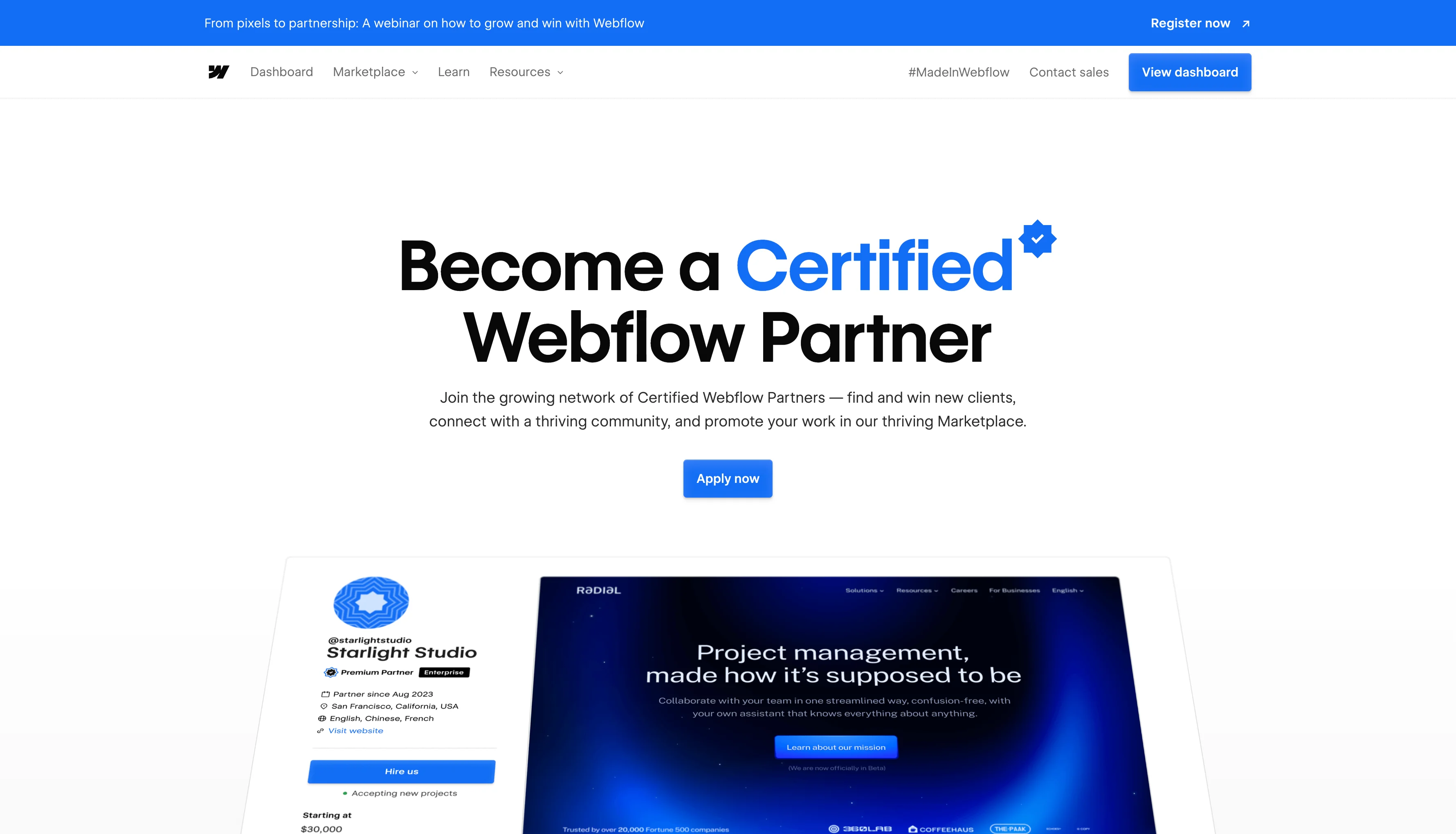
Webflow has built a partner program to connect qualified providers with businesses looking for help. This program has two levels: certified partner and premium partner.
Certified partner status is granted to agencies and freelancers who have demonstrated solid Webflow proficiency through a significant volume of projects, validated technical skills, and an active relationship with the Webflow ecosystem. Premium partner status represents the highest level of the program, reserved for providers who manage a large volume of complex projects and maintain a close relationship with Webflow.
In practice, the program works as a vetted directory. Webflow evaluates providers based on their activity (number of sites delivered, project complexity, client feedback) and assigns a level. Partners get access to additional resources: priority support, early access to certain features, and visibility in the official "hire a partner" directory.
The key takeaway: partner status is not a degree. It's Webflow's recognition of a certain level of practice on the platform. If a provider displays a status, you can verify their presence in Webflow's official directory.

The badge isn't meaningless. Here's what it signals, reasonably speaking.
A provider who has earned partner status has delivered a significant volume of projects on Webflow. They know the platform's mechanics: the Designer, the CMS, interactions, responsive constraints, technical limits. This isn't someone "discovering" Webflow on your project.
Consistency matters. A partner managing dozens of projects has seen more scenarios than an occasional provider. They've encountered performance issues, migration challenges, complex CMS structures, and they know how to handle them.
Certified partners have generally formalized their process: briefing, wireframes, prototyping, development, QA, delivery, client training. This isn't guaranteed by the badge alone, but it's a signal that the provider works within a framework, not by improvisation.
Multi-language, advanced CMS architecture, design systems, third-party integrations, WordPress migration with SEO preservation: these topics require experience. A structured partner is more likely to have the skills to address them than a provider who does Webflow "among other tools."
This is where caution is needed. The badge covers tool proficiency, not overall deliverable quality. Here are the most common blind spots.
Webflow is a production tool. Brand strategy, positioning, message hierarchy, conversion-oriented copywriting: these are distinct skills. A Webflow partner can perfectly well deliver a technically solid site that's strategically hollow. Before talking tools, verify that the provider understands your market, your audience, and your conversion goals.
Webflow generates clean code and offers solid SEO fundamentals (meta, sitemap, SSL, baseline performance). But "real" SEO goes much further: content architecture, internal linking, keyword strategy, Core Web Vitals optimization, schema markup, redirect management during migration. Partner status says nothing about the provider's ability to handle these topics. Ask the question explicitly about how they handle SEO and performances on Webflow websites.
Knowing how to build in Webflow is not the same as knowing how to design an effective user experience. Visual hierarchy, readability, conversion flow, accessibility: all of this falls under design and UX, not technical tool proficiency. Look at the portfolio. Analyze the delivered sites. Not just their aesthetics, but their clarity and user flow logic.
A Webflow site can look "polished" on the surface and be poorly structured underneath. Chaotic CSS classes, non-reusable components, nonexistent design system, performance degraded by unoptimized images or unnecessary scripts. Integration quality determines the site's long-term maintainability and scalability. It's invisible to a non-technical client, but it gets expensive when you need to redo the work six months later.
Many providers deliver and move on to the next project. The question of post-delivery support (fixes, updates, website maintenance, team training) is rarely covered by partner status. It's a selection criterion in its own right.
Partner status is a first filter. Here are the criteria that make the real difference.
Don't just look at screenshots. Open the delivered sites. Test them on mobile. Check loading speed (PageSpeed Insights). Verify whether the SEO is clean (meta, heading structure, optimized images). A good portfolio is one where the sites work well, not just where they look good.
Ask how a project runs from start to finish. A structured provider will be able to explain their steps: scoping, wireframes, design, development, QA, delivery, training. If the answer is vague or improvised, that's a warning sign.
Ask concrete questions: how do you handle redirects during a migration? What's your approach to internal linking? How do you structure the CMS for SEO? If the answers stay vague ("we fill in the meta"), that's insufficient for a site with SEO ambitions.
A good provider delivers a site your team can maintain. That means: Editor training, component documentation, clear naming conventions, and a CMS structured so marketing can publish without breaking the layout. Ask the question: "what will my team be able to change on their own after delivery?"
What's the framework after delivery? Is there a website maintenance contract? SLAs? An identified point of contact? Maintenance isn't a bonus: it's what ensures your site stays performant, secure, and up to date over time.
Ask to speak with one or two former clients. It's the best test. A provider confident in their work will agree without hesitation. Questions to ask references: was the project delivered on time? Is the site easy to maintain? Is the provider responsive after delivery?
Certain signals should make you step back: no live sites to show in the portfolio, "guaranteed" timelines without prior scoping, an abnormally low price with no explanation, no mention of training or knowledge transfer, and a pitch focused solely on aesthetics without mentioning performance, SEO, or conversion.
Not all Webflow providers are equal, and the right choice depends on your project. Here's a comparison of the typical profiles you'll encounter on the market.
| Criteria | Non-certified freelancer | Experienced freelancer | Specialized agency | Structured certified partner |
|---|---|---|---|---|
| Process | Informal, variable | Structured but personal | Formalized | Formalized and documented |
| Design quality | Variable | Good to very good | High | High, with design system |
| SEO | Basic (meta, titles) | Decent if dedicated skill | Variable by agency | Built into process (technical + content) |
| Client autonomy | Low (no training) | Medium | Good | High (training + documentation) |
| Maintenance | Rarely offered | Case by case | Often available | Structured contract |
| Project risk | High | Medium | Low to medium | Low |
| Indicative budget | Low | Medium | Medium to high | High (but predictable) |
| Timelines | Variable | Reasonable | Scoped | Scoped and contractualized |
The right provider depends on your project, not a badge. Here are five typical scenarios and the best-suited profile for each. If you also want a nearby team, compare options like our Webflow agency in Nantes.
An experienced freelancer may be enough. The project is well-defined, risks are low, and the budget doesn't necessarily justify an agency. Still check the portfolio and the ability to deliver a technically clean site. If you want a reusable design system or a foundation for growth, a certified partner is a better investment.
CMS structure, internal linking, performance, and scalability are critical. A provider who "knows how to use Webflow" isn't enough: you need someone who understands technical SEO and content architecture. A certified partner with demonstrated SEO expertise is the best-suited profile. How to optimize your Webflow website with CRO?
Webflow e-commerce has limitations (modest catalog size, no native multi-currency, simple cart logic). For a small catalog with standard needs, an experienced freelancer or specialized agency can handle it. For a more ambitious project, a certified partner will help anticipate limitations and structure the necessary integrations (payment, logistics, CRM).
Localization on Webflow requires specific configuration (localization module, hreflang, per-language SEO, collection management). It's a technical area where mistakes are costly for SEO. A certified partner with verifiable multi-language experience is recommended.
This is the riskiest scenario if poorly handled. Content migration, URL mapping, 301 redirects, internal linking preservation, post-migration verification: every mistake can cost organic traffic. This type of project requires a structured partner with a documented migration methodology and references on similar projects. You can read our guide for your website redesign.
Webflow partner status, whether certified or premium, is a useful signal. It reduces certain risks and indicates platform proficiency. But it doesn't replace concrete provider evaluation: their portfolio, their process, their SEO competence, their ability to make you autonomous, and their commitment after delivery. The question isn't "should I choose a partner or not." It's "what do I need for my project, and which provider can deliver it with proof?" If you are searching locally, our Webflow agency in Paris is one option to compare.
If you're deciding between several providers, or if you want to assess your current Webflow site before launching a project, let's talk.