How to choose a custom web developer for a Webflow project
Webflow
•
X min
•
Published on
10.08.2026
•
Updated on
27.08.2026
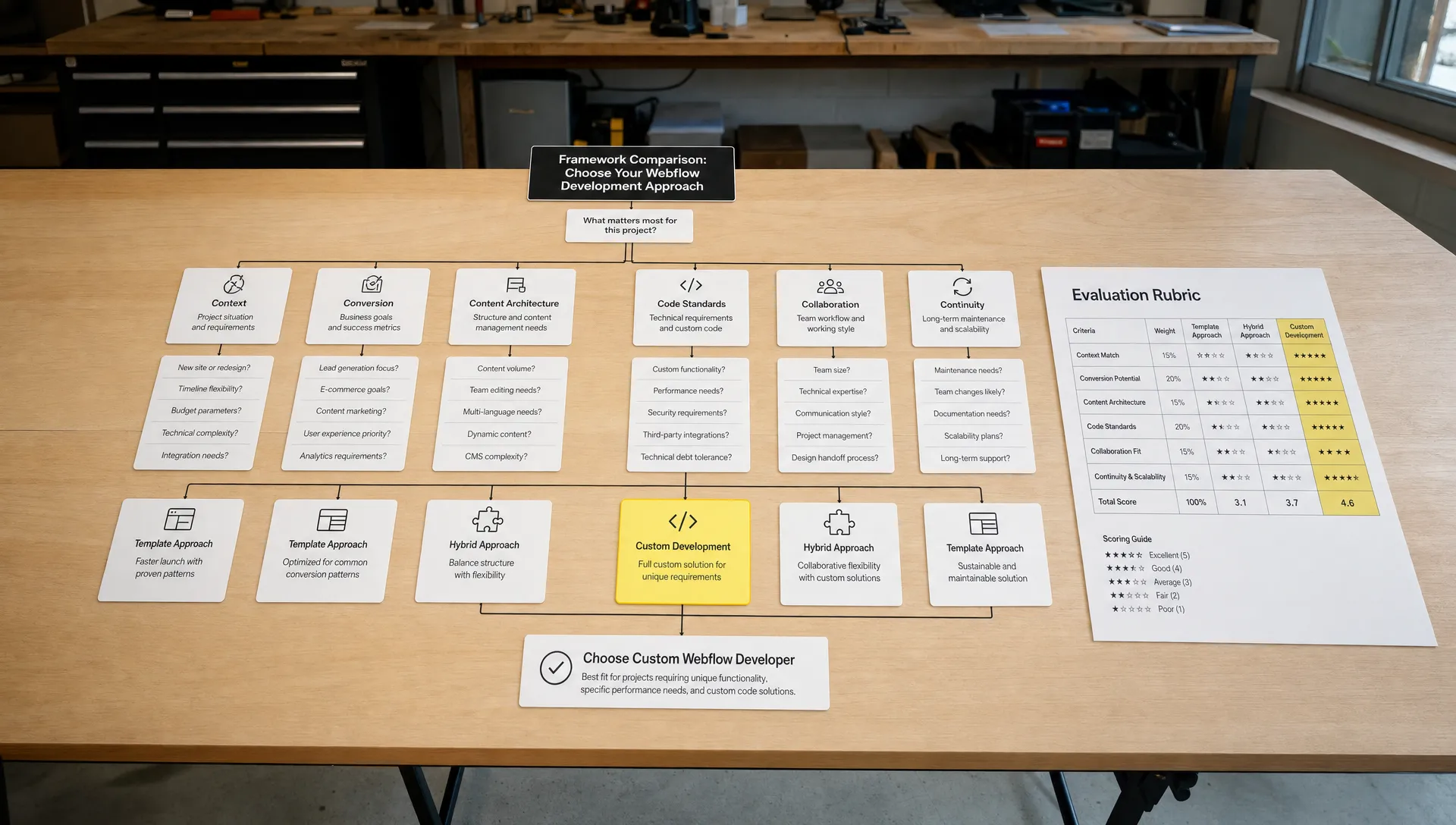
Choosing a custom web developer for a Webflow project is not just about finding someone who can build pages. It is about finding a partner who can translate your business goals into a site that is clear, maintainable, and ready for ongoing marketing work.
This guide gives CEOs, CMOs, founders, and marketing managers a practical way to evaluate candidates before signing a scope. You will see what to check, what to ask, what to avoid, and how to decide with less guesswork, including a comparison table for freelancers, agencies, and in-house hires.
A custom web developer for a Webflow project is a specialist who builds a tailored website structure, layout system, CMS, interactions, integrations, and SEO foundation inside Webflow rather than relying on a generic template.
In practice, this role sits between design, marketing, and technical execution. The developer needs to understand your conversion goals, your content model, your internal workflow, and the limits of Webflow as a platform. If you need a clear baseline first, start with this guide to how Webflow works as a platform.
The right profile should not only reproduce a Figma file. They should make implementation decisions that affect speed, maintainability, accessibility, SEO, CMS usability, and future campaigns. If you are still validating the platform choice, it is also worth reviewing why teams choose Webflow before evaluating providers.
Not every project needs custom development. The decision depends on how strategic the website is for your business.
A custom build usually makes sense when your website is tied to lead generation, hiring, investor credibility, sales enablement, or content growth. It also becomes relevant when you need flexible CMS collections, custom landing page systems, third-party integrations, or a clean technical SEO setup.
A template may be enough for a temporary campaign, an early proof of concept, or a very small site with no complex content structure. But if your marketing team will need to publish, test, optimize, and scale the website over time, a custom Webflow setup will usually give you more control. A B2B company building a resource center, a multi-market brand managing localized content, or a startup preparing for a funding round are typical cases where custom development pays off quickly.
For a deeper breakdown of the role itself, the skills involved, and how pricing is usually structured, you can read this guide to the Webflow developer role, skills, and pricing.
A clear framework helps you compare developers without being distracted by style, sales language, or portfolio screenshots.
The goal is not to find a developer who says yes to everything. The goal is to find someone who can make clear trade-offs and explain the consequences of each choice.
A portfolio shows taste and execution quality, but it does not always show how the project was managed or whether the website is easy to maintain.
Ask candidates to walk you through one or two relevant projects. Focus on the initial problem, the structure they proposed, the CMS decisions they made, and what they would improve if they rebuilt the site today. A strong developer should be able to explain decisions, not only show visuals.
You should also inspect the live sites. Check mobile behavior, page speed basics, CMS consistency, interaction performance, accessibility cues, and whether the pages still feel coherent outside the homepage. A polished hero section is not enough if the rest of the site is hard to update.
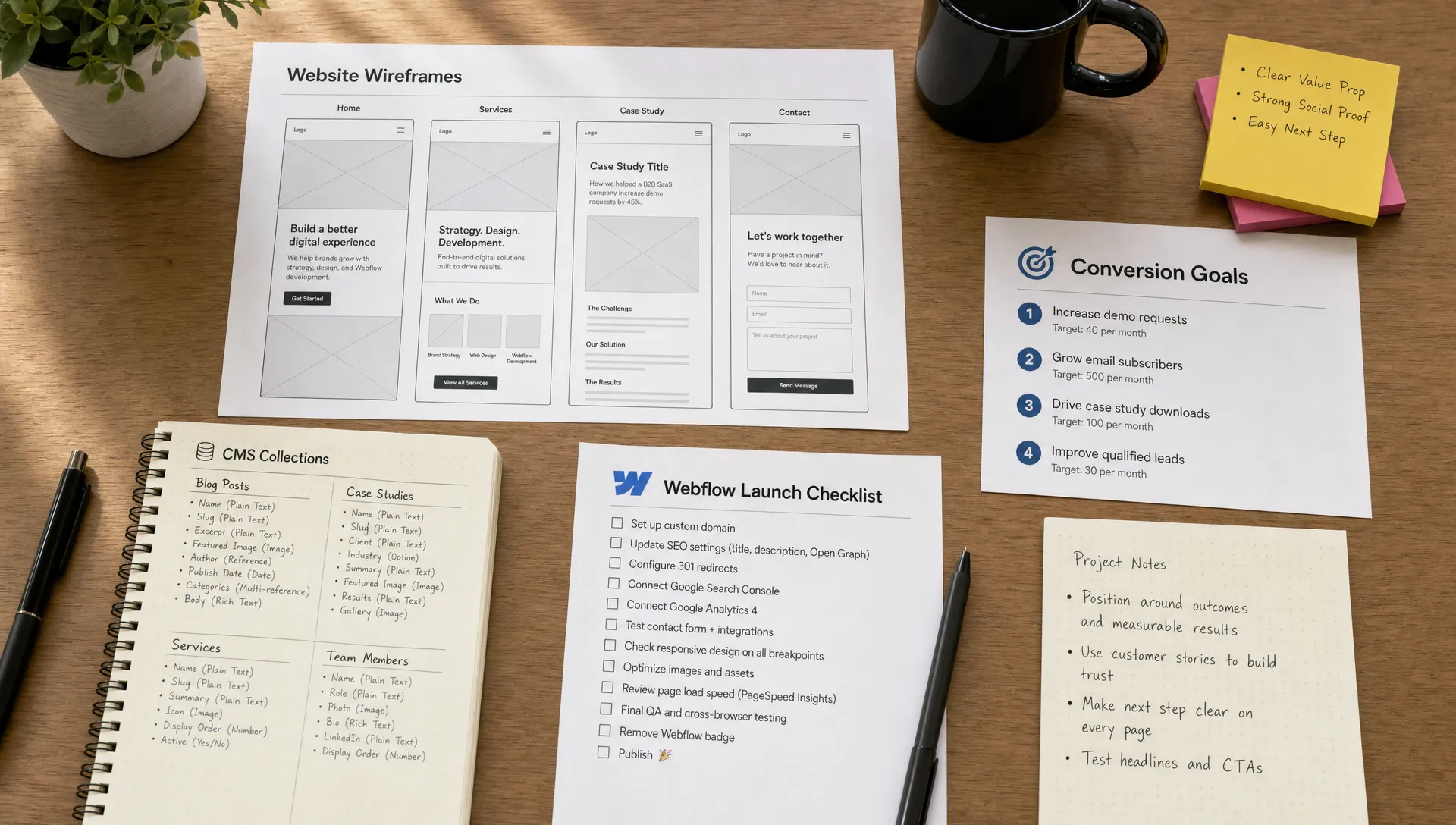
Good questions reveal how a developer thinks before you commit budget and time. Ask each candidate the same set of questions so you can compare answers fairly. Listen for specificity rather than reassurance, since a specific answer shows a repeatable process while a vague one usually signals scope risk later. The table below lists ten questions worth asking, along with what a strong answer should cover.
| Question to ask | What a strong answer should cover |
|---|---|
| How do you turn business goals into website structure? | A concrete process linking objectives to page hierarchy and content, not a general statement about design thinking. |
| What do you need from us before design or development starts? | A specific list: brand assets, copy status, existing analytics, stakeholder access, and decision makers. |
| How do you decide what should be static and what should be managed in the CMS? | A rule of thumb tied to publishing frequency and who on your team will edit content after launch. |
| What naming system or build methodology do you use in Webflow? | A named convention, such as Client-First, with an explanation of why it helps long-term maintenance. |
| What is included in your technical SEO setup? | Specific items: metadata, heading structure, sitemap, schema, redirects, and image handling. |
| How do you handle redirects, metadata, schema, and migration risk? | A documented migration checklist and a plan for preserving rankings if the site already exists. |
| How do you test responsiveness across breakpoints? | A description of the breakpoints tested and the devices or tools used, not just "it is responsive". |
| How do you manage feedback and design iterations? | A defined number of revision rounds and a clear channel for collecting and tracking feedback. |
| What does the handoff include? | Access transfer, documentation, CMS training, and a defined support window after launch. |
| What happens if we need new pages or sections after launch? | A clear process and rate for future work, agreed before launch rather than negotiated afterward. |
If every answer stays broad across the board, the scope may become unclear later. A reliable provider should be able to describe their workflow, not just promise a good outcome.
The right model depends on your growth stage, scope, and internal capacity. Each option, including hiring a Webflow agency, trades off cost, control, and available skill sets differently, so it helps to compare them side by side before deciding.
| Model | Best fit | Watch for |
|---|---|---|
| Freelancer | A contained project with a clear brief, a small number of pages, and a team able to manage strategy, copy, and QA internally. | Limited bandwidth for scope changes and single points of failure if availability shifts. |
| Webflow agency | Projects needing design, development, CMS architecture, SEO setup, integrations, and project management in one process. | Higher cost than a freelancer, so scope and deliverables should be defined precisely. |
| In-house support | Websites that change constantly and already generate enough volume of work to justify a dedicated hire. | Hiring and ramp-up time, plus a continued need for external help on redesigns or complex migrations. |
If your company is scaling, compare providers through the lens of stage, scope, system, and support. This is covered in more detail in our guide on how to choose a web design agency by growth stage.
It is also worth understanding badges and certifications with care. Partner status can be a useful signal, but it is not a substitute for evaluating process, fit, and execution quality. This article explains what Webflow partner agency status does and does not mean.
Choosing a developer before confirming the platform can create avoidable rework.
Webflow is often a strong option for marketing sites, CMS-driven content, custom design systems, and teams that want more control without managing a traditional development stack. Framer may be relevant for different needs, especially fast visual prototyping and simpler marketing sites. If your team is comparing both, review this Webflow vs Framer comparison before finalizing your brief.
For early-stage companies, the key question is usually not whether the first site can launch quickly. It is whether the site can evolve without becoming fragile. That is why many startups evaluate Webflow for flexible site building, as explained in this article on why startups use Webflow for flexible site building.
A custom web developer should be honest about platform fit. If Webflow is not suitable for your requirements, they should say so early rather than force the project into the wrong tool.
Understanding how a developer charges helps you compare quotes fairly, even before exact numbers are on the table.
Hourly pricing suits small, well-defined tasks where the scope may shift, such as fixes, small feature additions, or short consulting engagements. Project-based pricing is common for full builds with a defined page list and CMS structure, since it gives both sides a fixed budget to plan against. Retainers fit ongoing work such as ongoing content publishing support, incremental improvements, or a dedicated Webflow resource for a marketing team.
Whichever model is used, ask what triggers a change order, how out-of-scope requests are billed, and what happens if a milestone slips. A provider who answers these questions clearly before the contract is signed is easier to work with once the project is underway.
Most bad hiring decisions come from evaluating the wrong signals or leaving scope unclear.
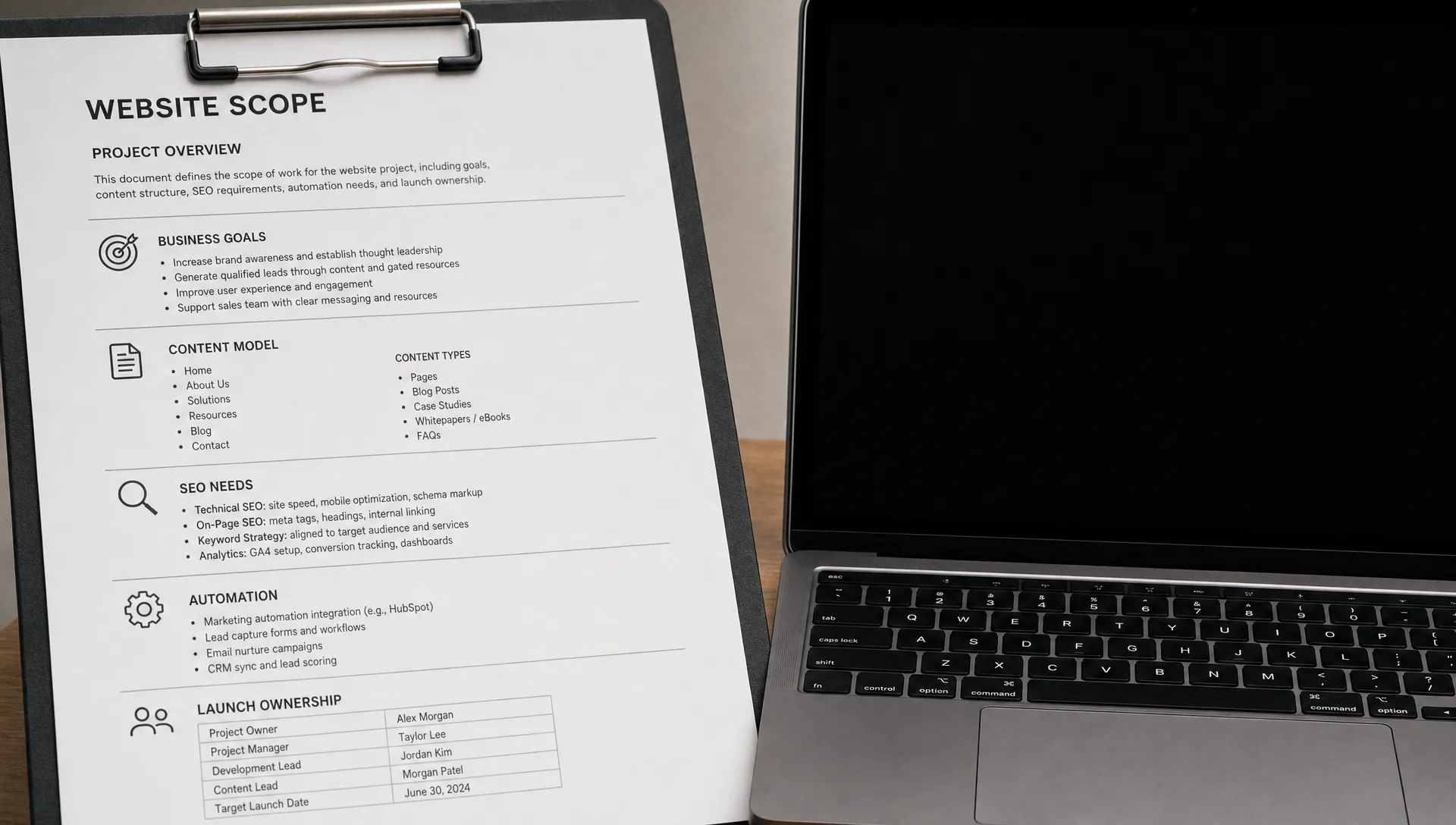
The practical fix is simple. Ask for decisions to be documented before development starts, and make sure the scope explains what is included, what is not included, and who validates each milestone.
A good scope protects both sides. It reduces ambiguity and makes the project easier to manage. Rather than a single paragraph of bullet points, it helps to check each area of the project separately, since gaps often hide inside broad phrases like "full CMS setup" or "SEO included".
| Scope element | What it should specify |
|---|---|
| Pages and templates | The full page list, plus which pages use a shared template versus a one-off layout. |
| Responsive breakpoints | Which breakpoints are tested and how edge cases, such as tablets, are handled. |
| CMS collections | Which content types live in the CMS, their fields, and who will manage them after launch. |
| Reusable components | Which sections are built as reusable symbols or components your team can reuse later. |
| Integrations | Forms, CRM, analytics, scheduling tools, and any other third-party connections included. |
| SEO and analytics setup | Metadata, schema, sitemap, redirects, and analytics or tag manager configuration. |
| Migration requirements | How existing content, URLs, and rankings will be preserved if the site already exists. |
| QA and feedback rounds | The number of revision rounds and how QA across browsers and devices is handled. |
| Launch support and handoff | What happens on launch day, and the documentation or training provided afterward. |
If copywriting, brand identity, illustrations, or ongoing maintenance are needed, they should be listed separately from the items above. A Webflow project includes structural decisions that affect future marketing operations, so those decisions should be visible before work begins.
Use this checklist to qualify a custom web developer before approving the project. Each row also explains why the check matters, so the list is useful even for a team member who is not technical.
| Checklist item | Why it matters |
|---|---|
| Confirm that Webflow is the right platform for your website goals. | Avoids paying for a rebuild later if the platform cannot support your requirements. |
| Define the business objective of the project in one clear sentence. | Keeps every design and structural decision anchored to a measurable outcome. |
| List all required pages, page templates, and CMS content types. | Prevents scope creep and gives an accurate basis for the quote. |
| Ask the developer to explain their Webflow build methodology. | Reveals whether the build will be consistent and easy to hand off later. |
| Review live portfolio projects on desktop and mobile. | Shows real quality rather than curated screenshots. |
| Ask how technical SEO, redirects, and metadata will be handled. | Protects existing rankings and avoids indexation issues after launch. |
| Clarify who owns copy, imagery, approvals, and content entry. | Removes ambiguity about internal responsibilities during the project. |
| Confirm the number of feedback rounds and how revisions are managed. | Avoids disputes about extra rounds once the project is underway. |
| Request a clear handoff process with documentation or training. | Ensures your team can maintain the site without the original developer. |
| Agree on post-launch support, maintenance, and future change requests. | Avoids surprise costs or delays for small updates after launch. |
| Make sure the final scope includes exclusions as well as inclusions. | Prevents disagreement about what counts as extra work later. |
| Check that the timeline has room for QA, content review, and launch coordination. | A rushed final week is one of the most common causes of launch issues. |
If a candidate cannot answer these points clearly, pause before signing. The issue may not be capability, but a lack of process that can create friction during the project.
What is the difference between a custom web developer and a Webflow developer? A Webflow developer builds inside Webflow. A custom web developer focuses on a tailored website solution, which may include strategy, CMS architecture, integrations, SEO setup, responsive structure, and maintainability.
Should I hire a freelancer or a Webflow agency? Hire a freelancer for a narrow, well-defined scope when your team can manage strategy and QA. Hire an agency when you need design, development, SEO, integrations, project management, and launch support in one process.
How important is CMS architecture in a Webflow project? CMS architecture is critical if your team will publish content, manage resources, create landing pages, or scale the website. Poor structure makes updates slower and increases the risk of layout issues.
What should be included in the Webflow handoff? A handoff should include access transfer, CMS guidance, editing instructions, component usage, basic SEO checks, analytics verification, and clear guidance on how to request future changes.
Can a custom Webflow developer help with SEO? Yes, but you should clarify the scope. Technical setup, metadata, heading structure, redirects, image handling, and indexation checks are different from full SEO strategy or ongoing content production.
How do I know if a Webflow build is maintainable? Ask how classes are named, how components are reused, how CMS collections are structured, and how your team will create or edit pages after launch. Maintainability should be visible in the build process, not promised at the end.
A good Webflow project should launch cleanly, but it should also remain easy to manage after launch. That is why the right custom web developer is the one who understands your business context, builds with structure, documents decisions, and leaves your team with a website they can actually use.
Before choosing a provider, define your scope, apply the 6C framework, compare your options against the table above, ask specific process questions, and check whether the candidate can explain their decisions clearly.
If you want a practical external review of your Webflow project before committing to a build, talk to BeBranded about a focused audit or project scoping call.