How to choose a web design agency that fits your growth stage
Design
•
X min
•
Published on
11.06.2026
•
Updated on
21.08.2026
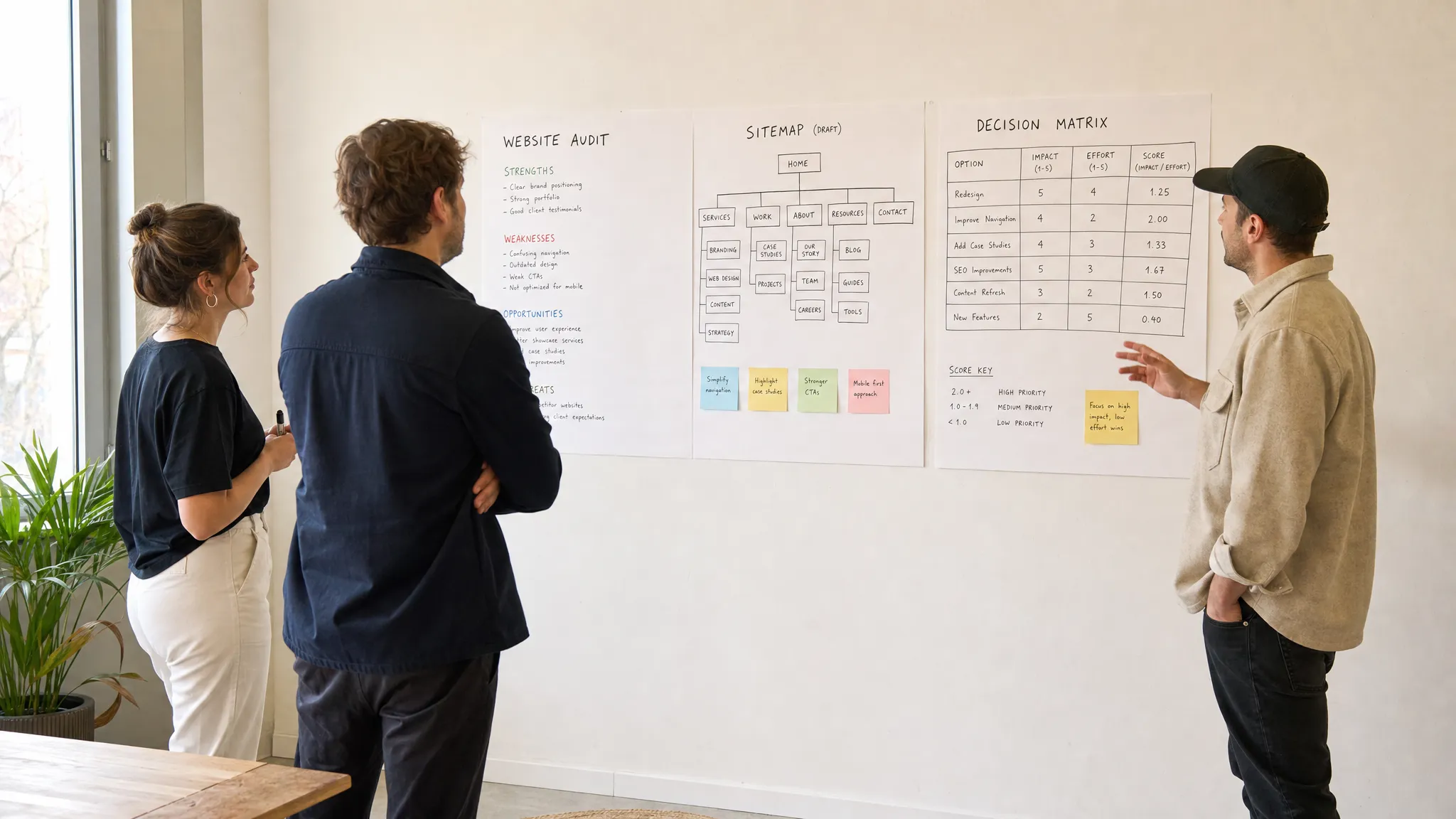
Choosing a web design agency is not just a creative decision. It affects how fast your team can launch campaigns, publish content, improve conversions, and evolve the website after launch.
The right agency depends on your growth stage. A founder validating a new offer does not need the same process as a CMO managing a content-heavy B2B site, a redesign, or an international rollout.
This guide gives you a practical way to choose a web design agency based on fit, not presentation. You will learn how to compare agencies, what to ask, what to avoid, and how to decide with less ambiguity.
A web design agency should translate business goals into a website structure, design system, CMS setup, and launch plan that your team can actually use.
For early-stage companies, the priority is usually speed, clarity, and a focused message. For scale-ups, the priority shifts toward conversion optimization, SEO, content operations, integrations, and maintainability.
The agency you choose should match that level of complexity. A studio that is effective for a one-page launch may not be the right fit for a migration with redirects, multiple stakeholders, and a CMS architecture.
The table below maps common growth stages to the main website need, the agency profile that fits, and the warning sign to watch for.
| Growth stage | Main website need | Agency profile that fits | Warning sign |
|---|---|---|---|
| Pre-launch or early validation | Clear positioning, fast launch, simple conversion path | Lean web design agency with strong messaging and no-code execution | Heavy discovery process before the offer is validated |
| Post-product-market fit | Scalable pages, landing pages, CMS, analytics, SEO basics | Webflow or Framer agency with marketing and technical SEO experience | Good visuals but no content, tracking, or CMS thinking |
| Growth and demand generation | Conversion optimization, content velocity, campaign pages, integrations | Agency that understands CRO, technical setup, and marketing workflows | Proposal focused only on redesigning the homepage |
| Redesign or migration | Information architecture, SEO protection, redirects, performance, governance | Structured agency with redesign, CMS, and migration experience | No clear redirect plan or pre-launch SEO checklist |
| Scaling team or multi-market company | Design system, localization, permissions, reusable components | Agency that can build a maintainable web system, not only pages | Everything depends on the agency after launch |
A structured framework prevents you from choosing based on portfolio style alone. If you prefer a local partner, for example a Webflow agency in Nantes, apply the same framework.
Use the 4S framework: stage, scope, system, and support. If an agency fits all four, the conversation is worth continuing. If one is unclear, the risk usually appears later in the project.
Your growth stage determines how much strategy, content, and technical depth you need.
An early-stage founder may need a focused website that explains the offer and captures qualified leads. A marketing team at a scale-up may need a CMS, multiple templates, campaign landing pages, SEO foundations, and a setup that reduces dependency on developers.
If your company is preparing a redesign, start with your constraints. Existing traffic, legacy pages, CRM forms, tracking, redirects, and brand changes all affect the project. The complete website redesign guide explains the main steps that need to be planned before design starts.
Scope is where many projects become vague. “We need a better website” is not enough to compare agencies properly.
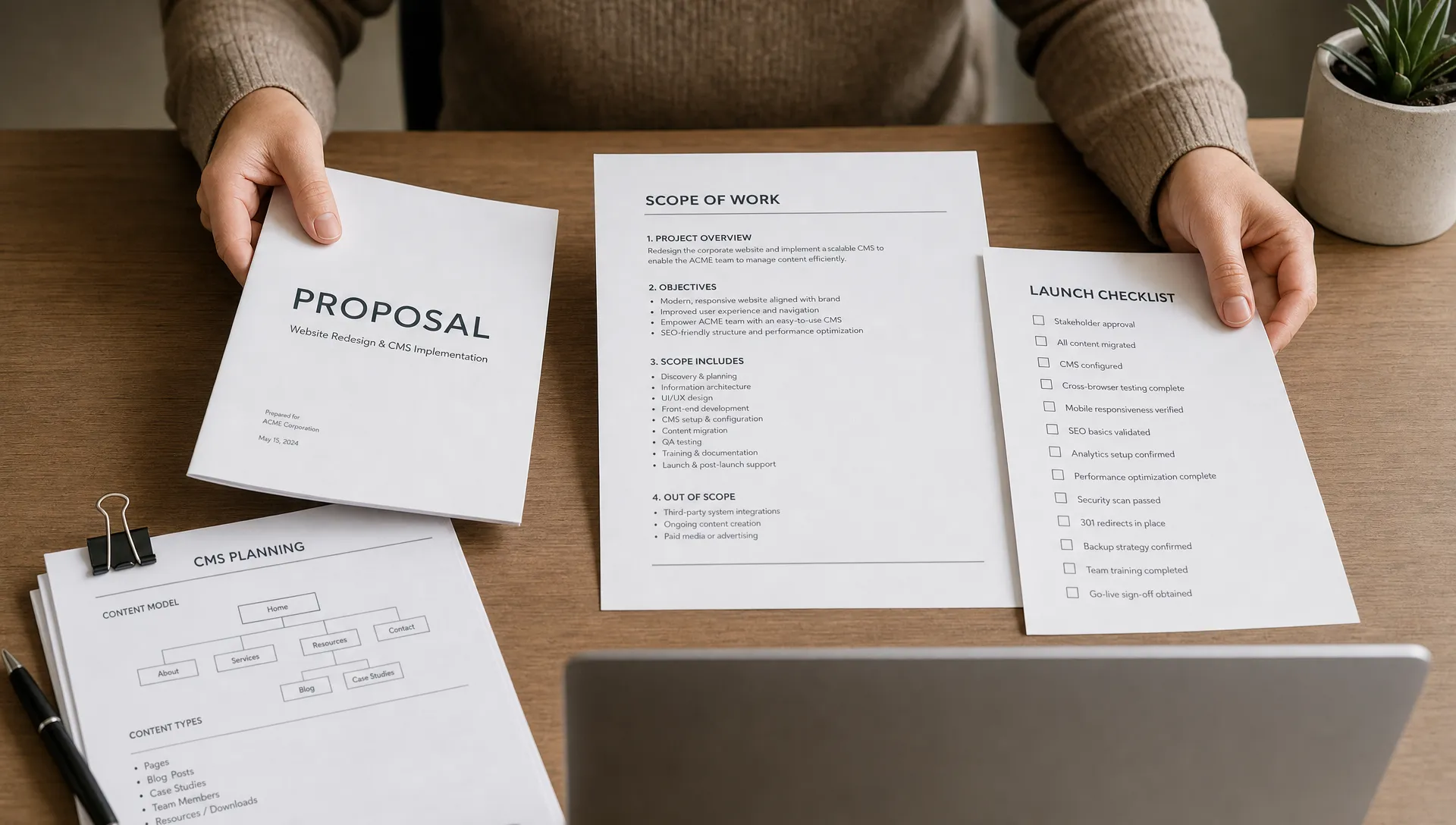
A useful scope explains the pages, templates, CMS collections, integrations, SEO requirements, analytics, copy needs, and launch responsibilities. It should also define what is not included.
If budget is part of the decision, compare scope before price. Two proposals can look similar while covering very different levels of work. The website redesign cost guide is useful for understanding why redesign quotes vary so much.
A website is not only a front-end design. It is also a system your team will use to publish, test, and improve content.
For many marketing websites, Webflow and Framer are practical options because they allow faster design and build cycles than traditional custom development. The right choice depends on your CMS needs, SEO depth, animation complexity, integrations, and internal skills. The Webflow vs Framer comparison breaks down those trade-offs in more detail.
If SEO is a core acquisition channel, ask how the agency handles technical setup, structured content, page speed, internal linking, redirects, and metadata. For Webflow projects, the Webflow SEO guide shows what should be configured before launch.
A website is rarely finished on launch day. Campaigns change, positioning evolves, content expands, and conversion data creates new priorities.
Before signing, decide whether you need a one-time project, ongoing maintenance, or a growth partner for iteration. These are different offers, with different expectations.
If your team needs recurring support, clarify response times, small updates, CMS help, new landing pages, analytics fixes, and technical maintenance. The website maintenance pricing guide explains the difference between light support, technical maintenance, and growth-focused iteration.
A portfolio shows taste and execution quality, but it does not show the full operating model. The same holds whether the studio is national or a local team like our Webflow agency in Toulouse.
When evaluating a web design agency, look for evidence that they can make decisions, handle constraints, and build a site your team can manage. The strongest signal is not a polished case study. It is the quality of the questions they ask before proposing a solution.
Ask why pages were structured in a certain way, how messaging decisions were made, and what trade-offs were considered.
If the agency only explains visual choices, you may get a nice website that does not solve the business problem. If they can explain user journeys, content hierarchy, SEO constraints, and conversion paths, the conversation is more useful.
For projects where conversion matters, ask how they approach page structure, forms, proof, and calls to action. The CRO method for Webflow gives a practical view of how conversion optimization should be handled.
A website can look good and still be difficult to maintain. Poor class naming, inconsistent components, fragile responsiveness, and unstructured CMS collections create long-term friction.
Ask the agency how they organize components, naming conventions, CMS fields, reusable sections, and responsive behavior. If the project starts in Figma, ask how the design will be translated into production. The Figma to Webflow workflow explains why a structured rebuild is often more maintainable than a direct visual import.
For larger sites, ask whether the agency will create or extend a design system. A good system keeps layouts consistent and helps marketing teams create new pages faster. The design system guide covers the foundations of a scalable website design system.
Good process is visible before the contract is signed.
Notice whether the agency clarifies assumptions, challenges vague requests, and explains trade-offs calmly. If every request is accepted without discussion, the team may be avoiding hard decisions.
Also check how feedback is handled. Unlimited rounds of unclear revisions do not guarantee quality. A better process defines who decides, what feedback is expected, and when a decision is final.
Good questions help you see how the agency thinks under real project conditions.
Use the same questions with every agency so you can compare responses fairly. The goal is not to make the process longer. It is to remove uncertainty before production starts.
Most poor agency choices come from unclear expectations, not lack of effort.
Avoid these mistakes before they become expensive to fix. They are especially common when companies are under pressure to relaunch quickly.
A specialized agency is useful when your website needs speed, design quality, and marketing autonomy without a traditional development cycle.
Webflow is often a good fit for content-rich marketing sites, B2B websites, SEO-driven pages, CMS-based resources, and redesigns that need clean technical execution. Framer is often a good fit for fast, design-led sites with lighter content structures.
If you are considering Webflow specifically, it is worth understanding what a qualified provider should bring. The article on Webflow partner agencies explains what partner status means, what it does not guarantee, and how to evaluate providers beyond badges.
For landing pages and campaigns, a Webflow agency can also help marketing teams move faster while keeping layouts consistent. The Webflow landing page conversion guide explains the structure of a focused page built for leads, demos, downloads, or paid traffic.
Use this checklist to make the decision concrete.
If an agency cannot answer these points clearly, do not assume the gaps will disappear after kickoff. Ask for clarification before signing.
Once you have two or three serious options, compare agencies on fit rather than preference.
A useful final decision should weigh four things: whether they understand your growth stage, whether the proposed scope is complete, whether their build system matches your team’s operating model, and whether support after launch is realistic.
Do not choose the cheapest proposal if it removes critical work. Do not choose the most polished proposal if it avoids technical details. Choose the agency that can explain the work clearly, identify risks early, and build a website your team can use without constant dependency.
The right web design agency is the one that fits your growth stage, not the one with the most polished presentation.
Use the 4S framework to clarify stage, scope, system, and support before you compare proposals. Then choose the team that can make trade-offs explicit and deliver a website your marketing team can operate after launch.
If you are planning a Webflow or Framer website and want a clear outside view before committing, ask BeBranded to review your project.