

The essentials · 30-second read
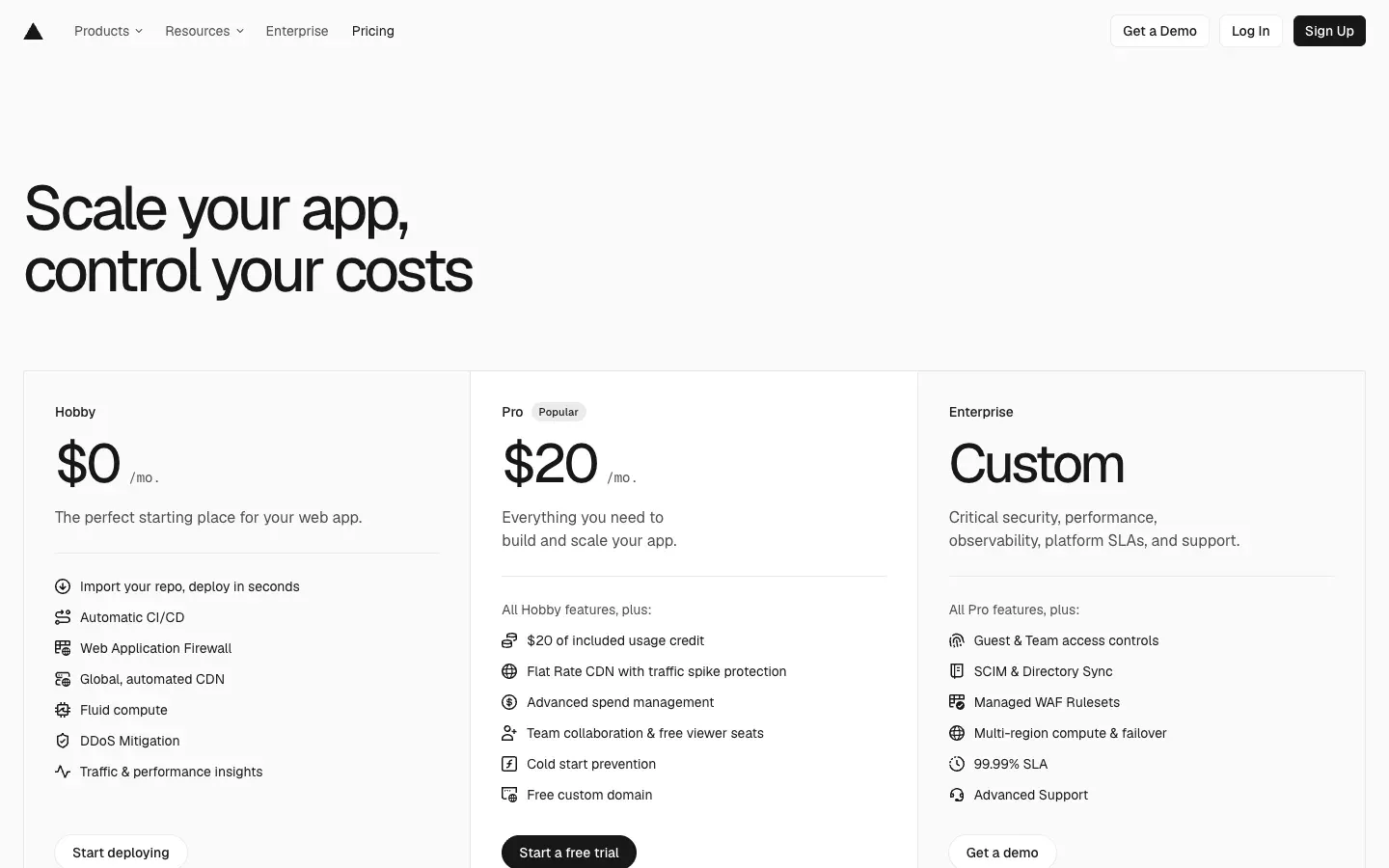
Vercel hosts Next.js and other front-end apps. Hobby is free with usage caps. Pro costs $20 per developer seat a month, with $20 of usage credit. Enterprise is on quote.
- Push to Git and Vercel builds and deploys; every branch or pull request gets its own preview URL.
- Hobby: $0, 1 developer seat, usage caps with no paid overage. Pro: $20 per developer seat a month with $20 of usage credit.
- Beyond the credit, Pro usage is billed as you go; set a spend budget to avoid surprises.
- Our verdict: the simplest home for a Next.js site; watch usage-based costs on high-traffic or heavy-compute apps.
Summarize this page with AI
Vercel hosts our own site. Since November 2026, bebranded.xyz is a Next.js app deployed on Vercel, with a staging environment on its own branch, media stored in Vercel Blob and audience measured with Vercel Analytics. This review covers what Vercel does, what the Hobby and Pro plans really include in 2026, the cost traps to watch and the alternatives.
01What is Vercel?
Vercel is a cloud platform for deploying websites and web applications. The company also maintains Next.js, and that is its strength: Vercel builds your project from Git, deploys it on a global CDN and runs server code in functions, with no server to configure.
Beyond hosting, Vercel offers storage (Blob for files), web analytics, speed insights, a firewall, feature flags and AI tooling. It supports many frameworks, but Next.js projects get the deepest integration.
02How we use Vercel at BeBranded
Our setup is simple and it is the one we recommend to clients on Next.js:
- Two branches, two environments. The
mainbranch on GitHub deploys to production. Thestagingbranch deploys to staging.bebranded.xyz, a custom domain attached to that branch, where we review every change before merging. - Vercel Blob for media. Images uploaded in our Payload CMS are stored in Vercel Blob through Payload's official storage adapter.
- Vercel Analytics for page views and a few custom events, without a heavy tag manager.
- Region close to our audience. Our functions run in the Paris region (cdg1), set in the project configuration.
- Database migrations at build time. The build command runs the CMS migrations before building the site.
Environment variables are managed per environment, with secrets kept in Doppler. The result: a change goes from a commit to a reviewable URL in a few minutes, and production stays untouched until we merge. We set this up for clients as part of our website, web app and maintenance work.
03Key features
- Git deployments: every push builds and deploys automatically.
- Preview deployments with a unique URL per branch or pull request, and comments on previews.
- Global CDN and functions with Fluid compute, billed on active CPU time.
- Incremental static regeneration and image optimisation for Next.js.
- Storage: Vercel Blob, plus databases from marketplace providers.
- Observability: Web Analytics, Speed Insights, runtime logs.
- Security: DDoS mitigation, Web Application Firewall, deployment protection.
- Spend management to cap or alert on usage costs (Pro).
04Vercel pricing in 2026
Prices checked on vercel.com/pricing on 14 November 2026, in US dollars, excluding tax.
| Plan | Price | |
|---|---|---|
| Hobby | $0/month | What you get 1 developer seat; per month: 1M CDN requests, 100 GB data transfer, 4 hours of active CPU, 1M function invocations, 5,000 image transformations, 1 GB Blob storage; no paid overage |
| Pro | $20 per developer seat/month | What you get $20 of included usage credit, unlimited free viewer seats, 10M CDN requests and 1 TB transfer included, then pay as you go; team collaboration, email support |
| Enterprise | Custom | What you get Custom usage and seats, SAML SSO, SCIM, audit logs, 12 custom environments, SLAs |
Examples of Pro on-demand rates: $2 per extra million CDN requests, from $0.15 per extra GB of transfer, $0.60 per million function invocations, from $0.128 per hour of active CPU.
Is Vercel free? Yes, the Hobby plan is free with no time limit, and it is enough for personal projects and prototypes. Caps are hard: when one is reached, the feature pauses. For a company site with a team, Pro at $20 per developer seat is the realistic starting point.
05Pros and cons
Advantages
- The smoothest way to deploy Next.js: zero configuration for builds, caching and images.
- Preview URLs per branch make reviews with clients and teammates easy.
- Fast global CDN and functions without managing servers.
- Integrated storage, analytics and firewall in the same dashboard.
- Viewer seats are free on Pro, so clients and marketers can review previews at no cost.
Drawbacks
- Usage-based billing can grow fast with heavy traffic, images or server compute.
- Hobby is limited to one developer and has no team features.
- Some advanced options (longer log retention, extra protection) are paid add-ons.
- The deepest integration is with Next.js; moving away later means reworking hosting.
06Our verdict
Who it's for
- Teams building with Next.js or another modern front-end framework.
- Agencies and freelancers who need preview links for client reviews.
- Startups that want to ship fast without a DevOps engineer.
- Marketing sites and web apps with moderate, predictable traffic.
Who it's not for
- Projects with very high bandwidth or compute where a dedicated server is cheaper.
- Back ends that need long-running processes, specific runtimes or full server control.
- Teams on a no-code platform like Webflow or Framer, which include hosting.
07Vercel alternatives
| Tool | Best for | |
|---|---|---|
| Vercel | Next.js sites and apps | Model Managed platform, seats plus usage |
| Netlify | Static sites and other frameworks | Model Managed platform, free tier plus paid plans |
| Cloudflare | Edge hosting, CDN, DNS and low-cost bandwidth | Model Workers and Pages, generous free tier |
| Firebase | Apps already on Google's back end | Model Managed hosting and back end |
| Self-hosted server | Full control at high volume | Model A VPS or containers you manage |
Our rule: Vercel for Next.js unless traffic or compute makes usage costs hard to predict; Cloudflare when bandwidth costs dominate; a dedicated server when you have the team to run it. Our article on Webflow alternatives places Vercel in the AI-native stack we now use.
08Moving a site to Vercel without losing SEO
We moved our own site from Webflow to Vercel in November 2026. The hosting switch itself is quick; the risk is in URLs and redirects. Keep the same URLs where possible, map every old URL to a new one with a permanent redirect, test on a preview deployment, then switch the DNS. Our guide to migrating without losing traffic details each step.