SEO redesign: migrate without losing your traffic
SEO
•
X min
•
Published on
24.03.2026
•
Updated on
18.08.2026
A poorly prepared website redesign on the SEO side can destroy months or years of ranking work in a matter of days. The main risk is the loss of SEO capital caused by URL changes without redirects: indexed pages disappear, backlinks point to nowhere, and positions drop. To secure SEO during a redesign, the process follows three phases. Before the migration: a complete SEO audit, identification of high-value pages, and an exhaustive URL mapping. During the migration: page-by-page 301 redirects, internal link updates, and systematic testing before going live. After the migration: new sitemap submission, daily Search Console monitoring, and before/after KPI comparison. Webflow simplifies this process thanks to its native 301 redirects, automatic sitemap, and clean code without plugins.
A website redesign is a structuring project that can improve design, user experience, performance, and conversion. But if the SEO dimension is not integrated from the start, that same redesign can destroy in a few days the organic traffic the site took months or years to build. This scenario happens regularly, and it is almost always avoidable.
This article is the technical companion to our complete guide to website redesigns, which covers the overall process (objectives, steps, budget, mistakes). Here, the focus is exclusively on SEO: how to preserve and even improve your organic search rankings during a CMS change, URL structure change, domain name change, or design overhaul. It provides a technical checklist, details the mechanics of 301 redirects, explains URL mapping, and lists the fatal mistakes that cause traffic to drop.
If you are planning a redesign or migration and want to make sure you do not lose your organic traffic, this guide covers exactly the actions to take before, during, and after going live.
Organic search rankings are built on capital accumulated over time. Every page indexed by Google has a history: positions on keywords, an authority score, backlinks pointing to it from other sites, a volume of organic traffic. This capital is attached to a specific URL. When that URL changes without a redirect, Google considers the page to have disappeared. The associated SEO capital is lost.
Several types of changes can trigger this problem. A CMS change (for example from WordPress to Webflow) often modifies the URL structure. A domain name change (rebranding) changes every URL on the site. A restructured site architecture (new navigation, reorganized pages) creates new URLs and removes old ones. Even a simple switch from HTTP to HTTPS is technically a URL change for Google. Each of these scenarios requires a redirect plan to prevent traffic loss.
In short, a redesign impacts SEO as soon as URLs change. Without systematic 301 redirects, indexed pages disappear, backlinks point to dead ends, and rankings drop. The risk exists across all migration types: CMS change, domain change, structure change, or protocol change.
The preparation phase is the most important part of any SEO migration. Without a complete assessment of the existing site, it is impossible to measure the redesign's impact or know what to protect first.
The first action is to perform a full crawl of the site using a tool like Screaming Frog or Sitebulb. This crawl produces a comprehensive inventory of all active URLs, their metadata (titles, meta descriptions, heading tags), their internal link structure, and any technical errors (404s, existing redirects, orphan pages). This is the reference snapshot of the site before the redesign, and without it, the entire rest of the process is built blindly.
Not all pages on the site carry the same SEO weight. Some generate significant organic traffic, hold strategic positions on important keywords, or accumulate quality backlinks. These are the pages that must be protected first. To identify them, cross-reference Google Search Console data (traffic, positions, indexed pages) with crawl data and backlink profiles (via Ahrefs, Semrush, or an equivalent tool). Pages that combine traffic, positions, and backlinks are the most critical: losing them would have a direct, measurable impact on the site's overall rankings.
The redesign is an opportunity to clean house. Not all existing pages deserve to be carried over. High-performing pages (traffic, positions, backlinks) should be preserved and redirected to their equivalent on the new site. Pages with redundant content can be merged into a single, more comprehensive page, which strengthens authority on the topic. Obsolete pages with no traffic, no backlinks, and no current relevance can be removed (with a redirect to the most relevant page). Pages with untapped potential (good content but poor optimization) should be optimized during the redesign. This classification directly guides the redirect plan.
Before touching anything, document the baseline KPIs: number of indexed pages, positions on strategic keywords, organic traffic by page and channel, number of backlinks by page, bounce rate, and conversion rate for organic pages. This baseline is essential for comparing the site's state before and after the migration. Without it, there is no way to know whether the redesign improved, maintained, or degraded SEO. For a comprehensive approach to SEO optimization, our Webflow SEO checklist covers the fundamentals to verify on every project.
301 redirects are the technical mechanism that transfers SEO capital from an old URL to a new one. Without them, the URL change is interpreted by Google as a page deletion, and all associated capital is lost. This is the most critical element of any migration, and the one most frequently botched.
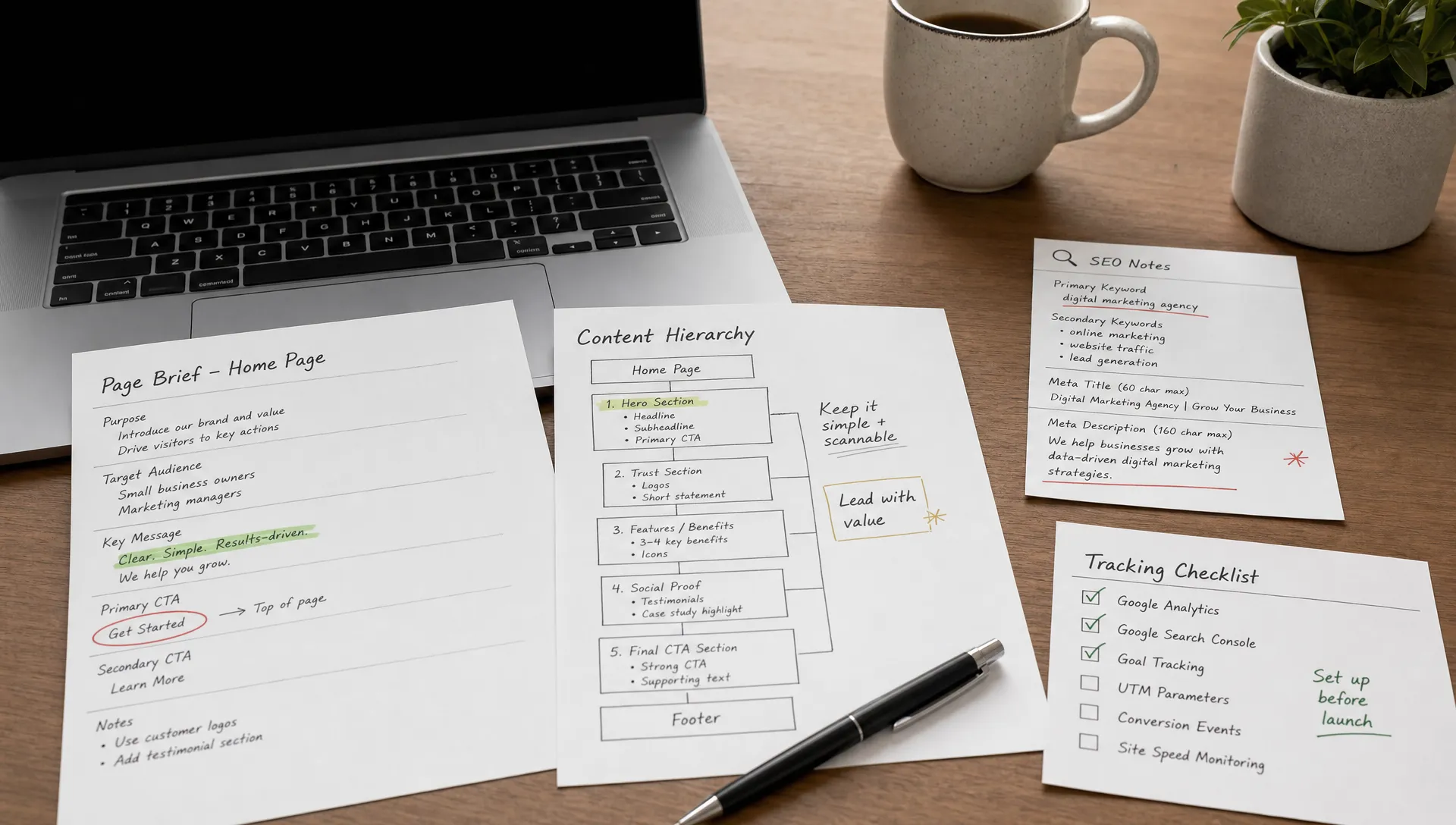
The URL mapping is a correspondence table that matches each old URL to its new URL on the redesigned site. It is the central working document of the SEO migration. Each row contains the old URL, the corresponding new URL, and ideally a note on the page's SEO value (traffic, backlinks). This mapping must be exhaustive: every page with organic traffic or backlinks must have a match. The mapping is built from the crawl data and Search Console data documented during the audit.
Every old URL that changes must be redirected to its new counterpart via a permanent 301 redirect. The redirect must be specific: the old "services" page redirects to the new "services" page, the old blog post redirects to the new blog post. This page-by-page correspondence is what allows Google to understand that the content has moved, not disappeared, and to transfer the SEO capital from one URL to the other.
Three redirect mistakes are particularly destructive. The first is redirecting all old URLs to the homepage. It is the easy solution, but it signals to Google that all the old pages have been replaced by a single one, which destroys the SEO capital of each. The second is creating redirect chains (URL A redirects to B, which redirects to C). Each link in the chain dilutes the SEO capital transfer and slows down loading. The third is using 302 redirects (temporary) instead of 301 (permanent). A 302 tells Google the change is provisional, which can delay or prevent the transfer of SEO capital.
Every redirect must be individually tested before going live. The test is straightforward: enter the old URL in a browser and verify it redirects to the correct new URL, without errors, without chains, and with a 301 code (verifiable with a tool like Redirect Checker or the browser's DevTools). The mapping file should be kept as reference documentation after the migration, because redirect issues can surface weeks after launch.
Internal linking (the links between the pages of your own site) is an SEO pillar that is often neglected during redesigns. When URLs change, all internal links pointing to old URLs technically become links to redirects, or worse, broken links if redirects are not in place.
The best practice is to update all internal links on the new site to point directly to the new URLs, not to the old URLs that redirect. An internal link that passes through a redirect works, but it adds extra loading time and slightly dilutes the authority transfer. Link anchors (the clickable text) should also be checked to ensure they remain consistent with the destination page's content.
After going live, a full crawl of the new site is essential to detect broken internal links (internal 404 errors). Every broken link is a leak in the internal linking structure that weakens the distribution of authority across pages. Fixes should be immediate, not postponed to "when there is time."
Launching a redesigned site without a testing phase is a risky bet. A staging environment (pre-production) allows verifying that everything works correctly before real users and search engines see the new site.
The pre-launch testing checklist covers the following points:
Every item on this list is a potential problem that, if discovered after going live, will require an emergency fix while the SEO impact is already underway.
Going live is not the end of the SEO migration process. It is the start of the monitoring phase, which is just as important as the preparation.
The first action after going live is to submit the new XML sitemap in Google Search Console. If the redesign involves a domain name change, you also need to use the "Change of Address" tool in Search Console to officially notify Google of the change. These two actions speed up Google's recognition of the new site and reduce the transition period.
During the first weeks, monitoring must be daily. Google Search Console is the primary tool: watch for crawl errors (new 404s, redirect errors), the number of indexed pages (which should remain stable or increase), and any issues flagged in the "Core Web Vitals" report. In parallel, tracking positions on strategic keywords and organic traffic in Google Analytics allows you to quickly detect an anomaly.
It is normal to observe a slight drop in traffic in the days following the migration. Google needs to crawl and index the new URLs, which takes time. This dip should be temporary, lasting a few days to a few weeks if the migration is well managed. If the drop persists beyond four to six weeks, or if it is sudden and significant, it is a sign of a problem to diagnose: missing redirects, 404 errors, indexation blocking, or degraded content. The before/after KPI comparison (documented during the audit) is then essential for identifying what changed.
The first mistake is leaving 404 errors unredirected, especially on pages that have traffic or backlinks. Every 404 is a page that has ceased to exist for Google. If that page had positions and backlinks, the associated SEO capital is lost. The solution is simple: every deleted or moved page must have a 301 redirect to the most relevant page on the new site.
The second mistake is redirecting all old URLs to the homepage. It is a shortcut that seems logical ("at least the visitor lands somewhere") but is destructive for SEO. Google interprets this mass redirect as a loss of content, not as a move. The SEO capital of each old page is lost, and the homepage does not benefit from their cumulative authority.
The third mistake is using 302 redirects (temporary) instead of 301 (permanent). A 302 tells Google "this page has temporarily moved, it will come back." Google may therefore keep the old URL in its index instead of replacing it with the new one, which delays or prevents the transfer of SEO capital. For a redesign, the redirect must always be 301.
The fourth mistake is not performing an SEO audit before the redesign. Without a baseline, it is impossible to know which pages to protect, which redirects to set up, or whether the migration improved or degraded performance. It is like driving without a dashboard: you are moving, but you do not know in which direction.
The fifth mistake is changing too many things at once. Switching the CMS, domain name, site architecture, and content in the same migration makes diagnosis impossible if something goes wrong. If traffic drops, is it because of the redirects, the new content, the new structure, or the domain change? The best practice is to sequence changes when possible, or at minimum to document every modification to facilitate diagnosis.
The sixth mistake is forgetting to update internal links. Even with 301 redirects in place, internal links pointing to old URLs create unnecessary redirects on every internal click. This wastes crawl budget (the number of pages Google explores on each visit) and slightly dilutes the authority transmitted by each link.
The seventh mistake is not submitting the new sitemap in Search Console. Without this submission, Google discovers new URLs through its natural exploration, which can take weeks. Submitting the sitemap considerably accelerates the indexation process for the new pages.
The eighth mistake is accidentally blocking indexation. A robots.txt file containing "Disallow: /" or a "noindex" tag left in production prevents Google from indexing the new site. This is a classic error that occurs when the development environment (where indexation is deliberately blocked) is copied to production without verification.
The ninth mistake is not monitoring performance after going live. A missing redirect, a 404 error on an important page, or an indexation block can go unnoticed for weeks if no one is watching the data. Daily monitoring of Search Console during the first four to six weeks is insurance against silent losses.
The choice of target CMS has a direct impact on how easy it is to manage SEO during and after a migration. Webflow offers several structural advantages that simplify the process.
301 redirects are managed directly in the project settings panel, through a simple, visual interface. There is no need to edit an .htaccess file (as on Apache/WordPress) or install a third-party redirect plugin (which can itself create conflicts or performance issues). Adding, modifying, and verifying redirects is done within the Webflow interface, which reduces the risk of technical errors.
The XML sitemap is generated automatically and updated with every publication. There is no need for a dedicated plugin (like Yoast on WordPress) or manual configuration. The sitemap always reflects the actual state of the published site, which ensures Google receives up-to-date information.
SEO tags (title, meta description, Open Graph, alt attributes) are configurable page by page and through the CMS. The Editor then allows the marketing team to update SEO content independently without touching the design or code. The HTML code generated by Webflow is clean and semantic, without the code bloat often seen on WordPress sites loaded with plugins. And the integrated hosting (global CDN, automatic SSL, compression) contributes to strong Core Web Vitals, which is a complementary ranking factor.
On WordPress, managing 301 redirects goes through a third-party plugin (Redirection, Yoast Premium, or .htaccess modification), which introduces a layer of complexity and a risk of conflict with other plugins. The sitemap requires a dedicated plugin. And updates to WordPress, the theme, or plugins can break redirects or technical SEO if not handled carefully. These differences do not make WordPress incompatible with a successful SEO migration, but they make the process more complex and riskier. For a detailed comparison of the two platforms on the SEO front, our article on improving SEO visibility covers best practices by platform.
The SEO dimension of a redesign is too often treated as a secondary concern, when it is the factor that determines whether the site keeps or loses its organic traffic. The process is methodical: a complete audit before the migration, an exhaustive URL mapping, page-by-page 301 redirects, internal link updates, systematic testing before going live, and rigorous monitoring after launch.
The most common mistakes (no redirects, redirecting everything to the homepage, 302 instead of 301, no prior audit) are avoidable when the process is followed. Webflow simplifies the technical management thanks to its native redirects, automatic sitemap, and clean code, but the methodology remains the same regardless of the platform.
This article is the technical companion to our complete guide to website redesigns, which covers the overall process. For budget questions, our article on website redesign pricing details the ranges by project type.
If you are planning a migration to Webflow and want support that secures SEO at every step, you can get in touch with us for an initial conversation. We will start with an audit of your existing site to build a solid migration plan.