


The essentials · 30-second read
8base is a serverless GraphQL backend on AWS. Free plan; Developer $25 a month; Professional $50 per developer (3 minimum). Still online, little public news since 2024.
- A backend-as-a-service on AWS: data model, auto-generated GraphQL API with subscriptions, authentication and roles, serverless custom functions, file storage, plus a frontend app builder.
- Pricing page as displayed: Free $0, Developer $25 a month, Professional $50 per developer a month (3 developers minimum), Enterprise $75 per developer (10 minimum).
- Status check, November 2026: the site, the docs and the app are online, but the blog stops in August 2024, the footer shows 2024 and the Archie link returns an error.
- Our verdict: technically sound, but for a new project we recommend a backend with a more visible roadmap, such as Supabase or Xano.
Summarize this page with AI
8base is a low-code backend that many JavaScript developers looked at when they wanted a GraphQL API without running servers. Before you choose it in 2026, one point matters more than any feature: the product is still online, but its public activity has slowed sharply since 2024. This page explains what 8base does, what its pricing page shows, what we found when we checked its status, and which alternatives we recommend. Checks were made on 17 November 2026.
Status note (17 November 2026): 8base.com, its pricing page, its documentation and the app sign-in are online. But the latest blog post we found is dated August 2024, the home page footer reads "© 2024 8base Inc." and the pricing page "© 2023", and the link to Archie (archie.8base.com), the AI product presented on the home page, returns a "page not found" error. We found no announcement of a closure or an acquisition. If you plan a new project on 8base, ask the team about the roadmap and support first.
01What is 8base?
8base is a low-code development platform for full-stack JavaScript applications. Its documentation describes it as built for professional developers who want to go faster without losing control. The core is a backend-as-a-service: you design a data model, and 8base generates a GraphQL API with queries, mutations and real-time subscriptions, handles authentication and role-based permissions, runs your custom serverless functions and stores files, all on AWS.
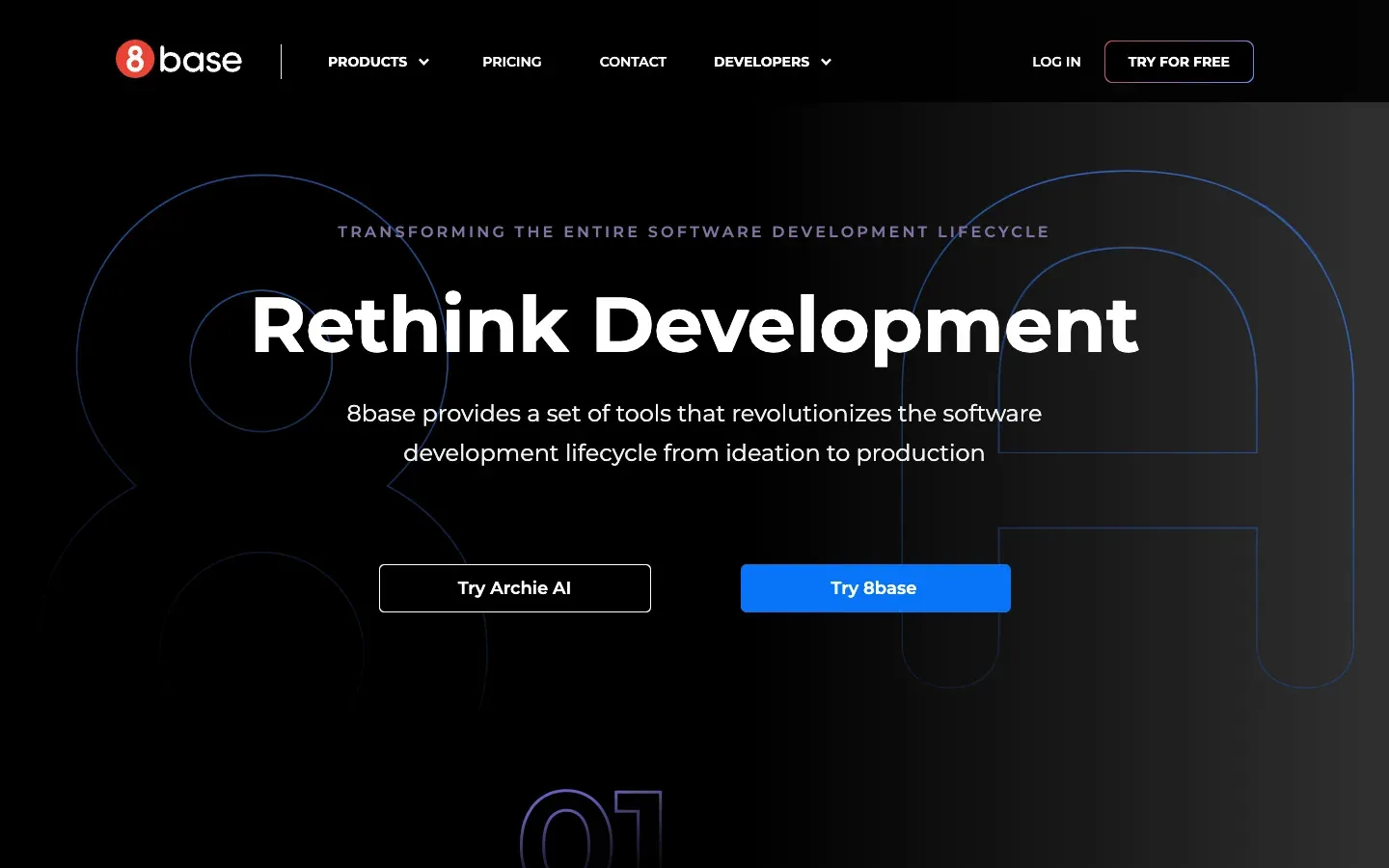
Around that backend, the home page presents a four-step approach: Design (with Archie, an AI product architect), Generate (data model, test data, functions and GraphQL API), Build (finish the application with your team or 8base's partners) and Run (managed hosting on shared or dedicated environments, or self-hosted, with SOC 2 and HIPAA compliance as needed). An App Builder adds frontend development, preview and hosting.
02How we look at 8base at BeBranded
8base is not part of our stack. When a client asks us about it, it is usually because an existing application already runs on it, or because the GraphQL approach appeals to their developers. Our position:
- We recommend keeping 8base when an application already runs well on it and the team is satisfied: a migration has a cost, and the platform is still online. We do suggest documenting the data model and planning an exit path.
- We advise against it for a new project in 2026, mainly because of the lack of visible activity. For a hosted backend, we usually suggest Supabase (PostgreSQL, the backend we use for our own site) or Xano for teams that prefer a visual approach.
- Our usual job: scoping the application, choosing the backend and building it, through our web apps, MVP and internal tools services, or auditing an existing stack before a decision with our project scoping service.
03Key features
- Data model: tables, relations, field types, views and custom indexes, with a data viewer and test data generation.
- Auto-generated GraphQL API: queries, mutations and subscriptions for real-time updates, with a custom API domain on paid plans.
- Authentication and roles: 8base authentication, external identity providers (Auth0, any OpenID provider on higher plans), self sign-up and role-based permissions.
- Custom functions: serverless JavaScript functions to add business logic, triggers and integrations.
- CLI and CI/CD: a command line tool and several environments for a professional development lifecycle on Professional and above.
- App Builder: frontend applications per project, preview, deployment and hosting on 8base's AWS infrastructure.
- Hosting options: region selection, encryption in transit and at rest, backups, dedicated or self-hosted environments for Enterprise.
04Use cases
Maintaining an existing 8base application
A company runs a customer portal or an internal tool built on 8base a few years ago. The priority is stability: document the schema and the custom functions, export data regularly, and test that the GraphQL API still behaves as expected after each change. This is also the moment to estimate what a migration would cost, so the decision is not made in a hurry.
A GraphQL backend for a JavaScript frontend
A React or Vue team wants a typed GraphQL API without writing resolvers. 8base generates it from the data model, including subscriptions for live updates. In 2026, the same need can also be met by PostgreSQL with a GraphQL layer, which keeps the database portable.
An agency delivering several client apps
The pricing page offers agencies one free Professional project, and billing is per project. An agency can separate each client in its own project with its own environments. Check the current agency terms with 8base before relying on them.
Prototyping with generated specifications
8base presented Archie as a way to go from an idea to specifications and an architecture, then to generate the backend. Since the Archie link on 8base's site no longer works, we would not build a process on it today.
05Integrations
8base connects to the outside mainly through code: custom functions can call any third-party API, the GraphQL API can be consumed by any frontend or automation tool that sends HTTP requests, and authentication can delegate to Auth0 or an OpenID provider. Tools such as Make or n8n can call the GraphQL endpoint with an HTTP module. We did not find a recent list of native connectors on the site.
068base pricing in 2026
Prices checked on 8base.com/pricing on 17 November 2026, in dollars, per month. The page shows no annual option and no tax information. Its footer reads "© 2023" and some figures are inconsistent between the plan cards and the comparison table, so confirm the current prices with 8base before you commit.
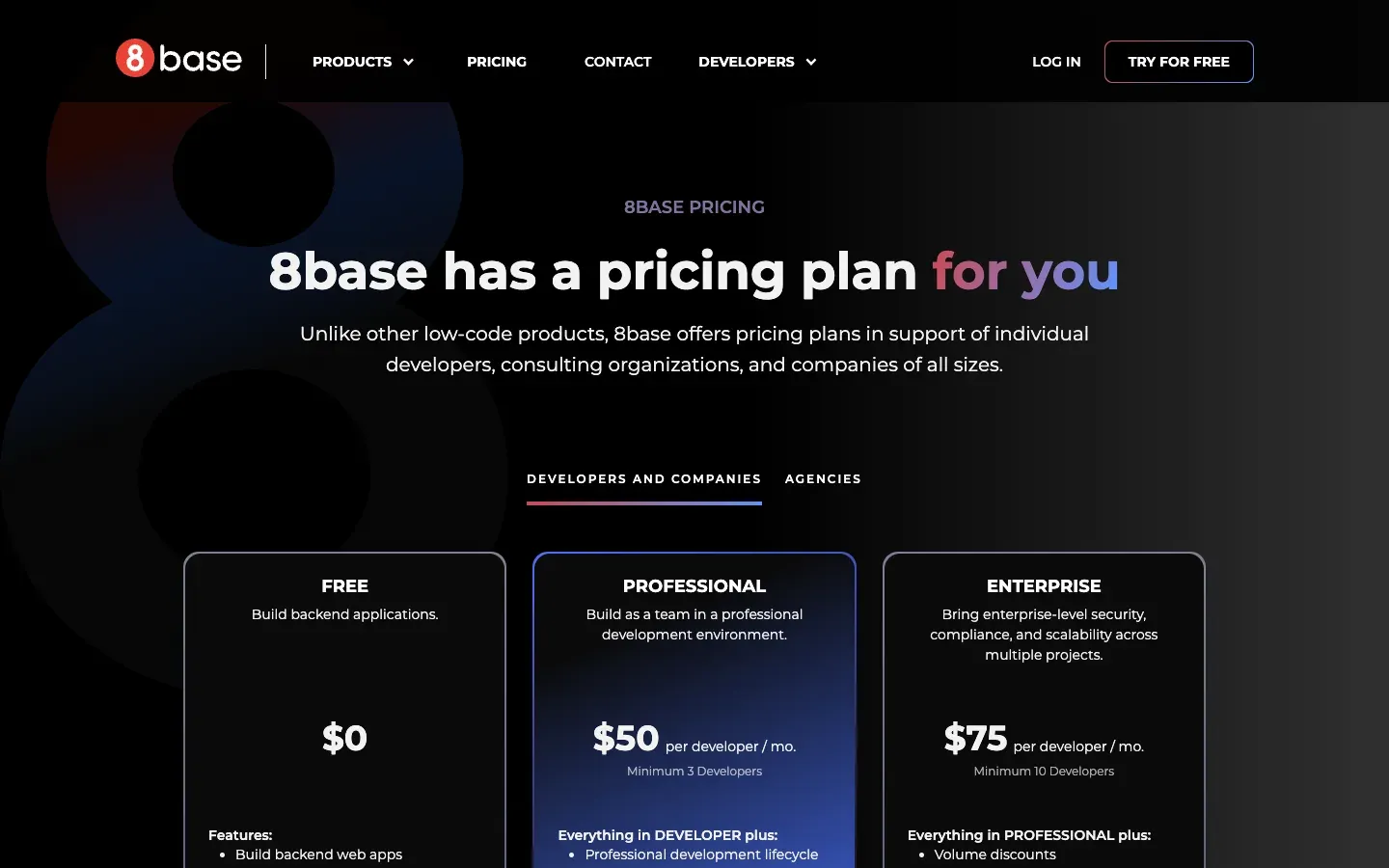
| Plan | |||
|---|---|---|---|
| Free | Price shown $0 a month | Included capacity 2,500 rows, 0.5 GB storage, 1 GB-hour compute, 100,000 API calls a month, 5 app users | Notes 1 team member, community support, frontend hosting for the first 14 days |
| Developer | Price shown $25 a month | Included capacity 500,000 rows, 50 GB storage, 20 GB-hours, 1 million API calls a month, 1,000 app users | Notes 1 team member, 48-hour email support |
| Professional | Price shown $50 per developer a month, 3 developers minimum | Included capacity 5 million rows, 500 GB storage, 200 GB-hours, 5 million API calls a month, 10,000 app users | Notes CI/CD, role-based permissions, several environments, 24-hour support |
| Enterprise | Price shown $75 per developer a month, 10 developers minimum | Included capacity As much capacity as needed | Notes SLAs up to 99.999%, self-hosting, advanced SQL access, premium support |
Usage above the included capacity is billed: for example $10 (Developer) or $6 (Professional) per extra 100,000 database rows, $0.95 or $0.75 per extra GB of storage. SOC 2, HIPAA and GDPR compliance, dedicated environments and SLAs are add-ons from Professional. Agencies get one free Professional project.
Is 8base free? Yes, the Free plan costs $0, but its limits (2,500 rows, 5 client app users, frontend hosting for 14 days) make it a learning plan, not a production plan. A small real application starts on Developer at $25 a month, and a team on Professional pays at least $150 a month.
07Pros and cons
Advantages
- A GraphQL API generated from the data model, with real-time subscriptions.
- Custom serverless functions in JavaScript for business logic.
- Professional workflow: CLI, environments, CI/CD on paid plans.
- Hosting on AWS with encryption, backups and compliance options.
- Usage-based capacity that can grow without a server to manage.
Drawbacks
- Little visible activity since 2024: dated blog and pricing page, broken Archie link.
- A smaller community than Supabase or Firebase, so fewer tutorials and answers.
- GraphQL-first: teams that prefer SQL or REST may feel constrained.
- The Professional plan's three-developer minimum makes small teams pay for seats.
- Portability: moving a data model and functions out of a proprietary platform takes work.
08Our verdict
Who it's for
- Teams that already run an application on 8base and want to keep it stable.
- JavaScript developers who like a GraphQL-first backend and know the platform.
- Agencies that already deliver client projects on 8base.
Who it's not for
- New projects that need a backend with a long, visible roadmap.
- No-code makers who want a visual backend: Xano is easier.
- Teams that want open source and the ability to self-host freely: Supabase.
- Mobile apps that rely on Google services: Firebase fits better.
098base alternatives
| Tool | |||
|---|---|---|---|
| 8base | Best for GraphQL backend for JavaScript apps | Free plan Yes, very limited | Paid from $25 a month (Developer) |
| Supabase | Best for PostgreSQL, auth, storage, APIs, open source | Free plan 2 projects | Paid from $25 a month (Pro) |
| Xano | Best for Visual backend and APIs for no-code fronts | Free plan For testing | Paid from $85 a month billed yearly |
| Firebase | Best for Web and mobile apps in the Google ecosystem | Free plan Spark plan with quotas | Paid from Pay as you go (Blaze) |
Our rule: Supabase by default for a new custom application, Xano when the team builds visually and wants APIs without code, Firebase for mobile apps close to Google services. Keep 8base only where it already runs well. For the frontend, a visual tool like WeWeb connects to Supabase or Xano. Our guide on how to select the right no-code tools lists the questions to ask before you commit.
108base vs Supabase
Both are hosted backends with authentication, storage and an API, and both have a Pro-level paid plan around $25 a month, but they take different paths. 8base is GraphQL-first and proprietary: the API is generated for you, logic lives in serverless functions, and the data model belongs to the platform. Supabase is built on PostgreSQL with an open source core: you get a full SQL database, generated REST and GraphQL access, row-level security and the option to self-host.
For a new project in 2026, the difference that matters most is momentum. Supabase publishes frequent releases and has a large community; 8base's public activity has slowed. Our own site runs on PostgreSQL hosted by Supabase, which is one reason we know that path well.
11Migrating away from 8base
- Export the schema: list tables, relations, roles and permissions from the data model and the CLI.
- Export the data table by table and check record counts against the source.
- List custom functions, their triggers and the external APIs they call: they are the hardest part to move.
- Rebuild the API contract on the new backend (PostgreSQL with REST or GraphQL), so the frontend changes as little as possible.
- Run both in parallel for a short period and switch authentication last, since users must keep their accounts. Our maintenance and growth team can plan this with you.

