


The essentials · 30-second read
Surfer (ex Surfer SEO, now surfer.ai, owned by Positive) optimises content for Google and AI answers. From €49 a month yearly (€59 monthly); Standard €99, Pro €182.
- Surfer SEO now presents itself as Surfer, an AI visibility platform on surfer.ai. The French group Positive announced its acquisition in October 2025; Surfer remains based in Wrocław, Poland.
- Core tools: the Content Editor with live guidelines and the Surfy assistant, Content Audit, Topical Map, and an AI Tracker for ChatGPT, Gemini, Perplexity, AI Mode and AI Overviews.
- Prices in euros, per month, billed yearly: Discovery €49, AI Search Analytics €82, Standard €99, Pro €182, Peace of Mind €299, Enterprise on quote. Monthly billing: €59, €95, €119, €219 and €359.
- Our verdict: a strong editor for teams that already know what to write; the score is a guide, not a goal, and AI tracking should be checked against Search Console and your own tests.
Summarize this page with AI
Surfer SEO was for years the best known content editor for SEO: you typed a keyword, it analysed the pages ranking on Google and told your writers which terms, headings and length to aim for. In 2026 the product has changed name, domain and owner. It now presents itself as Surfer, an AI visibility platform on surfer.ai, part of the French group Positive. This guide explains what Surfer does today, what the plans cost in euros, how it compares with Clearscope and Frase, and when we recommend it to clients.
01What is Surfer (formerly Surfer SEO)?
Surfer is a content optimisation platform built by a company based in Wrocław, Poland. Its core is still the Content Editor: you choose a query, Surfer studies the results that rank and gives live guidelines while you write, with a content score that rises as the draft covers the topic better. Around it, Surfer has added content audits, topical maps, internal linking suggestions and, more recently, an AI Tracker that measures how often a brand is mentioned or cited by AI assistants.
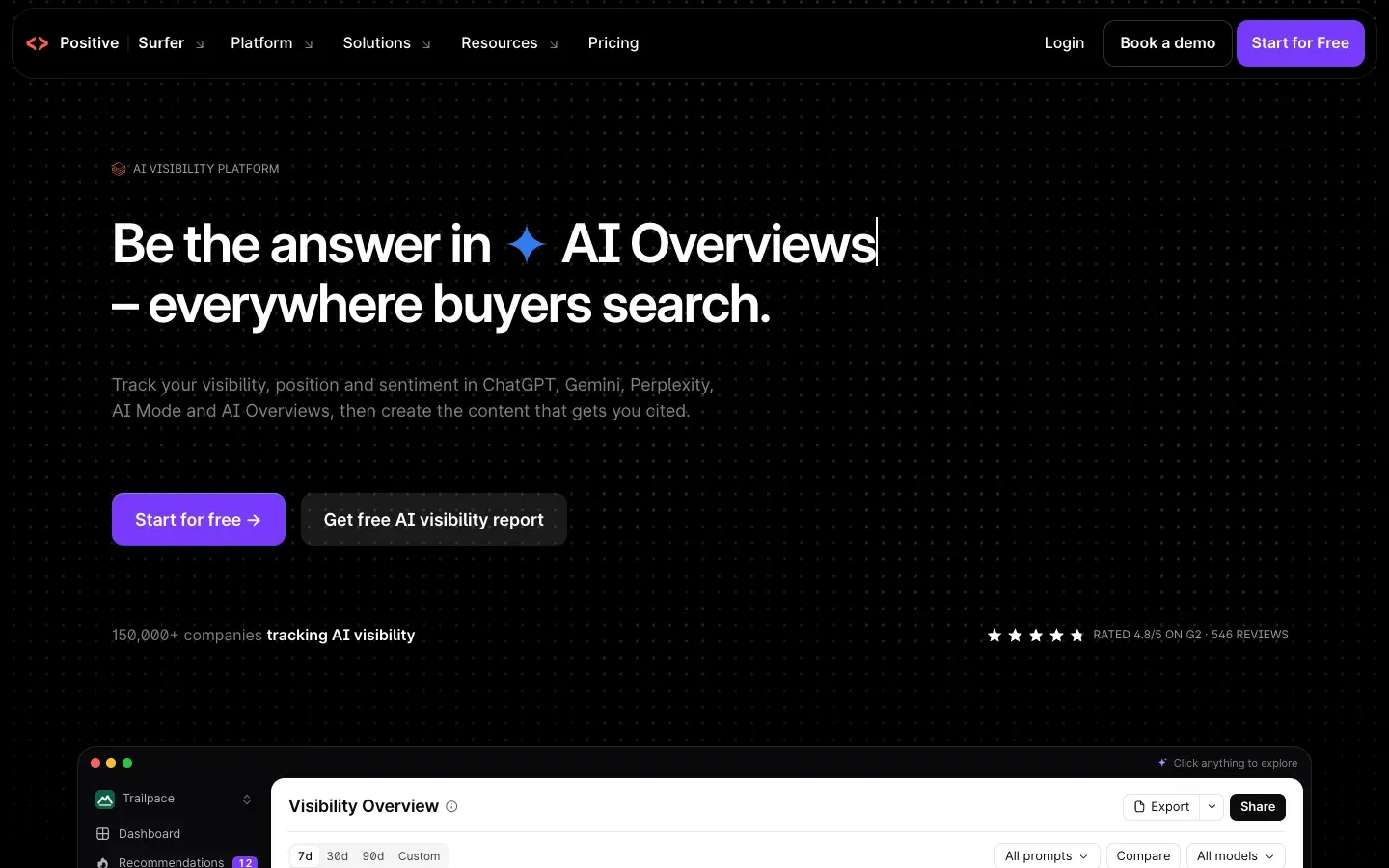
What changed. The French group Positive announced the acquisition of Surfer on 28 October 2025. According to Positive, Surfer had more than 150,000 active users and around 12,000 customers at the time. Since then, surferseo.com redirects to surfer.ai, the site describes Surfer as an "AI visibility platform to get cited in AI search", and the navigation lists it among Positive's products, alongside tools such as Iconosquare and noCRM. The positioning has moved from "rank on Google" to "be visible in Google and in AI answers", which explains the new plans built around AI prompt tracking.
02When we recommend Surfer at BeBranded
We work on on-page SEO, SEO and GEO and AI visibility for clients. Our own daily monitoring relies on Google Search Console and Ahrefs, and Surfer is not part of our daily stack. This section explains when we suggest it to clients and their content teams.
- We recommend Surfer to content teams that publish several articles a month and want every writer, in-house or freelance, to follow the same data-based guidelines.
- We recommend it for refreshing existing content: Content Audit and rank drop detection help pick the pages to update first, which is often a better investment than writing new ones.
- We suggest Clearscope when the priority is a very simple grading tool that every writer understands in minutes, with unlimited users.
- We suggest Frase when the team lacks an editorial process and wants the tool to propose topics and drafts.
- We advise against chasing the score. A page that hits every suggested term but says nothing new will not earn links or AI citations. Our guide on optimising content for AI explains what matters beyond keywords.
03Key features
- Content Editor: live guidelines on terms, headings, length and structure, based on the pages that rank, with a content score.
- Surfy: an AI writing assistant inside the editor, plus a humanizer to rework AI-sounding text.
- Content Audit: finds weak pages on your site and the gaps compared with competitors.
- Topical Map and content ideas: questions and topics your audience asks Google and AI assistants.
- AI Tracker: visibility, position and sentiment across ChatGPT, Gemini, Perplexity, Google AI Mode and AI Overviews, with views on sources, competitors, brand perception and volatility.
- Recommendations and re-optimisation loop: flags lost mentions and suggests fixes.
- Internal linking, cannibalisation report and rank drop detection on the higher plans.
- Brand knowledge, templates and custom voices to keep drafts on brand.
- Plagiarism checker and team collaboration.
- MCP server and API to use Surfer data in Claude, ChatGPT or your own tools.
04Use cases
Brief and edit articles with a shared standard
A company works with three freelance writers and an in-house editor. Each brief comes from the Content Editor, so writers know which subtopics to cover and the editor checks the draft against the same guidelines. What to know: decide who owns the final call. The editor must be able to remove a suggested term that does not fit the reader.
Refresh pages that are losing traffic
A blog with a few hundred articles sees traffic drop on older posts. Content Audit and rank drop detection list the pages that slipped and what competitors cover that they do not. What to know: confirm the drop in Google Search Console before rewriting, and update the date only when the content really changes.
Plan topical coverage for a new section
A SaaS company wants to build a resource hub around a theme. Topical Map suggests the questions and subtopics to cover, which helps plan a cluster of pages with clear internal links. What to know: the map shows demand, not your expertise; keep only topics where you have something specific to say.
Track brand visibility in AI answers
A B2B brand wants to know whether ChatGPT, Perplexity or Google AI Overviews mention it on key questions. The AI Tracker follows a set of prompts and reports mentions, sources and competitors. What to know: AI answers vary from one run to the next, so read trends over several weeks rather than one result. Our article on tracking your brand in AI search explains how to set up a useful prompt list.
Agency reporting across several brands
Agencies manage content for several clients. The higher plans include several brand spaces, white-label on Enterprise and API access on Peace of Mind. What to know: check the number of documents and prompts per plan against the number of clients before choosing.
05Integrations
The pricing page lists integrations with WordPress and Google Docs from the Standard plan, so writers can optimise drafts where they already work. Pro adds a Contentful integration, and Peace of Mind adds Zapier and API access. Surfer also publishes an MCP server that brings its data into Claude and ChatGPT, and a free Chrome SEO extension. If your site runs on another CMS, such as Webflow or a custom stack, the usual route is to write and optimise in Google Docs or in the editor, then paste the final text into the CMS.
06Surfer pricing in 2026
Prices checked on surfer.ai/pricing on 18 November 2026, in euros, per month. A switch shows yearly or monthly billing; the FAQ says yearly plans save up to 17% and are charged upfront for the whole year. Document allowances follow the billing period: 360 documents a year on yearly billing, 30 a month on monthly billing for Standard and Pro. The page does not say whether VAT is included.
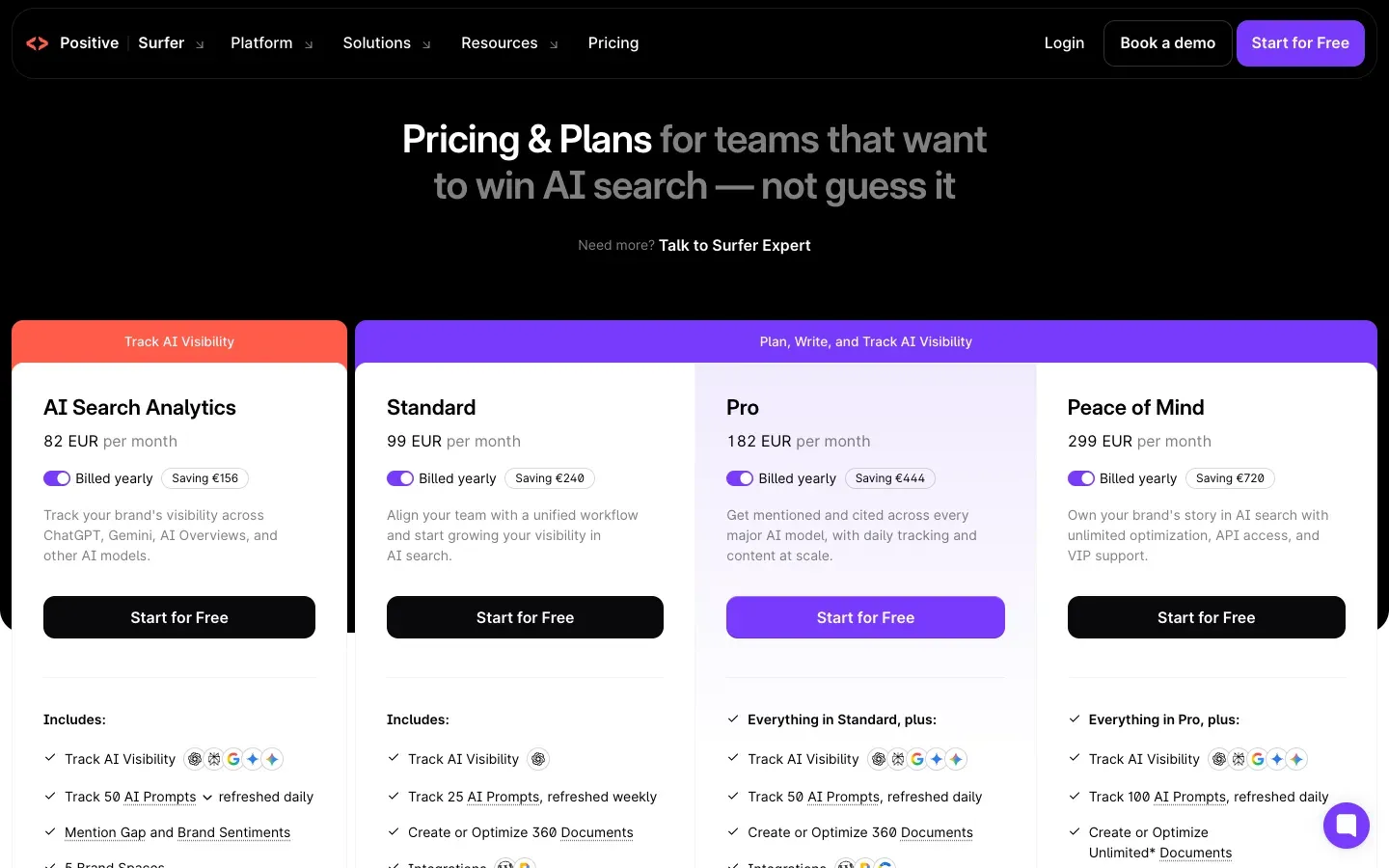
| Plan | ||||||
|---|---|---|---|---|---|---|
| Discovery | Per month, billed yearly €49 | Per month, billed monthly €59 | AI prompts tracked None | Documents 120 a year (10 a month) | Seats, brands 1 seat, 1 brand | Highlights AI SEO guidelines, Surfy and humanizer, 10 tracked pages |
| AI Search Analytics | Per month, billed yearly €82 | Per month, billed monthly €95 | AI prompts tracked 50, refreshed daily | Documents None | Seats, brands 5 seats, 5 brand spaces | Highlights AI visibility tracking, mention gap and sentiment, MCP |
| Standard | Per month, billed yearly €99 | Per month, billed monthly €119 | AI prompts tracked 25, refreshed weekly | Documents 360 a year (30 a month) | Seats, brands 3 seats, 1 brand | Highlights WordPress and Google Docs, 1-click optimisation, plagiarism checker, rank drop detection |
| Pro | Per month, billed yearly €182 | Per month, billed monthly €219 | AI prompts tracked 50, refreshed daily | Documents 360 a year (30 a month) | Seats, brands 5 seats, 5 brands | Highlights Tracking across ChatGPT, Perplexity, Google, AI Overviews and Gemini, Contentful, internal linking, cannibalisation report |
| Peace of Mind | Per month, billed yearly €299 | Per month, billed monthly €359 | AI prompts tracked 100, refreshed daily | Documents Unlimited (fair use) | Seats, brands 10 seats, unlimited brands | Highlights Advanced SERP analysis, Zapier, API access, dedicated success manager |
| Enterprise | Per month, billed yearly On quote | Per month, billed monthly On quote | AI prompts tracked Custom | Documents Custom | Seats, brands Custom | Highlights SSO, white-label, advisory programme, priority support |
Payment is by card on monthly and yearly plans, or by bank transfer on yearly plans only; PayPal is not accepted. You can upgrade or downgrade from the billing settings and turn off auto-renewal at any time, keeping access until the end of the paid period. On the Standard plan, the feature list says prompts are tracked across ChatGPT, without listing the other engines, so check which assistants are covered before you buy for AI tracking.
Is Surfer SEO free? Not as a plan. The pricing page shows "Start for Free" buttons without stating a trial length or its limits, so check the conditions when you sign up. The free tools (AI Humanizer, AI Detector, Chrome extension, AI Visibility Audit and AI Volatility Tracker) are a way to try the approach. The cheapest paid plan is Discovery at €49 a month billed yearly, or €59 billed monthly.
07Pros and cons
Advantages
- A mature Content Editor that writers learn quickly.
- Optimisation and AI visibility tracking in the same tool.
- Content Audit and rank drop detection to prioritise updates.
- WordPress and Google Docs integrations, an API and an MCP server.
- Prices in euros with several entry points.
- Backed by a larger group since the Positive acquisition.
Drawbacks
- Following the score blindly leads to generic, over-optimised pages.
- A pricing grid with six plans and different prompt and document limits that takes time to read.
- Monthly billing costs up to 17% more than yearly billing.
- AI tracking results vary from run to run and need careful reading.
- API and Zapier only on Peace of Mind.
- A changing product and brand: check that the features you need are in your plan.
08Our verdict
Who it's for
- Content teams and editors who publish often and want shared guidelines.
- SEO managers who refresh a large library of existing articles.
- Agencies that produce content for several brands.
- Marketing teams that want a first view of their visibility in AI answers.
Who it's not for
- Small sites that publish a few pages a year: Google Search Console and a good brief are enough.
- Teams looking for backlink and keyword databases: Ahrefs or Semrush cover that.
- Technical SEO problems such as crawling or indexing: use Screaming Frog or a technical SEO audit.
- Teams that want an AI tool to write everything without editorial review.
09Surfer alternatives
| Tool | ||
|---|---|---|
| Surfer | Best for Content optimisation and AI visibility in one tool | Approach Editor, audits, topical map, AI Tracker |
| Clearscope | Best for Simple content grading for many writers | Approach Focused editor, unlimited users |
| Frase | Best for Research, drafting and monitoring driven by an agent | Approach Agent-led workflow |
| Semrush | Best for SEO suite with a writing assistant | Approach All-in-one suite |
| Ahrefs | Best for Keyword research, backlinks, AI brand tracking | Approach SEO suite |
| Jasper | Best for Marketing copy at scale with a brand voice | Approach AI marketing agents |
Our rule: choose Surfer when your team writes regularly and wants detailed, shared guidelines plus AI visibility tracking in one place. Choose Clearscope for simplicity and unlimited users, Frase for an agent-led process, and a suite like Ahrefs or Semrush when keyword research and backlinks come first. Our guide to GEO vs SEO explains how content work changes with AI answers.
10Surfer vs Clearscope and Frase
These three tools are the ones most often compared for content optimisation, and all three now track AI visibility. Their differences lie in how they expect your team to work.
Surfer vs Clearscope. Clearscope bets on simplicity: a clean grade, an editor any writer understands, unlimited users on every plan, and a product focused on page monitoring and AI mention tracking. According to our Clearscope page, Essentials costs $129 a month. Surfer gives more levers (detailed guidelines, audits, topical maps, internal linking, cannibalisation reports) and lower entry prices in euros, but its plans limit seats and documents. Choose Clearscope when adoption by many writers matters most; choose Surfer when an SEO manager wants to go deeper.
Surfer vs Frase. Frase has moved towards an agent that decides what to write from an audit, drafts, publishes to the CMS and monitors results in Google and AI engines. According to our Frase page, it starts at $39 a month billed yearly. Surfer keeps the human editor at the centre. If you already have an editorial calendar and writers, Surfer fits naturally; if you need the tool to drive the process, Frase covers more ground.
In every case, test the tools on the same three articles you want to improve and compare the briefs they produce before committing to a year.
11Getting started with Surfer
- List the pages that matter: your top articles and the queries they target, taken from Search Console.
- Start with a refresh, not a new article: run Content Audit on one page that is slipping and compare its guidelines with your own judgement.
- Write a brief template that combines Surfer guidelines with your angle, sources and examples, so writers do not just chase the score.
- Choose the plan by volume: count documents per month, seats and, if you need AI tracking, the number of prompts and engines covered.
- Set up AI tracking carefully: pick prompts your buyers really ask, and read the trend over several weeks.
- Measure in Search Console after publishing: clicks and impressions, not the content score, tell you whether the work paid off. Our on-page SEO team can set up this process with you.