

The essentials · 30-second read
Clearscope grades and guides SEO content and tracks AI mentions. Essentials $129 a month, Business $399, Enterprise on quote. Unlimited users, 14-day free trial.
- Clearscope covers the content lifecycle: discover buyer questions, track mentions in Google, ChatGPT, Gemini and Claude, write with live term guidance and a grade, and monitor published pages.
- Essentials costs $129 a month (50 tracked queries, 50 pages, 20 discoveries and 20 drafts a month); Business $399 a month (300 tracked queries, 300 pages, 50 discoveries, 20 drafts, account manager). Enterprise on quote.
- Unlimited users and projects on every plan, Google Docs, Microsoft Word and WordPress add-ons, and a 14-day free trial; no free-forever plan.
- Our verdict: excellent for teams that publish often and want a shared quality bar; too expensive for a blog with a few posts a month.
Summarize this page with AI
Clearscope is often the first tool content teams look at when they want every article to meet the same quality bar, whoever writes it. It used to be known as a content grader; in 2026 it presents itself as a platform to "write what Google ranks and AI mentions". This review explains what Clearscope does today, what each plan includes, how much it costs, how it compares with Surfer SEO, Frase and the big SEO suites, and when we think it is worth the price.
01What is Clearscope?
Clearscope is a content optimisation platform built around four steps. Discover finds the questions buyers ask Google and AI assistants, with search volume, intent and the brands each engine names. Track shows how often Google, ChatGPT, Gemini and Claude mention you or chosen competitors for each query. Write starts drafts from a query's intent and your tone, with term guidance and a live grade that show gaps. Monitor connects to Search Console to follow each page's grade, clicks and value over time, and flags content decay.
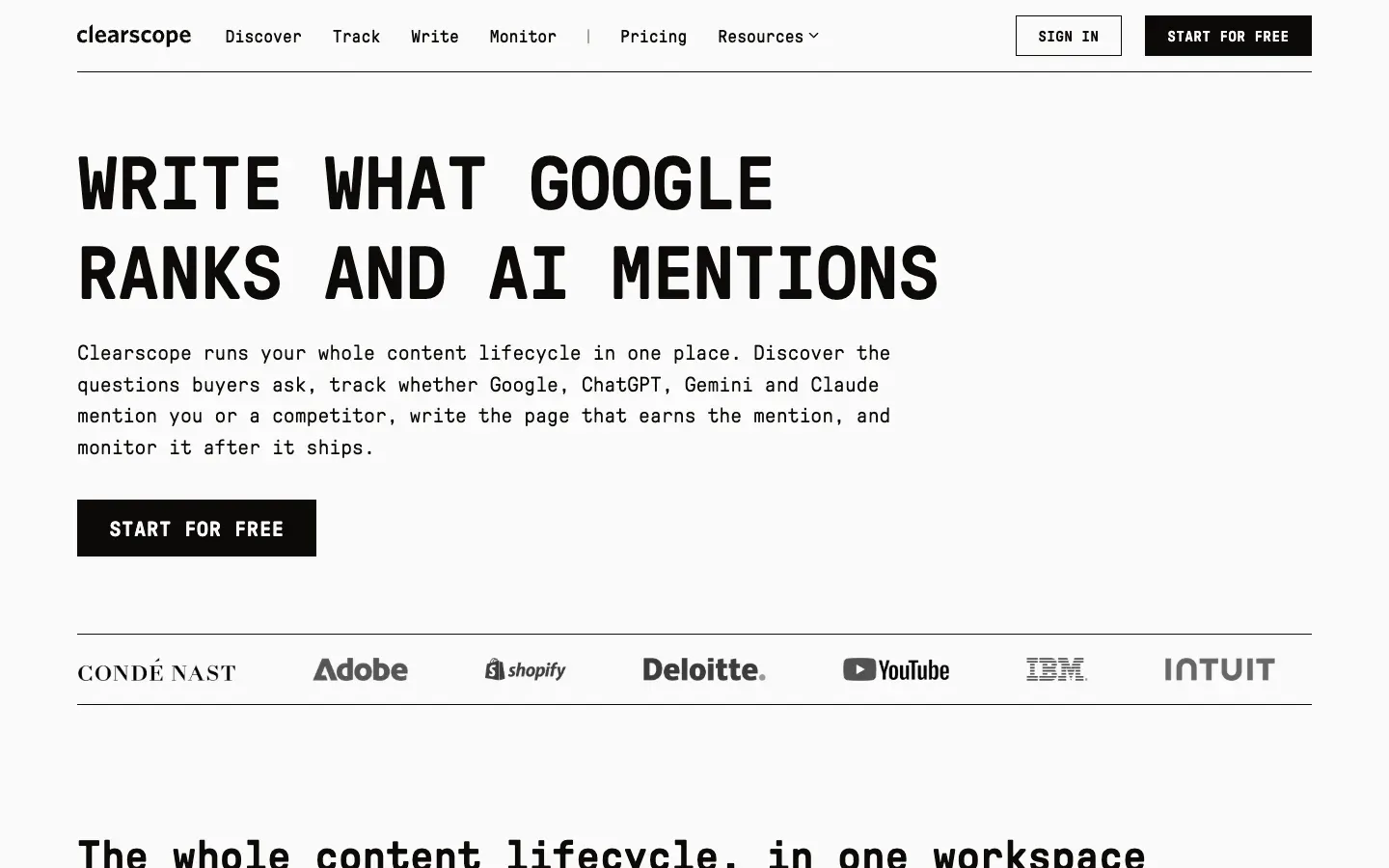
The site displays logos such as Intuit, Condé Nast, Adobe, Shopify, Deloitte, YouTube and IBM, and testimonials from content teams at companies including Webflow and Optimizely. The footer credits Mushi Labs as the company behind the product. What sets Clearscope apart is its focus: it does not try to be an all-in-one SEO suite, it tries to make each piece of content better and to show whether it is visible in search and in AI answers.
02How we look at Clearscope at BeBranded
We do not use Clearscope in our own work: our daily SEO tracking runs on Google Search Console and Ahrefs. Clearscope comes up when clients with a content team ask us how to scale their SEO and GEO work without lowering quality. Our rule of thumb:
- We recommend Clearscope to teams that publish or refresh content every week, work with several writers or freelancers, and need a shared, measurable standard. The grade gives writers a clear target, and AI mention tracking answers a question many marketing directors now ask: "does ChatGPT mention us?"
- We advise against it for a small business publishing one or two articles a month. The budget is better spent on a solid brief, internal linking and on-page SEO work on the pages that already get impressions.
- We warn against chasing the grade. Any term-based tool can push writers to stuff words into a text. The grade is a check, not the goal: a useful article with original information, examples and a clear structure beats a perfect score on a generic one.
03Key features
- Discover: finds the questions buyers ask in Google and AI assistants, with volume, intent and the brands cited by each engine; 20 discoveries a month on Essentials, 50 on Business.
- Track: tracked queries show how often Google, ChatGPT, Gemini and Claude mention you or your competitors; 50 queries on Essentials, 300 on Business.
- Write: drafts started from a query's intent and your tone, recommended terms, a live content grade and a "Boost Content Grade" function to fill gaps; 20 drafts a month on both self-serve plans.
- Monitor: a Search Console connection to follow each page's grade, clicks and value, with saved views for content decay and queries close to page one; 50 pages on Essentials, 300 on Business.
- Editor add-ons: guidance inside Google Docs, Microsoft Word and WordPress.
- Collaboration: unlimited users and projects, unlimited sharing and exporting, notes for writers in the workspace.
- Support: free training and onboarding and priority support on every plan; a dedicated account manager on Business.
04Use cases
Content team working with freelance writers
A content lead commissions ten articles a month from five freelancers. Each brief is a Clearscope report: the writer sees the terms and questions to cover and the target grade, and the editor checks the grade before reviewing the substance. The benefit is consistency; the risk is that writers optimise for the score, so editorial review stays essential.
Refreshing old articles
Most sites have dozens of articles that slowly lose clicks. Monitor, connected to Search Console, flags pages whose performance is decaying and queries where a page sits just outside the top results. The team refreshes those first, which is usually faster than writing new content.
Tracking AI search visibility
Marketing teams now want to know whether AI assistants recommend their brand. Track shows mentions across Google, ChatGPT, Gemini and Claude for chosen queries, alongside competitors. It is a monitoring tool, not a guarantee: improving visibility still requires content that answers questions clearly and is cited elsewhere. Our guide on how to track your brand in AI search explains the method.
Agencies reporting to clients
Agencies share Clearscope reports with clients to explain why an article covers certain subtopics, and use the grade and Monitor data in monthly reporting. Unlimited users and projects help, since clients and writers can be invited without extra seats.
Planning content from buyer questions
Discover lists the questions people ask Google and AI assistants about a topic, with their intent. A team can turn that list into an editorial calendar and avoid writing articles nobody searches for. Pair it with Search Console data on your own site to prioritise.
05Integrations
Clearscope's writing guidance works inside Google Docs, Microsoft Word and WordPress, so writers keep their usual editor. Monitor connects to Google Search Console to pull clicks and queries per page. Clearscope does not replace a keyword database or a backlink index: teams usually pair it with Semrush or Ahrefs for research and with Search Console for performance. Check the integrations page during the trial if you publish through another CMS, such as Webflow or a headless CMS.
06Clearscope pricing in 2026
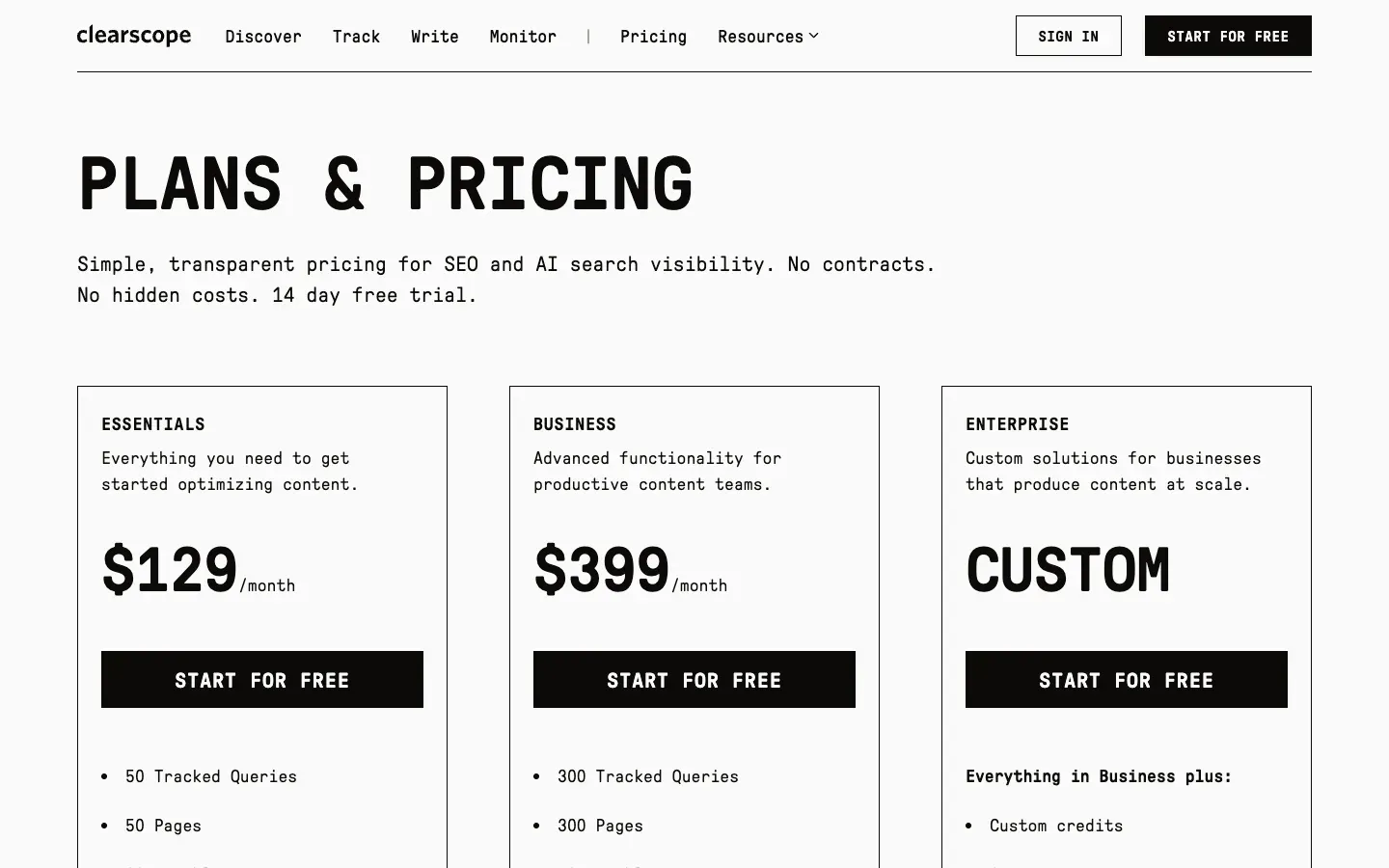
Prices checked on clearscope.io/pricing on 17 November 2026, in US dollars, per month. The page shows monthly prices and mentions that yearly custom plans can be invoiced; no annual discount is displayed.
| Plan | ||||||
|---|---|---|---|---|---|---|
| Essentials | Price $129 a month | Tracked queries 50 | Pages monitored 50 | Discoveries a month 20 | Drafts a month 20 | Extras Unlimited users and projects |
| Business | Price $399 a month | Tracked queries 300 | Pages monitored 300 | Discoveries a month 50 | Drafts a month 20 | Extras Dedicated account manager |
| Enterprise | Price On quote | Tracked queries Custom credits | Pages monitored Custom | Discoveries a month Custom | Drafts a month Custom | Extras Custom agreements, crawler whitelisting, SSO |
Every plan includes unlimited users and projects, query tracking across AI assistants, brand visibility tracking, unlimited sharing and exporting, free training and onboarding, priority support and flexible plan changes. Add-ons let you buy extra tracked queries, pages and drafts; the page lists them in tiers, but the mapping between quantities and prices was not readable reliably, so we do not quote those amounts here.
Is Clearscope free? No. There is a 14-day free trial on every plan, then Essentials starts at $129 a month. Use the trial on real pages: create reports for three articles you want to refresh, connect Search Console and check whether the recommendations change what your writers produce.
07Pros and cons
Advantages
- A clean editor that non-technical writers adopt quickly.
- A shared, measurable quality bar for every article.
- AI mention tracking across Google, ChatGPT, Gemini and Claude in the same tool.
- Page monitoring through Search Console to prioritise refreshes.
- Unlimited users and projects, useful for agencies and freelancers.
- Add-ons for Google Docs, Microsoft Word and WordPress.
Drawbacks
- One of the more expensive tools in its category, with no free plan.
- Quotas on tracked queries, pages and drafts, even on Business.
- Narrow scope: no backlink analysis, technical audit or full keyword database.
- Term recommendations can push writers towards generic, padded content.
- Add-on pricing is not easy to read on the pricing page.
08Our verdict
Who it's for
- Content marketing teams publishing or refreshing several articles a week.
- SEO and content agencies that brief freelance writers.
- B2B and SaaS companies that want to know how AI assistants mention them.
- Editors who need a common standard across many contributors.
Who it's not for
- Small sites publishing a couple of articles a month.
- Teams that need a full SEO suite with backlinks and technical audits.
- Freelancers on a tight budget.
- Writers who already work from strong, research-based briefs.
09Clearscope alternatives
| Tool | ||
|---|---|---|
| Clearscope | Best for Writing standard and AI mention tracking | Scope Content optimisation and monitoring |
| Surfer SEO | Best for Broader on-page and content optimisation | Scope Content editor, audits, AI writing |
| Frase | Best for Research-based briefs and outlines | Scope Briefs, outlines and optimisation |
| Semrush | Best for All-in-one SEO and AI visibility suite | Scope Keywords, backlinks, audits, content tools |
| Ahrefs | Best for Backlinks, keywords and site audits | Scope SEO suite with content features |
| AlsoAsked | Best for Mapping the questions people ask | Scope Question research only |
Our rule: if you already pay for Semrush or Ahrefs, test their content tools before adding another subscription. Choose Clearscope when writing quality and adoption by writers matter most, Surfer SEO when you want a wider on-page toolkit, and Frase when you mainly need research-based briefs and outlines. For question research alone, AlsoAsked is enough.
10Clearscope vs Surfer SEO
These two are the names most often compared for content optimisation. Both analyse what ranks for a query, recommend terms and give a score while you write. Clearscope's strengths are simplicity and focus: an editor that writers understand in minutes, unlimited users, and, in 2026, a product centred on AI mention tracking and page monitoring. Surfer covers a wider range of on-page optimisation and content production features. In practice, a team that wants writers to adopt one clear standard tends to prefer Clearscope; a team where an SEO specialist optimises pages in depth often prefers Surfer. Before choosing, test them on the same three articles and compare the briefs they produce.
11Getting started with Clearscope
- Start the 14-day trial and connect Google Search Console first, so Monitor has data on your own pages.
- Pick three existing articles with impressions but few clicks, and refresh them with Clearscope's guidance before writing anything new.
- Choose 20 to 50 queries to track in AI assistants: your category, your main use cases and your competitors' names.
- Write a short internal rule for the grade: a minimum target, but editorial judgement first. Our guide to optimising content for AI lists what matters beyond terms.
- Install the Google Docs or WordPress add-on for your writers and add the report link to every brief.
- Review results after a month: grades, clicks on refreshed pages and AI mentions. If you need help building the process, our GEO and AI visibility service covers it.