

The essentials · 30-second read
Semrush covers SEO and AI search visibility. Free: 10 reports a day. Annual billing: SEO €112.52, Starter €158.40, Pro+ €238 a month. 7-day free trial on paid plans.
- Keyword research, competitor analysis, rank tracking, site audit, backlinks and AI search visibility, organised in toolkits.
- Free plan with 1 demo project and 10 reports a day. SEO + AI Search plans on annual billing: SEO €112.52, Starter €158.40 and Pro+ €238 a month; €134, €190 and €286 billed monthly.
- Semrush has been part of Adobe since the acquisition closed in April 2026; other toolkits (local, content, social, advertising) are priced separately.
- Our verdict: one of the most complete suites on the market; we use Ahrefs and Search Console ourselves, and both tools do the core job.
Summarize this page with AI
Semrush is often the first name that comes up when a marketing team decides to take SEO seriously. It answers the questions every site owner asks: which keywords bring traffic, where do we rank, what do competitors do better, what is broken on the site. In 2026 it adds a new one: how does the brand appear in AI answers. This guide explains what Semrush does, what its plans cost after its 2026 overhaul, how it compares with Ahrefs, and when a paid subscription is really worth it.
01What is Semrush?
Semrush is an online visibility platform. It started as an SEO tool and now covers SEO, AI search, content, local search, social media, advertising and market research. Its core is a large database of keywords, domains, rankings and backlinks: enter a domain or a keyword and Semrush returns search volumes, difficulty, ranking positions, estimated traffic and competitors.
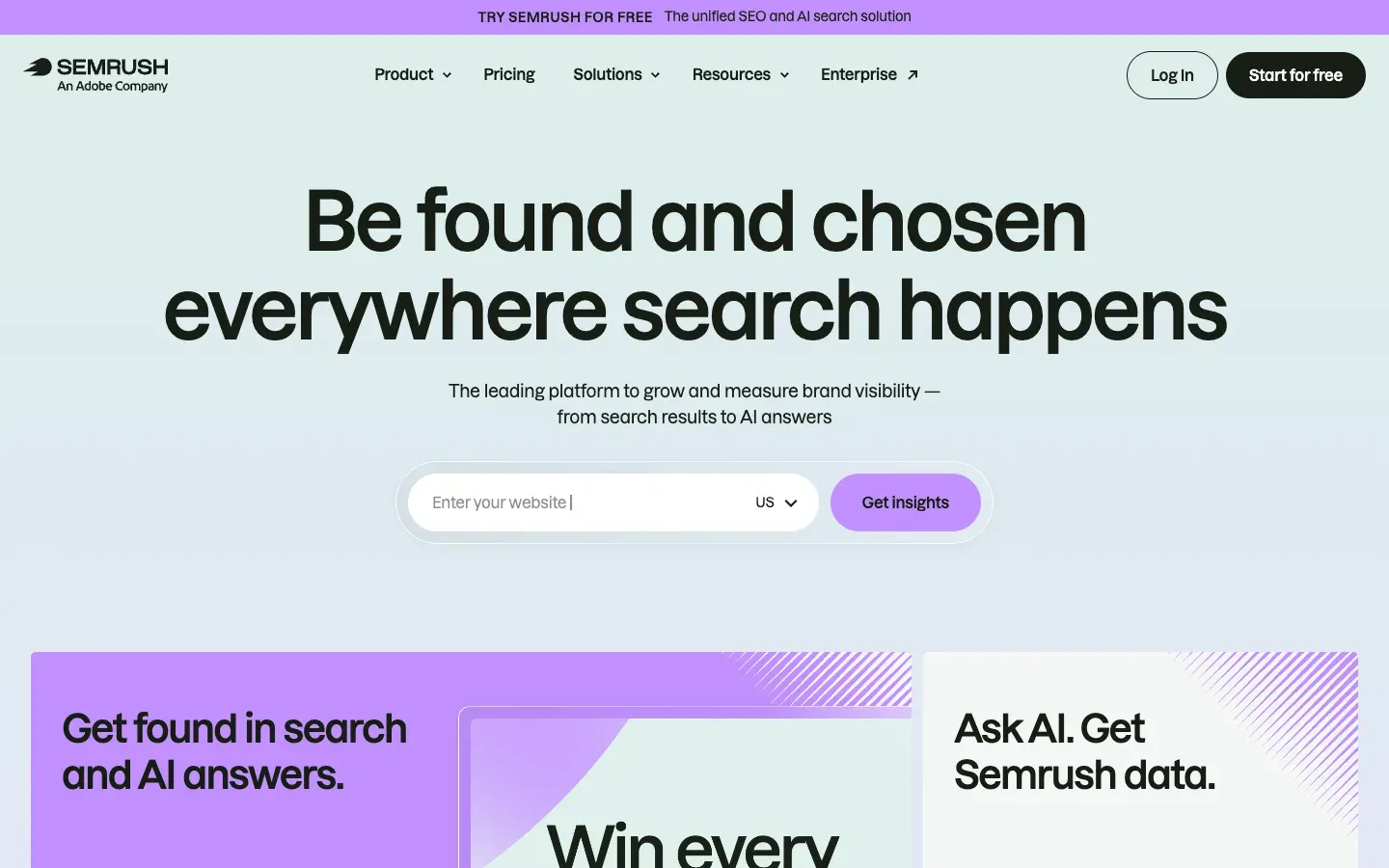
Semrush is now part of Adobe: Adobe announced the completion of the acquisition on 28 April 2026, and the Semrush logo now reads "An Adobe Company". The product is still sold under its own name. Its pricing is organised in toolkits (SEO + AI Search, AI Visibility, Traffic & Market, Local, Content, Social, Advertising and others), each with its own plans. The video below is an English tutorial for beginners recorded on an earlier version of the interface.
02How we look at Semrush at BeBranded
We do not use Semrush day to day. Our own SEO follow-up relies on Google Search Console, connected to our tools, and Ahrefs. We talk about Semrush with clients because many marketing teams already pay for it, or are about to. Our advice:
- Semrush is a good choice for a marketing team that works on SEO every week and also needs advertising, social or local toolkits in the same place. Its breadth is its strength.
- It is not necessary for a small site whose owner checks rankings once a month. Search Console, which is free and based on Google's real data, plus the free Semrush plan, is enough. A one-off technical SEO audit is often a better investment than a year of subscription.
- Whatever the tool, third-party data are estimates. We always cross-check volumes and traffic with Search Console before making a decision.
Our SEO and GEO work is about acting on the data: fixing what blocks indexing, writing pages that answer real queries, and making the brand visible in AI answers. The tool is only the dashboard.
03Key features
- Keyword research: Keyword Magic Tool and Keyword Overview, with volumes, difficulty, intent and related questions.
- Competitor analysis: organic and paid keywords, top pages and keyword gaps between domains.
- Position Tracking: daily rank tracking for your keywords, by location and device on higher plans.
- Site Audit: a crawl that flags technical issues (errors, redirects, speed, internal links, crawlability).
- Backlinks: backlink profiles, referring domains and link gap analysis.
- On-page and content: recommendations to optimise pages, content optimisation and cannibalisation analysis on Pro+.
- AI search visibility: tracking of custom prompts, brand mentions and sentiment in AI answers.
- Reporting and MCP access: dashboards and reports; the Starter plan lists MCP access to use Semrush data in AI assistants.
- Other toolkits: Traffic & Market, Local, Content, Social, Advertising, sold separately.
04Use cases
Keyword research for a new site or section
A team prepares a blog, a resources section or new service pages. Semrush lists keywords around the topic with volumes, difficulty and intent, and groups them so each page targets a clear query. The output is a content plan, not just a list. Remember that volumes are estimates: Search Console tells you what really happens after publication.
Competitor benchmarking
A company wants to understand why a competitor outranks it. Semrush shows the competitor's best pages, the keywords it ranks for that you do not, and the sites that link to it. This is often the fastest way to find content gaps and realistic targets.
Technical audit before or after a redesign
Before a migration, a Site Audit crawl lists all pages, redirects and errors, which helps build the redirect plan. After launch, a second crawl checks that nothing broke. Our guide on SEO during a redesign explains the full process.
Rank tracking for a marketing team
A team follows a few hundred priority keywords every day, by country and device. Weekly reports show progress after each publication or optimisation. On the SEO and Starter plans, the limit is 500 keywords tracked daily; Pro+ goes to 1,500.
Measuring visibility in AI answers
A brand wants to know whether AI assistants cite it when users ask about its market. Semrush's AI features track custom prompts and the brand's presence and sentiment in the answers. This is still a young field: use it as a trend indicator, alongside an AI visibility audit.
05Integrations
Semrush connects to Google Search Console and Google Analytics to enrich its reports with your real data, and to Looker Studio for custom dashboards. Its App Center adds tools from Semrush and third parties. Higher plans offer API access to pull data into your own tools, and the Starter plan lists MCP access, which lets AI assistants query Semrush data directly. The details of each integration depend on the toolkit and plan.
06Semrush pricing in 2026
Prices checked on semrush.com/prices on 17 November 2026, in euros, per month, for the SEO + AI Search toolkit. The page has a monthly/annual switch ("save up to 17%"), with the annual view shown by default. The page does not say whether VAT is included.
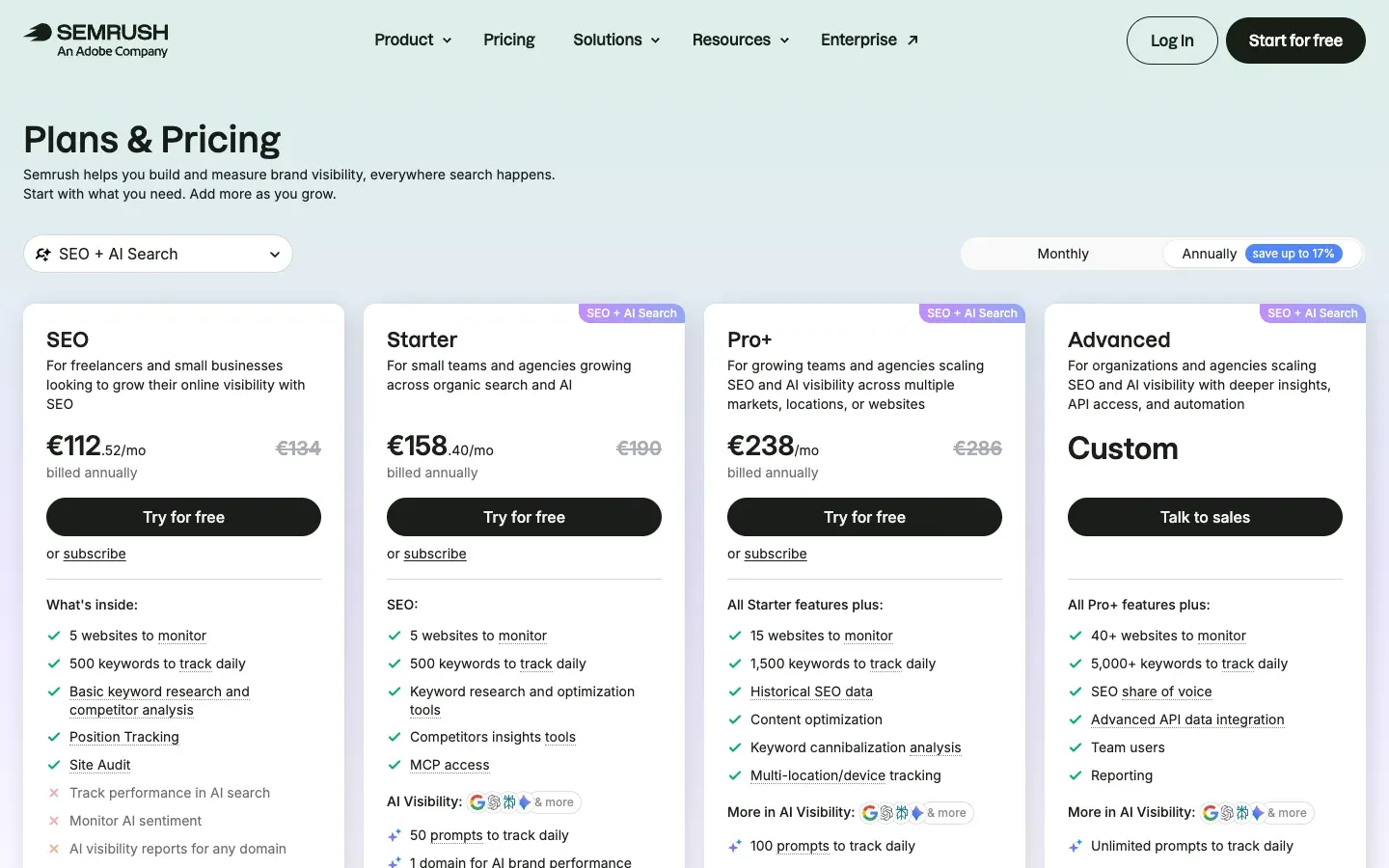
| Plan | ||||
|---|---|---|---|---|
| Free | Annual billing $0 | Monthly billing $0 | Websites and keywords tracked 1 demo project | Highlights 10 reports a day across the main tools |
| SEO | Annual billing €112.52 a month | Monthly billing €134 a month | Websites and keywords tracked 5 websites, 500 keywords daily | Highlights Keyword and competitor research, Position Tracking, Site Audit; AI visibility features not included |
| Starter | Annual billing €158.40 a month | Monthly billing €190 a month | Websites and keywords tracked 5 websites, 500 keywords daily | Highlights Full keyword and competitor tools, MCP access, 50 AI prompts tracked daily |
| Pro+ | Annual billing €238 a month | Monthly billing €286 a month | Websites and keywords tracked 15 websites, 1,500 keywords daily | Highlights Historical data, content optimisation, cannibalisation, multi-location tracking, 100 prompts daily |
| Advanced | Annual billing On request | Monthly billing On request | Websites and keywords tracked 40+ websites, 5,000+ keywords daily | Highlights Share of voice, API, team users, reporting, unlimited prompts |
Additional users start at €43 a month. The other toolkits (AI Visibility, Traffic & Market, Local, Content, Social, Advertising and more) are priced separately on the same page, and Enterprise is on request.
Is Semrush free? Yes, in a limited way: the free plan gives 1 demo project and 10 reports a day, without a credit card. Paid plans can be tried free for 7 days. For a single site with occasional needs, the free plan plus Search Console often covers the essentials.
07Pros and cons
Advantages
- One of the most complete suites: SEO, AI visibility, content, local, social and advertising.
- Large keyword and domain databases, useful for competitor research.
- Daily rank tracking with clear reports.
- A Site Audit that is easy to read for non-specialists.
- Early AI search visibility features and MCP access.
- A free plan and a 7-day trial to test before paying.
Drawbacks
- Expensive for a small business, especially once extra users and toolkits are added.
- Toolkits sold separately make the real price harder to estimate.
- Data are estimates and can differ widely from Search Console.
- The number of tools and reports has a real learning curve.
- The annual discount commits you for a year.
08Our verdict
Who it's for
- Marketing teams working on SEO and content every week.
- SEO consultants and agencies managing several sites.
- E-commerce sites with many pages and competitors to watch.
- Companies that want SEO, advertising and social data in one platform.
Who it's not for
- Small sites whose owners check SEO once a month: Search Console is enough.
- Teams that will not have time to act on the data.
- Very tight budgets: a one-off audit costs less than a year of subscription.
- Developers who only need a crawler: Screaming Frog is more direct.
09Semrush alternatives
| Tool | ||
|---|---|---|
| Semrush | Best for Broad marketing and SEO suite with AI visibility | Model Free plan, then monthly or annual plans per toolkit |
| Ahrefs | Best for SEO research and backlinks | Model Monthly or annual plans |
| Moz | Best for SEO metrics and link research | Model Monthly plans |
| Google Search Console | Best for Real Google data for your own site | Model Free |
| Screaming Frog | Best for Technical crawling and audits | Model Free version, then annual licence |
| Surfer SEO | Best for Content optimisation | Model Monthly plans |
Our rule: start with Google Search Console for every site. Add Semrush or Ahrefs when someone works on SEO weekly and needs competitor data. Add Screaming Frog for deep technical audits. Our article on GEO vs SEO explains what changes with AI search.
10Semrush vs Ahrefs
Semrush and Ahrefs are the two reference suites, and for core SEO work (keyword research, competitor analysis, rank tracking, audits, backlinks) both do the job. The differences are elsewhere. Semrush is broader: it adds toolkits for advertising, social media, local SEO, content and market research, and it has pushed AI search visibility into its main plans. Ahrefs stays more focused on SEO, with a reputation for its backlink index and a direct interface.
We use Ahrefs ourselves, alongside Search Console. That is a choice of habit and scope, not a verdict: a marketing team that also manages ads and social media may get more from Semrush. The best test is practical: run both trials on your own domain and three competitors, and keep the one whose data and reports your team actually reads.
11Getting started with Semrush
- Connect Search Console and Analytics first, so you can compare Semrush estimates with your real data.
- Create one project per site and run a Site Audit: fix critical errors before chasing keywords.
- Set up Position Tracking for 50 to 100 priority keywords, by country, rather than hundreds at once.
- Analyse three real competitors, the ones that rank on your queries, not only your business rivals.
- Turn findings into a plan: pages to create, pages to improve, technical fixes, with owners and dates.
- Review the plan after the trial or the first month and keep only the toolkits you actually use.
Want a second opinion on your SEO before you subscribe? Our technical SEO audit and on-page SEO services start from your real Search Console data.