


The essentials · 30-second read
AlsoAsked turns Google's People Also Ask boxes into question trees for content and FAQ planning. A few searches without an account; paid plans from $9 a month, billed yearly.
- Enter a topic, choose a country, city and language: AlsoAsked returns the live People Also Ask questions and the questions that branch from them.
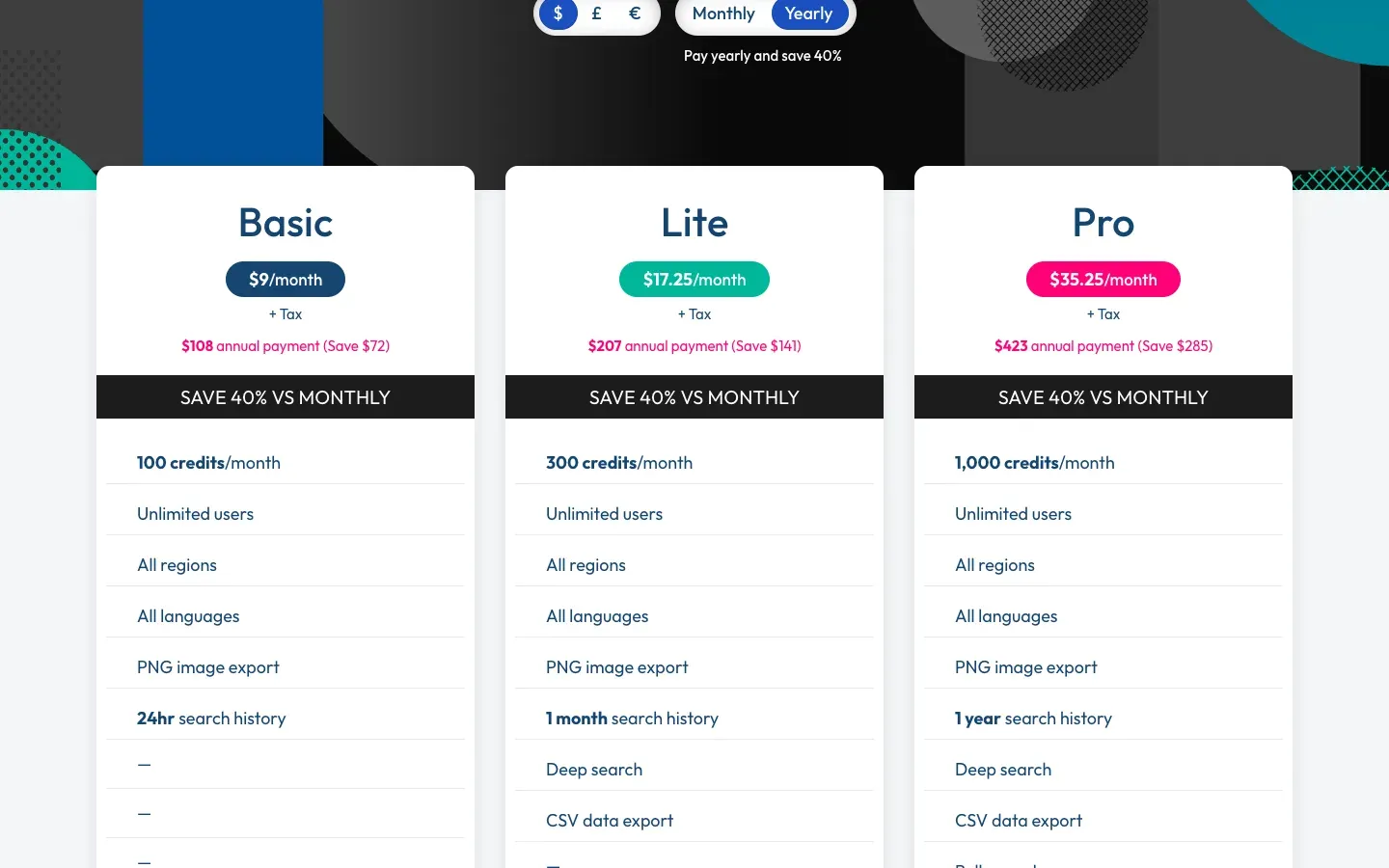
- A limited number of searches without signing in. Paid plans, billed yearly: Basic $9, Lite $17.25, Pro $35.25 a month, for 100, 300 and 1,000 credits.
- Every plan includes unlimited users and PNG export. Lite adds deep search and CSV export; Pro adds bulk searches, the API, pay-as-you-go credits and an MCP server.
- Our verdict: the clearest view of how people phrase their questions; pair it with Search Console and a volume tool.
Summarize this page with AI
When you write a page, the hardest part is often not the topic but the questions around it: what people want to know next, how they phrase it, what they confuse. AlsoAsked answers that by mapping Google's People Also Ask boxes into trees of questions. It is a small, focused tool, cheap and fast to use. This page explains what AlsoAsked does, how to use People Also Ask data in SEO analyses, what it costs in 2026, and which tools to pair it with.
01What is AlsoAsked?
AlsoAsked (alsoasked.com) is a keyword research tool built around Google's People Also Ask (PAA) results. You enter a topic or a question, choose a country, a city if needed, and a language, and the tool returns the questions Google displays in its People Also Ask box, then the questions that appear behind each of them. The result is a tree: a first level of questions, and branches of follow-up questions.
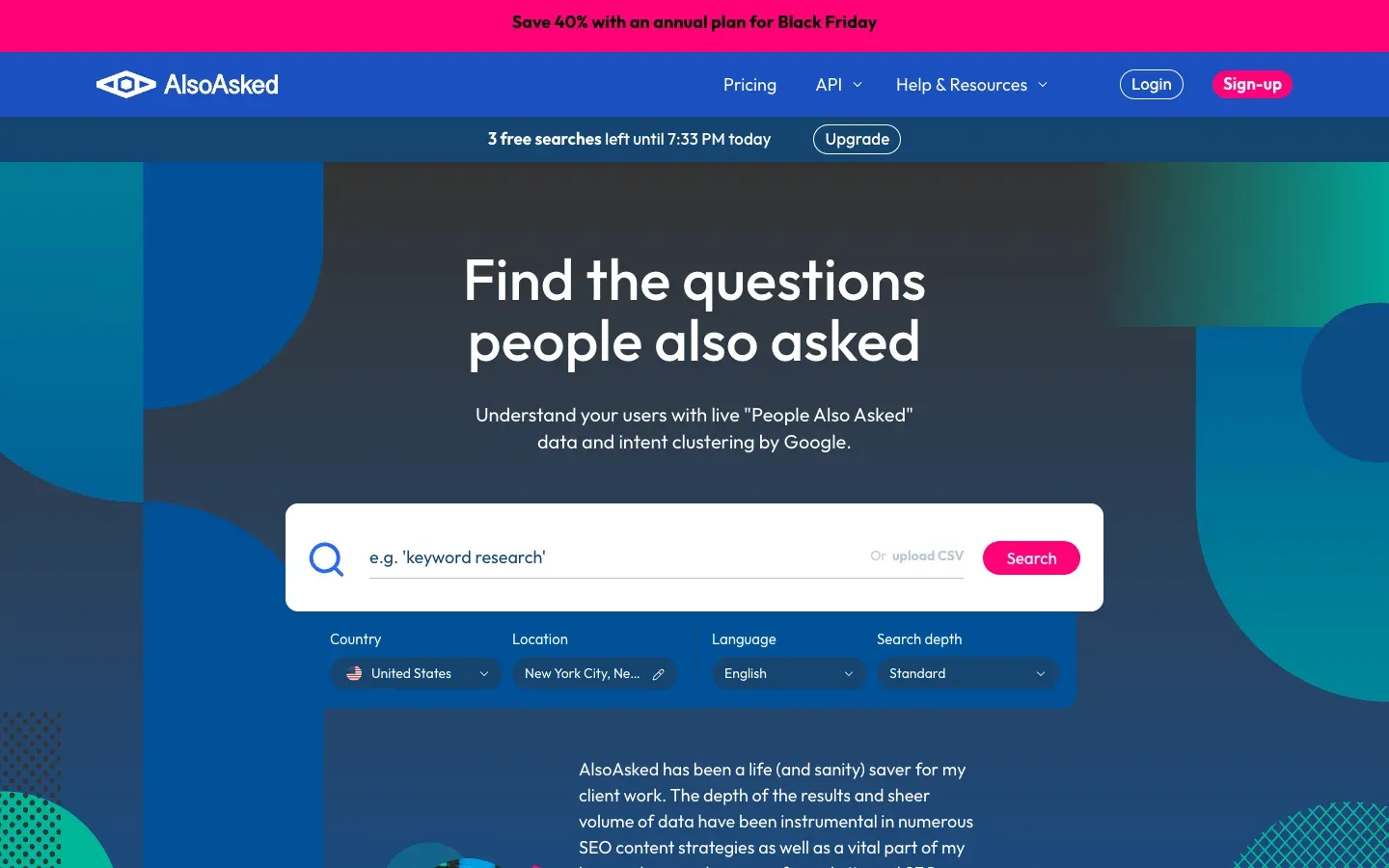
AlsoAsked is made by Candour, a UK digital marketing agency. The tool says it provides live People Also Ask data, which means results reflect what Google shows at the time of the search rather than an old database. Its Deep Search mode returns on average 150 questions per query, according to its home page.
02How we use AlsoAsked at BeBranded
AlsoAsked is not in our daily stack: our SEO monitoring runs on Google Search Console and Ahrefs, connected to our own tools. We point clients and writers to AlsoAsked in a precise situation: preparing a content brief or a FAQ section, when you need to know which questions to answer and in what order.
How we fit PAA data into an on-page SEO analysis:
- Start from real queries: Search Console shows the queries that already bring impressions to a page. They come first.
- Add the questions around them: People Also Ask shows the follow-up needs that the page does not yet cover.
- Decide the structure: questions that share an intent become one section; isolated questions go into the FAQ; questions that open a new topic justify a separate article.
We also use this logic for our SEO and GEO work, because pages that answer clear questions in short, self-contained paragraphs are easier for AI assistants to quote.
03Key features
- Question trees: People Also Ask questions displayed as a branching diagram, with several levels.
- Live data: questions fetched from Google at the time of the search.
- Country, city and language targeting: city-level targeting in all languages supported by Google, according to AlsoAsked.
- Deep search: on average 150 questions per query, from the Lite plan.
- Bulk searches: run several topics in one go, on the Pro plan.
- Exports: PNG image for presentations on every plan, CSV for spreadsheets and briefs from Lite.
- Search history: 24 hours on Basic, one month on Lite, one year on Pro; cached searches can be recalled for free.
- API and MCP server: a sync and async API with webhook support, and an MCP server to use AlsoAsked from AI agents, on the Pro plan.
04Use cases
Writing a content brief
A writer prepares an article on a topic. AlsoAsked shows the questions Google associates with it: definitions, comparisons, prices, problems. The brief gets an outline based on real questions rather than guesses. To know: not every question deserves a section; keep the ones that match the page's intent.
Building a FAQ section that matches search
A service or product page needs a FAQ. Rather than inventing questions, the team takes the PAA questions for the main query, keeps six to eight, and writes short, direct answers. Combined with the queries seen in Search Console, it gives a FAQ that answers what people actually search.
Understanding search intent before choosing a page type
If the questions around a query are mostly "how to", searchers want a guide; if they are "best" and "vs", they compare; if they are "price" and "is it free", they are close to buying. AlsoAsked makes that pattern visible in one screen.
Finding new article ideas
Branches of the tree often open topics adjacent to the starting point. They are good candidates for separate articles linked to the main page, which strengthens a topic cluster.
Preparing content for AI answers
AI Overviews and AI assistants answer questions. Mapping the questions around a topic helps structure pages so that each section answers one question clearly. Our guide on optimizing content for AI details the method.
05AlsoAsked pricing in 2026
Prices checked on alsoasked.com/pricing on 17 November 2026, in US dollars, excluding tax.
| Plan | |||||
|---|---|---|---|---|---|
| Basic | Price per month (billed yearly) $9 | Yearly payment $108 | Credits per month 100 | Search history 24 hours | Included Unlimited users, all regions and languages, PNG export |
| Lite | Price per month (billed yearly) $17.25 | Yearly payment $207 | Credits per month 300 | Search history 1 month | Included Basic, plus deep search and CSV export |
| Pro | Price per month (billed yearly) $35.25 | Yearly payment $423 | Credits per month 1,000 | Search history 1 year | Included Lite, plus bulk searches, API access, pay-as-you-go credits and MCP server |
The plan cards on the page show deep search and CSV export from Lite, and bulk searches, API, pay-as-you-go credits and the MCP server on Pro only. The page states that paying yearly saves 40% compared with monthly billing, and presents these yearly prices as a Black Friday offer valid until 30 November 2026; the monthly billing price is not displayed in the page text. The pricing page lists credits rather than searches and does not say how many credits a search uses. Annual plans renew automatically and purchases are non-refundable, according to the page.
Is AlsoAsked free? You can run a limited number of searches without signing in (the site showed three free searches when we checked), which is enough to try the tool. There is no free plan on the pricing page: exports, bulk searches, history and regular use require a paid plan, starting at $108 a year.
06Pros and cons
Advantages
- The clearest visualization of how questions relate around a topic.
- Live People Also Ask data, by country, city and language.
- Cheap entry price and unlimited users on every plan.
- PNG and CSV exports (CSV from Lite) that fit straight into briefs and presentations.
- An API and an MCP server (Pro plan) for automated workflows and AI agents.
Drawbacks
- No search volume, keyword difficulty or ranking data: it needs other tools.
- Results depend on Google showing People Also Ask for the query, which varies by topic, language and country.
- Credits are not translated into a number of searches on the pricing page, and the Basic plan has neither deep search nor CSV export.
- Monthly billing prices are not shown clearly, and the yearly price is presented as a time-limited offer.
- A single-purpose tool: teams with Semrush or Ahrefs may find similar question data there.
07Our verdict
Who it's for
- Content writers and editors who prepare briefs and outlines.
- SEO specialists who analyze search intent and build FAQ sections.
- Agencies that present content plans to clients, thanks to image exports.
- Teams working on AI visibility who structure pages around questions.
Who it's not for
- Teams looking for an all-in-one SEO suite with volumes, backlinks and rankings.
- Sites in niches where Google rarely shows People Also Ask.
- Anyone who only needs a handful of questions a year: Google's own results are enough.
- Teams that want long-tail keyword lists with volumes rather than questions.
08AlsoAsked alternatives
| Tool | ||
|---|---|---|
| AlsoAsked | Best for People Also Ask question trees | Data source Live Google People Also Ask |
| AnswerThePublic | Best for Many question and preposition phrasings | Data source Search autocomplete |
| Ahrefs | Best for Volumes, difficulty, backlinks and question keywords | Data source Ahrefs keyword database |
| Semrush | Best for All-in-one SEO and question keywords | Data source Semrush keyword database |
| Frase | Best for Content briefs built from search results | Data source Search results and questions |
| Google Search Console | Best for Queries that already reach your site | Data source Your own Google data |
Our rule: Search Console first, because it shows the queries you already appear for. AlsoAsked next, to see the questions around them. Ahrefs or Semrush to size the opportunity with volumes. Frase or Surfer SEO if you want a full content brief tool.
09People Also Ask in SEO analyses
People Also Ask data is useful in an SEO analysis for three reasons. It shows the vocabulary of searchers, which is often different from the vocabulary of the company. It shows the order in which questions come, which suggests the order of a page. And it shows which sites Google trusts to answer, since each expanded question cites a source page.
A simple method:
- List the five to ten main queries of the page in Search Console.
- Run them in AlsoAsked with the right country and language.
- Group the questions by intent: definition, method, comparison, price, problem.
- Map each group to a section, a FAQ entry or a new page.
- After publication, watch in Search Console which new queries the page gains.
Questions are also a good basis for FAQ structured data. If your site is multilingual, read our article on multilingual FAQ schema.
10Getting started with AlsoAsked
- Try a few searches without an account to see whether your topics trigger People Also Ask.
- Set the right country and language: questions differ a lot between markets.
- Export the tree (CSV from the Lite plan) and sort the questions by intent in a spreadsheet.
- Compare with your Search Console queries before writing anything.
- Choose the plan by need: Lite for deep search and CSV export, Pro for bulk searches, the API or the MCP server.
Want a content plan built on real questions and real data? See our on-page SEO and GEO and AI visibility services.