


The essentials · 30-second read
Frase researches, writes, optimises and monitors content for Google and AI answers. 7-day free trial, then from $39 a month billed yearly ($49 monthly). Prices in USD.
- An agent that audits pages, finds topics and gaps, drafts in your brand voice, scores for SEO and GEO, publishes to your CMS and monitors Google and AI visibility.
- 7-day free trial, no card. Billed yearly, per month: Starter $39, Professional $103, Scale $239; monthly billing: $49, $129, $299. Enterprise on quote.
- Plans are sized by seats, sites, articles, audit pages and AI generations; AI Visibility tracks ChatGPT and Google AI from Starter, more engines on higher plans.
- Our verdict: a strong briefing and monitoring tool; drafts still need a human editor, and auto-publishing should stay off for anything that matters.
Summarize this page with AI
Frase started as a tool for building content briefs from Google's top results. In 2026 it presents itself as something broader: an agent that audits your site, writes, publishes and keeps an eye on both Google rankings and AI answers. This review explains what Frase does today, what each plan includes and costs, where it helps an SEO and GEO workflow, and where you should keep a human in charge. It also compares Frase with Surfer SEO, Clearscope and the large SEO suites.
01What is Frase?
Frase is an SEO and GEO content platform. Its homepage tagline is "Rank on Google. Get cited by AI.", and its own description is "the content operating system for AI search". GEO, or generative engine optimisation, is the work of making your content visible in AI answers such as ChatGPT, Perplexity, Gemini or Google's AI results.
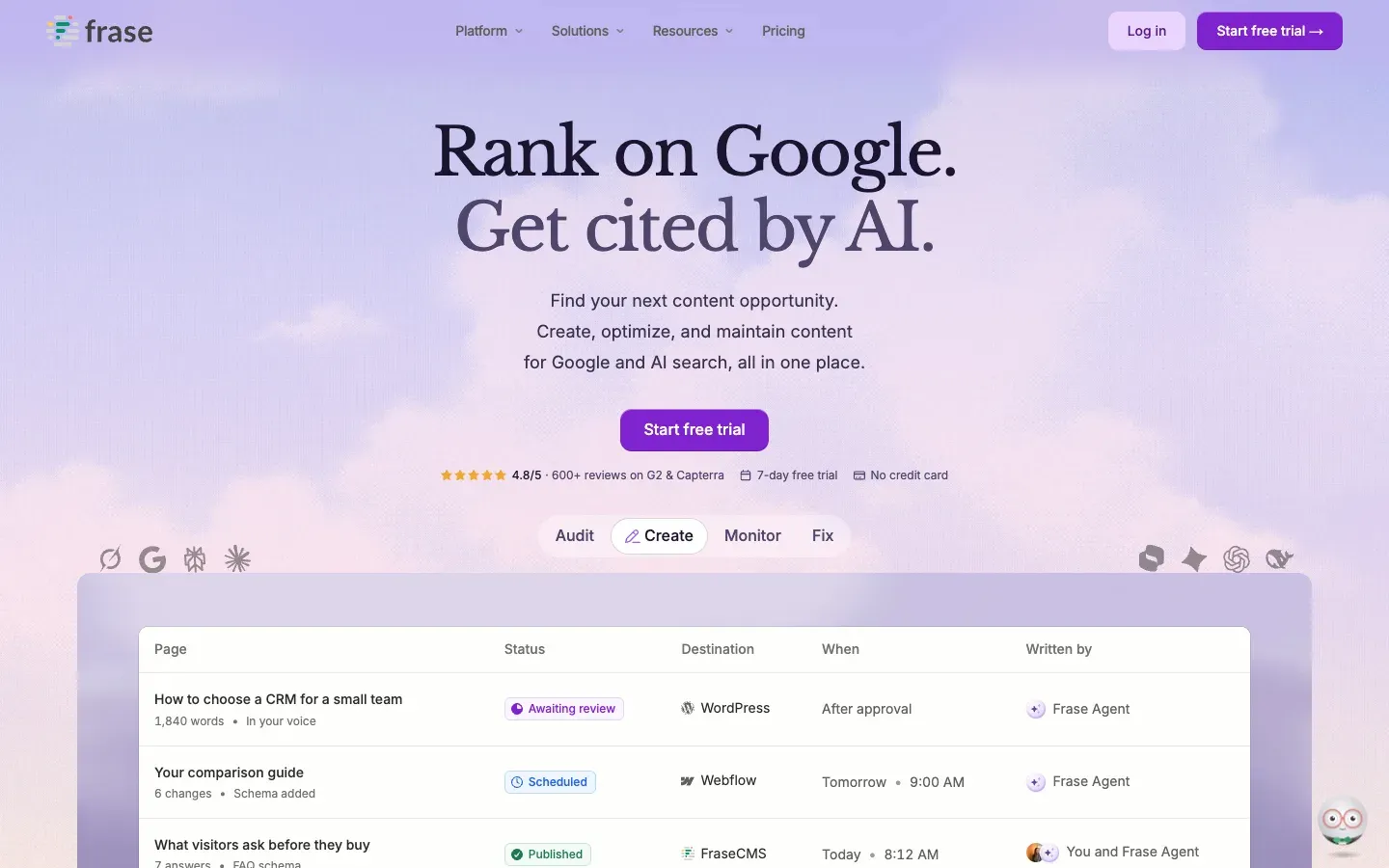
The product works as a loop. The agent audits your site and scores each page out of 100 for search and AI readiness, then ranks fixes and opportunities (content decay, competitor gaps, missing topics). It drafts content in a brand voice learned from your site or set in a Brand Hub, scores the draft for SEO and GEO, publishes it to your CMS once you approve, and then monitors rankings and AI mentions. When a page slips, Content Guard drafts a revision.
The early Frase features are still there: research from the top-ranking pages, the questions people ask, and briefs that turn this into an outline. What changed is the amount of work the agent can do on its own, and the shift from Google alone to Google plus AI engines.
02How we look at Frase at BeBranded
We do not use Frase in-house. Our daily SEO monitoring runs on Google Search Console and Ahrefs, and we write our content ourselves. Frase comes up when clients with a content team ask us which tool to pick, or when we set up an SEO and GEO strategy for them. Our position:
- We recommend Frase to teams that publish regularly and lack a research and briefing routine. The briefs, the GEO score and AI Visibility give writers a shared reference and give managers a way to track results across Google and AI engines.
- We advise against auto-publishing for anything that carries your expertise or your brand. AI drafts read smoothly but stay generic without first-hand examples, data and opinions. Keep approval on and have an expert edit every piece.
- We point elsewhere when the problem is technical (indexing, site structure, speed) or authority (links, mentions). A technical SEO audit or link building will move results more than another content tool.
03Key features
- Site Audit: a score out of 100 per page for search and AI readiness, with a ranked "Fix Pack".
- SEO Research and Topic Clusters: topics mapped against competitors and your existing content.
- Opportunity list: content decay, competitor gaps and programmatic opportunities in one prioritised list.
- AI writer and agent: drafts based on top-ranking pages, in your brand voice, revised from your feedback.
- SEO and GEO scores: content optimisation for Google and for AI answers.
- AI Visibility: mentions, share of voice, position and sentiment in ChatGPT, Google AI, Perplexity, Claude and Gemini depending on the plan.
- Content Guard: weekly check of published pages using Search Console data, with drafted revisions.
- Frase Answers: a free widget on your site that captures visitor questions to suggest new topics.
- Publishing: WordPress, Webflow, Sanity, Wix or FraseCMS, with scheduling and schema.
- MCP server and CLI: drive Frase from Claude, ChatGPT, Codex or Cursor.
04Use cases
Briefing a content team
A content manager needs ten articles a month from freelance writers. Frase builds the brief from the top results and common questions, so every writer starts with the same outline and topic list. The time saving is real, but the brief is a starting point: add your angle, your examples and what your competitors miss.
Refreshing decaying pages
A site with a few hundred articles loses traffic slowly as pages age. Content Guard reads Search Console positions and clicks every week, flags pages that slip and drafts updates. This is one of the most useful parts of Frase, because refreshing existing content is often cheaper than writing new pages.
Tracking brand presence in AI answers
A B2B company wants to know if ChatGPT or Perplexity mention it when buyers ask about its category. AI Visibility tracks prompts you define and reports mentions, share of voice and sentiment. Our guide on tracking your brand in AI search explains how to choose those prompts.
Agencies managing several sites
The Scale plan covers up to 10 domains and 5 seats, with client-ready reports. An SEO agency can run audits, briefs and monitoring for each client from one account. White-label reports and a branded client portal are reserved for Enterprise.
Building FAQ and answer-style content
Frase's question research and Frase Answers widget surface the questions people actually ask. They feed FAQ sections and answer-first paragraphs, which suit both featured snippets and AI answers. Our article on optimising content for AI covers the structure that works.
05Integrations
Frase publishes to WordPress, Webflow, Sanity and Wix, or to FraseCMS, its own hosted or headless CMS that works on your domain. It reads Google Search Console data for Content Guard. Its MCP server and CLI let you run Frase from Claude, ChatGPT, Codex or Cursor, and an API is available with a monthly request quota per plan. FraseCMS is free up to 100,000 page views and 25 GB of bandwidth a month; Basic costs $19 a month ($190 a year) for 250,000 views, and Pro $99 a month ($990 a year) for 1,000,000.
06Frase pricing in 2026
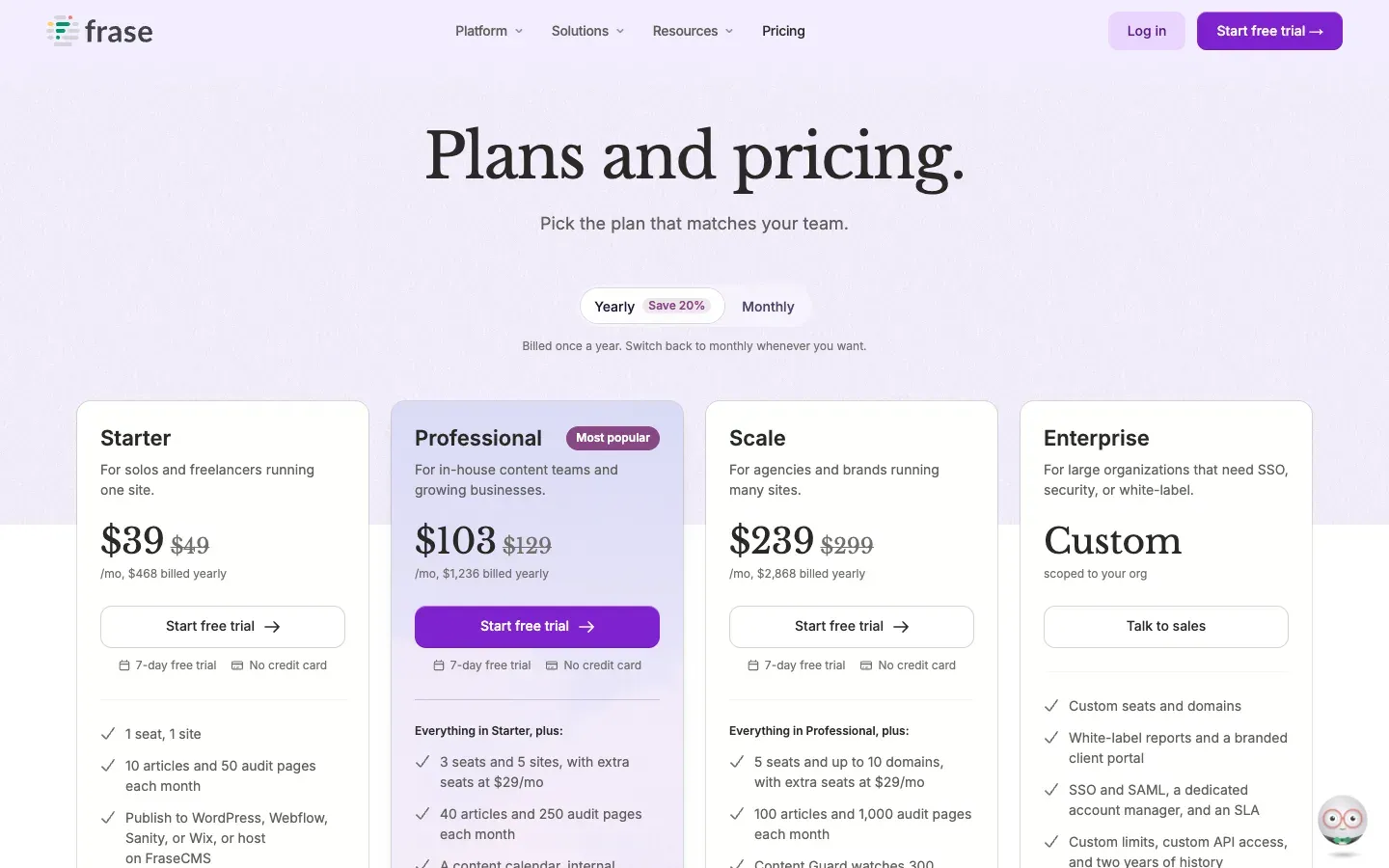
Prices checked on frase.io/pricing on 17 November 2026, in US dollars. The page opens on yearly billing ("Save 20%") and shows the monthly price struck through; it does not mention taxes.
| Plan | |||||
|---|---|---|---|---|---|
| Starter | Billed yearly $39 a month ($468 a year) | Billed monthly $49 a month | Seats and sites 1 seat, 1 site | Volume per month 10 articles, 50 audit pages, 25 AI generations | AI Visibility 20 prompts, ChatGPT and Google AI |
| Professional | Billed yearly $103 a month ($1,236 a year) | Billed monthly $129 a month | Seats and sites 3 seats, 5 sites | Volume per month 40 articles, 250 audit pages, 100 AI generations | AI Visibility 50 prompts, adds Perplexity |
| Scale | Billed yearly $239 a month ($2,868 a year) | Billed monthly $299 a month | Seats and sites 5 seats, up to 10 domains | Volume per month 100 articles, 1,000 audit pages, 350 AI generations | AI Visibility 75 prompts, adds Claude and Gemini |
| Enterprise | Billed yearly On quote | Billed monthly On quote | Seats and sites Custom | Volume per month Custom | AI Visibility Adds Grok, Copilot and DeepSeek |
Starter stops at its monthly limits with no overage. On Professional and Scale, pay-as-you-go is optional and off by default: $5 per extra article, $0.50 per audit page and $0.25 per AI prompt on Professional; $4, $0.40 and $0.20 on Scale. Extra seats cost $29 a month. History is kept for 3 months on Professional, 12 on Scale and 24 on Enterprise. SSO, white-label reports and a client portal are Enterprise only.
Is Frase free? No. There is a 7-day free trial with no credit card, with Professional features but capped at 5 articles, 50 audit pages, 25 AI prompts and 3 seats. After that, the cheapest option is Starter at $39 a month billed yearly or $49 month to month.
07Pros and cons
Advantages
- One workflow from audit to publishing to monitoring, instead of three tools.
- Content Guard turns Search Console data into a list of pages to refresh.
- AI Visibility tracks brand mentions in several AI engines.
- Direct publishing to WordPress, Webflow, Sanity and Wix.
- MCP server and CLI on every plan, useful for teams working with AI assistants.
- Starter holds at its limits, so no surprise bill.
Drawbacks
- No permanent free plan, and the trial is short.
- AI drafts need substantial editing to carry real expertise.
- Low volumes on Starter: 10 articles and 50 audit pages a month.
- AI Visibility coverage depends on the plan; Claude and Gemini require Scale.
- Prices in dollars only, with no tax information on the page.
08Our verdict
Who it's for
- Content teams that publish several articles a month and need consistent briefs.
- SEO freelancers and agencies managing a handful of sites.
- B2B marketers who want to measure presence in AI answers.
- Teams with large archives that need a refresh routine.
Who it's not for
- Occasional bloggers who publish a few times a year.
- Companies looking for a full SEO suite with backlink and keyword databases.
- Teams expecting AI to replace subject-matter experts.
- Sites whose main issues are technical or authority-related.
09Frase alternatives
| Tool | ||
|---|---|---|
| Frase | Best for Agent-driven content workflow for SEO and GEO | Main difference Audit, write, publish and monitor in one loop |
| Surfer SEO | Best for On-page optimisation in a content editor | Main difference Editor-first, strong scoring |
| Clearscope | Best for Content grading for editorial teams | Main difference Simple, focused on content quality |
| Semrush | Best for Full SEO suite with content tools | Main difference Keyword, backlink and competitor data |
| Ahrefs | Best for Keyword and backlink research | Main difference Data depth, less writing help |
| AlsoAsked | Best for Question research | Main difference Narrow and cheap |
Our rule: choose Frase if you want one agent to run the content loop and track AI visibility. Choose Surfer SEO or Clearscope if your writers mainly need an optimisation editor, Semrush or Ahrefs if you need market data and backlinks, and AlsoAsked for question research on a budget. For the difference between the two disciplines, read GEO vs SEO.
10Frase vs Surfer SEO
Both started from the same idea: compare your draft with the pages that rank and tell you what is missing. They have since moved apart. Surfer keeps the content editor at the centre, with a detailed optimisation score that writers follow as they type. Frase has built around an agent: it decides what to write from an audit and opportunity list, drafts, publishes to your CMS, and monitors results in Google and AI engines.
If your team already has an editorial process and only wants better on-page optimisation, Surfer fits more naturally. If you lack a process and want the tool to propose, draft and follow up, Frase covers more ground. In both cases, the score is a guide, not a goal: a page that hits every suggested term but says nothing new will not earn links or AI citations.
11Getting started with Frase
- Connect Search Console first, so audits and Content Guard work with real data.
- Run a Site Audit and start with the Fix Pack on pages that already get impressions.
- Set your brand voice in the Brand Hub with real examples of your best content.
- Keep approval on. Let the agent draft, and have an expert add examples, data and opinion before publishing.
- Define 20 to 50 AI Visibility prompts that buyers would actually ask, not just your brand name.
- Review monthly: compare Search Console clicks and AI mentions before adding volume. If you need a hand, our on-page SEO and GEO and AI visibility services can set up the process.