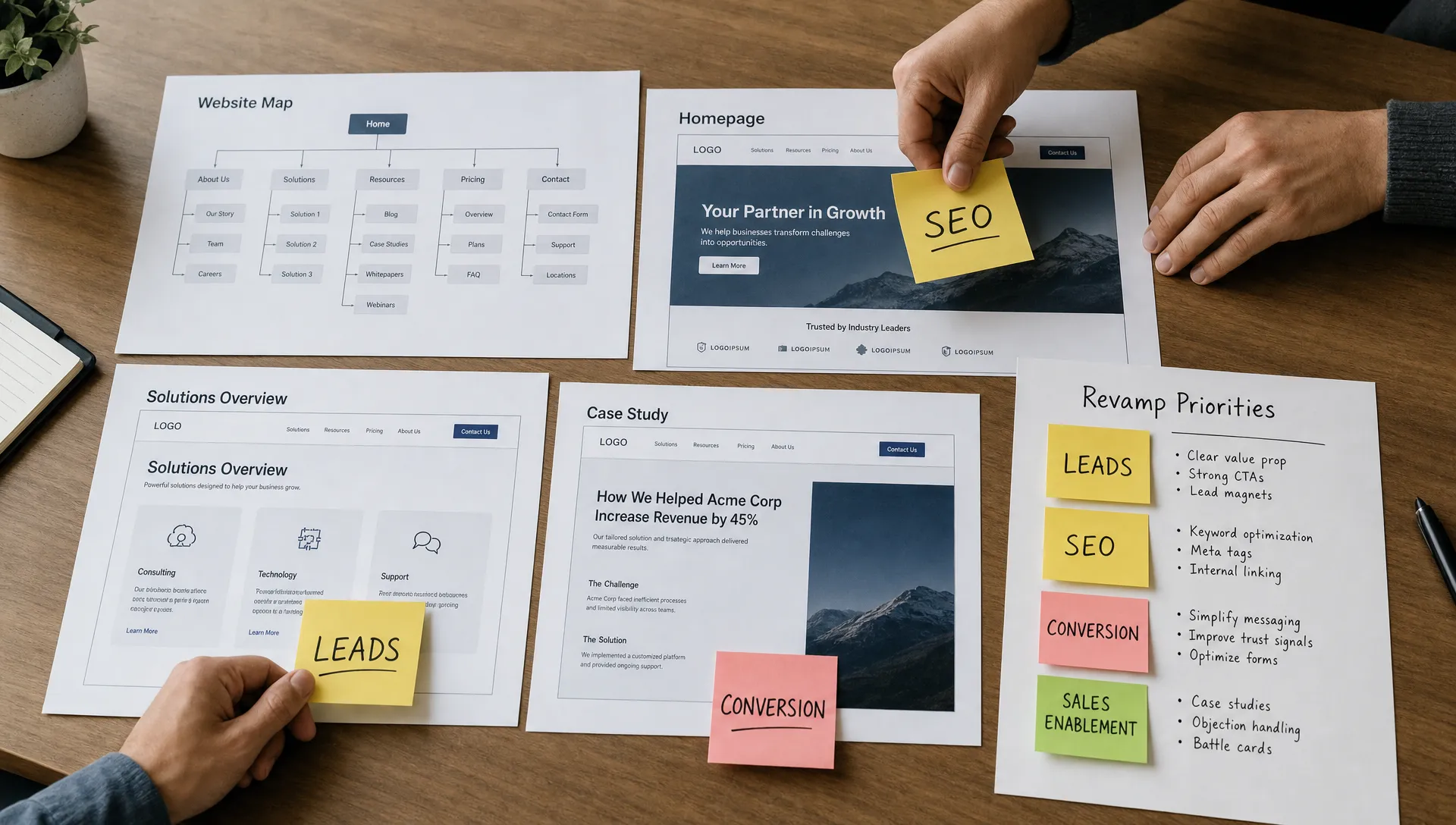
A website revamp often fails when it starts as a design exercise. The new site may look cleaner, but if it does not improve lead quality, sales conversations, SEO performance, or marketing execution, the project has not solved the right problem.
Planning around business outcomes means defining what the website must change in buyer behavior and internal operations before deciding what to redesign. This article gives you a practical framework to scope a website revamp, avoid common mistakes, and launch with a clear measurement plan.
What a website revamp should mean for a business
A website revamp is a focused improvement of an existing website’s structure, content, design, and technical setup so it supports current business goals.
It does not always mean rebuilding every page. Sometimes the right move is to improve core service pages, rewrite positioning, simplify conversion paths, and fix technical SEO. In other cases, the site architecture, CMS, brand system, and development approach are too limiting, so a full rebuild becomes more practical.
The key is to separate visual dissatisfaction from business friction. “The site looks outdated” is a useful signal, but it is not a business outcome. “The site does not explain our offer clearly enough for enterprise buyers” is a clearer planning input.
The vocabulary matters less than the scope. Revamp, redesign, and rebuild are often used interchangeably, which makes quotes hard to compare. The table below sets a working definition for each.
Approach
What actually changes
Typical trigger
When it is the right call
Revamp
Messaging, key page structures, conversion paths, technical SEO fixes
The current setup prevents the team from shipping at all
A good revamp should answer three questions before design starts: who must take action, what they need to understand, and what the business wants to improve.
Start with business outcomes before scope
Most teams move too quickly from “we need a new website” to pages, layouts, and visual references.
Before choosing a CMS, hiring an agency, or writing a sitemap, define the business outcome the revamp must support. Keep the list short. A website cannot fix every go-to-market issue at once, and a broad objective usually creates a vague project.
Common business outcomes for a website revamp include:
Increase qualified inbound leads: The website should attract and convert visitors who match your ideal customer profile, not just generate more form submissions.
Improve sales enablement: The site should help prospects understand your offer, pricing logic, proof points, and differentiation before a sales call.
Support a repositioning: The site should reflect a clearer category, audience, value proposition, or shift in company maturity.
Improve organic acquisition: The site should protect existing rankings, fix technical SEO issues, and create a stronger content structure for future growth.
Reduce marketing dependency on developers: The CMS should let the marketing team publish pages, update content, and manage campaigns without bottlenecks.
An outcome only becomes actionable once it is tied to a visitor behavior and a metric you can read after launch. Use this mapping to pressure-test your own list.
Business outcome
Behavior that must change
What to measure after launch
More qualified inbound leads
Fit-matching visitors self-identify and complete the right form
Share of leads accepted by sales, not raw form volume
Better sales enablement
Prospects read pricing logic and proof before the first call
Fewer basic questions in first calls, shorter qualification
Support a repositioning
Visitors describe the offer the way you intend it
Message testing, sales feedback, engagement on positioning pages
Improve organic acquisition
Search visitors land on a page that matches their intent
Rankings held through migration, impressions and clicks by page
Less marketing dependency on devs
Marketers publish and edit without opening a ticket
Time to publish a landing page, number of dev requests
Choose one primary outcome and two supporting outcomes. If everything has the same priority, the project will be harder to scope, harder to review, and harder to measure.
A practical rule is to write the outcome as a sentence: “This website revamp should help us convert more mid-market demo requests by making the offer clearer, improving proof, and reducing friction on key pages.”
Use an outcome-first planning framework
Use a simple framework to translate business priorities into website decisions.
The outcome-first framework has five steps. It keeps the project grounded in measurable business value rather than subjective design preferences.
Define the business outcome: Start with the commercial or operational result you want to influence. This can be better lead quality, clearer positioning, more organic visibility, faster campaign launches, or stronger trust for a specific buyer segment.
Identify the audience behavior that must change: A website cannot directly create revenue, but it can influence actions that contribute to revenue. Examples include booking a call, requesting a quote, downloading a comparison guide, visiting a pricing page, or reading proof before contacting sales.
Map the buyer journey: Identify what each visitor needs at each stage. Early visitors need clarity. Evaluating buyers need detail, proof, and risk reduction. Sales-ready buyers need a clear path to action.
Translate the journey into page requirements: Decide which pages must exist, what each page must communicate, and what action each page should support. This prevents the sitemap from becoming a list of internal departments.
Define measurement and ownership: Decide what you will track before launch and who owns updates after launch. A revamp without measurement becomes a visual project, not a performance project.
If your revamp is closer to a full redesign, it can help to compare this planning step with a broader website redesign process so you understand where strategy, design, development, SEO, and launch planning connect.
Build the revamp brief around decisions, not preferences
A useful website brief should reduce ambiguity for everyone involved.
Many briefs include visual inspiration, competitor links, and a rough sitemap. Those inputs can help, but they are not enough. A strong brief explains the decisions already made and the decisions the project must resolve.
Your revamp brief should answer these questions:
What business outcome are we prioritizing? State the primary outcome clearly, then explain why it matters now.
Who are we designing for? Define the main audience segments, their level of awareness, and the objections they bring to the site.
What is not working today? Separate symptoms from causes. Low conversions may come from unclear messaging, weak proof, poor page hierarchy, slow performance, or the wrong traffic.
Which pages are critical? Identify the pages that influence acquisition, conversion, sales enablement, and retention.
What must the marketing team be able to edit? Clarify CMS needs before development, especially for landing pages, blog content, case studies, resources, and service pages.
What are the constraints? Include deadlines, brand limits, technical systems, SEO risks, CRM integrations, analytics requirements, and internal approval processes.
For growing teams, this is often where priorities become clearer. The question is not just “what should the site look like?” but “what should marketing and sales be able to do with it after launch?” That distinction is also central to website design and development priorities for teams that need a site to scale with them.
Decide what to keep, improve, and remove
A website revamp should not treat the current site as either fully broken or fully reusable.
Before creating new wireframes, audit the existing site through four lenses: performance, content, SEO, and operations. This gives you a clearer view of what deserves investment and what can be removed.
Performance audit: Look at conversion paths, form friction, mobile usability, page speed, analytics setup, and the behavior of key traffic sources. The goal is to find where users hesitate or drop off.
Content audit: Review whether pages explain the offer clearly, address buyer objections, show credible proof, and guide visitors toward the next step. Keep content that supports decisions. Remove content that exists only because it was once published.
SEO and URL audit: Identify pages with search visibility, backlinks, organic traffic, or ranking potential. If URLs will change, redirect planning must happen before launch. Google’s guidance on site moves with URL changes is a useful reference for avoiding avoidable search visibility issues.
Operations audit: Review how easy it is for the team to update content, create landing pages, manage CMS collections, publish resources, and maintain consistency without relying on developers for every change.
Each lens produces a different kind of decision. Running them separately keeps the audit from collapsing into a single subjective verdict on the current site.
Audit lens
What to look at
Red flag
Decision it informs
Performance
Conversion paths, form friction, mobile usability, page speed
This step protects you from two costly decisions: rebuilding pages that already work, and keeping pages that no longer support the business.
Turn outcomes into page-level requirements
A business outcome becomes useful when it changes what each page is expected to do.
Do not define pages only by type, such as homepage, services, about, blog, and contact. Define the role of each page in the buyer journey. A homepage may need to clarify positioning. A service page may need to reduce sales objections. A case study may need to prove delivery capability for a specific segment.
For each priority page, define the following:
Primary audience: Who is this page for, and what do they already know when they arrive?
Main question: What question should the page answer better than the current version?
Required proof: What evidence is needed to make the claim credible?
Primary action: What should a qualified visitor do next?
SEO role: Should the page target search demand, support internal linking, or mainly serve conversion and sales enablement?
This is where strategy becomes concrete. If the goal is better qualified leads, the page needs stronger messaging, clearer qualification signals, and proof that helps the right buyers recognize themselves. If the goal is organic growth, the page also needs search intent alignment, internal linking, metadata, and a content structure that search engines can understand.
Plan conversion, SEO, and performance together
Conversion, SEO, and technical performance should not be handled as separate workstreams at the end of the project.
A conversion-focused page still needs crawlable structure, clear headings, useful copy, and fast loading. An SEO page still needs to help visitors decide what to do next. A visually polished site still needs responsive layouts, clean CMS structures, analytics, and reliable forms.
Plan these disciplines together from the beginning:
Conversion planning: Define page hierarchy, calls to action, proof placement, form structure, and next-step logic before final design.
SEO planning: Map keywords to pages only where search intent is relevant. Protect existing URLs, plan redirects, optimize metadata, and make sure important content is indexable.
Performance planning: Keep page speed, image handling, scripts, responsive behavior, and accessibility in scope during design and development.
If you are comparing what belongs in the project, focus on services that directly affect outcomes. Strategy, UX, content planning, technical SEO, responsive development, CMS setup, and analytics are more useful than cosmetic changes in isolation. This is the same logic behind evaluating web design services that improve conversion and SEO.
Common mistakes to avoid during a website revamp
The most common website revamp mistakes happen before development starts.
They usually come from unclear goals, weak ownership, or treating the website as a design asset instead of a business system.
Starting with visual references instead of outcomes: References can guide style, but they cannot define strategy. Start with what the site needs to achieve, then use references to inform execution.
Trying to satisfy every stakeholder equally: A revamp needs input, but not every preference should carry the same weight. Assign decision owners before design reviews begin.
Rewriting copy after design is approved: Copy affects layout, hierarchy, messaging, and conversion. Treat it as a design input, not a final layer.
Changing URLs without an SEO plan: URL changes can be necessary, but they require redirects, internal link updates, sitemap updates, and launch checks.
Keeping legacy pages without a purpose: Old pages can dilute navigation, confuse visitors, and create maintenance work. Keep pages because they serve a role, not because they exist.
Ignoring the CMS experience: A site that looks good but is hard to update will slow down marketing. CMS structure is part of the revamp scope.
Launching without baseline metrics: If you do not know current traffic, conversion paths, form performance, rankings, and page speed, post-launch evaluation becomes guesswork.
Measuring only traffic after launch: Traffic matters, but it does not show the full picture. Track qualified actions, engagement on priority pages, organic visibility, and marketing team usability.
Avoiding these mistakes will not make the project effortless, but it will make decisions clearer and reduce rework.
Actionable checklist before you start
Use this checklist before briefing an internal team, freelancer, or agency.
It is designed to confirm that the revamp is tied to business outcomes before execution begins.
Define the primary business outcome in one sentence.
Choose two supporting outcomes, not ten.
Identify the main audience segments and their buying stage.
Review current analytics, conversion paths, traffic sources, and form performance.
List the pages that influence acquisition, sales, trust, or retention.
Mark each priority page as keep, improve, merge, or remove.
Identify current pages with SEO value before changing URLs.
Document key buyer objections and proof points.
Define what the marketing team must be able to edit after launch.
Confirm required integrations, such as CRM, forms, analytics, scheduling, or automation tools.
Set decision owners for strategy, copy, design, development, and launch approval.
Define launch success criteria and a post-launch review date.
A checklist does not replace strategy. It makes sure the right strategic questions have been answered before money, time, and internal attention move into production.
How to choose the right revamp scope
The right scope depends on the gap between your current website and the business outcome you want.
A smaller scope can work when positioning is stable, the CMS is usable, and core pages only need stronger messaging, design refinement, or conversion improvements. This is often enough for teams that need a sharper site quickly without changing the underlying system.
A focused revamp is appropriate when the site needs new page structures, improved content architecture, stronger SEO foundations, better CMS collections, and clearer conversion paths. This is the common middle ground for B2B teams whose offer has evolved faster than their website.
A full rebuild makes sense when the current website blocks execution. Signs include poor CMS flexibility, weak technical foundations, inconsistent design systems, slow performance, unclear architecture, or a brand and positioning shift that affects the whole experience.
The decision should not be based only on budget. It should be based on what level of change is required to support the outcome without creating avoidable technical or content debt.
How long a website revamp takes
Timelines vary with scope, decision speed, and how ready the content is. What matters more than a fixed calendar is how effort is distributed across the project.
The breakdown below reflects a typical outcome-driven revamp. Use it to spot the phases teams usually underestimate.
Phase
What happens
Share of the project
Most common blocker
Discovery and outcomes
Goals, audience, audit of the current site, success criteria
10-15%
Decision makers unavailable for interviews
Content and messaging
Positioning, page narratives, proof, copy for priority pages
20-30%
Copy treated as a final layer instead of a design input
Design
Wireframes, visual system, responsive states for key templates
Two phases are underestimated most often: content, because it is treated as a final layer, and redirects, because they are treated as a launch-day task. Both are cheaper to handle early.
What success should look like after launch
A website revamp is not finished the day the site goes live.
The launch gives you a new baseline. The first phase is about checking that forms work, redirects are correct, analytics are tracking, priority pages are indexable, and the site performs properly across devices.
After that, review whether visitors are moving through the site as expected. Look at key page engagement, form quality, calls booked, organic landing pages, and sales feedback. If sales teams are still answering basic questions that the website should cover, content gaps remain.
Reviewing at fixed intervals keeps the evaluation honest, because different signals stabilize at different speeds.
When
What to check
Signal that it worked
Launch week
Forms, redirects, analytics events, indexability, mobile rendering
No broken paths, no lost URLs, tracking firing correctly
First 30 days
Engagement on priority pages, form completion, sales feedback
Organic visibility, rankings on migrated URLs, lead quality
Search performance recovered and trending up
Ongoing
Time to publish a page, volume of dev requests from marketing
The team ships campaigns without a development project
The later phase is about iteration. A good revamp gives the team a better foundation for campaigns, landing pages, SEO content, case studies, and positioning updates. If every improvement still requires a development project, the operational outcome has not been met.
Conclusion: make the next decision smaller
A website revamp becomes easier to plan when you stop asking “what should we redesign?” and start asking “what business outcome must the website support?”
Define the outcome, map the buyer journey, audit what exists, and translate the strategy into page-level requirements. From there, design and development decisions become clearer because they are tied to a business reason.
If you want an external view on what to keep, improve, or rebuild, start with a focused website strategy review with BeBranded.
A website revamp is needed when the current site no longer supports business goals, buyer expectations, marketing execution, or search performance. Common signs include unclear messaging, weak conversions, poor mobile experience, slow updates, outdated positioning, or technical SEO issues.
What is the difference between a website revamp and a website redesign?
A website revamp is usually a focused improvement of an existing site, while a redesign often implies a broader change to structure, visuals, content, and development. In practice, the difference depends on scope. The important point is to define the business outcome before choosing the label.
How long should planning take before a website revamp starts?
Planning should be long enough to define outcomes, audit current performance, clarify page priorities, and agree on ownership. For a focused project, this can often be done efficiently if decision makers are available and existing data is accessible.
Should SEO be handled before or after the revamp?
SEO should be included before design and development decisions are finalized. URL structure, page hierarchy, content priorities, metadata, redirects, internal links, and indexability all affect whether the new site protects and improves search performance.
What should be measured after a website revamp?
Track the metrics connected to your original outcome. This may include qualified leads, conversion rate on priority pages, organic visibility, engagement with key content, form completion, page speed, and feedback from sales or marketing teams.
Can a website revamp improve conversion without increasing traffic?
Yes. If the same traffic understands the offer faster, sees stronger proof, and encounters less friction, conversion quality can improve. Traffic growth and conversion improvement are related, but they are not the same objective.
Here you can find articles on No-Code tools, tips and tricks, and case studies for specific business sectors. We post regularly to help you get the most out of your next project.