
The essentials · 30-second read
Portfolios on web design agency websites show visual judgment; you need inspectable evidence to judge delivery.
- Score every relevant project on five dimensions: relevance, contribution, execution, outcomes and handover.
- Confirm what the agency actually delivered, and whether the live site still reflects that work.
- Test a real customer journey on desktop, phone and keyboard; quick checks reveal issues but do not prove conformance.
- Read PageSpeed Insights lab and field data separately; missing field data is not proof of poor performance.
- Turn each portfolio strength into a written proposal commitment covering deliverables, ownership, testing and support.
Summarize this article with AI
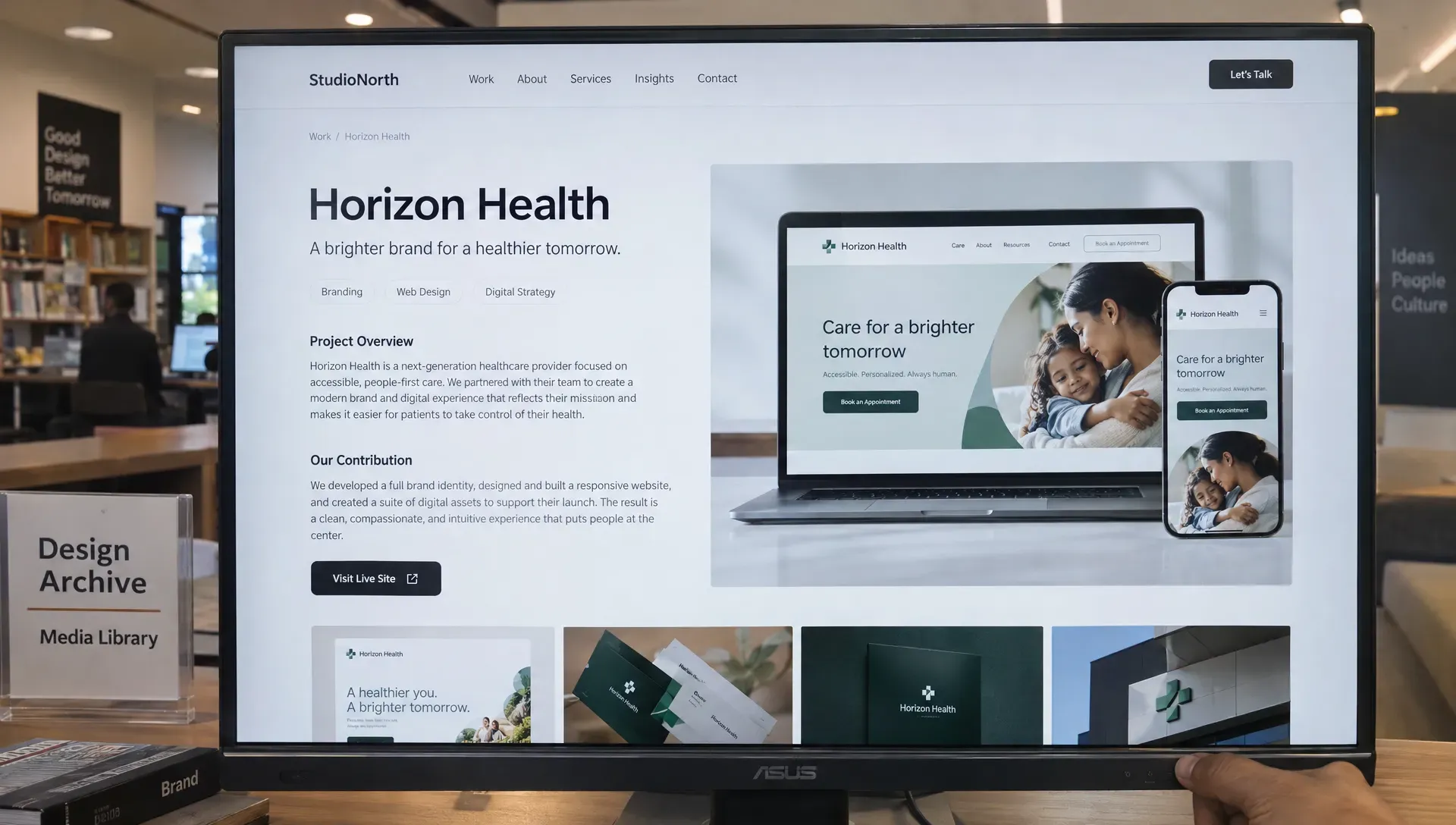
To assess portfolios on web design agency websites, check five things for each relevant project: whether it resembles your problem, what the agency actually delivered, how the live site works, what supports any reported result and whether your team could run the site after handover. Screenshots show visual judgment; only inspectable evidence shows delivery capability.
A polished homepage can make very different agencies look equally capable. It does not tell you who built the site, whether visitors can use it or what the client can update after launch. For founders, CMOs and marketing managers, the practical challenge is separating presentation quality from delivery capability.
This guide gives a repeatable way to inspect portfolios, verify case studies and record gaps before you request proposals. The goal is not a full technical audit, nor rewarding whichever agency publishes the most detail. It is a defensible shortlist, with a clear list of what each agency still needs to demonstrate.
What web design agency websites can actually prove
A portfolio is a collection of selected work, not a complete record of delivery quality. Each format proves something different, so do not treat them as interchangeable.
| Evidence format | What it can show | What it cannot show |
|---|---|---|
| Screenshot or mockup | Composition, typography, visual hierarchy | Whether the site was built, launched or used |
| Live website | Navigation, responsive behavior, customer journeys, speed | Who built it, and what changed after launch |
| Detailed case study | The brief, the agency's stated contribution, the reported outcome | Whether the outcome was measured consistently |
| Client reference or walkthrough | How the project ran, what happened after launch | How the agency handles projects unlike that one |
Start with two or three projects that resemble your operational problem. A B2B company might prioritize clear service pages, lead qualification and a manageable resource library. A business entering new markets might need localization, reusable landing pages and a content model that supports expansion. Similar colors or an identical industry label matter less than comparable complexity.
Write down your requirements before browsing: the primary visitor action, the important page types and who will maintain the site. Your company's growth stage can help define those requirements, but the portfolio assessment should stay focused on the work you can inspect.
Use a repeatable evidence framework
Apply the same five checks to every agency you review, and record evidence rather than general impressions. The framework below is a proposed evaluation method, not an industry certification. Keep a separate note for each project so a strong example does not hide gaps elsewhere.
| Dimension | Evidence to inspect | Decision question |
|---|---|---|
| Relevance | Business brief, audience and page structure | Does this address a problem comparable to ours? |
| Contribution | Named responsibilities, collaborators and launch date | What did this agency actually deliver? |
| Execution | Live journeys, mobile behavior and technical checks | Does the work function beyond the screenshot? |
| Outcomes | Measurement definitions, dates and supporting context | What supports the reported result? |
| Handover | CMS demonstration, ownership terms and support scope | Can our team operate the finished site? |
For each dimension, give a simple evidence status:
- 0: not provided.
- 1: described but unverified.
- 2: supported by an inspectable artifact or a relevant client confirmation.
This measures confidence in the evidence, not the agency's overall competence. Do not let a total score override a non-negotiable requirement: missing accessibility testing or unclear ownership can remain blockers whatever the visual quality. Use the broader criteria for evaluating professional website services when you turn these findings into procurement requirements.
Verify who did the work before judging it
Establish the agency's contribution before giving it credit for a finished website. Case studies may cover strategy, brand identity, design, development or only one part of that work. Ask:
- Which responsibilities belonged to the agency, and which to the client?
- Did specialist partners or freelancers contribute, and on what?
- When did the project launch, and does the current live site still reflect that delivery?
An accurate, narrow attribution is more useful than an impressive project with an unclear scope. A client may have changed its navigation, content or platform since launch. Conversely, an attractive concept may never have been commissioned or built. When the public site no longer reflects the original work, ask for a dated walkthrough or launch documentation.
For shortlisted agencies, request a reference relevant to your project and contact that person with permission. Ask what the agency owned, what caused delays and what happened after launch. Public reviews can reveal recurring themes, but check that they concern comparable work. Confidentiality may limit public detail, so accept private walkthroughs or redacted documentation as alternative evidence.
Test the live site through a real customer task
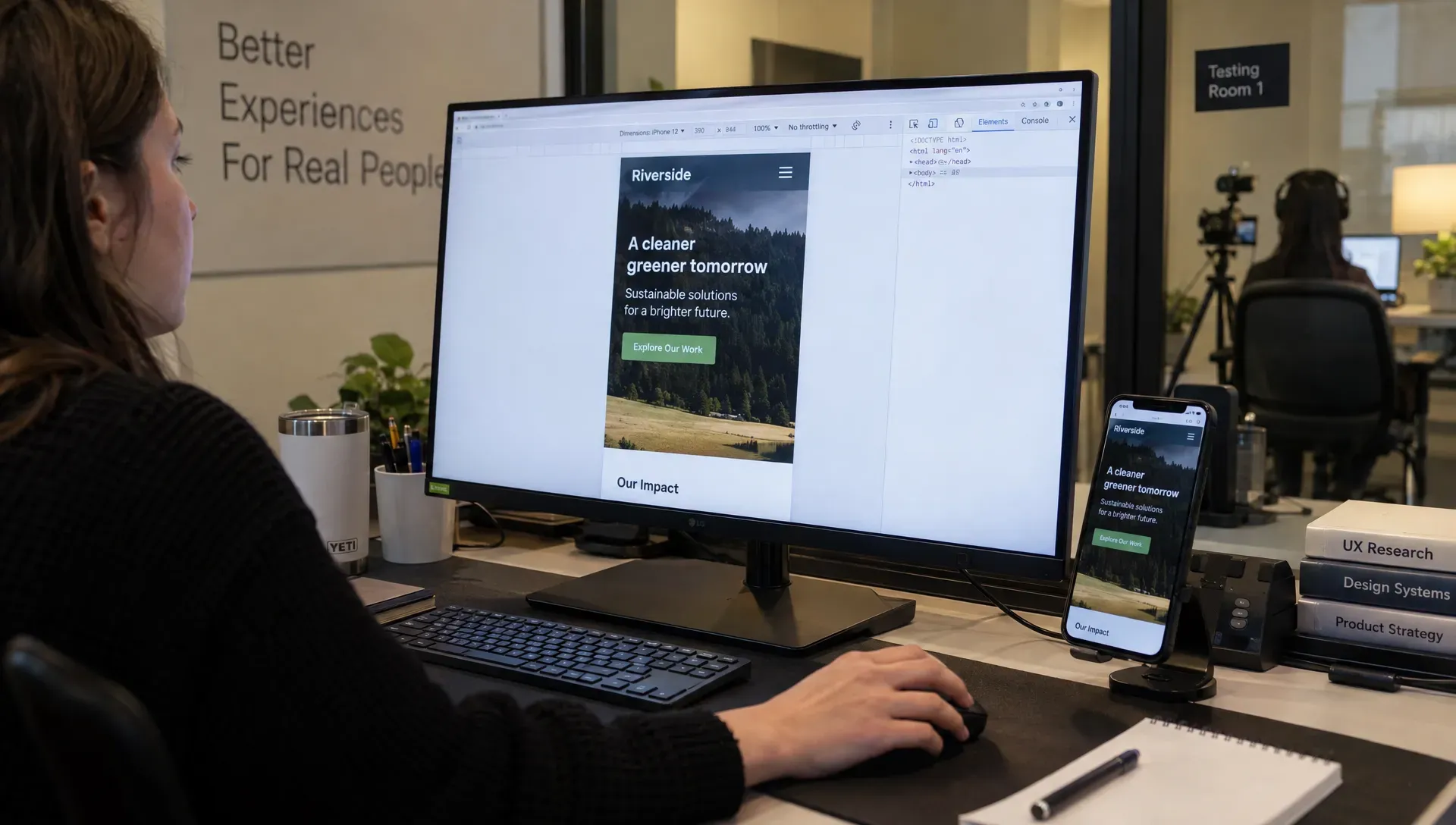
Evaluate the website as a visitor before evaluating it as a design artifact. Choose a realistic journey, such as understanding a service, checking suitability and reaching the inquiry form. Start from an internal page as well as the homepage, and repeat the journey on a phone. Do not submit false inquiries to client websites: stop before submission or ask for a demonstration.
| Quick check | How to run it | Reference |
|---|---|---|
| Keyboard access | Tab through the menu, buttons and form fields; each must be reachable and usable | WCAG 2.2 criterion 2.1.1, Keyboard |
| Visible focus | While tabbing, you should always see which element is selected | WCAG 2.2 criterion 2.4.7, Focus Visible |
| Zoom | Zoom the browser to 200%; content and controls should remain usable | WCAG 2.2 criterion 1.4.4, Resize Text |
| Forms | Check that fields have visible labels and that error messages explain the problem | W3C preliminary accessibility checks |
| Mobile journey | Open menus, tap buttons, dismiss the cookie notice, reach the form | Your own requirements |
The W3C's preliminary accessibility checks are a useful starting point, but the W3C itself warns that a page can seem to pass them yet still have significant barriers. Automated scanners have the same limit: the W3C notes that some accessibility checks cannot be automated. Neither a quick review nor a scan establishes full conformance. Record what you observe without assuming who introduced the problem.
Check performance and maintainability without guessing
Technical quality needs both public testing and a look behind the finished pages.
Performance: read lab and field data separately
Test representative pages from the portfolio in PageSpeed Insights: a content-heavy page and a conversion page, not just the homepage. Google explains that PSI shows two kinds of data: lab data, collected in a controlled environment and useful for debugging, and field data from real users. Field data reflects actual experience; lab data helps explain it.
| Core Web Vital | What it measures | "Good" threshold |
|---|---|---|
| Largest Contentful Paint (LCP) | Loading | 2.5 seconds or less |
| Interaction to Next Paint (INP) | Responsiveness | 200 milliseconds or less |
| Cumulative Layout Shift (CLS) | Visual stability | 0.1 or less |
These thresholds come from Google's Core Web Vitals guidance, measured at the 75th percentile of page loads (see our Core Web Vitals definition). Missing field data is not, by itself, evidence of poor performance: the Chrome UX Report only includes pages and sites that are sufficiently popular and publicly discoverable, so many smaller client sites have none.
Treat a single result as a snapshot. Test conditions, third-party scripts and changes made after launch affect what you observe. Ask the agency to explain significant issues and to separate what it controlled from what the client added later. A reasoned explanation with evidence is more useful than a perfect-score promise or a blanket dismissal of testing tools.
Maintainability: ask for a demonstration
Ask the agency to show, on a real project, how someone:
- adds a CMS item;
- changes a reusable component;
- publishes a new landing page without breaking the layout.
For a Webflow project, examples of well-structured website development help identify what to inspect. No platform, whether Webflow, Framer or a custom stack, guarantees an organized build on its own, so ask for evidence from the implementation rather than relying on the platform logo.
Check whether reported results support the claim
A business result needs a definition, a timeframe and context. Treat outcome claims as statements to investigate, using the questions below.
| Question | Why it matters |
|---|---|
| What counted as a conversion? | A form view, a submission and a qualified lead are very different results. |
| Which dates were compared? | Seasonality can create or hide a change. |
| What is the denominator? | A percentage without its base can hide a very small sample. |
| Did tracking stay the same? | A new analytics setup can change the numbers without changing behavior. |
| What else changed at the same time? | Advertising spend, traffic sources, pricing, positioning and sales qualification all influence results. |
A redesign may have contributed without being the only cause. Agencies should be able to separate the observed result from their interpretation of why it happened, even when they cannot establish direct causation.
Where commercial confidentiality applies, accept anonymized reports or a client-confirmed account with appropriate limits. If outcome data is unavailable, assess the stated objectives and the delivered work without inventing a performance conclusion. Record "result not verified" rather than treating an attractive design as proof of revenue impact, and apply the same standard to every shortlisted agency.
Check whether the process fits your internal team
The same agency process can work well for one client and create delays for another. Use a portfolio walkthrough to ask how a completed project moved from brief to launch:
- Who supplied the copy?
- Who approved the structure?
- How were conflicting stakeholder comments resolved?
- Which project artifacts exist: a content inventory, an approval record, a handover guide?
"Collaborative process" is not a sufficient answer on its own. Then map those responsibilities onto your own team. If marketing has limited time, a portfolio built around extensive client-produced content may reflect a delivery model you cannot support. Clarify who will make decisions, consolidate feedback and provide access to analytics, domains and existing systems. A schedule should reflect those dependencies, not just the agency's production time.
For a marketing-led B2B project, connect these questions to the requirements for choosing a Webflow design agency. The useful evidence is how the agency handled comparable constraints, including missing content or delayed approvals. "Unlimited revisions" does not replace a clear decision process.
Turn portfolio promises into proposal commitments
Portfolio evidence should shape the scope you buy, not stay separate from it. Before comparing proposals, translate each strength you noticed into an explicit deliverable.
| What impressed you in the portfolio | What to write into the proposal |
|---|---|
| Reusable landing pages | The templates, editable fields and publishing workflow you need |
| Accessibility | The testing scope, the target standard (for example WCAG 2.2 AA) and who fixes issues |
| Fast pages | Which pages are tested, with which tool, and what happens if targets are missed |
| Clean handover | Documentation, training and administrative access at launch |
| Post-launch support | Support period, response expectations and escalation route |
Clarify ownership and access as well. Identify who controls the site account, domain and analytics, which design files are delivered and which assets depend on third-party licenses. Confirm whether paid fonts, stock imagery, plugins or integrations require ongoing subscriptions.
Post-launch terms deserve the same precision: separate defect fixes from content changes, platform maintenance and new feature development. When comparing web design packages beyond page count, attach each important portfolio finding to a written scope item. "Similar to our previous project" is not a substitute for an agreed deliverable.
Avoid mistakes that distort the shortlist
Keep attractive presentation from becoming a shortcut around verification.
- Treating visual polish as business proof. Strong art direction is valuable, but it does not establish lead quality, usability or maintainability. Assess each separately and record which evidence supports your judgment.
- Confusing missing evidence with poor work. Sparse case studies may reflect confidentiality or weak documentation. Ask for an appropriate alternative before rejecting the agency, then decide whether the remaining uncertainty is acceptable.
- Judging only the agency's own website. Its site shows taste and positioning, but client projects reveal how it works within another organization's constraints. Inspect both without assuming they serve the same purpose.
- Ignoring evidence that contradicts the presentation. Broken journeys or unclear attribution need follow-up. Do not excuse an unresolved issue because another project looks persuasive.
Use web design agency websites to identify questions, not to skip them. Separate essential delivery work from presentation extras when deciding which website design services are worth paying for, and keep unresolved risks visible in the shortlist instead of averaging them away.
Use this checklist before requesting a proposal
Create one short evidence record for each shortlisted agency.
- Define relevance. State your primary visitor action, important page types, content requirements and internal constraints. Identify which portfolio projects show comparable work.
- Confirm attribution. Record what the agency designed or built, who else contributed and whether the live site still reflects its delivery.
- Test customer journeys. Inspect representative desktop and mobile routes, navigation and forms without submitting false inquiries.
- Record technical observations. Note the tested URLs, test dates, Core Web Vitals status and accessibility concerns. Distinguish preliminary observations from a completed audit.
- Qualify outcome claims. Capture metric definitions, comparison periods and relevant changes in traffic or marketing activity. Mark unsupported claims as unverified.
- Inspect the handover. Request a CMS demonstration, an access plan and an explanation of documentation, training and ongoing responsibilities.
- Validate the working relationship. Confirm client inputs, approval ownership and a relevant reference where available. Document unresolved process risks.
- Carry evidence into scope. Convert important findings into proposal requirements: deliverables, ownership, testing and support boundaries.
If a critical point remains unclear, specify the evidence that would resolve it and who should provide it. That is more actionable than a vague concern or an unexplained numerical ranking. Bring the same questions to each conversation so the answers remain comparable.
How BeBranded approaches portfolio reviews
BeBranded works in two stages: consulting first, then production. The consulting stage is where we help a team write down the requirements this guide relies on (visitor actions, page types, who maintains the site) and decide which approach fits: a custom build on Next.js and Payload, Webflow when it is the right choice, or AI, app and automation work around the site. We expect to be assessed with the same questions as any other agency: what we delivered on a project, what the client can edit, and who owns the accounts after launch. If you are building a shortlist, our consulting service page explains how that first stage works, or you can contact us with your evidence brief.
Sources
- 1. W3C WAI: Easy Checks, a first review of web accessibility · w3.org/WAI/test-evaluate/preliminary/
- 2. Google PageSpeed Insights · pagespeed.web.dev/
- 3. Google for Developers: About PageSpeed Insights (lab and field data) · developers.google.com/speed/docs/insights/v5/about
- 4. web.dev: Web Vitals and Core Web Vitals thresholds · web.dev/articles/vitals
- 5. Chrome for Developers: CrUX methodology and eligibility · developer.chrome.com/docs/crux/methodology
- 6. W3C: Understanding WCAG 2.2 success criterion 2.1.1, Keyboard · w3.org/WAI/WCAG22/Understanding/keyboard.html
- 7. W3C: Understanding WCAG 2.2 success criterion 2.4.7, Focus Visible · w3.org/WAI/WCAG22/Understanding/focus-visible.html
- 8. W3C: Understanding WCAG 2.2 success criterion 1.4.4, Resize Text · w3.org/WAI/WCAG22/Understanding/resize-text.html
- 9. W3C WAI: Selecting web accessibility evaluation tools · w3.org/WAI/test-evaluate/tools/selecting/