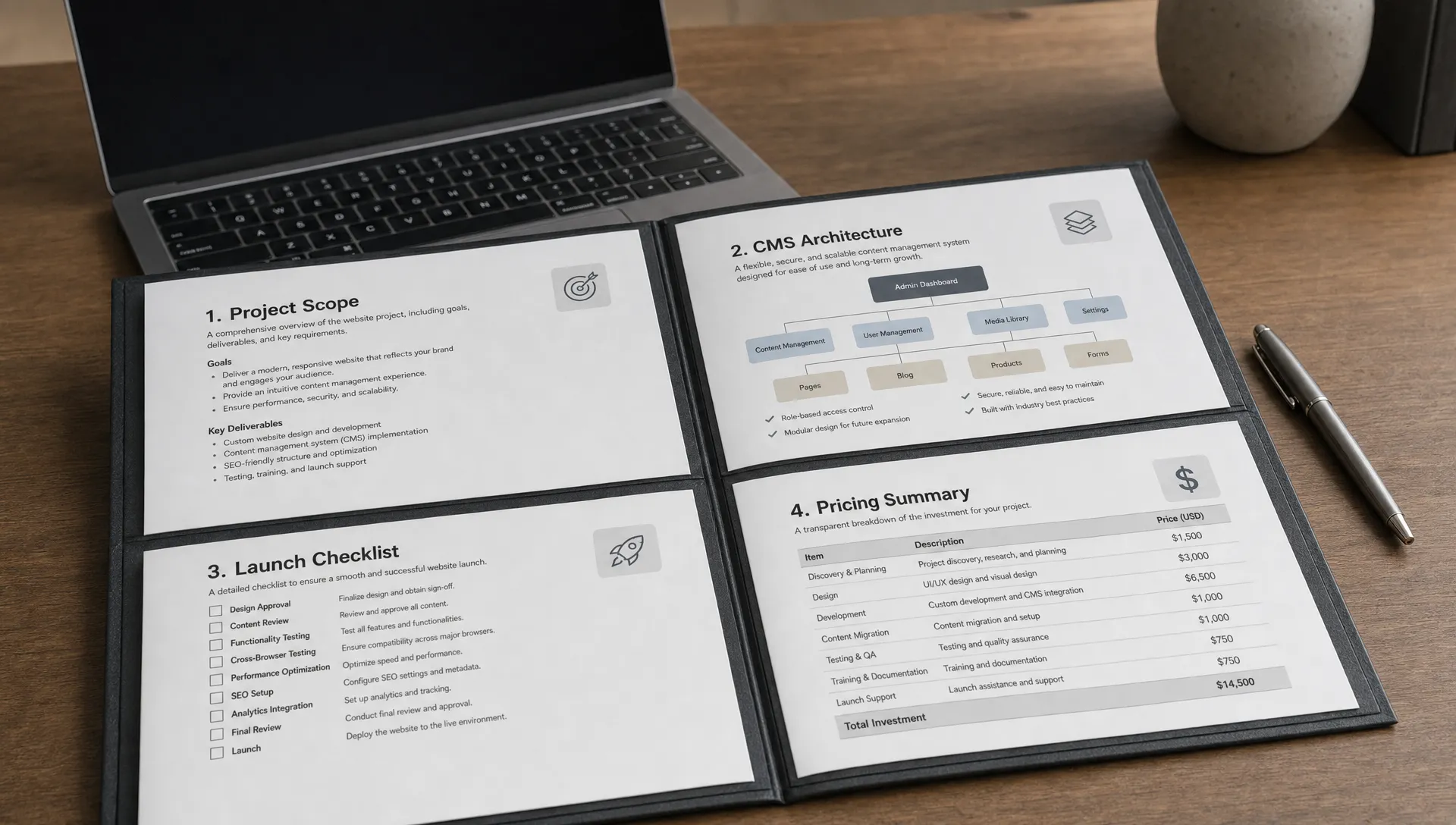
When your website needs an expert, not another template
Development
•
X min
•
Published on
15.09.2026
•
Updated on
10.10.2026
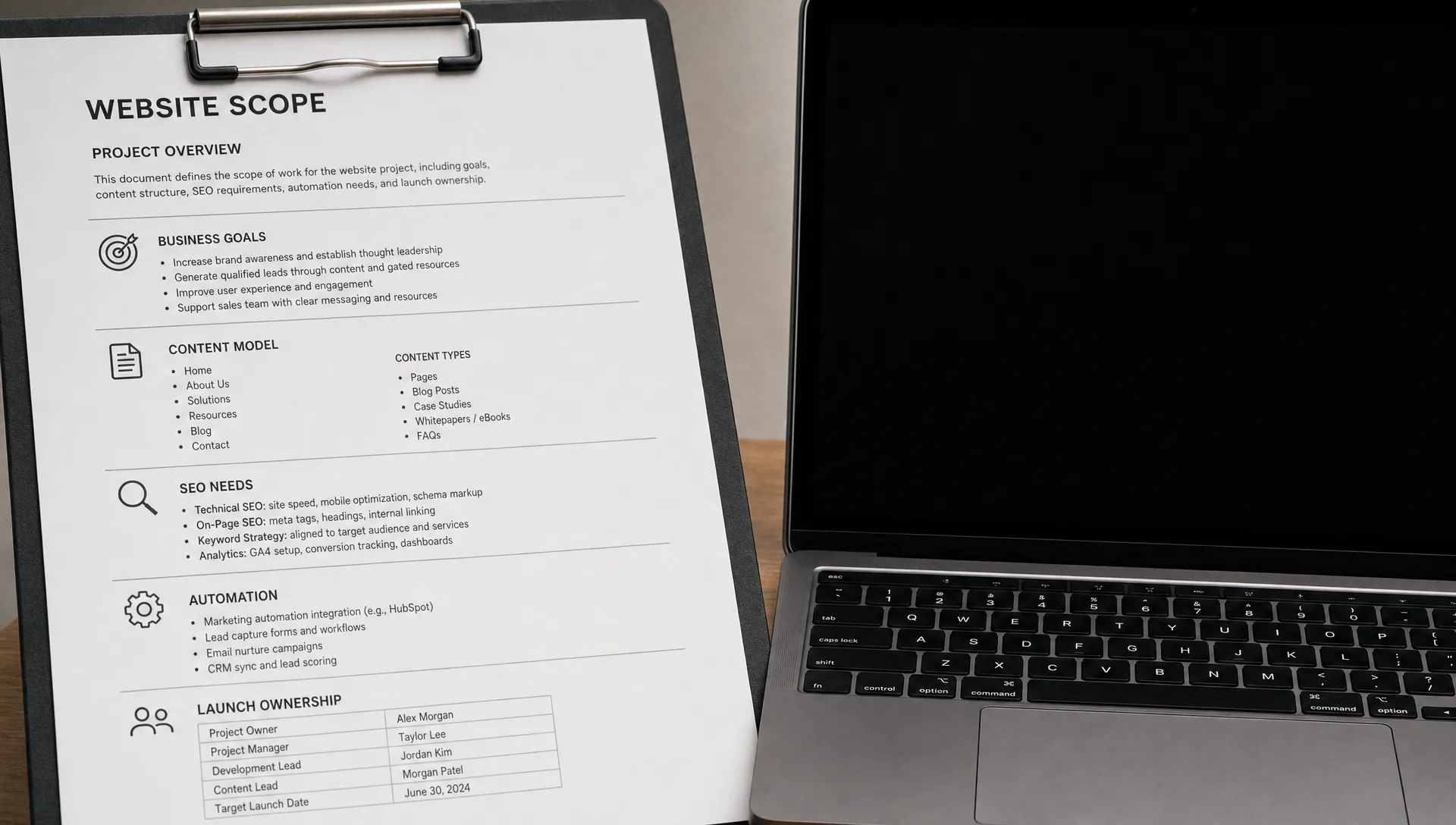
Templates are useful when a website has a narrow job: present a company, publish a few pages and make contact information easy to find. They become a risk when the site must support sales conversations, SEO, CMS workflows, integrations and growth. That is when a website expert is not a luxury, but a way to remove guesswork before the build starts.
This guide gives CEOs, CMOs, founders and marketing managers a practical way to decide whether another template is enough or whether the website now needs deeper judgment. It is not an argument against templates. It is a decision framework for knowing when a template has reached its limit.
A template gives you a starting structure. It does not give you positioning, prioritization, buyer logic or operational decisions.
Most template projects slow down when the team starts bending the template around a business it was not designed for. Navigation becomes a compromise. CMS fields are added without a content model. Landing pages look consistent but do not answer the questions buyers need answered before they convert.
That is why the simplest option can become expensive later. We covered this tradeoff in more detail in why the simplest website builder is not always the best fit, especially for teams that need SEO control, conversion paths, integrations and room to scale.
A website expert is the right call when the website must do more than look finished. It needs to support a commercial process, connect with marketing operations and remain manageable after launch.
In this context, an expert is not only a designer or a developer. The role connects business goals, information architecture, conversion strategy, CMS structure, technical SEO, responsive execution and launch planning. The value is not the tool choice. The value is knowing what decisions need to be made before production starts.
Use this simple framework before you choose a template, hire a freelancer or brief an agency. Score each area from 0 to 2, where 0 means simple, 1 means moderate and 2 means complex.
Add the five scores together to get a total between 0 and 10. The table below shows what each range usually means and what to do next. It is a guide for discussion, not a verdict, so adjust it if one area carries unusual weight in your business.
| Total score | What it usually means | Recommended next step |
|---|---|---|
| 0 to 3 | The site has a narrow job and the stakes are low. | Use a template, keep expectations modest and limit customization. |
| 4 to 6 | The site has real requirements that a template only partly covers. | Adapt the template carefully, or get a short expert review of structure and CMS before building. |
| 7 to 10 | The site is tied to revenue, content volume or integrations. | Involve a website expert before design and development, so the structure is defined first. |
The cost of a poor fit rarely appears as a single invoice. It builds up as extra revisions, slower publishing and pages that nobody trusts enough to promote.
Teams often realize this only when they plan a rebuild. At that point the content, URLs and rankings built on the old structure all have to be migrated, which is more work than defining the structure properly the first time. Deciding earlier is almost always cheaper than rebuilding later.
Templates do not usually fail all at once. They fail through friction that becomes normal inside the team.
The first signal is messaging friction. If every new page requires internal debate because no one knows what the page should say, the issue is not the template. The issue is a lack of website strategy. A useful website is organized around buyer decisions, which is why designing a website around the decisions buyers need to make is often a better starting point than choosing layouts.
The second signal is operational friction. Marketing wants to publish faster, but the CMS is rigid. Sales wants industry pages, but the design system does not support them. Leadership wants clearer reporting, but tracking was added late. A website expert can identify whether these problems come from the platform, the build or the original website architecture.
The third signal is quality drift. Over time, teams duplicate pages, add inconsistent sections and publish content that does not match the original structure. If this is already happening, use what a professional website for business should include as a baseline for what needs to be brought back under control.
An expert-led website project changes the order of decisions. The work starts with clarity, then structure, then execution.
Instead of opening a template library first, the team defines what the website must help users understand, believe and do. This affects navigation, page hierarchy, messaging, proof points, calls to action, CMS collections and SEO requirements. It also reduces subjective design feedback because each section has a job.
The practical value of a website expert is the sequence: strategy before layout, content model before CMS build and launch requirements before handoff. If you are comparing scopes, what website development and design services should include gives a useful view of the work that should be covered beyond visual design.
The table below sets out the order of decisions in an expert-led project. Each stage produces something concrete that the next stage depends on. If a stage is skipped, the problem usually reappears later as rework.
| Stage | Key decision | What you should receive |
|---|---|---|
| Strategy | What the site must help each audience understand, believe and do. | A short brief with goals, audiences and priorities. |
| Structure | Which pages exist, how they connect and what each page is for. | A sitemap and page hierarchy. |
| Content model | Which CMS collections and fields the team will need. | A CMS structure the team can maintain. |
| Design and build | How sections, components and calls to action are applied. | A consistent design system and responsive pages. |
| Launch | What must be verified before going live. | A signed-off launch checklist. |
The expert should also define what happens at launch. That includes redirects, analytics, form testing, metadata, responsive QA and CMS training. For a deeper launch benchmark, review what professional website developers should deliver at launch before signing off on a project.
Launch is where many projects lose quality, because the checks are spread across several people. The table below groups the main checks so that nothing depends on memory. Ask for a named owner on each line.
| Area | What to verify | Typical owner |
|---|---|---|
| Redirects | Old URLs point to the right new pages and no internal link returns an error. | Developer |
| Analytics and tracking | Page views, key events and conversions are recorded correctly. | Marketing and developer |
| Forms | Every form submits, sends a notification and reaches the CRM if connected. | Developer |
| Metadata | Each page has a unique title, description and indexation setting. | Marketing |
| Responsive QA | Layouts, menus and tables work on mobile, tablet and desktop. | Designer and developer |
| CMS training | The team can edit, publish and unpublish content without help. | Agency and client |
| Performance | Images are compressed and pages load quickly on mobile. | Developer |
| Handoff | Access, documentation and maintenance rules are transferred. | Agency |
Use this table to decide whether a template is enough or whether expert support is justified. Read each row against your own situation, and note where the right column describes your site more accurately than the left one.
| Situation | A template is usually enough when | Expert support is needed when |
|---|---|---|
| New company website | You need a simple presence with limited pages and low dependency on organic search. | The site must explain a differentiated offer, support sales and make the company credible quickly. |
| Marketing website redesign | The existing structure works and the main need is visual refresh. | The structure, messaging, conversion paths or CMS no longer match how the business sells. |
| SEO growth | You only need basic metadata and clean page titles. | You need indexable content structures, performance control, redirects and a scalable publishing system. |
| Content-heavy site | You publish a few static pages and rarely update them. | You need reusable CMS collections for articles, resources, case studies, landing pages or multiple markets. |
| Operational integrations | A basic contact form is enough. | The site must connect with CRM, analytics, automation tools or lead qualification workflows. |
This table is not a procurement rule. It is a way to make the decision explicit. A website expert should turn unclear requirements into build decisions, not simply replace one visual template with another custom-looking design.

Most website mistakes happen before development starts. They come from unclear decisions, not from the platform itself.
If your website needs to support a growing team, the broader planning issues are covered in website development in 2026, especially the need to build for maintenance rather than only for launch day.
For a Webflow-specific view of how structure, speed and indexation fit together, the complete guide to SEO on Webflow walks through the technical setup step by step.
Once the site is live, ownership matters as much as design. This website maintenance guide explains what ongoing care should cover so the site does not drift after launch.
Before hiring a website expert, align internally on what the website must achieve and where the current approach is failing.
If you are still at the stage of defining the first step, how to choose the right website starting point can help separate platform decisions from business decisions.
How do I know if I need a website expert instead of a template? You likely need one when the website affects sales, hiring, fundraising, SEO or marketing operations. If the site only needs to present basic information, a template may be enough.
Is a template ever the right choice? Yes. A template can work well for a simple site with few pages, low content complexity and limited integrations. The issue is not the template itself, but using it for a job that requires more strategic decisions.
What should I prepare before speaking to an expert? Prepare your business goal, target audiences, current pain points, required pages, content needs, integrations and examples of websites you think work well.
Can an expert work with Webflow or Framer? Yes. Webflow and Framer can both support professional websites when the structure, content, design system and technical setup are planned correctly.
How much control should my team keep after launch? Your team should be able to edit routine content, publish CMS items and manage core pages without breaking the design system. The right level of control depends on your internal marketing resources.
Does hiring an expert mean rebuilding everything? Not necessarily. An expert can start with a short review of structure, messaging and CMS, then recommend whether to adapt the current site or rebuild parts of it.
A template is a tool. It is useful when the site is simple and the stakes are low. When the website must clarify positioning, support demand generation, scale content and connect with operations, the decision should be based on complexity rather than frustration with the current design.
If your score suggests that a website expert is the right next step, share your current site and goals with BeBranded so the scope can be assessed before you commit to another rebuild.