What website development and SEO services should cover
Development
•
X min
•
Published on
25.08.2026
•
Updated on
19.09.2026
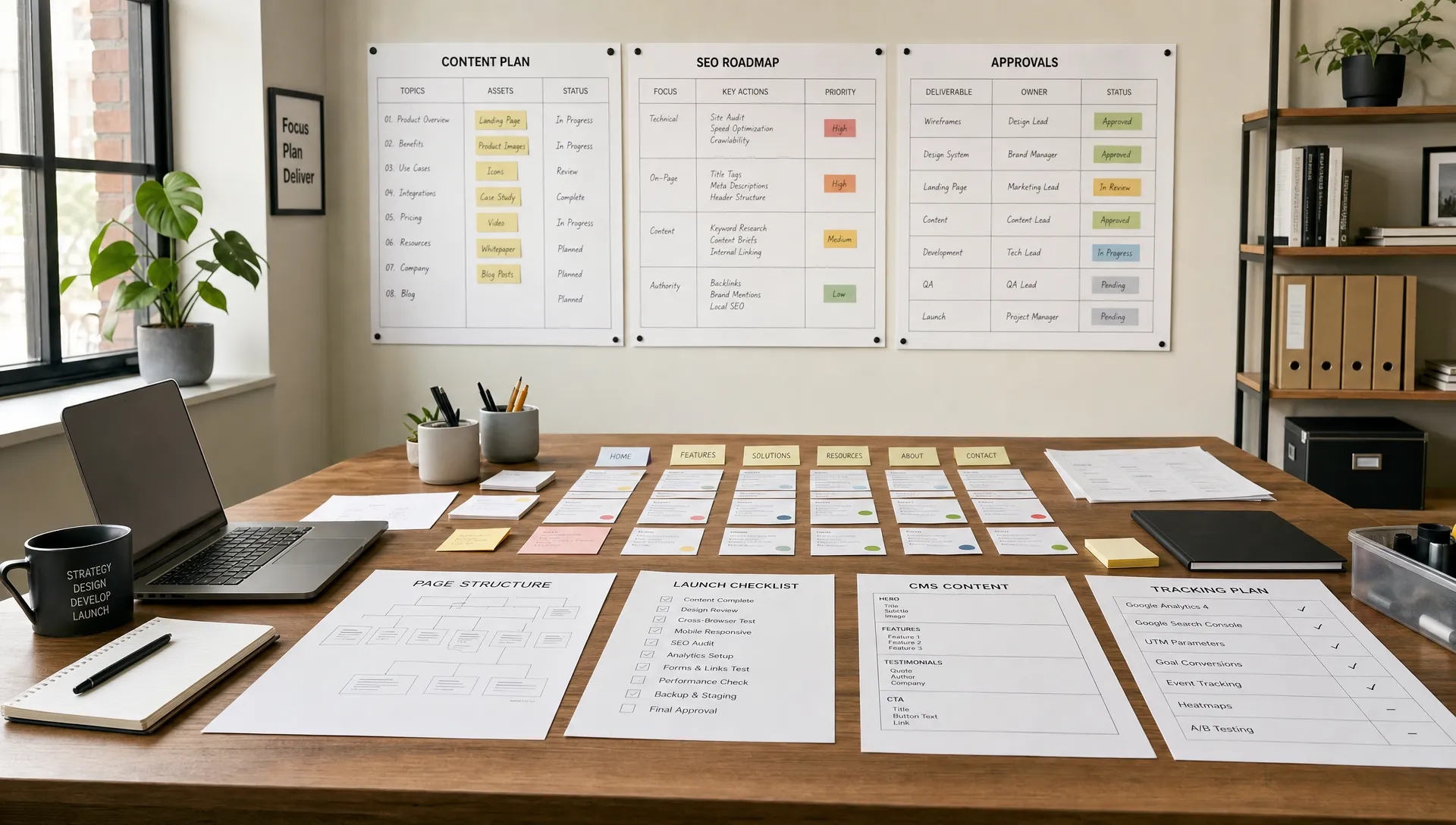
Website development and SEO services should not be treated as separate workstreams. A site can look finished and still be hard to crawl, slow to load, unclear for buyers or difficult for the marketing team to update.
The right scope connects strategy, design, development, content, technical SEO and measurement. This article gives you a practical way to evaluate what should be included before you approve a proposal, brief an agency or rebuild a growth website.
Website development and SEO services are a combined scope that covers how a website is planned, built, structured, optimized and launched so it can attract qualified traffic and convert that traffic into pipeline or revenue.
For a CEO, CMO, founder or marketing manager, the key point is ownership. You are not only buying pages. You are buying a working system that your team can maintain, measure and improve after launch.
A useful scope should answer three questions before production starts: what the site needs to achieve, how users and search engines will understand it and how the business will operate it once it is live.
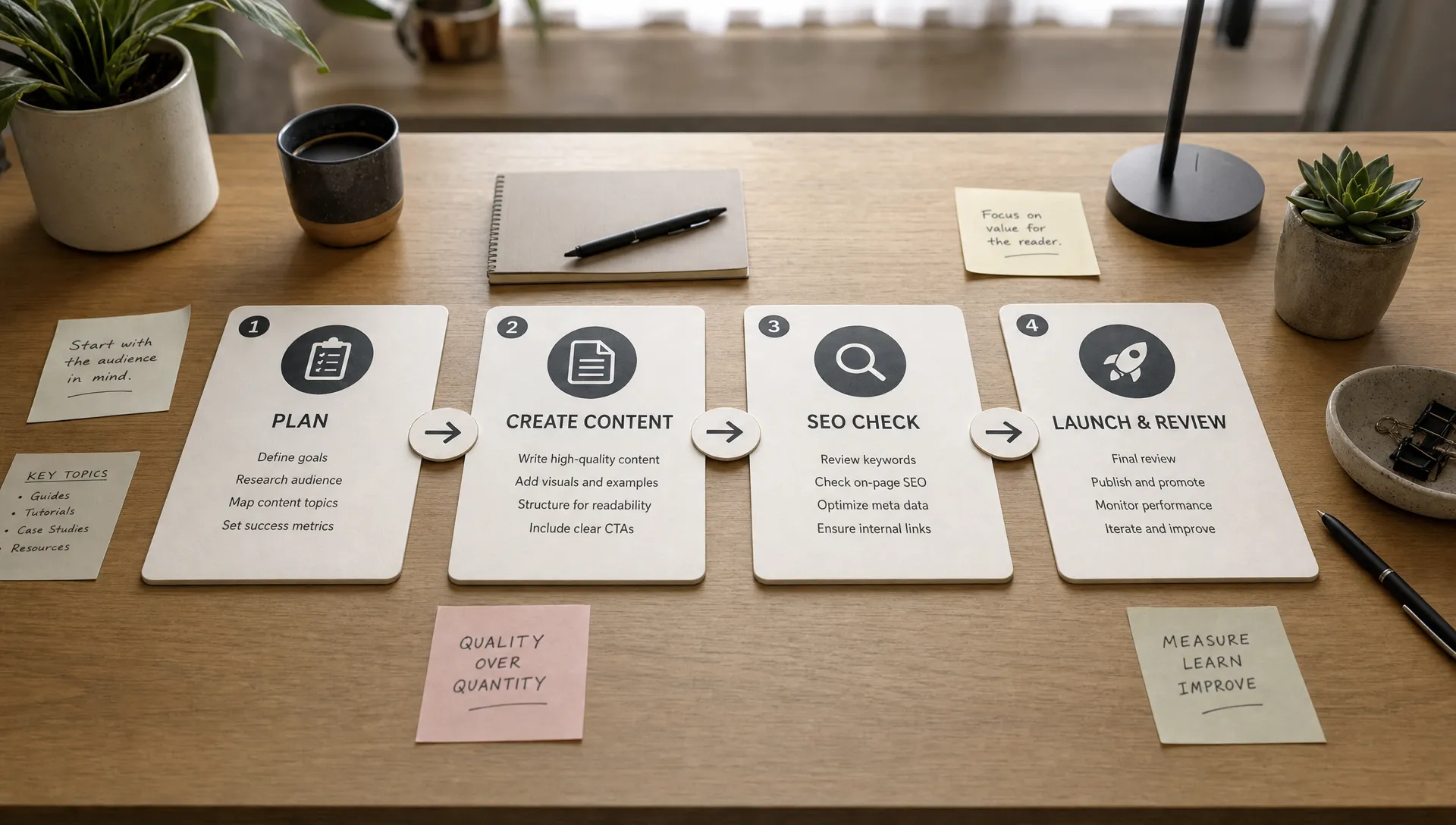
A simple framework keeps the project from becoming a collection of disconnected tasks. Use it to review any proposal for website development and SEO services.
This framework is useful because it makes tradeoffs visible. If a proposal only focuses on visual design, it is weak on visibility and operations. If it only focuses on technical SEO, it may miss positioning and conversion.
For a broader view of the non-SEO parts of the scope, BeBranded has a related guide on what website development and design services should include. This article goes one layer deeper into how SEO should be integrated into that work.
Development quality affects SEO before a single meta title is written. The platform, CMS logic, page templates and front-end implementation all influence how easily your site can grow.
The development scope should start with information architecture. This means deciding which pages exist, how they relate to each other, which pages are commercial priorities and which content types need CMS templates. A clear architecture also shapes website structure that helps users and search engines find the right pages, which is where many later SEO problems actually start.
It should also include responsive design, accessibility basics, performance expectations, form logic, analytics requirements and integration planning. The W3C Web Content Accessibility Guidelines are a useful reference for making accessibility decisions more concrete.
For growing teams, the goal is not to build every possible feature. The goal is to build the structure that supports the buyer journey now and can scale later. That is why website scope should be tied to clear website design and development priorities, not only design preferences.
SEO should be planned during design and development, not added after launch. When SEO is added late, teams often need to rework URL structures, headings, templates, internal links and content blocks.
A proper SEO scope should include technical SEO, on-page SEO and content architecture. Technical SEO covers crawlability, indexation control, redirects, sitemap logic, performance, canonical tags and structured data where appropriate.
On-page SEO covers search intent, page titles, meta descriptions, heading structure, content sections, image alt text and internal linking. Content architecture covers how CMS collections, blog categories, resource hubs, service pages and landing pages support organic growth.
Google's Search Essentials provide a useful baseline: pages should be accessible, useful, crawlable and not built to manipulate ranking systems. Google's Core Web Vitals also help teams discuss speed and user experience with more precision.
| Scope area | What it should include | What to verify before signing |
|---|---|---|
| Strategy | Business goals, audience segments, page priorities and conversion paths | The proposal explains why each key page exists |
| UX and design | Wireframes, responsive layouts, trust signals, calls to action and content hierarchy | Design decisions are tied to user intent and conversion |
| Development | Clean front-end build, CMS setup, reusable components, forms and integrations | The marketing team can update core content after launch |
| Technical SEO | Indexation rules, redirects, sitemap, metadata fields, schema and performance checks | SEO requirements are handled before launch, not after |
| Measurement | Analytics, events, form tracking and reporting inputs | The team can see which pages and actions drive results |
| Launch support | QA, migration checks, redirect testing, crawl checks and post-launch fixes | There is a clear owner for launch risk |
The strongest projects do not pass a design file to developers and then ask an SEO specialist to clean things up later. Development and SEO should work together from the first sitemap discussion.
During strategy, SEO input helps define which pages deserve individual URLs, which pages can be combined and which content should be managed through the CMS. During design, SEO input helps shape headings, content modules, internal links and page depth.
During development, SEO input helps avoid avoidable issues such as missing metadata fields, hidden content, weak heading logic, broken canonical tags or a CMS structure that cannot support future content. This mirrors the same cross-functional logic behind how web design and development should work together.
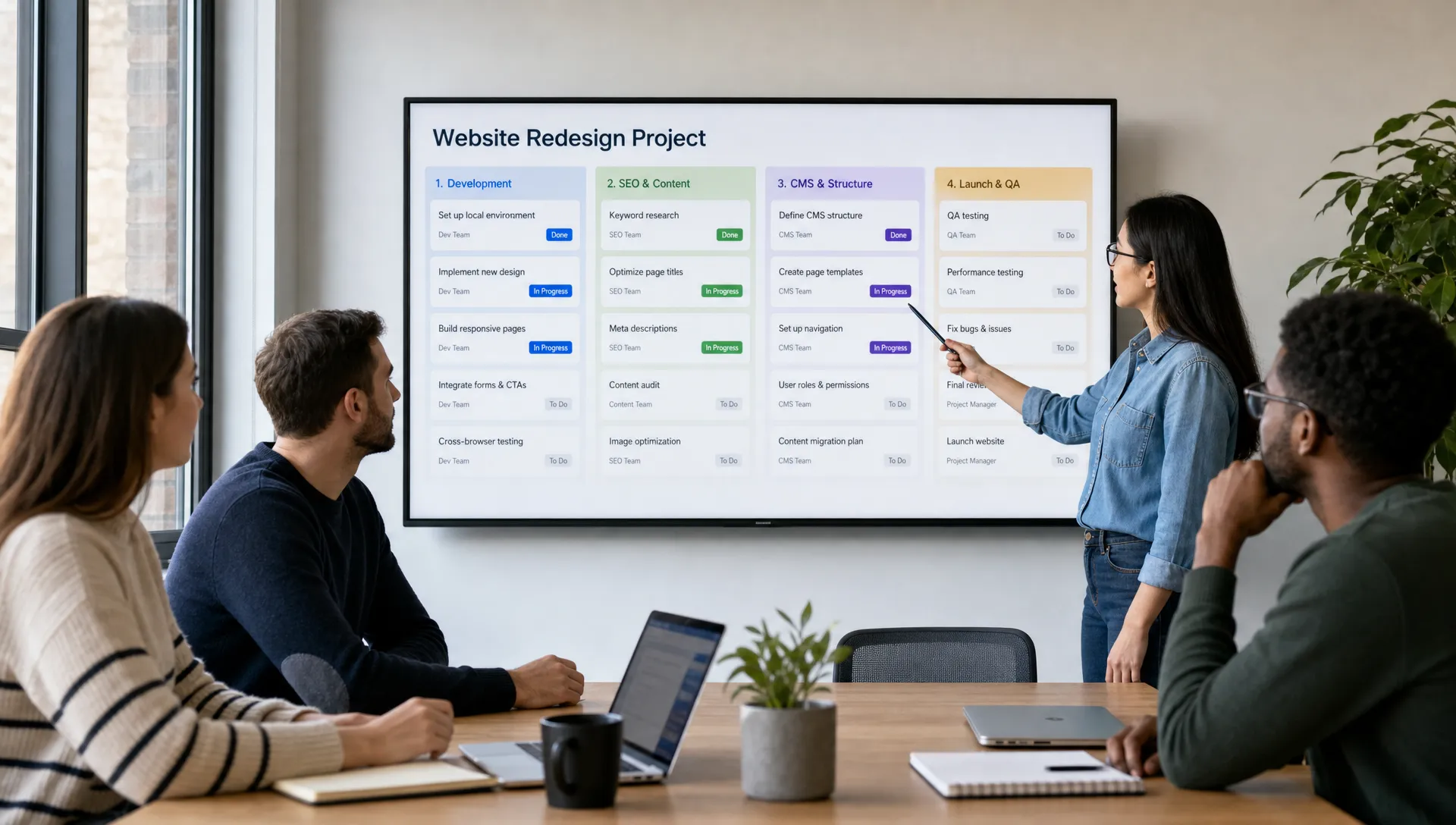
Good deliverables reduce ambiguity. They show what will be built, how it will be optimized and what the client will own when the project is complete.
At minimum, expect a sitemap, wireframes or page structure, design mockups, developed pages, CMS collections, on-page SEO setup, technical SEO checks, analytics setup and launch QA. If migration is involved, expect a redirect map and content inventory.
You should also receive practical documentation. This does not need to be a long manual, but it should explain how to update CMS content, add new pages, manage SEO fields and avoid breaking key templates. For a fuller picture of what should be handed over, see what professional website developers should deliver at launch.
For conversion-focused projects, deliverables should also connect page intent to action. A service page, product page, pricing page and resource article should not all use the same CTA logic. BeBranded covers this in more detail in its guide to web design services that improve conversion and SEO.
The platform you build on sets a ceiling for what development and SEO services can actually deliver. A rigid page builder limits CMS structure no matter how good the strategy is, while a fully custom build can support anything but depends entirely on the team maintaining it.
The table below compares three common approaches on the dimensions that matter most for a growing team: how flexible the CMS is, how much technical SEO control it allows and how independently the marketing team can operate once the site is live.
| Approach | CMS flexibility | Technical SEO control | Marketing team autonomy | Best fit |
|---|---|---|---|---|
| Generic no-code page builder | Limited, template-bound content types | Basic, often locked behind the platform | Low, small edits still need developer help | Very small sites with only a few static pages |
| Webflow or a comparable structured CMS | High, collections modelled around the business | Strong, direct control over metadata, redirects and structured data | High, marketing can publish without breaking layouts | Growing teams that publish often and need SEO control |
| Fully custom development | Unlimited, built to the exact specification | Strong, but depends entirely on the development team's discipline | Depends entirely on the admin tooling that gets built | Complex products or workflows that outgrow standard CMS options |
Most website projects fail quietly. They launch, look acceptable and then create operational or SEO problems that only become visible months later. The table below lists the mistakes that come up most often, why they happen and what to do instead.
| Mistake | Why it happens | What it costs you | How to prevent it |
|---|---|---|---|
| Treating SEO as a launch checklist | SEO is sequenced after development instead of during it | Costly rework of URLs, headings and templates once the site is live | Bring SEO input into the sitemap and template discussion from day one |
| Choosing design without content strategy | Visual direction gets approved before messaging is clear | Polished pages that still fail to explain the offer | Lock a content and messaging plan before final mockups |
| Building a CMS around current pages only | Collections are modelled for what exists today | Future case studies, locations or service pages force a rebuild | Design collections for the content you expect to publish next year, not only this one |
| Ignoring redirects during a redesign | URL structure changes without a migration plan | Organic traffic that took months to earn gets lost after launch | Build a full redirect map before launch, as covered in this guide to SEO-safe redesign and migration |
| Overloading pages with animation | Motion is added late, as decoration rather than function | Slower pages, higher bounce and weaker conversion paths | Reserve animation for moments that clarify interaction, not decoration |
| Using generic metadata across templates | Titles and descriptions are copied from one template to every page | Pages compete with each other instead of ranking for distinct intent | Write metadata for each page around its own search intent |
| Launching without measurement | Analytics and form tracking are added after go-live | No way to learn from the new site's first months of traffic | Set up analytics, events and conversion tracking before launch, not after |
These mistakes are often scope problems, not talent problems. If the proposal does not define responsibility, the work usually gets skipped or handled too late.
Use this checklist to pressure-test a proposal before budget is committed. It works for Webflow, Framer and custom development projects alike. Run through it item by item, and treat every vague answer as a gap to close before you sign.
| Item to confirm | What good looks like |
|---|---|
| Business goal | The proposal explains the goal of the website, not only a page count |
| Sitemap | Core commercial pages, supporting content and utility pages are clearly separated |
| Search intent | The provider explains how search intent will shape page structure and copy |
| CMS collections | Collections are defined for any content type that needs to scale |
| Technical SEO | Technical SEO setup is included before launch, not treated as an afterthought |
| Metadata and Open Graph | Metadata, Open Graph settings and image alt text are part of the written scope |
| Redirects | A redirect plan is included whenever the project replaces an existing site |
| Template testing | Core templates are tested on both mobile and desktop before sign-off |
| Forms and integrations | Forms, automations and third-party integrations are specified in writing |
| Analytics | Analytics and conversion events are included in the scope, not billed later |
| Launch QA | Launch QA has a named owner and a documented process |
| Post-launch support | Post-launch support or maintenance terms are defined clearly upfront |
If a proposal is vague on several of these points, ask for clarification before comparing price. A cheaper proposal can become expensive when key SEO, CMS or launch responsibilities are excluded.
The right partner should be able to explain how the website will support acquisition, conversion and internal operations. If they only talk about visual style, the scope is incomplete.
Ask how they handle sitemap decisions, technical SEO, CMS structure, page speed, analytics and post-launch fixes. You do not need a long theoretical answer. You need a clear process and evidence that these topics are handled during the build.
When comparing providers, evaluate scope clarity before cost. The cheapest quote often leaves important work undefined. BeBranded has a separate guide on how to compare web development services without wasting budget, which is useful if you are reviewing several proposals.
You should also consider whether the partner understands the current standards for growth websites. The expectations around CMS flexibility, performance, SEO and marketing autonomy are covered in more detail in website development in 2026.
What should website development and SEO services include? They should include strategy, page structure, UX design, development, CMS setup, technical SEO, on-page SEO, analytics, launch QA and post-launch support where needed.
Should SEO happen before or after website development? SEO should start before development. It needs to shape the sitemap, URL structure, content hierarchy, CMS templates and launch plan.
Do all websites need technical SEO? Yes, but the level of work depends on the site. A small marketing site may need basic crawlability, metadata, sitemap and performance checks. A larger site may need redirects, structured data, indexation rules and deeper template review.
What is the difference between web design SEO and technical SEO? Web design SEO focuses on content hierarchy, page intent, internal linking and user experience. Technical SEO focuses on crawlability, indexation, performance, redirects and the way search engines access the site.
How do I know if an agency proposal is complete? A complete proposal explains what will be planned, designed, built, optimized, tested and handed over. It should also name what is excluded so there are no assumptions at launch.
Can Webflow or Framer websites rank well in search? Yes, they can rank well when the site is planned correctly, built cleanly, structured around search intent and maintained with strong content and technical discipline.
Website development and SEO services should cover more than design, build and a few SEO fields. The scope should connect business goals, search visibility, conversion paths and team operations.
Your next step is to review your current proposal against the checklist above. If you want a focused external view on scope, conversion and SEO risk, talk to BeBranded about the website you need to build.