How to compare web development services without wasting budget
Development
•
X min
•
Published on
11.06.2026
•
Updated on
21.08.2026
Comparing web development services is difficult because most proposals use the same words for very different work. One quote may include strategy, UX, SEO, CMS setup, integrations, QA, and launch support. Another may only include page development from an existing design.
The goal is not to find the cheapest provider. The goal is to understand what you are buying, what is missing, and which provider can deliver the business outcome without creating hidden costs later.
This guide gives you a practical way to compare providers, pricing, scope, and risk before you commit budget.
Start by defining the category before comparing suppliers.
Web development services are the strategy, design, build, integration, testing, optimization, and support work required to create or improve a website. For a business website, this usually means more than coding pages. It includes how the site will attract traffic, explain the offer, convert visitors, and stay easy to manage after launch.
A serious website scope usually covers these areas:
If you do not specify these elements, every provider will make assumptions. A clear website requirements document is often the simplest way to make quotes comparable.
Price differences usually come from scope differences, not only provider quality.
A founder may see three quotes for the same website and assume one provider is overpriced. In practice, the expensive quote may include positioning workshops, copy support, SEO migration, CMS architecture, custom animations, integrations, and post-launch support. The cheaper quote may only include visual implementation.
The provider model also changes the offer. A freelancer, a no-code agency, a full-service agency, and an in-house hire do not solve the same problem.
| Provider model | Best fit | Main risk to check |
|---|---|---|
| Freelance developer | Defined builds, fixes, and smaller scopes with a clear brief | Limited strategic input or launch support if the scope is vague |
| Specialist no-code agency | Marketing sites, landing pages, CMS builds, SEO setup, and fast execution | Not always suitable for complex web applications or heavy backend logic |
| Full-service agency | Brand, content, campaign, and website projects that need many disciplines | Higher overhead and slower decision cycles if the project is simple |
| In-house team | Continuous product development, frequent internal requests, and long-term ownership | Recruiting, management, and fixed cost even when website needs fluctuate |
This is why you should compare the operating model before comparing the price. The right model depends on how much strategy you need, how quickly you need to launch, and who will manage the site after delivery.
A simple framework makes web development services easier to compare.
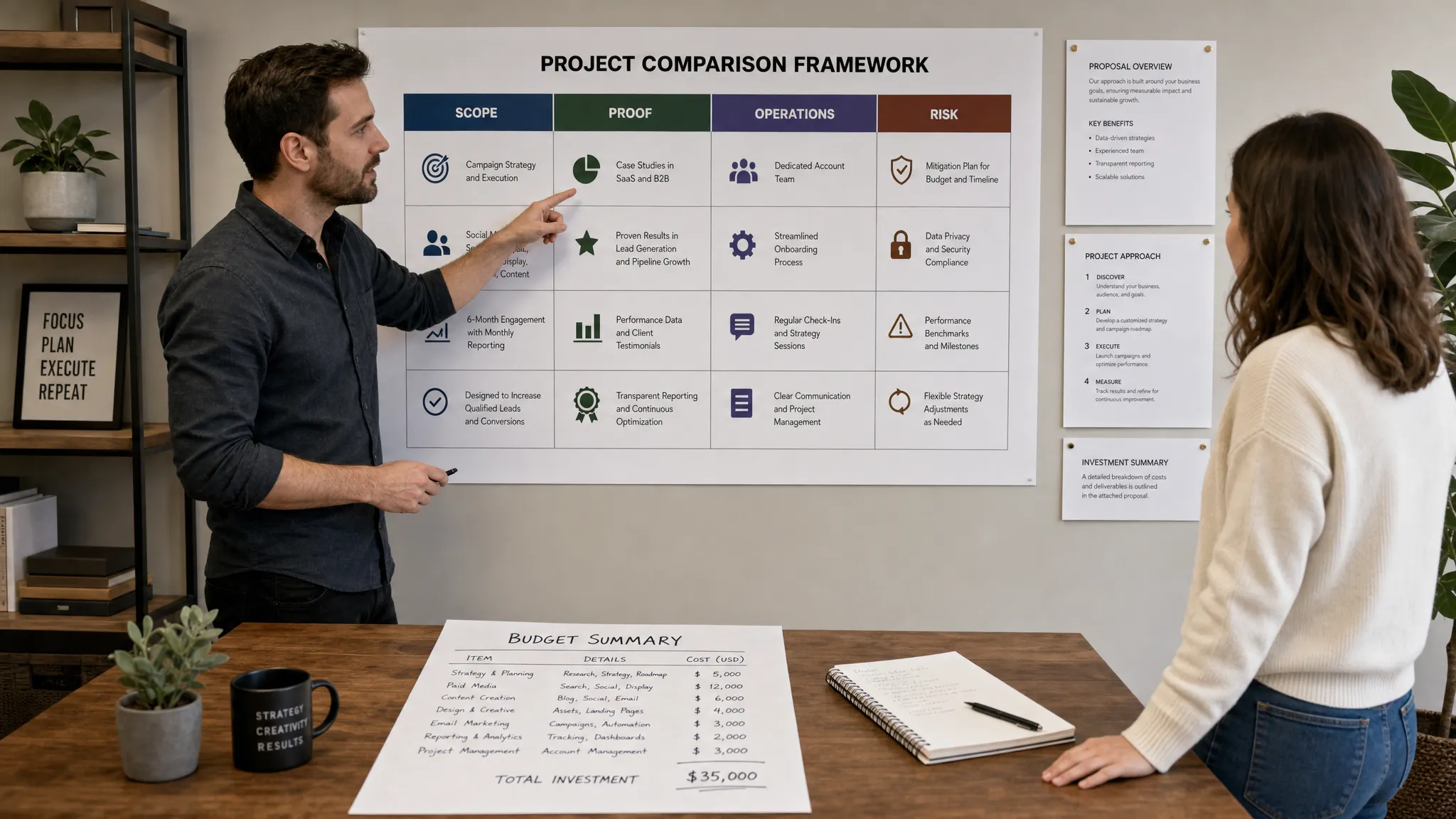
Before you select a provider, evaluate four areas: scope, proof, operations, and risk. This forces the conversation away from vague claims and toward concrete delivery conditions.
A proposal should describe deliverables precisely. Page count, templates, CMS collections, integrations, responsive breakpoints, SEO tasks, animation complexity, QA, and training should all be visible.
Ask the provider to state what is excluded. Copywriting, brand identity, advanced SEO, migration, content entry, legal pages, custom tracking, and maintenance are often left out unless requested.
A portfolio is useful, but it is not enough. Look for work that matches your constraints, such as a content-heavy site, a B2B lead generation site, a multilingual site, or a fast landing page system.
You can also ask how they improved structure, conversion, SEO, or maintainability. If conversion and search visibility matter, review which web design services improve conversion and SEO so you know what to look for in their process.
Good web development services depend on execution rhythm. You need to know who makes decisions, how feedback is collected, how revisions are handled, and what happens when content is late.
Ask about project management, staging links, design review workflow, approval points, and communication cadence. A good provider reduces ambiguity before production starts.
Every project has risk. The issue is whether the provider can identify it early.
Common risk areas include unclear copy, stakeholder misalignment, custom integrations, SEO migration, animation performance, unsupported CMS structures, third-party scripts, and late changes. A credible provider will flag these before the contract is signed.
Budget decisions should be based on total cost, not just launch cost.
A low quote can be the right choice when the brief is simple and the scope is controlled. It becomes expensive when the proposal omits strategy, QA, SEO, responsive testing, or CMS setup, then charges every correction as a change request.
When reviewing web development pricing, separate four cost layers:
If the project is a redesign, read a dedicated website redesign pricing guide before comparing offers. If you need broader budget ranges and scenarios, the website redesign cost guide will help you understand what usually drives the final number.
Do not ask only what the website costs. Ask what the website will cost to operate, change, and improve after launch. This is where many cheap builds become expensive.
A polished design is useful only if the website supports the buying journey.
For a marketing site, your provider should understand the path from visitor intent to qualified lead. That includes page structure, messaging hierarchy, trust signals, calls to action, forms, and analytics.
Conversion rate optimization is not only A/B testing. It starts with clearer pages, reduced friction, better offer presentation, and better measurement. If conversion is part of the goal, make sure the provider has a practical CRO method, not only visual opinions.
SEO should also be discussed before production. A late SEO checklist is better than nothing, but technical SEO, heading structure, redirects, internal linking, CMS fields, and metadata rules are easier to build correctly from the start. For Webflow projects, a structured SEO setup for Webflow helps avoid common launch issues.
A website should not become dependent on the original builder for every small update.
Good providers think about editing rights, CMS structure, components, naming conventions, reusable sections, documentation, and training. This matters for marketing managers who need to publish new pages, update content, and run campaigns without waiting for development support every time.
Ask how the provider builds for handover. If the answer is vague, you may end up with a visually acceptable website that is difficult to update, slow to scale, or risky to edit.
Post-launch support should also be clear. Maintenance can mean simple fixes, technical monitoring, growth iterations, or regular page production. Review website maintenance pricing before accepting a maintenance retainer that is either too light or too broad for your real needs.
The person selling the project is not always the person building it.
Ask who will work on strategy, design, development, SEO, QA, and project management. For smaller providers, one person may cover several roles. That can work well if the project is focused. For broader projects, check whether the team has the right depth.
For Webflow projects, the difference between a visual builder and a structured developer is important. A strong provider should understand responsive behavior, CMS architecture, naming systems, components, SEO fields, performance, and client handover. The Webflow developer guide explains what to look for.
Also check how the website fits your sales or service process after launch. If new messaging changes how your team handles inquiries, align the website rollout with team enablement. Tools focused on AI roleplay training for sales and service teams can help teams practice conversations, objections, and follow-up scenarios that come from a sharper website funnel.
The right development service depends partly on the platform.
Webflow and Framer are both strong options for marketing websites, but they do not fit the same needs. Webflow is often better for structured CMS, SEO-driven content, scalable marketing sites, and more advanced content architecture. Framer can be a good fit for fast, design-led sites with lighter content requirements.
The platform decision should come after the business requirement, not before. If you need a blog, landing page system, gated resources, multilingual SEO, integrations, and a maintainable CMS, the provider should explain how the chosen platform supports those needs.
If you are unsure, compare the tradeoffs in a detailed Webflow vs Framer comparison. The wrong platform can increase maintenance cost even when the initial build looks successful.
Most wasted budget comes from avoidable decisions made before the project starts.
The safest approach is to prioritize what the first version must achieve, then keep a backlog for improvements after launch.
Use this checklist to compare providers on the same basis.
If a provider cannot answer these points clearly, pause before signing. Lack of clarity before launch usually becomes cost after launch.
A specialist agency is often the right choice when the site is a growth asset, not just an online brochure.
For CEOs, CMOs, founders, and marketing managers, the key advantage is speed with structure. A focused Webflow or Framer partner can move faster than a traditional build while still handling design, CMS, SEO setup, integrations, and responsive execution.
This model is not right for every project. If you are building a complex SaaS application, marketplace, or backend-heavy platform, you may need a product development team. If you need a high-performing marketing website with clean design, fast delivery, and a CMS your team can use, specialist no-code web development services can be a practical option.
The best provider will not push a tool before understanding the job. A mature website project starts with goals, audience, pages, content, conversion paths, and operations. The platform is selected to serve that plan.
What is the best way to compare web development services? Compare providers using the same scope, then review proof, process, ownership, SEO, timeline, and post-launch support. Do not compare only the final price.
Why are web development quotes so different? Quotes vary because providers include different levels of strategy, design, development, SEO, content support, integrations, QA, and maintenance. Always ask what is included and excluded.
Should I choose a freelancer or an agency? Choose a freelancer for focused, well-defined work with limited complexity. Choose an agency when you need strategy, design, development, SEO, integrations, and project management handled together.
What should a web development proposal include? A serious proposal should include scope, deliverables, timeline, responsibilities, platform, revision process, SEO tasks, integrations, QA, launch plan, support terms, and exclusions.
How important is SEO when comparing providers? SEO is important if organic traffic matters or if you are redesigning an existing site. The provider should plan technical SEO, page structure, redirects, metadata, and indexation before launch.
How can I avoid paying twice for the same website? Start with a clear brief, choose a maintainable platform, confirm CMS ownership, require responsive testing, plan SEO early, and make sure your team can update the site after launch.
The safest way to compare web development services is to make every provider respond to the same brief. Once scope, responsibilities, SEO, integrations, timeline, and support are clear, pricing becomes much easier to evaluate.
Do not buy a website based only on presentation quality or hourly cost. Choose the provider that understands the business goal, explains the tradeoffs, and gives your team a site it can actually use after launch.
If you are comparing options for a Webflow or Framer project, the next step is simple: ask BeBranded to review your scope before you commit budget.