What makes the best web agency for a complex website
Development
•
X min
•
Published on
28.09.2026
•
Updated on
07.11.2026

A complex website fails when strategy, content architecture, SEO and development are treated as separate workstreams. The best web agency for this kind of project is not simply the one with the nicest portfolio. It is the one that can turn messy business requirements into a clear website system your team can launch, manage and improve.
This matters for CEOs, CMOs, founders and marketing managers because complex websites carry operational risk. The wrong partner can leave you with a site that looks acceptable on launch day but is slow to update, difficult to scale and weak in search. The right partner reduces uncertainty before production starts.
A complex website is a marketing or commercial website with multiple audiences, content types, SEO dependencies, integrations, approval paths and internal owners.
Complexity is rarely just visual. It usually comes from the number of decisions that need to work together: positioning, navigation, page templates, CMS collections, forms, analytics, conversion paths and post-launch governance. If these are not planned as one system, the site becomes fragile.
For a complex project, an agency should be judged less on taste and more on operating quality. Strong visual direction still matters, but it should serve a structure that helps buyers understand the offer and helps the internal team manage the site without constant developer support.
A 12-page website can be complex if every page serves a different audience, market or product line. A 60-page website can be straightforward if the content model is clear and the CMS is well planned.
The best web agency will identify where complexity sits before proposing layouts. That might mean mapping buying committees, auditing current SEO performance, reviewing CRM requirements or defining which pages should be reusable templates rather than one-off designs.
Use a structured framework before comparing proposals. This keeps the decision grounded in delivery risk rather than personal preference.
For a complex website, the best web agency should make tradeoffs visible before production starts. A useful framework is the 6A model: alignment, architecture, acquisition, activation, administration and aftercare. If you are still unsure which type of partner suits your size and stage, start with this guide on choosing a web design agency that fits your growth stage.
The table below turns the six areas into something you can check during sales conversations. Read it as a pair: what a credible answer looks like, and the warning sign that suggests the agency has not planned that area.
| Area | What a credible answer looks like | Warning sign |
|---|---|---|
| Alignment | Written goals, audiences and stakeholders | Design starts before goals are agreed |
| Architecture | Sitemap, templates and CMS model before high-fidelity design | Pages designed one by one with no shared system |
| Acquisition | Search intent and tracking mapped to the structure | SEO described as a final checklist |
| Activation | Conversion paths matched to each stage of the buyer journey | One generic contact page for every audience |
| Administration | Editing rules, roles and reusable components | Only the agency can make changes |
| Aftercare | Documented support, fixes and monitoring | Support terms missing from the proposal |
This framework is useful because it separates visual preference from project readiness. If an agency cannot discuss each area clearly, it may still be a good design studio, but it may not be the right fit for a complex website.
Strategy should reduce ambiguity, not produce a long document that nobody uses. Ask how the agency turns strategic decisions into page structure, content priorities and production tasks.
For B2B companies, the website often needs to serve several stakeholder groups at once. A CFO, end user, technical evaluator and founder may all need different proof before they trust the same offer. If that describes your sales process, your website should be shaped around complex B2B buying journeys, not only around a standard homepage and service page model.
The best web agency should be able to explain the relationship between audience intent, website hierarchy and conversion flow. If the strategy conversation stays limited to moodboards, colors and competitor screenshots, the project is starting too late in the decision chain.
Good website strategy should produce clear operating decisions. These include which pages are needed, what each page must prove, how content will be maintained, which search opportunities matter and where users should convert.
It should also define what not to build. Complex projects often grow because every stakeholder wants a page, a section or a feature. A strong agency will protect focus by asking whether each item supports a measurable business goal.
Technical quality is not only code quality. It is the ability to build a site that performs, ranks, scales and stays manageable after handoff.
For complex sites, development and SEO should not be planned separately. URL structure, redirects, metadata, schema, page speed, accessibility, CMS fields and tracking all affect launch quality. The same principle is covered in more detail in this guide to website development and SEO services.
Google Search Central’s SEO starter guide is a useful baseline for how search engines understand pages, links and content. For accessibility, the WCAG 2.2 standard provides a clearer reference than subjective opinions about usability.
The right agency does not need to overcomplicate technical language. It should be able to tell you what will be configured before launch, what needs ongoing monitoring and what risks exist if you migrate from an existing site. The migration question deserves special attention, and this guide on how to migrate a site without losing search traffic explains what to protect.
The checklist below groups the technical items that most often cause late surprises. The last column shows when each one should be settled, so you can tell whether a proposal places it early enough.
| Item | Why it matters | When to settle it |
|---|---|---|
| URL structure and redirects | Protects existing rankings and avoids broken links | Before design |
| Metadata and structured data | Helps search engines read each template | Before build |
| CMS fields and collections | Decides what your team can update alone | Before build |
| Page speed and image handling | Affects usability and search performance | During build |
| Accessibility checks | Reduces usability and compliance risk | During design and QA |
| Analytics and conversion tracking | Lets you measure whether the site works | Before launch |
| Indexation checks | Confirms the right pages are visible in search | At launch and after |
A proposal should show how the agency thinks, not only what it will deliver. Look for specificity in scope, process and ownership.
The table below lists the areas where proposals are most often vague, with the question that exposes the gap. If you also want a shorter list of technical questions, this guide to choosing a custom Webflow developer is a useful complement.
| Area to evaluate | What good looks like | Question to ask |
|---|---|---|
| Discovery | Clear goals, audiences, constraints and decision-makers | How do you turn discovery into site structure? |
| Information architecture | Navigation, page hierarchy and content models are defined before design | How will you decide which pages and templates we need? |
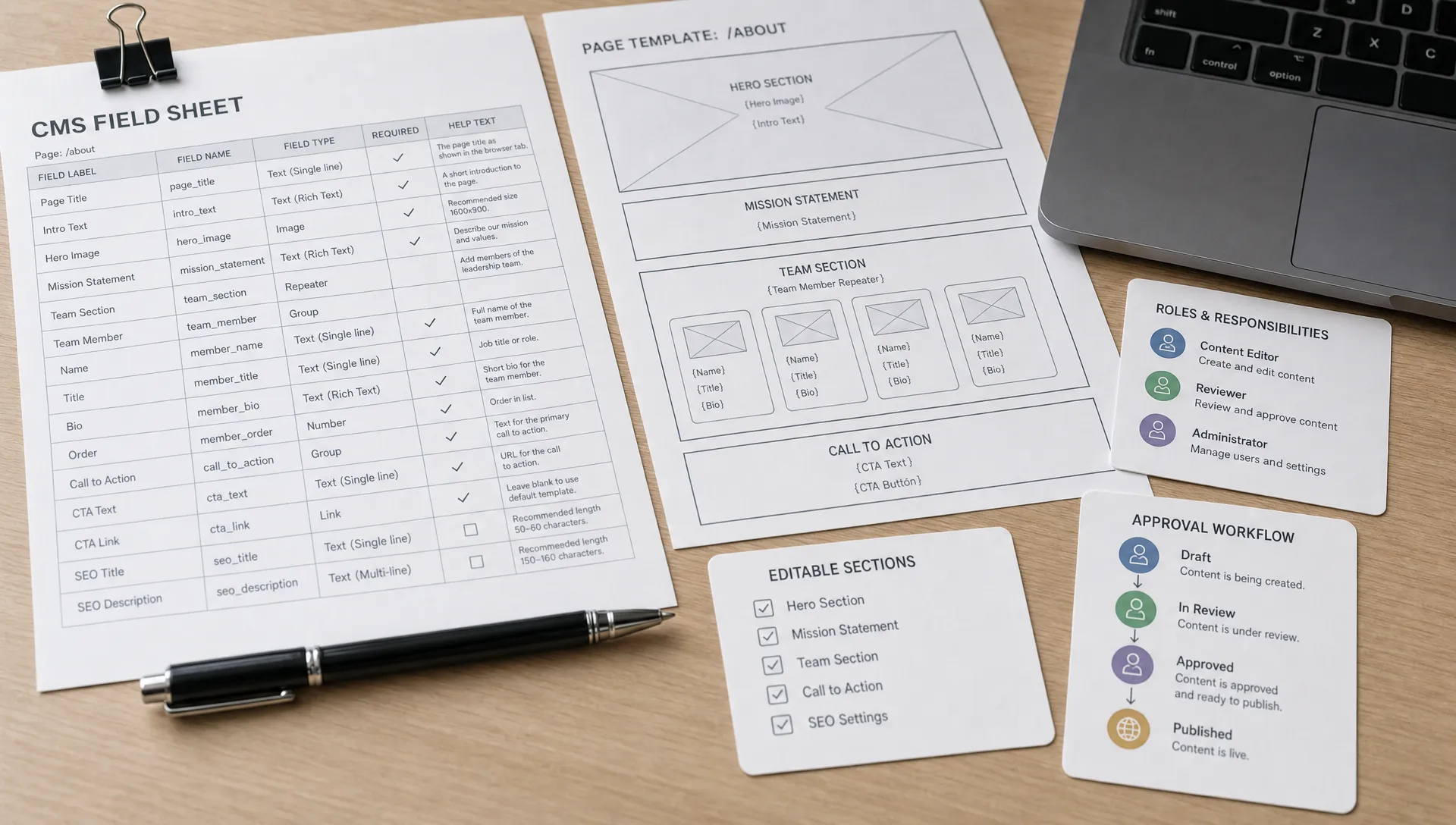
| CMS planning | Reusable collections and fields match marketing workflows | What will our team be able to update without developer support? |
| SEO migration | Redirects, metadata, indexation and URL risks are planned before launch | How do you protect existing organic traffic during the rebuild? |
| Integrations | Forms, CRM, analytics and automations are scoped early | Which integrations are included and which require separate scope? |
| Launch governance | QA, approvals, training and post-launch fixes are documented | What happens in the first weeks after launch? |
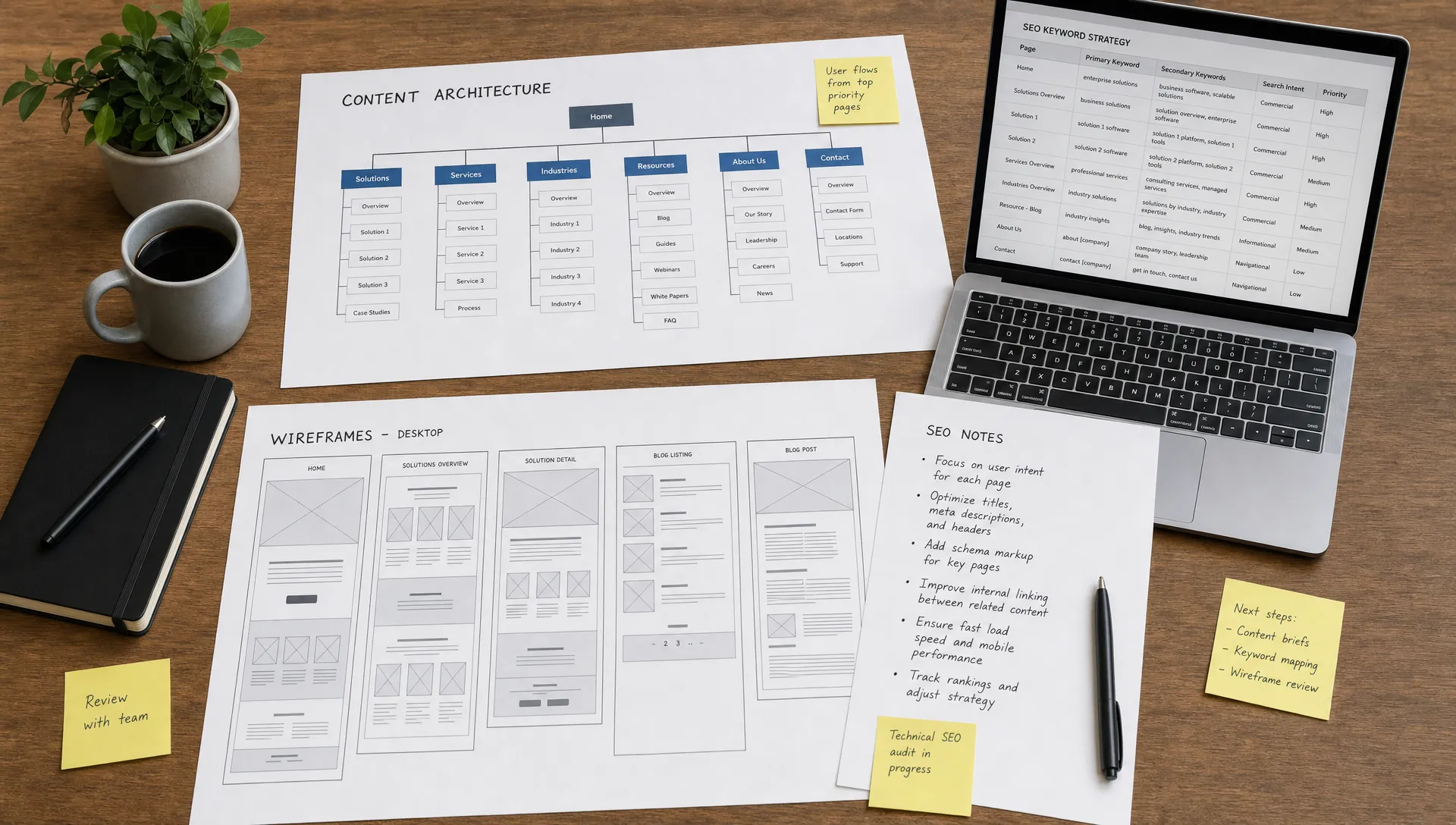
A vague proposal can still lead to a good result if the project is simple. For a complex website, vague scope creates avoidable risk because every unclear decision becomes a late-stage tradeoff.
Once proposals arrive, a simple scoring grid keeps the discussion objective.
Score each agency from 1 to 5 on every criterion, multiply by the weight and compare the totals. The weights below are a starting point for a complex marketing website. Adjust them if, for example, migration risk matters more than design ambition in your case.
| Criterion | Suggested weight | What to look for |
|---|---|---|
| Strategy and architecture | 25% | Structure defined before design, clear link to business goals |
| Technical and SEO readiness | 25% | Redirects, metadata, tracking and performance planned early |
| CMS and handoff | 20% | Documentation, training and editing rules your team can follow |
| Delivery process | 15% | Milestones, approval steps and honest communication on risks |
| Design quality and relevance | 15% | Work that solves problems similar to yours, not only attractive screens |
Ask two or three colleagues to score independently before you compare notes. Large gaps between scores usually show where the team disagrees about priorities, which is worth resolving before you sign.
Most poor agency matches are visible before the contract is signed. The warning signs usually appear in the questions asked, the proposal structure and the level of interest in your operating constraints.
The best web agency will help you avoid rushed decisions that make the launch harder to manage. Be careful with these mistakes.
The pattern is simple: complexity must be managed early. If it is postponed, it usually returns during QA, migration or launch week, when changes cost more attention and create more stress.
Use this checklist before shortlisting agencies or approving a proposal. It works for Webflow, Framer and other modern website builds.
A checklist will not replace judgment, but it helps you compare agencies on the factors that affect the launch and the months after launch. For the period after go-live, it is worth reading what website agency services should cover after launch before you accept any support terms.
No-code does not mean simple. Webflow and Framer can support sophisticated marketing sites when the build is planned with the same discipline as a traditional development project.
The best web agency for a complex marketing site may be a Webflow or Framer specialist if the main needs are speed, custom design, CMS flexibility, SEO setup and easier marketing ownership. The key is not the platform alone. It is whether the agency knows how to structure the site so the team can use it without creating layout, performance or SEO issues. For content heavy projects, the Webflow CMS complete guide shows what a well planned content model looks like.
If Webflow is part of the project, the evaluation should also cover build quality, component structure and long-term maintainability. This overlaps with the criteria for choosing a custom Webflow developer, especially when the site includes CMS collections, landing page systems or third-party integrations. If you are weighing certified partners specifically, see how to choose a Webflow partner agency.
The table below compares the two options on the needs that usually decide the question. Use it to check whether your project sits inside the website layer or goes beyond it.
| Project need | Webflow or Framer specialist | Product engineering team |
|---|---|---|
| Marketing site with CMS content | Strong fit | Possible, often more than needed |
| Fast iteration by the marketing team | Strong fit | Depends on the stack and workflow |
| SEO control and landing page systems | Strong fit | Depends on the implementation |
| Custom back-end logic | Limited | Strong fit |
| User accounts and application features | Limited | Strong fit |
A no-code specialist is usually a poor fit when the project is actually a complex web application, requires deep custom back-end logic or depends on engineering workflows that exceed the website layer. In those cases, a product engineering team may be more appropriate.
What counts as a complex website? A complex website has multiple audiences, content types, SEO dependencies, integrations, approval paths or CMS requirements. It is not defined only by page count.
How early should SEO be involved in a website redesign? SEO should be involved before design and development. URL structure, page hierarchy, redirects, metadata and content priorities affect the build from the beginning.
Can a no-code agency handle a complex website? Yes, if the project is a marketing website and the agency can plan CMS structure, responsive design, technical SEO, integrations and handoff properly. No-code is not a substitute for planning.
How do I compare two agencies with similar portfolios? Compare their process, questions, technical planning, CMS approach, SEO coverage, handoff quality and ability to explain tradeoffs. A similar portfolio does not mean similar delivery quality.
What should be included in the proposal? A strong proposal should include scope, timeline, deliverables, responsibilities, technical assumptions, SEO coverage, integration details, revision process, launch plan and post-launch support terms.
How long should it take to choose an agency for a complex website? Allow enough time for a structured shortlist, discovery conversations and a side by side comparison of proposals. Rushing the decision usually moves the cost to scope changes later, so time spent comparing agencies is normally recovered during the build.
A complex website needs more than strong visuals. It needs clear strategy, solid architecture, SEO readiness, reliable execution and a structure your team can manage after launch.
The next step is to define the real complexity of your project before you compare proposals. If you are planning a Webflow or Framer build and want a clear view of scope, risks and priorities, start with a focused website project audit with BeBranded.