How to find the best website designer for your project
Development
•
X min
•
Published on
27.09.2026
•
Updated on
06.11.2026

Finding the best website designer for your project is less about taste and more about fit. A strong designer should understand your business goal, translate it into a clear user journey and build a site your team can maintain after launch.
This guide gives you a practical way to evaluate website designers before you commit. It covers what to look for, what to avoid, how to compare options and which questions to ask when your website needs to support leads, sales or investor confidence.
A website designer is not just someone who makes pages look polished. For a business website, the role sits between brand, user experience, content structure and technical delivery.
The best website designer for one company may not be right for another. A SaaS startup, consulting firm, ecommerce brand and B2B service business all need different page structures, proof points, CMS logic and conversion paths.
Start by defining the job the website has to do. If the site must generate qualified leads, your evaluation should focus on messaging clarity, forms, calls to action, landing page logic and SEO foundations. If the site must support hiring or fundraising, brand perception and storytelling may carry more weight.
A portfolio shows taste and execution quality, but it does not prove that the designer can solve your specific business problem.
Before reviewing designers, write a short project statement. It should explain who the website is for, what action visitors should take, what content is already available and what needs to change from the current site.
If you are still unsure where to begin, BeBranded has a practical guide on choosing the right first step when you need a website. That clarity helps you avoid hiring around a vague brief.
The best website designer will ask about outcomes before discussing colors, animations or page count. That is a useful signal. It means they are thinking about the website as a business asset, not only a visual deliverable.
Use the same criteria for every designer you compare. This keeps the decision objective and prevents the strongest sales call from winning by default.
The best website designer should score well across five areas: business fit, conversion fit, technical fit, SEO fit and collaboration fit. Weakness in one area may be acceptable if your project is simple, but it should be visible before you sign.
| Evaluation area | What to check | Why it matters | Question to ask |
|---|---|---|---|
| Business fit | Experience with similar business models, audiences or buying cycles | The site structure should match how your buyers decide | How would you structure this site around our buyer journey? |
| Conversion fit | Approach to calls to action, forms, landing pages and proof | Good visuals do not guarantee qualified enquiries | What would you change to improve conversion on our current site? |
| Technical fit | Platform knowledge, responsive build quality, CMS setup and handover process | Your team needs a site that is reliable and easy to update | How do you structure pages and CMS collections for future changes? |
| SEO fit | On-page SEO, crawlability, headings, metadata, redirects and performance | Design decisions can help or limit organic visibility | What SEO checks are included before launch? |
| Collaboration fit | Process, timelines, feedback rounds, ownership and communication rhythm | A clear process reduces delays and rework | What do you need from us each week to keep the project moving? |
Business fit means the designer understands the commercial context behind the project. A founder-led service business does not need the same website logic as a multi-product SaaS company.
Look for questions about audience segments, sales cycle, objections, positioning and success criteria. If the first conversation stays only on visual preferences, the project may start too shallow.
Conversion fit is about helping visitors understand the offer and take the next step. This includes page hierarchy, calls to action, social proof, friction in forms and clarity of messaging.
The best website designer should be able to explain why a section exists, not only how it looks. If they cannot connect design choices to user behavior, the site may look good without supporting pipeline.
Technical fit matters because your website will need updates after launch. For marketing teams, a flexible CMS, clean naming system and reliable responsive behavior are not small details.
If you are considering Webflow or Framer, ask how the designer handles reusable components, CMS collections, responsive testing, redirects and handover documentation. For Webflow-specific projects, technical structure can affect both maintenance and SEO. BeBranded's complete guide to SEO on Webflow shows what a clean build should cover.
SEO fit does not mean the designer must replace your SEO strategist. It means they understand the basics that affect discoverability and indexation.
At minimum, ask about heading structure, title tags, meta descriptions, image alt text, internal links, page speed, redirects and sitemap submission. Google’s SEO starter guide is a useful reference for the fundamentals a professional process should respect.
For a deeper view on the design services that affect organic performance, see BeBranded’s article on web design services that improve conversion and SEO.
Collaboration fit is often underestimated. A designer can have strong work but still create delays if the process is unclear.
Ask how feedback is collected, how revisions are handled, who validates content, what happens if assets are late and what is included after launch. The best website designer will make responsibilities clear early, so both sides know how the project will move.
A portfolio is evidence, but only if you know how to read it.
Look past the screenshots and ask what the goal was, who the audience was and what changed after launch. Case studies that mention constraints, trade-offs and results are more useful than galleries with no context. The same logic applies to the wider service, as explained in our guide on how to evaluate professional website services.
The table below separates the signals that matter from the ones that only look good. Use it while reviewing two or three candidates side by side, and note one answer per row for each of them. Gaps will become obvious quickly.
| Signal | Strong sign | Weak sign |
|---|---|---|
| Project context | The case study states the business goal, the audience and the constraints | Only screenshots and a list of pages |
| Structure | Page hierarchy and calls to action are explained | Layout choices are described only as style |
| Results | Qualified leads, conversion rate or time saved are mentioned, even in ranges | No outcome is mentioned at all |
| Technical detail | CMS setup, responsive behavior and handover are covered | Nothing about how the site is built or updated |
| Consistency | Several projects show the same level of care across sizes and sectors | One standout project and a weak remainder |
| References | Past clients can be contacted or their feedback is documented | No client voice or verifiable context |
A structured selection process helps you compare designers without overcomplicating the decision.
You do not need a long RFP for most SMB or scale-up website projects. You do need a clear brief, consistent questions and a way to evaluate the quality of thinking behind each proposal.
The best website designer will help refine your brief, but they should not need to guess the entire business context from scratch. The better your input, the better their decisions.
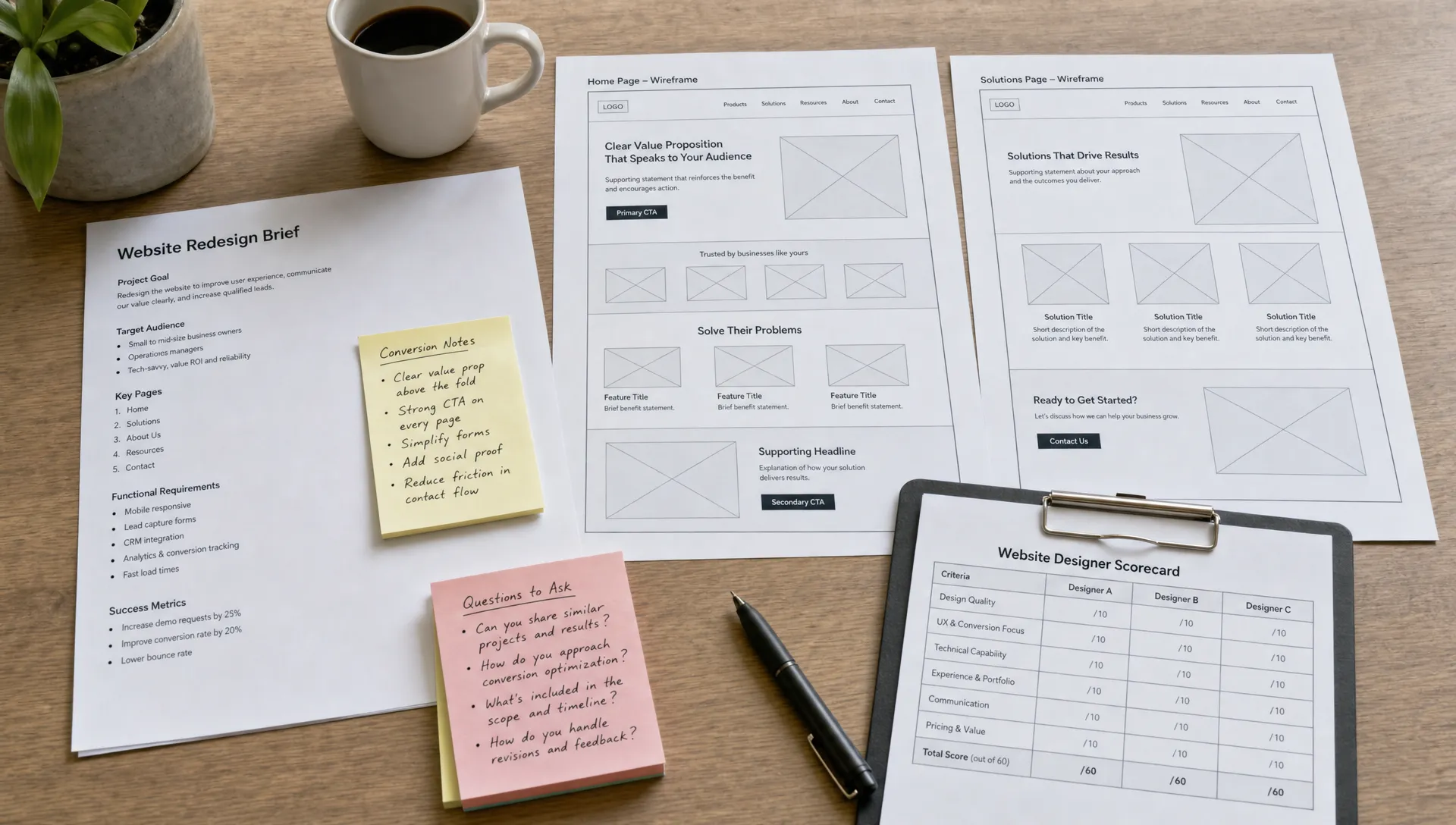
The right partner type depends on complexity, timeline and how much strategic support you need.
A freelancer can be a good choice for a focused project with a clear scope. An agency is usually stronger when you need strategy, design, development, SEO setup, integrations and project management in one workflow. In-house support makes sense when the website needs constant iteration and you have enough workload to justify the role.
| Option | Good fit when | Main limitation | What to verify |
|---|---|---|---|
| Freelancer | You have a narrow scope, a defined brief and one main skill gap | Capacity may be limited if strategy, copy, SEO and development are all needed | Availability, process, platform expertise and backup plan |
| Agency | You need strategy, design, development and launch coordination | Costs can be higher than hiring one independent specialist | Who does the work, timeline, communication rhythm and included deliverables |
| In-house designer | You need ongoing experimentation, frequent page production and brand ownership | Hiring takes time and may still require technical specialists | Skill coverage, platform knowledge and ability to work with marketing goals |
If you are evaluating an agency, ask to see how strategy becomes structure, then design, then build. A professional service should explain the path from discovery to launch with enough detail for your team to know what to expect. BeBranded's article on choosing a web design agency that fits your growth stage goes deeper on that decision.
If you are also considering doing the work yourself, read whether to build your own website or hire a specialist before you decide.
Most hiring mistakes happen before the project starts. They usually come from unclear goals, shallow comparison or pressure to move too fast.
The best website designer is not always the cheapest, fastest or most visually distinctive option. The right choice is the one whose process matches the risk level and commercial importance of the project.
Proposals often look similar on the surface, so compare them line by line.
Two quotes with the same page count can hide very different levels of strategy, testing and support. Put every proposal in the same grid before you look at the price. For a longer method, see how to compare web design packages beyond the page count and what to expect from a website creation service.
The table below lists the seven elements every proposal should address, what a clear answer sounds like and what should trigger a follow-up question. If a line is missing, ask for it in writing.
| Proposal element | What a clear proposal says | What should raise a question |
|---|---|---|
| Scope | Pages, templates, CMS collections and integrations are listed | Broad wording such as 'a full website' |
| Deliverables | Design files, build, content setup and documentation are named | Deliverables described only by outcome |
| Timeline | Phases with dates and client approval points | A single launch date with no milestones |
| Revisions | Number of rounds and the definition of new scope | Unlimited revisions with no process |
| SEO and launch | Metadata, redirects, sitemap and testing are included or assigned | SEO mentioned only as a future option |
| Handover and support | Training, ownership of files and post-launch support terms | Nothing planned after go-live |
| Pricing | Fixed or capped price with payment steps tied to milestones | A low total with many extras billed later |
Use this checklist before approving a proposal or paying a deposit.
The ten checkpoints below fall into three groups: the brief, the scope and the delivery. Each one has a clear sign that it is ready and a person who should confirm it. If one row stays open, resolve it before the deposit.
| Checkpoint | What 'ready' looks like | Who confirms |
|---|---|---|
| Business goal | Written in one clear sentence | You |
| Audience and main action | Target audience and primary conversion defined | You and the designer |
| Scope | Pages, templates, CMS needs and integrations listed | Designer |
| Process | Brief-to-launch process explained | Designer |
| SEO setup | Redirects and metadata included or assigned | Designer or SEO specialist |
| Testing | Responsive and browser testing part of delivery | Designer |
| Content ownership | Copy, images, brand assets and approvals assigned | You |
| Revision rules | Documented, including what counts as new scope | Both sides |
| Post-launch updates | Named person who updates the site | You |
| Commercial terms | Timeline, deliverables, payment terms and support stated | Both sides |
A simple checklist forces clarity. If a candidate cannot answer these points, pause before signing. The best website designer will welcome clear expectations because they reduce avoidable rework.
A strong brief does not need to be long. It needs to make decisions easier.
Include the business context, target audience, offer, competitors, current site problems, required pages, technical constraints, brand assets and launch deadline. If you have analytics, CRM insights or sales objections, share them early.
Also explain what success means. That may be more qualified demo requests, a clearer enterprise offer, a stronger employer brand or a site your marketing team can update without developer dependency.
A clear brief helps the best website designer move faster without guessing. It also gives you a fairer way to compare proposals because each candidate is responding to the same context.
The right questions reveal how the designer thinks and how the collaboration will work.
For performance, ask how they think about loading speed and Core Web Vitals. Google’s Core Web Vitals documentation explains the user experience signals that should be considered during build and optimization.
For accessibility, ask whether they consider contrast, keyboard navigation, semantic headings and readable structure. The WCAG standards overview is a reliable reference for the principles behind accessible websites.
How do I know if someone is the best website designer for my project? Look for evidence that they understand your business goal, audience, conversion path, technical requirements and launch constraints. A strong fit will ask precise questions and explain the reasoning behind their recommendations.
Should I hire a freelancer or an agency for a business website? Hire a freelancer when the scope is narrow and you know exactly what you need. Choose an agency when the project needs strategy, design, development, SEO setup and project management working together.
How much should I rely on a designer’s portfolio? Use the portfolio as a quality signal, not as the full decision. Ask what problem each project solved, what constraints existed and how the final structure supported the client’s goals.
What should be included in a website design proposal? A proposal should include scope, deliverables, timeline, revision process, platform, CMS needs, SEO setup, responsibilities, payment terms and post-launch support details.
Can a website designer also handle SEO? Some designers can handle technical and on-page SEO foundations, such as headings, metadata, redirects, alt text and clean structure. For advanced content strategy or competitive SEO, you may still need a specialist.
What is the biggest red flag when choosing a designer? The biggest red flag is a designer who gives a price or visual direction before understanding the business goal, audience, content needs and technical constraints.
Finding the best website designer means choosing the person or team with the right combination of business thinking, design judgment, technical discipline and collaboration process.
Do not rush the decision based on portfolio aesthetics alone. Define the outcome, compare candidates using the same framework and ask enough questions to understand how each designer will move from strategy to launch.
If your project is a Webflow or Framer website that needs clear structure, fast execution and a conversion-focused build, the next step is to discuss your website project with BeBranded.