What website agency services should cover after launch
Development
•
X min
•
Published on
19.09.2026
•
Updated on
14.10.2026

After launch, website agency services should not stop at publishing pages and fixing visible bugs. A live website becomes an operating asset, which means it needs ownership, measurement, technical care, content workflows and ongoing improvements tied to business goals.
For CEOs, CMOs, founders and marketing managers, the question is not whether the site is live. The question is whether the site is still reliable, editable, crawlable, measurable and useful three months later.
A launch checklist is useful, but it covers only the handover moment. If you want a clearer view of what should be ready before go-live, BeBranded has a separate guide on what professional website developers should deliver at launch. This article focuses on what should happen after that point.
Post-launch support is the operational layer that keeps a website working after it leaves the project phase. It includes technical monitoring, SEO protection, CMS support, analytics review, conversion improvements, content updates and integration maintenance.
The right scope depends on your team. A founder-led company may need its agency to handle most changes. A larger marketing team may need templates, governance and occasional technical support. In both cases, website agency services should make responsibilities explicit instead of leaving the team to guess who owns what.
If you are still defining the original project scope, it helps to compare post-launch needs with what website development and design services should include. The launch project and the post-launch retainer should connect, but they are not the same job.
| Post-launch area | What the agency should cover | What the client should clarify |
|---|---|---|
| Technical maintenance | Fix bugs, check responsiveness, monitor forms and maintain integrations. | Who approves fixes, what is urgent and what can wait. |
| SEO monitoring | Watch indexation, metadata, redirects, internal links and content structure. | Which pages drive acquisition and which keywords matter. |
| CMS operations | Support collections, templates, publishing rules and editor training. | Who publishes content and how often updates happen. |
| Conversion improvement | Review journeys, CTAs, forms, landing pages and friction points. | Which conversions define success for the business. |
| Analytics and reporting | Check tracking, events, dashboards and campaign attribution basics. | Which decisions reports should help the team make. |
A structured 90 day plan prevents post-launch support from becoming a queue of random requests. It also helps your team separate urgent fixes from strategic improvements.
Good website agency services usually move through three phases after launch: stabilize, measure and improve. Each phase has a different purpose, so the work should not be managed as one generic maintenance bucket.
The table below summarizes what each phase should produce, so your team can check progress without reading a long report.
| Phase | Timing | Main focus | Typical output |
|---|---|---|---|
| Stabilize | Days 1 to 30 | Reliability of forms, responsive layouts, redirects and tracking | List of fixed defects, tested forms, working analytics |
| Measure | Days 30 to 60 | Data quality and SEO health | Verified conversion events, indexation review, baseline dashboard |
| Improve | Day 60 onward | Priority pages, content and conversion paths | Prioritized backlog, tested page updates, campaign ready sections |
The first month should focus on reliability. The agency should check forms, responsive behavior, page speed basics, CMS editing, broken links, 404 pages, redirects and tracking setup.
This is also the period when real users reveal issues that internal QA may have missed. A CTA label may be unclear. A mobile section may be too long. A sales form may send leads to the wrong inbox. These are not strategic failures, but they need fast ownership.
If your team is preparing for launch and wants to reduce this risk earlier, use a proper website launch checklist before publishing. The fewer issues you carry into week one, the more useful the post-launch period becomes.
Once the site is stable, measurement becomes the priority. This does not mean producing a decorative report. It means checking whether the website is collecting data that supports decisions.
The agency should confirm that analytics, conversion events, forms, cookie consent, search console access and campaign parameters are working as expected. For SEO, this is where indexation patterns, metadata, redirect behavior and crawlability should be reviewed carefully.
When website agency services include SEO support, they should protect the site from avoidable traffic loss and identify early opportunities. BeBranded has a dedicated article on launching a website without last minute SEO issues, which is especially relevant for redesigns and migrations.
After the first two months, the focus should shift toward improvement. This includes refining priority pages, adjusting content, improving conversion paths, strengthening internal links and preparing reusable sections for future campaigns.
At this stage, support should be tied to business activity. If the company is hiring, launching paid campaigns, entering a new market or updating positioning, the website should adapt without requiring a full redesign.
A professional website is never finished in the abstract. It is finished enough for the current business cycle, then improved based on evidence, team needs and growth priorities.
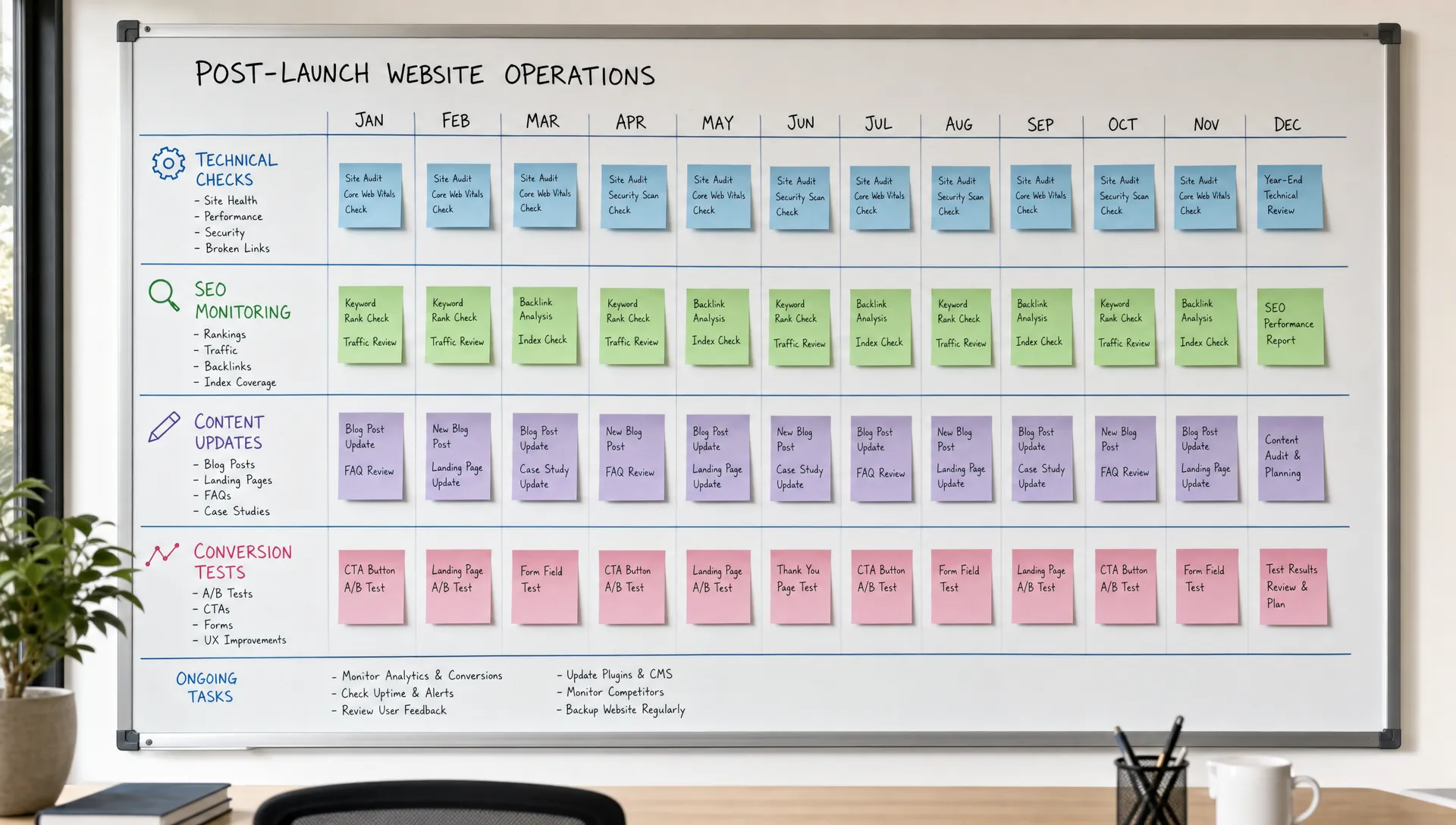
Post-launch reliability starts with simple operational discipline. The agency should make sure the site does not break silently, especially around forms, integrations and CMS content.
A professional website for business should already include a solid structure, clear messaging and conversion paths. If those fundamentals are unclear, review what a professional website for business should include before investing heavily in optimization.
Technical maintenance covers bug fixes, browser checks, responsive issues, layout inconsistencies, broken links, form validation and integration errors. For Webflow and Framer sites, it can also include component cleanup, CMS field adjustments and publishing support.
This work should be documented. If an agency fixes issues without recording what changed, your team loses visibility and future troubleshooting becomes harder. A simple change log is often enough.
A scalable CMS is not just a database of posts. It should help your team publish landing pages, case studies, resources, team pages or location pages without rebuilding layouts each time.
Post-launch support should include CMS guidance, editor permissions, naming conventions and publishing rules. If your site needs to support more content, campaigns or markets over time, align the structure with principles from building a business website that can scale.
Forms, CRM routing, email notifications, calendar tools, marketing automation and no-code workflows can fail quietly. That creates operational friction long before anyone notices a visual issue on the site.
The agency should test critical integrations after launch and after meaningful changes. If your website is part of your lead generation system, these checks are not optional maintenance. They are part of revenue operations.
The table below lists the integrations that most often fail quietly, with the check and the rhythm we recommend.
| Integration | What to test | When to test |
|---|---|---|
| Contact and demo forms | Submission, validation, confirmation message and spam filtering | After launch and after every form change |
| CRM routing | The lead reaches the right owner with the right fields and source | Monthly, and after any CRM change |
| Email notifications | Delivery, sender settings and spam folder behavior | After launch and after a domain or email change |
| Calendar and booking tools | Embed display, time zones and confirmations | Quarterly |
| Analytics and consent | Events, conversions and consent banner behavior | After launch and after each tracking change |
Once the site is stable, the agency should help your team improve outcomes. This work should connect design, content, SEO and conversion rather than treating each area separately.
Website agency services create more value when improvements are prioritized by impact, not by whoever asks loudest. The agency should help you decide what to change now, what to test later and what to ignore.
Conversion work should start with the pages that influence pipeline, signups, demos, bookings or qualified inquiries. That often includes the homepage, service pages, pricing pages, contact pages and campaign landing pages.
The agency should review CTA clarity, form length, content hierarchy, proof elements, mobile layout and page speed basics. For a deeper view of this connection, see BeBranded's guide to web design services that improve conversion and SEO.
SEO after launch is not only about publishing blog posts. It includes improving internal links, cleaning duplicate metadata, updating outdated pages, resolving crawl issues and aligning page intent with search demand.
Your agency should also help protect existing rankings during content updates. Small changes to headings, slugs, canonical tags and internal links can affect visibility if nobody is watching the technical layer.
Marketing teams often need to move faster after launch than during the original build. New offers, paid campaigns, webinars and partner pages all require landing pages that fit the brand system.
This is where reusable sections and clear page patterns matter. BeBranded covers this operational benefit in its article on how online web design supports faster campaign launches, especially for teams that need speed without sacrificing consistency.
A useful monthly report fits on one page. It shows what changed, what it means and what the team should do next.
Focus on leads, conversion rate on priority pages, indexed pages, top landing pages and open technical issues. If a metric does not lead to a decision, remove it from the report.
Most post-launch problems are not caused by one large failure. They come from unclear ownership, poor documentation and treating the website as a finished file instead of a live system.
Avoid these mistakes when reviewing website agency services after your next launch.
For growing teams, these mistakes become more expensive as the site expands. If your roadmap includes new pages, campaigns or markets, revisit website design and development priorities for growing teams before adding more layers.
Not every company needs the same post-launch package. The right level depends on internal capability, website complexity, traffic value and how often the business changes.
A light support model may be enough if your team edits content confidently and the site has limited integrations. A more involved model makes sense if the website supports paid acquisition, sales pipeline, content publishing, SEO growth or multi-team collaboration.
To make the choice concrete, the table below compares three common support levels. Use it as a starting point, then adjust it to the value of your traffic and your publishing pace.
| Support level | Best for | Typical scope | Review rhythm |
|---|---|---|---|
| Light | Teams that edit content confidently and run few integrations | Bug fixes, CMS questions and a quarterly health check | Quarterly |
| Standard | Sites that support lead generation and regular publishing | Monitoring, SEO checks, small improvements and integration tests | Monthly |
| Active | Paid acquisition, several markets or several teams | Ongoing optimization, campaign pages, reporting and governance | Every two weeks, with a monthly strategic review |
Use this decision framework to define the scope before signing a retainer.
This keeps website agency services aligned with real business use rather than a vague promise of maintenance.
Use this checklist to audit your current agency scope or define a new one. It is intentionally practical, because a useful post-launch plan should be easy to inspect.
If your current website agency services do not cover these items, the issue may not be the agency's skill. It may be that the post-launch scope was never defined clearly enough.
What should a website agency do after launch? A website agency should monitor technical issues, check analytics, maintain SEO fundamentals, support CMS updates, test integrations and help improve conversion paths based on business priorities.
How long should post-launch support last? At minimum, support should cover the first 30 to 90 days after launch. After that, ongoing support depends on how often your team updates the site, launches campaigns or relies on the website for lead generation.
Is website maintenance the same as optimization? No. Maintenance keeps the site working correctly. Optimization improves performance, conversion, SEO visibility and user experience over time.
Who should own website updates after launch? The client should usually own priorities, approvals and business context. The agency should own technical implementation, quality control and recommendations within the agreed scope.
Do small businesses need ongoing agency support? Many small businesses benefit from lightweight support, especially if the website handles leads, content publishing or integrations. The scope can be simple, but ownership should still be clear.
A website launch is a milestone, not the end of the work. The value of the site depends on what happens after it goes live: how it is maintained, measured, updated and improved.
The most useful post-launch support is not a vague maintenance plan. It is a clear operating system with owners, priorities, response rules and a quarterly improvement rhythm.
If your website is live but the next steps are unclear, the next move is simple: review your current scope against the checklist above, then ask BeBranded for a focused post-launch website audit.