How to get help building a website without losing control
Development
•
X min
•
Published on
02.09.2026
•
Updated on
27.09.2026
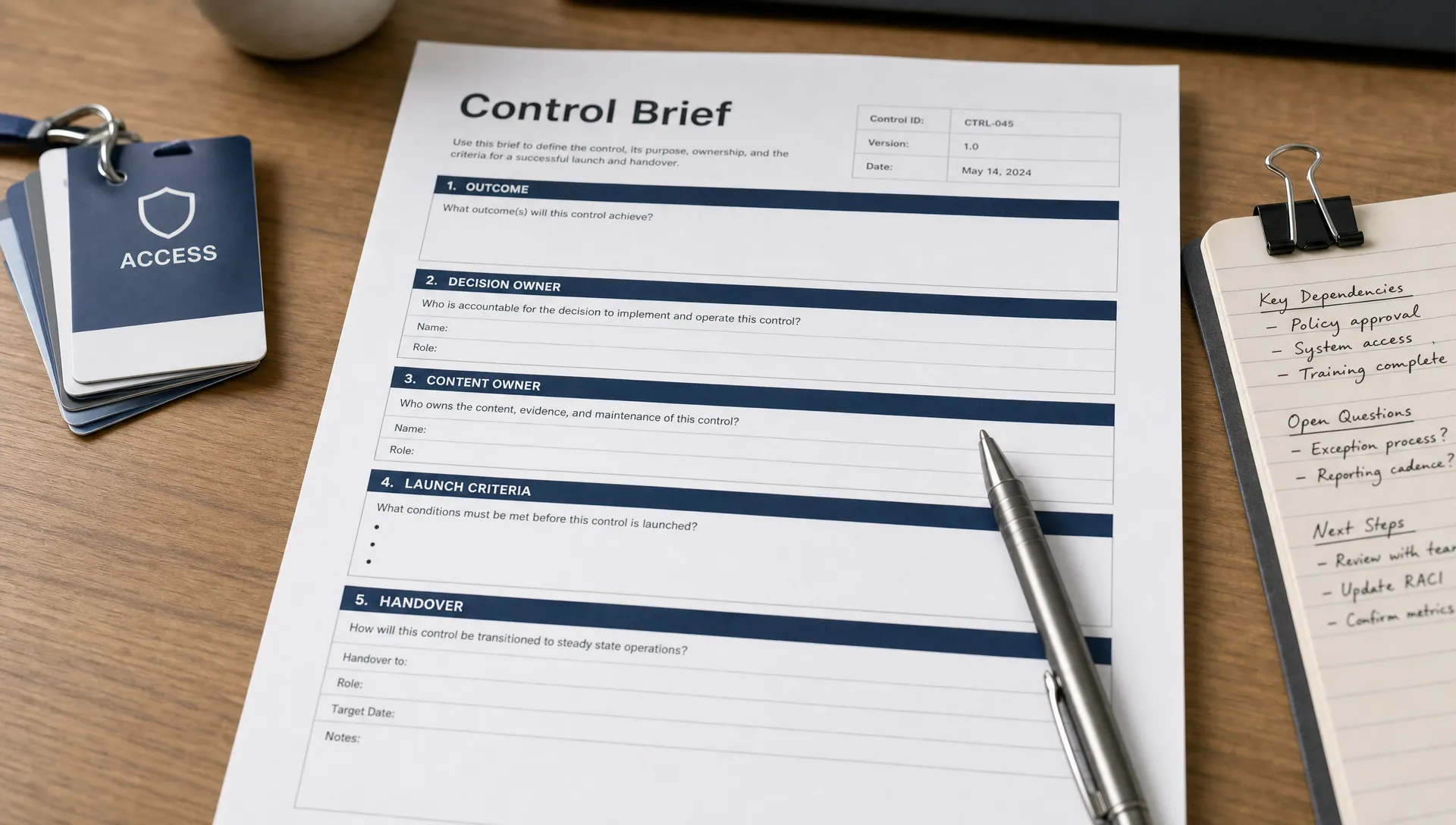
Getting help building a website should reduce execution pressure, not create a dependency you cannot manage. The risk is not hiring outside support. The risk is hiring support before you define who owns decisions, content, access, priorities and launch criteria.
This guide is for CEOs, CMOs, marketing managers and founders who want external website help without losing control of strategy, brand, performance or future updates.
Control does not mean approving every pixel or rewriting every section yourself.
A controlled website project is one where your team owns the business direction, the final approvals, the content logic, the platform access and the post-launch operating model. The partner owns execution, technical recommendations and delivery quality.
This distinction matters because too much control slows the project down, while too little control creates a site your team cannot manage after launch. The goal is not to supervise every task. The goal is to make the few decisions that shape the outcome.
A useful definition is simple: you have control when you can explain why each major page exists, who it serves, what action it should drive and how your team will update it later.
Before you speak with a freelancer, agency or no-code specialist, define the project rules.
This framework keeps you in control without forcing you to become the designer, developer or SEO specialist. It gives the external partner enough direction to move fast, while keeping business-critical choices on your side.
Use the framework as a filter during sales calls. If a partner avoids questions about ownership, content, CMS logic or handover, the project may become harder to manage later.
Not every website project needs the same kind of support. The right fit depends on how much strategic thinking, technical complexity and ongoing publishing your site requires. Getting this choice wrong is a common source of lost control, especially when the wrong Webflow partner agency is asked to cover strategy, design, development and SEO all at once. The table below summarizes the main types of help, when each one fits and how to reduce the control risk that comes with it.
| Type of help | When it fits | Control risk | How to reduce the risk |
|---|---|---|---|
| Freelancer | You have a clear scope and one main skill gap | Delivery may depend heavily on one person | Define milestones, handover and file ownership upfront |
| Generalist agency | You need strategy, design and build support | Process can become slow if too many layers are involved | Ask who does the actual work and who approves decisions |
| No-code specialist | You need a custom site in Webflow or Framer with a manageable CMS | Poor structure can limit future updates | Review component logic and CMS fields before build starts |
| Internal team | You already have design, content and development capacity | Internal priorities can delay launch | Block time, assign one owner and keep the scope tight |
| Website builder template | You need a simple temporary presence | Brand, SEO and conversion limits can appear quickly | Use it only when customization and scalability are not priorities |
The right choice depends on complexity, urgency and how much the website affects revenue. A simple brochure site may not need a full agency process. A lead-generation site with multiple audiences, SEO pages, integrations and frequent updates needs more structure. If a no-code platform is part of the plan, this breakdown of how to select the right no-code tools helps you compare options before you commit.
If you are still deciding between platforms and levels of support, it helps to understand why the simplest website builder is not always the right fit when SEO, conversions and content operations matter.
A good brief defines the destination, not every execution detail. For a structured starting point, use a website requirements document to capture these decisions before you brief anyone.
The brief should explain your business, audience, offer, constraints and priorities. It should not prescribe layout details unless they are tied to a clear reason. For example, “we need a pricing section that lets users compare plans quickly” is useful. “Make the pricing cards bigger” is feedback for a later stage.
Include the decisions your partner cannot guess. These usually include the primary audience, core conversion action, must-have pages, brand constraints, product claims, integration needs and internal approval process.
A brief should create alignment, not lock the project into weak assumptions. Leave room for the partner to challenge structure, messaging and technical choices when there is a better path.
Control improves when decisions happen in the right order.
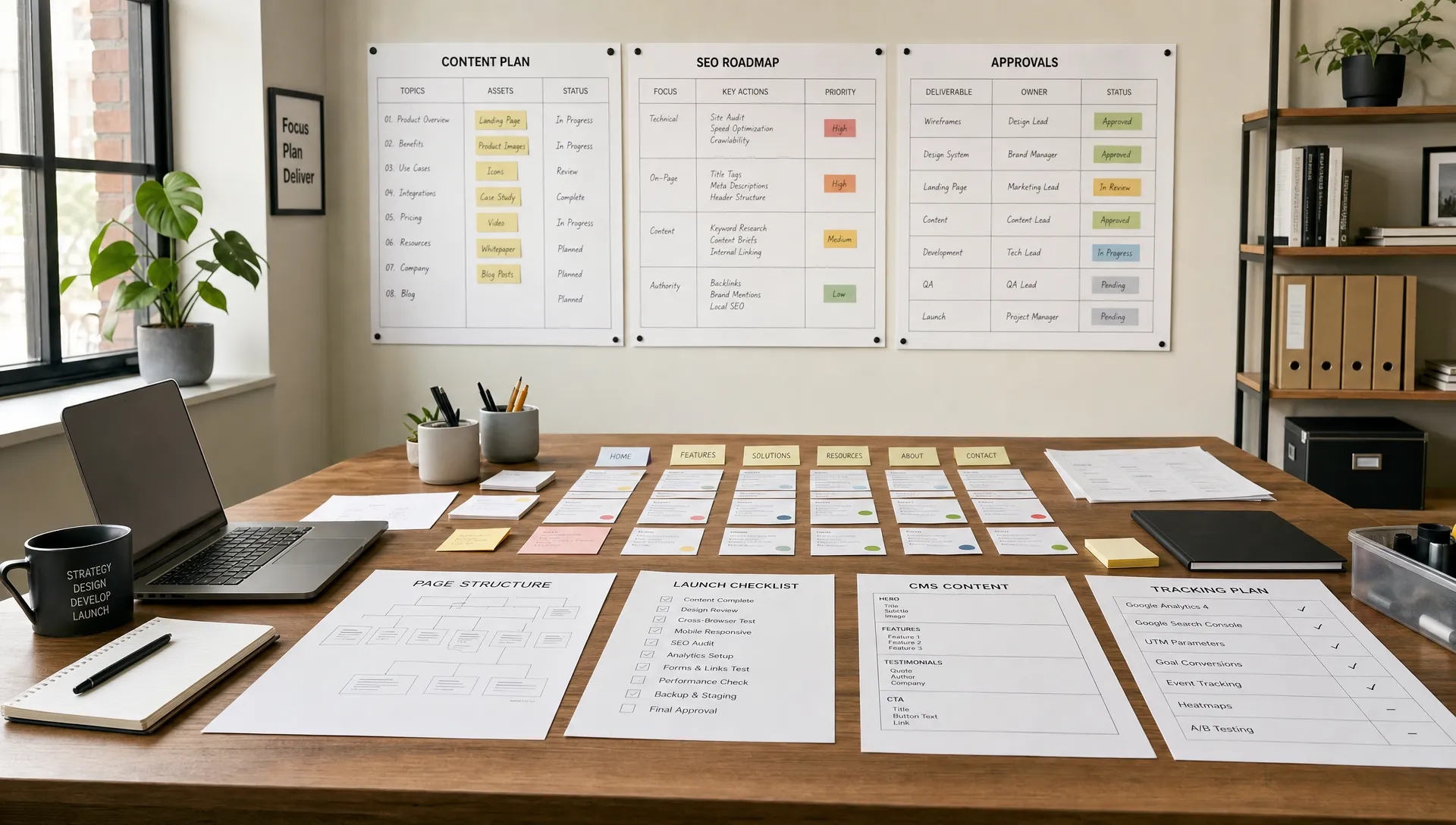
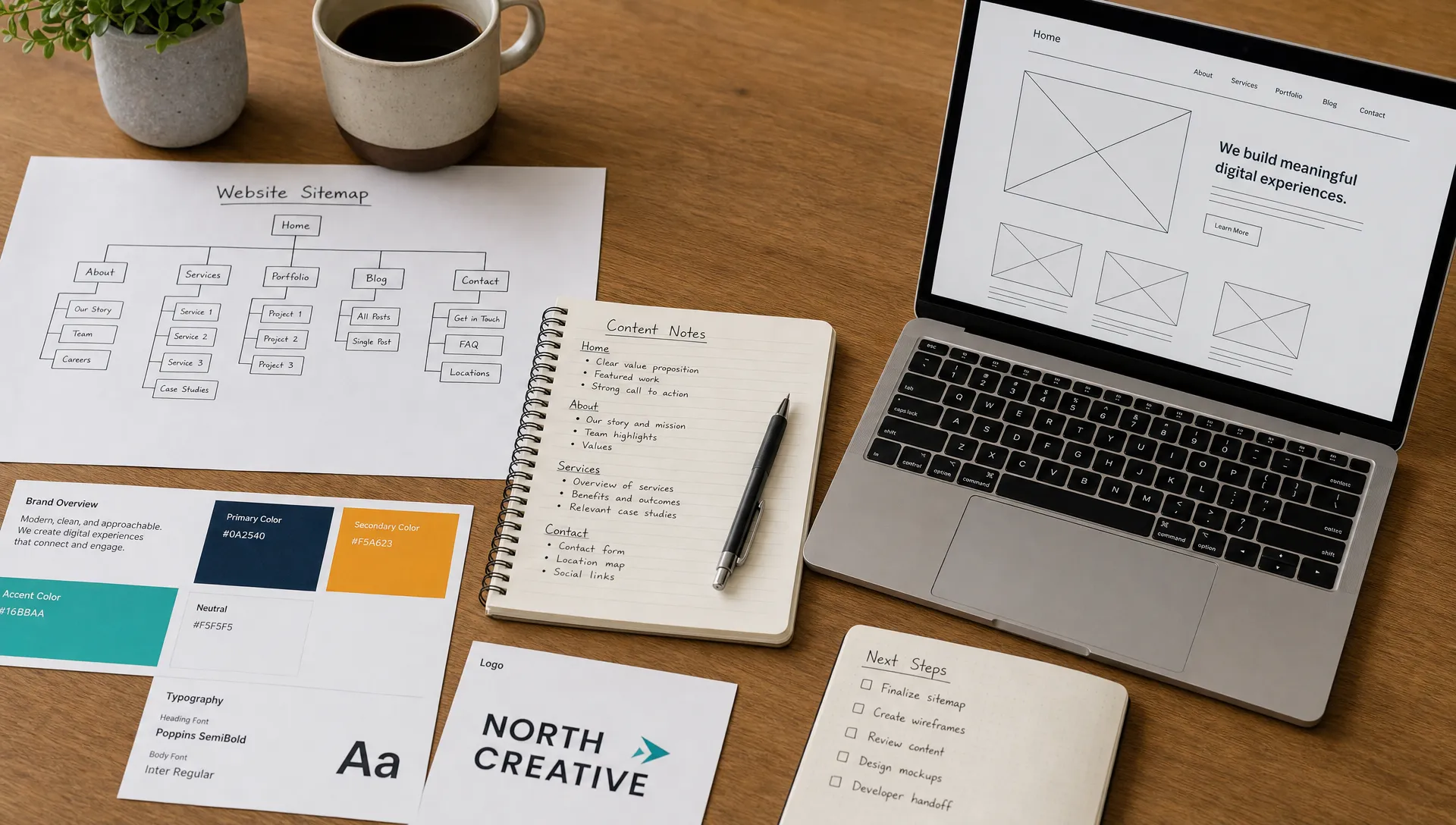
Approving visual design before validating page structure is a common source of rework. A cleaner sequence starts with goals and sitemap, then wireframes, then visual direction, then build, then pre-launch QA.
If your page hierarchy is still unclear, start with building the right website structure before you review layouts. Structure affects navigation, SEO, conversion paths and CMS logic.
Six checkpoints keep this sequence disciplined without adding bureaucracy. Each one has a clear question to answer before the project moves forward, so reviewers know exactly what they are approving at every stage.
| Checkpoint | What to confirm before moving on |
|---|---|
| Strategy checkpoint | Confirm goals, audience, positioning, required pages and success criteria. |
| Structure checkpoint | Approve sitemap, navigation, page purpose and core user journeys. |
| Wireframe checkpoint | Validate message flow, section order and conversion paths before visual polish. |
| Design checkpoint | Approve visual system, key page designs, responsive direction and reusable components. |
| Build checkpoint | Review CMS setup, interactions, forms, SEO fields, accessibility basics and performance basics. |
| Launch checkpoint | Test redirects, tracking, forms, metadata, mobile behavior, legal pages and indexability. |
For SEO and technical hygiene, use known standards rather than personal preference. Google’s Search Essentials and web.dev’s Core Web Vitals guidance are useful references for crawlability, content quality and performance basics.
The real test of control starts after the site goes live.
Your team should know how to edit common content, publish CMS items, update SEO fields, manage forms and request larger changes. If every small update requires a developer, the project was not structured for operational control. A good reference point is BeBranded’s complete guide to website maintenance, which outlines what ongoing ownership should include.
Ask for a practical handover. This can include a walkthrough, editing rules, CMS documentation, naming conventions, component usage guidance and a list of what not to edit without technical review.
For teams that publish often, the website should be built as an operating system rather than a set of static pages. BeBranded covers this in more detail in its guide to web design and maintenance for teams that publish often.
Most control problems start before design begins, and they tend to trace back to one of eight recurring patterns. Naming them early makes it easier to catch them before they cost time or budget, and the table below pairs each mistake with the reason it undermines control.
| Mistake | Why it undermines control |
|---|---|
| Hiring before defining the owner | If nobody owns final decisions, every review becomes a negotiation. |
| Starting with design inspiration instead of business goals | Visual references help, but they cannot replace audience, message and conversion strategy. |
| Treating copy as filler | Website copy shapes structure. If copy arrives too late, design decisions often need to be reopened. |
| Approving pages one by one without a system | This creates inconsistency across sections, CMS templates and responsive behavior. |
| Skipping CMS planning | A beautiful site can become frustrating if collections, fields and templates are not built around real publishing needs. |
| Leaving SEO until the end | Metadata, headings, redirects, internal links and indexability should be part of the build process, not a launch-week patch. |
| Confusing access with ownership | Having login details is not enough. Your team also needs documentation, editing rules and a clear maintenance process. |
| Expanding scope during every review | New ideas are normal, but they should be sorted into launch requirements, post-launch improvements and ideas to reject. |
If you are still shortlisting a partner, this list of Webflow certified partner agencies in France is a useful starting point for comparing vetted options rather than hiring on reputation alone.
The pattern is clear: teams lose control when decisions are vague, late or spread across too many people.
Use this checklist before contacting a website partner.
The fourteen items below turn the framework into something you can act on this week. They are grouped loosely by phase, from defining the goal to planning post-launch maintenance, and each one includes the reason it protects control.
| Checklist item | Why it matters |
|---|---|
| Write the main business goal of the website in one sentence. | Keeps every later decision anchored to a single outcome instead of five competing priorities. |
| Choose one final decision-maker for the project. | Prevents reviews from turning into open-ended negotiations. |
| Define the primary audience and their main objections. | Gives the partner the context needed to write and design with intent. |
| List the pages that must exist at launch. | Separates the core scope from ideas that can wait for a later phase. |
| Separate launch requirements from nice-to-have ideas. | Protects the timeline from scope creep during review cycles. |
| Gather brand assets, product notes, sales materials and existing analytics. | Speeds up onboarding and reduces guesswork on messaging and design. |
| Decide who owns website copy and who validates claims. | Avoids late-stage rewrites that force design decisions to reopen. |
| Define CMS needs, including blog posts, case studies, landing pages or resources. | Ensures collections, fields and templates match how your team actually publishes. |
| List required integrations such as forms, CRM, analytics, automation tools or consent management. | Surfaces technical dependencies before they become launch blockers. |
| Confirm who will own platform accounts, domains, hosting and third-party tools. | Keeps access and billing under your control after the partner moves on. |
| Agree on approval checkpoints before design starts. | Sets the review sequence so feedback happens at the right stage, not the wrong one. |
| Ask for handover documentation before signing the proposal. | Makes the operational handover a deliverable, not an afterthought. |
| Decide what your team should be able to update without external help. | Defines the boundary between self-service edits and technical review. |
| Set a process for post-launch maintenance, SEO updates and performance checks. | Keeps the site improving after launch instead of slowly going stale. |
You do not need every answer before the first conversation, but you should know which decisions are yours and which ones you expect the partner to guide.
How do I get help building a website without giving up control? Define the goal, owner, approval checkpoints, content responsibilities, platform access and handover requirements before the project starts. This gives the partner room to execute while keeping strategic decisions with your team.
Should I hire a freelancer or an agency to build my website? Hire a freelancer when the scope is narrow and you can manage the project closely. Hire an agency when you need strategy, design, build, SEO, CMS planning and integrations handled together.
What should my team always own in a website project? Your team should own business goals, final approvals, content accuracy, brand direction, platform accounts, domain access and post-launch priorities.
How detailed should a website brief be? A useful brief should explain goals, audience, required pages, content sources, technical needs and approval process. It should guide decisions without dictating every layout detail.
How do I avoid becoming dependent on the website partner after launch? Ask for a CMS built around your publishing needs, clear editing rules, documentation, platform access and a defined maintenance process.
Can no-code platforms like Webflow or Framer give my team enough control? Yes, if the site is built with reusable components, clear CMS structure, responsive rules and proper handover. The platform alone does not create control. The build process does.
Getting help with a website works when control is designed into the project from the start. That means clear ownership, a useful brief, ordered approval checkpoints, a manageable CMS and a practical handover.
Your next step is to create a one-page control brief before you evaluate any partner. If you want that brief turned into a custom Webflow or Framer website with SEO setup, CMS structure and execution handled in a focused timeline, work with BeBranded to define the right scope.