
The essentials · 30-second read
What to remember from François Dragon's talk at The Shift 01.
- GEO targets AI assistants such as ChatGPT, Claude, Perplexity and Gemini, while AIO targets Google's AI Overviews: same mechanism, different surfaces.
- SEO is not dead: it is the foundation of AIO and a pillar of credibility in GEO, and an llms.txt file alone does not help.
- Three levers: a legitimate brand, a brand mentioned outside its own site, and a site that is accessible to bots and kept fresh.
- The plan: test 10 prompts tomorrow, create or refresh 3 pages this week, fix indexing and earn 2 to 3 independent mentions within 30 days.
- According to François Dragon, GEO and SEO are one content and reputation strategy with two places where it shows.
Summarize this article with AI
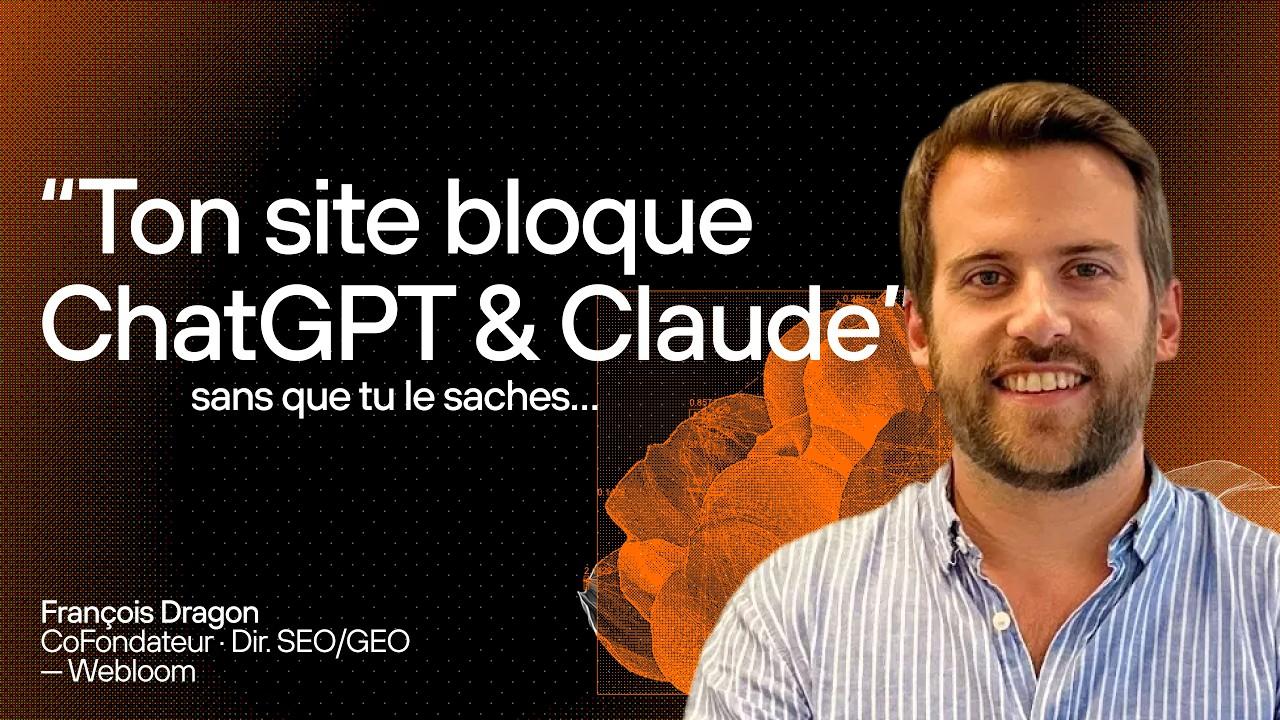
To get cited by ChatGPT and Claude, your brand has to become the answer the AI expects: a legitimate brand, mentioned by others, on a site that bots can read and that stays fresh. That is the core message of François Dragon, head of the agency Webloom, who presented three levers and a 30-day action plan at The Shift 01.
His talk, recorded on 14 September 2026 at The Shift, our SEO and GEO event, promised "3 ideas, not an overview". This guide follows the same order: how AI answers are built, the myths to drop, the levers that matter and the plan to apply from tomorrow.
Who is François Dragon?
According to his own slides, François Dragon has run Webloom since 2018. He has 20 years of SEO experience and 3 years of GEO experience. Webloom describes its approach as aligning the best consultants with the best AI agents to drive acquisition, across Google, Bing, ChatGPT, YouTube, Reddit and Meta.
The talk is available on our videos page, and the full deck can be downloaded from the conference slides. You can also visit Webloom's website.
GEO and AIO: same mechanism, different surfaces
François Dragon starts by separating two terms that are often mixed up. Both describe visibility in AI generated answers, but not in the same place.
- GEO (generative engine optimization) is visibility in AI assistants such as ChatGPT, Perplexity, Claude and Gemini. When they rely on the web (Google, Bing or Brave), they retrieve authoritative sources, then write a synthesis adapted to each user. The goal is to be a brand or a source that is selected, cited or recommended.
- AIO (AI Overviews) is visibility at the very top of the Google results page, in the generative answer Google shows there. It is closely tied to classic SEO and to the Google top 10: crawl, indexing, relevance and authority. The goal is to make a page eligible as a source for Google's answer.
His summary: same mechanism, different surfaces. If you need a refresher on the vocabulary, our GEO glossary entry covers the basics.
RAG and the index: two complementary technologies
To explain how an assistant picks its sources, François Dragon relies on RAG (retrieval augmented generation). The AI first retrieves external content, then generates its answer from it. In his words, it is the short "web search" pause you see before a ChatGPT answer or an AI Overview.
The index is one possible source. Each platform uses a different one: Google, Bing, Brave, its own crawlers or partners. AIO relies on Google only. The other assistants depend on their own choices or on third party contracts. One chapter of the video looks at Claude searching through Brave, and why ranking first there matters.
He adds an important nuance: GEO is not only about the index. The rest of the context also shapes the answer: the user's conversation history, their organisation and the model's training. A chapter of the video compares ChatGPT and Google on this point (user history and identity).
Four myths to drop
The second part of the talk is about misconceptions. François Dragon lists four things he hears too often, and answers each one.
- "SEO is dead." False, according to him. SEO is the foundation of AIO and a pillar of credibility in GEO, since assistants rely on search indexes (Google, Bing and now Brave).
- "An llms.txt file is enough." No engine officially commits to using it today. He calls it an urban legend.
- "AI makes up its answers." No: it cites sources it has found. The job is to become that source.
- "It is a topic for tech experts only." It is first and foremost a matter of content and online reputation.
The three levers to get cited by ChatGPT and Claude
The third part is the heart of the talk. François Dragon frames it as "becoming the expected answer". A bar chart on his slides gives his own estimated impact on AI citation, out of 10: about 9 for authority, about 8 for structure and about 7 for freshness. No source or method is given for these figures: they are the speaker's estimate, read from the chart.
Lever 1: your brand must be legitimate
The first lever is about covering the questions people ask before a decision: use cases, alternatives, comparisons, selection criteria, sourced figures, author and date. In the video, he sums it up as thinking brand, not website.
His examples are comparison pages published by brands themselves. One is an article by Factorial titled "The 3 best alternatives to Payfit". Another is an e-commerce page comparing hair gummies in 2026. These pages answer the exact questions prospects ask an assistant before buying. A chapter of the video also covers author pages and dates as freshness signals.
We saw the same pattern in the Crealo case study: a neutral guide on how to choose a royalty management software became one of the pages cited by AI assistants.
Lever 2: your brand must be mentioned
The second lever goes beyond your own site. Reviews, media, partners and customer feedback confirm that the brand exists and is credible. In the video, he describes it as getting people to talk about your brand everywhere.
To illustrate it, his slide shows a live answer from Claude to the prompt "best electronic signature solution". The sources Claude retrieved are comparison articles published on third party sites: obat.fr, tool-advisor.fr and go.sellsy.com. The lesson: the assistant builds its answer from pages that list and compare brands. If you are absent from those pages, you are likely absent from the answer.
Lever 3: your site must be accessible and fresh
The third lever is technical, but simple. Bots must be allowed in, and each page should serve one intent: a direct answer, a table when useful, and content that is updated often.
His slide shows an extract of a robots.txt file that blocks a list of bots with "Disallow: /", followed by a crawl delay for all user agents. It is an example of what to check on your own site. One chapter of the video makes the point explicit: do not block GPTBot and ClaudeBot. Another covers checking and updating the dates on your content.
The GEO/AIO action plan, step by step
François Dragon closes with a plan in three time frames. Here it is, close to his wording.
Tomorrow: map
- Test 10 prompts on a GEO tool, using patterns such as "best", "alternative", "how to choose" and "for [use case]".
- Write down the brands and sources that get cited.
This week: act
- Create or refresh 3 pages: a use case page, a comparison page and a buying guide.
- Add proof, a date, an author and a verifiable result.
Within 30 days: amplify
- Fix indexing issues and weak content.
- Get 2 to 3 independent mentions where your prospects look for information.
Summary table: levers and actions
| Lever | What it means, according to François Dragon | Matching actions in his plan |
|---|---|---|
| Legitimate brand | Cover the questions asked before a decision: use cases, alternatives, comparisons, selection criteria, sourced figures, author and date. | This week: create or refresh a use case page, a comparison page and a buying guide, with proof, date, author and a verifiable result. |
| Mentioned brand | Reviews, media, partners and customer feedback confirm the brand beyond its own site. | Tomorrow: note which brands and sources are cited. Within 30 days: get 2 to 3 independent mentions where prospects look. |
| Accessible and fresh site | Bots allowed, one intent per page, a direct answer, a table when useful, content updated often. | Within 30 days: fix indexing and weak content. Check robots.txt and content dates. |
| Starting point | Know where you stand before acting. | Tomorrow: test 10 prompts ("best", "alternative", "how to choose", "for [use case]") on a GEO tool. |
GEO and SEO reinforce each other
The last message of the talk is about strategy. According to François Dragon, every action taken for AI visibility also strengthens classic SEO: better content, better structure, more citations and more authority lead to better Google rankings and a better presence in AI answers.
There are not two separate strategies: there is one content and reputation strategy, with two places where it shows.
In practice, that means you do not need a separate team or budget line for GEO. The same pages, the same proof and the same mentions serve both. At the end of the talk, Webloom also offered a free workflow to check whether a site is visible on AI assistants, along with a personalised diagnosis.
How BeBranded approaches AI visibility
At BeBranded, we work on SEO and GEO, build custom websites, and set up automation and AI for our clients. We co-organised The Shift with Paloma Agency and initWeb to share practical feedback on these topics. Our approach follows the same logic as the one described here: pages that answer real buying questions, a clean technical base that lets bots in, and work on mentions outside the site. We start with an audit of the prompts where you want to appear, then prioritise the pages to create or refresh. Learn more about our GEO and AI visibility service.
Sources
- 1. François Dragon, conference slides (The Shift 01) · download.initweb.ai/conference-webloom.pdf
- 2. Webloom · webloom.fr
- 3. Video: How to get cited by ChatGPT and Claude quickly? (The Shift 01, YouTube) · youtube.com/watch?v=3fLKRV75fh8