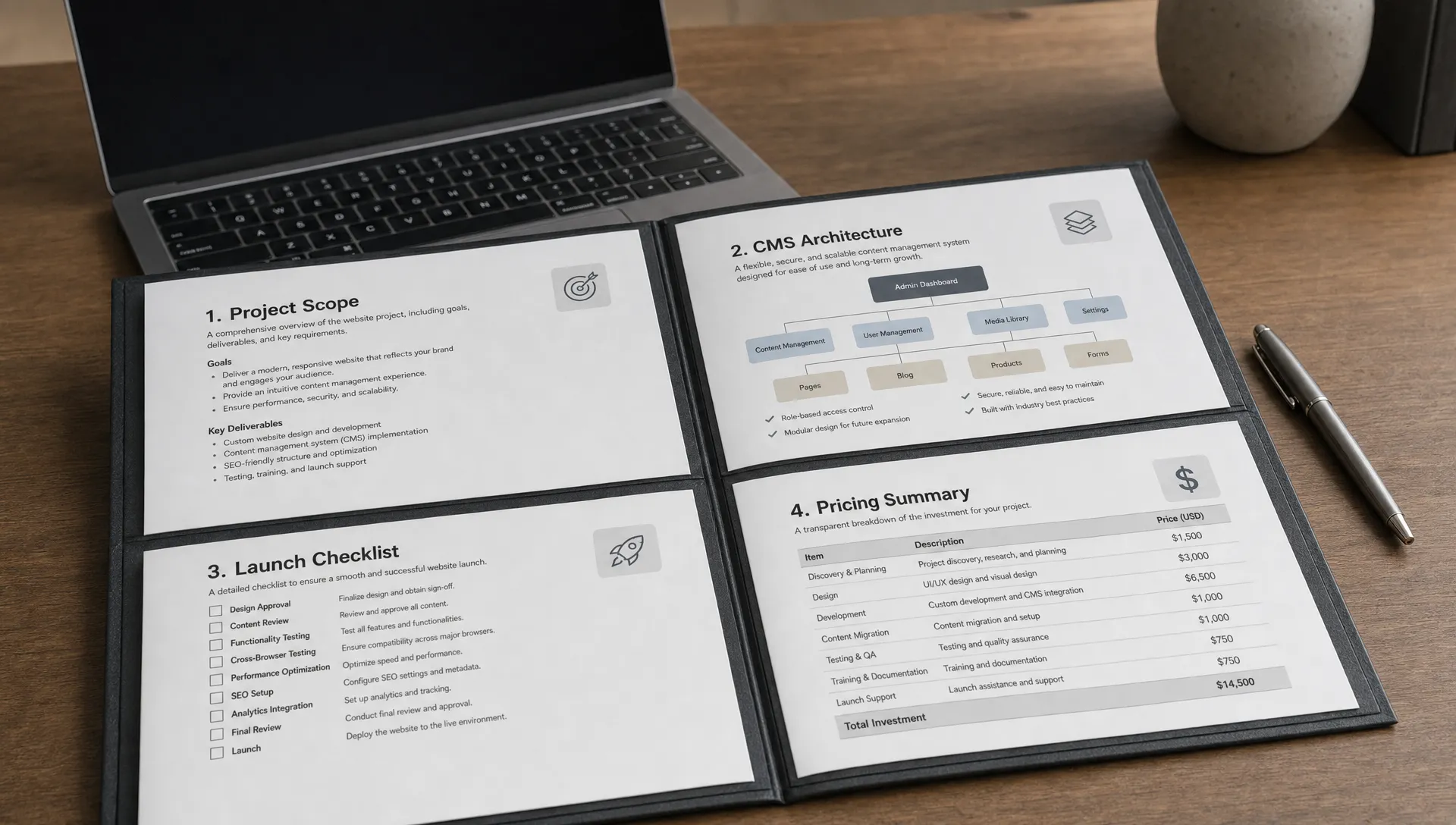
Website package pricing: what to compare before you buy
Development
•
X min
•
Published on
16.09.2026
•
Updated on
11.10.2026
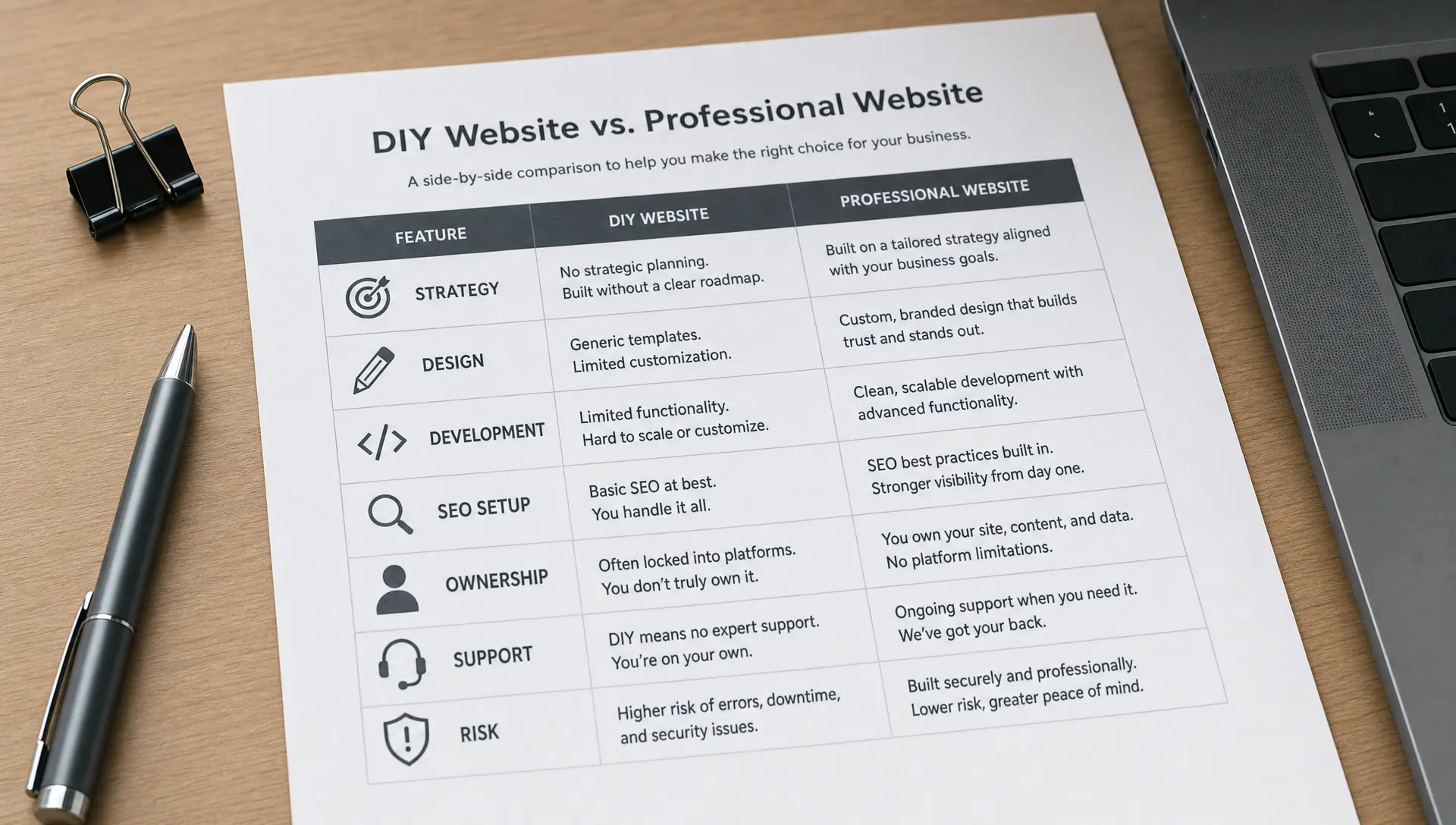
Website packages pricing can look comparable on the surface, but two proposals with the same number of pages can represent very different levels of strategy, design quality, technical setup and post-launch support. This guide gives you a practical way to compare packages before you commit, especially if you are buying for a growing business rather than a one-off online brochure.
The goal is not to find the cheapest option. It is to understand what you are actually buying, what will still be missing after launch and where hidden costs can appear later.
A website package is a bundled offer that combines several services into one commercial scope.
A useful way to read website packages pricing is to separate the visible deliverables from the operating system behind them. Pages, templates and sections are visible. Content structure, CMS logic, performance setup, SEO foundations, handover and support are less visible, but they often decide whether the site is easy to run after launch.
A package price usually reflects four things: the amount of work included, the seniority of the team, the level of customization and the level of risk the provider accepts. If one quote is much lower than another, it is usually because one of those areas has been reduced.
For broader budget context by site type, BeBranded’s guide on how much a website costs in 2026 is a useful companion before you compare specific packages.
The table below lists the six building blocks found in most packages. Read it as a map of where the work sits, not as a promise that every block is covered. For each row, the last column tells you what to verify before you buy.
| Package item | What it usually covers | What to verify before buying |
|---|---|---|
| Strategy and planning | Goals, structure, user journeys and page priorities | Whether positioning, conversion goals and sitemap decisions are included |
| Design | Visual direction, page layouts and responsive states | Whether the design is custom, template-based or adapted from an existing system |
| Development | Build in Webflow, Framer or another platform | Whether CMS, animations, forms, speed and accessibility basics are included |
| SEO setup | Metadata, headings, indexation basics and technical hygiene | Whether on-page optimization is actually done or only listed as a checklist item |
| Content | Copywriting, content upload or migration | Who writes, edits, approves and uploads the final content |
| Launch and support | QA, publishing, bug fixes and post-launch help | How long support lasts and what is excluded after go-live |
Use a structured comparison instead of scanning the final number first.
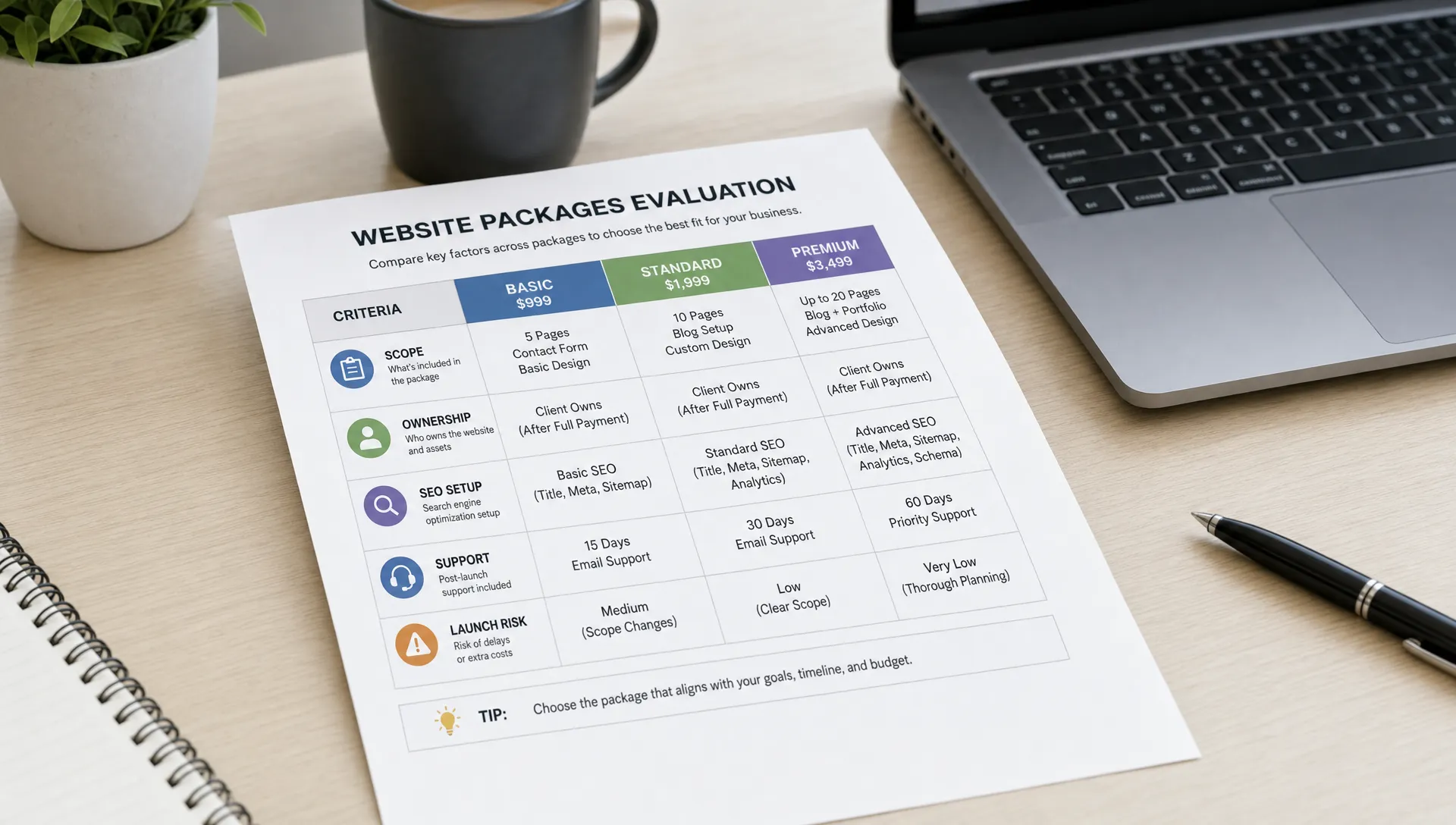
The cleanest way to compare website packages pricing is to score each proposal across five dimensions: scope, system, ownership, support and risk. This keeps the discussion practical and prevents page count from becoming the only decision criterion.
The scorecard below turns those five dimensions into questions you can put to every provider. For each line, note whether the answer is stated clearly, only implied or missing. A missing answer is not an automatic reason to reject a provider, but it is a point to resolve before you sign.
| Dimension | Question to ask | Strong answer | Warning sign |
|---|---|---|---|
| Scope | What exactly is delivered for each page and template? | A written list of pages, templates, CMS collections and exclusions | Only a page count and a total price |
| System | How will the site be structured so my team can extend it? | Reusable components, clear CMS fields and a documented class structure | Pages built one by one with no shared logic |
| Ownership | Who controls accounts, files and documentation at handover? | Client-owned accounts, a handover session and written documentation | Access kept by the provider or paid for separately |
| Support | What happens in the weeks and months after go-live? | A defined bug-fix period and clear options for ongoing help | Support mentioned without duration or limits |
| Risk | How are delays, revisions and quality issues handled? | Milestones, review rounds, acceptance criteria and a QA process | No process detail and open-ended revisions |
Scope defines what the provider is responsible for delivering.
Do not stop at “five pages” or “ten pages.” Ask what each page includes: copy support, wireframes, custom design, responsive variants, CMS fields, forms, analytics events and SEO metadata. A landing page with strategy, copy refinement and conversion-focused design is not the same scope as a static template page.
If you want to go deeper on this point, the article on how to compare web design packages beyond the page count explains why page volume alone is a weak buying metric.
A website is not just a set of pages. It is a system your team will update, measure and improve.
When website packages pricing is too vague, the system layer is usually where problems appear. For example, a package may include a blog, but not a proper CMS architecture, reusable components or author-friendly editing fields. That creates friction later when marketing needs to publish quickly.
For Webflow and Framer projects, ask how the provider structures components, classes, CMS collections, breakpoints and reusable sections. These decisions affect how easy the site is to maintain after launch.
Ownership means your business can use, edit and evolve the website without being locked into unnecessary dependency.
Clarify who owns design files, account access, CMS structure, source assets, domain settings and integrations. Also ask whether your team receives a handover session or written documentation. A lower price can become expensive if every small content edit requires paid support.
Good ownership does not mean you will never need expert help. It means routine marketing operations should not be blocked by the original provider.
Launch is not the end of a website project. It is the start of the operating phase.
Some packages include a short bug-fix period. Others include ongoing maintenance, analytics review, SEO monitoring or content support. These are not interchangeable. If support is important to your team, compare the service model directly rather than assuming it is included.
BeBranded’s guide to what website management packages should include gives a clear breakdown of protection, operations, improvement and governance after launch.
Risk is the difference between what is promised and what happens when the project gets messy.
Look for clear process details: milestones, review rounds, acceptance criteria, QA, browser testing, mobile testing, redirect planning and launch responsibilities. A proposal that explains how decisions are made is usually easier to manage than one that only lists deliverables.
For more procurement-level questions, the guide on how to compare web development services without wasting budget is worth reviewing before you sign.
A serious package should make delivery predictable without hiding important work.
For a business website, website packages pricing should usually account for discovery, information architecture, design, development, responsive build, CMS setup, SEO basics, QA and launch support. Not every project needs deep brand strategy, complex animations or custom integrations, but the proposal should say what is included and what is not.
The most useful packages are specific without being rigid. They define the baseline clearly, then explain how additional needs are handled. That matters for teams that may discover new requirements during content review, stakeholder feedback or technical implementation.
Be careful with packages that promise “everything included” without limits. In practice, every project has limits. A transparent limit is easier to manage than an undefined promise.
Some items are left out of packages more often than others, and they tend to surface as extra costs once the project is under way. The table below lists the most common ones, explains why each matters and gives you a question to put to the provider. BeBranded’s article on what website development packages often leave out goes further on this topic.
| Often excluded item | Why it matters | Question to ask |
|---|---|---|
| Copywriting and content creation | Content is often the main cause of project delays | Who writes the copy and who approves it? |
| Photography, illustration and video | Visual assets shape credibility and are rarely free | Are visual assets included or supplied by us? |
| Redirects and URL migration | Missing redirects can cost existing rankings | Who maps and tests the old URLs? |
| Third-party integrations | CRM, newsletter and booking tools add setup and testing time | Which integrations are covered and which are not? |
| Accessibility and performance testing | Both affect user experience and search visibility | What is tested before launch, and against which targets? |
| Hosting and platform plans | Platform subscriptions are usually billed separately | Which plan is required and who pays for it? |
| Extra revision rounds | Unlimited revisions are rare, and limits are often unwritten | How many rounds are included and how are more billed? |
Most poor website packages pricing decisions happen before the project starts.
The issue is rarely that a buyer chose the wrong platform. It is more often that the proposal was not interrogated carefully enough, or that internal responsibilities were unclear.
If the project is a redesign rather than a new build, the risk profile changes. Existing rankings, redirects, legacy content and stakeholder expectations all matter. BeBranded’s article on website redesign costs in 2026 explains those additional variables in more detail.
A package price rarely describes the full cost of owning a website.
The build fee is a one-off cost. Platform plans, hosting, domain renewals, paid plugins and maintenance usually recur every month or every year. When you compare two proposals, put both on the same footing by listing the recurring items next to the build fee.
For Webflow projects, the subscription tier depends on traffic, CMS size and the features you need. BeBranded’s breakdown of Webflow pricing in 2026 shows how plans translate into real annual costs.
Use this checklist before you approve a proposal or present it internally.
Before you accept website packages pricing, confirm the work in writing and make sure your internal team understands its own responsibilities. A clear package does not remove the need for client-side decisions, content approvals and timely feedback.
If maintenance is not included, budget for it separately. The guide on website maintenance pricing can help you separate small fixes from structured ongoing support.
Packages are useful when the problem is defined. They become risky when the problem is still unclear.
Website packages pricing works best for projects with a clear site type, clear decision-makers and a realistic content plan. A brochure site, marketing site, landing page system or focused redesign can often fit a package if the provider has a disciplined process.
A custom proposal is usually better when the project includes complex stakeholder alignment, unusual integrations, multiple markets, heavy migration, deep SEO recovery or a new brand system. In those cases, the discovery phase may need to happen before the final build price is fixed.
The table below sets the two buying models side by side across six criteria. Use it to decide which model fits your project before you request quotes, because the answer changes the kind of proposal you should ask for.
| Criterion | A fixed package fits when | A custom quote fits when |
|---|---|---|
| Scope clarity | Pages, templates and features are known in advance | Requirements will only become clear after discovery |
| Stakeholders | One or two decision-makers validate the work | Several teams or markets need alignment |
| Integrations | Standard forms and common marketing tools | Custom data flows, CRM logic or unusual tools |
| Migration and SEO risk | New site, or a redesign with few existing URLs | Large legacy site, ranking recovery or domain change |
| Budget certainty | You need a fixed figure to approve internally | You accept a range in exchange for a better-fitted plan |
| Brand and design depth | An existing brand can be applied to proven layouts | A new brand system or custom components are needed |
If you are unsure what your website should include, start with scope definition rather than requesting several generic package quotes. BeBranded’s guide to what website development and design services should include can help frame that conversation.
When two proposals look similar, evaluate the operating cost after launch.
The better choice is often the package that reduces dependency, makes future updates easier and gives your marketing team a cleaner foundation. A slightly lower build price can be the wrong decision if the site is difficult to edit, poorly structured for SEO or unclear to maintain.
Ask each provider to walk you through a real post-launch scenario. For example, “How would we add a new service page, publish three case studies and update a form integration?” The answer will reveal whether the package is built for ongoing marketing work or only for launch day.
Also pay attention to communication quality during sales. If the provider is vague before you sign, the project is unlikely to become clearer after kickoff.
What is website package pricing? Website package pricing is a bundled pricing model where a provider groups defined website services, deliverables and support into one offer. It should specify scope, process, responsibilities, exclusions and post-launch terms.
Why do website package prices vary so much? Prices vary because providers include different levels of strategy, custom design, development quality, SEO setup, CMS structure, integrations, revisions and support. Two packages with the same page count can have very different scopes.
Should I choose the cheapest website package? Choose the cheapest package only if it clearly covers your business goals, content needs, technical requirements and ownership expectations. A low price is not a problem by itself, but vague scope is.
What should I ask before buying a website package? Ask what is included, what is excluded, who writes content, how revisions work, how SEO is handled, who owns the assets and what support is available after launch.
Is a fixed package better than a custom quote? A fixed package is better when the project is clear and the scope is stable. A custom quote is better when discovery, integrations, migration, SEO risk or stakeholder alignment require deeper planning.
The right website package is not the one with the longest deliverables list. It is the one that gives your team a clear scope, a maintainable system, transparent ownership and a reliable launch path.
If you are comparing website packages pricing now, create a simple scorecard using the five areas in this guide: scope, system, ownership, support and risk. Then ask each provider to clarify any weak or vague area before you sign.
If you want a focused external view before committing, ask BeBranded to review your website project scope and identify what should be clarified before production starts.