What to expect from a website creation service
Development
•
X min
•
Published on
28.08.2026
•
Updated on
21.09.2026
A website creation service should give your team a clear path from business goals to a live website that can be maintained, measured and improved. If the service is framed only around page count, visual style or a vague promise to “make it modern”, the project will likely create more decisions than it resolves.
This guide explains what to expect before you hire a provider, what should happen during the project, which deliverables matter and how to decide whether a proposal is solid enough for your business.
A website creation service is an end to end process that plans, designs, builds, launches and supports a business website. It should connect strategy, user experience, content, technical setup and performance into one controlled project.
For a CEO, CMO, founder or marketing manager, the service should reduce operational friction. You should know what will be delivered, who makes decisions, what the timeline depends on and how the site will support acquisition, trust and conversion after launch.
A useful proposal will be specific about scope. If you want a deeper view of the components that belong in a serious project, BeBranded has a separate guide on what website development and design services should include.
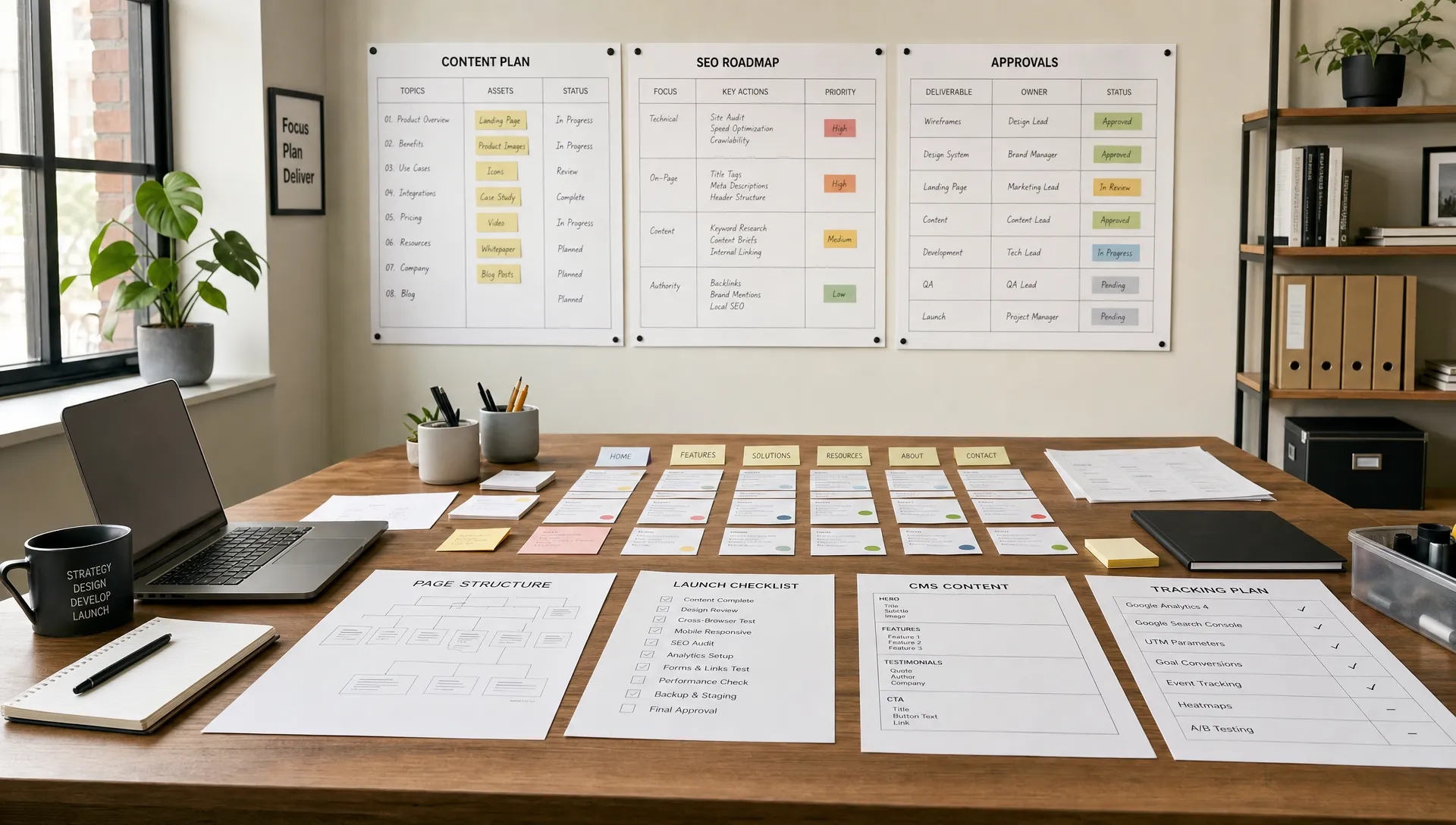
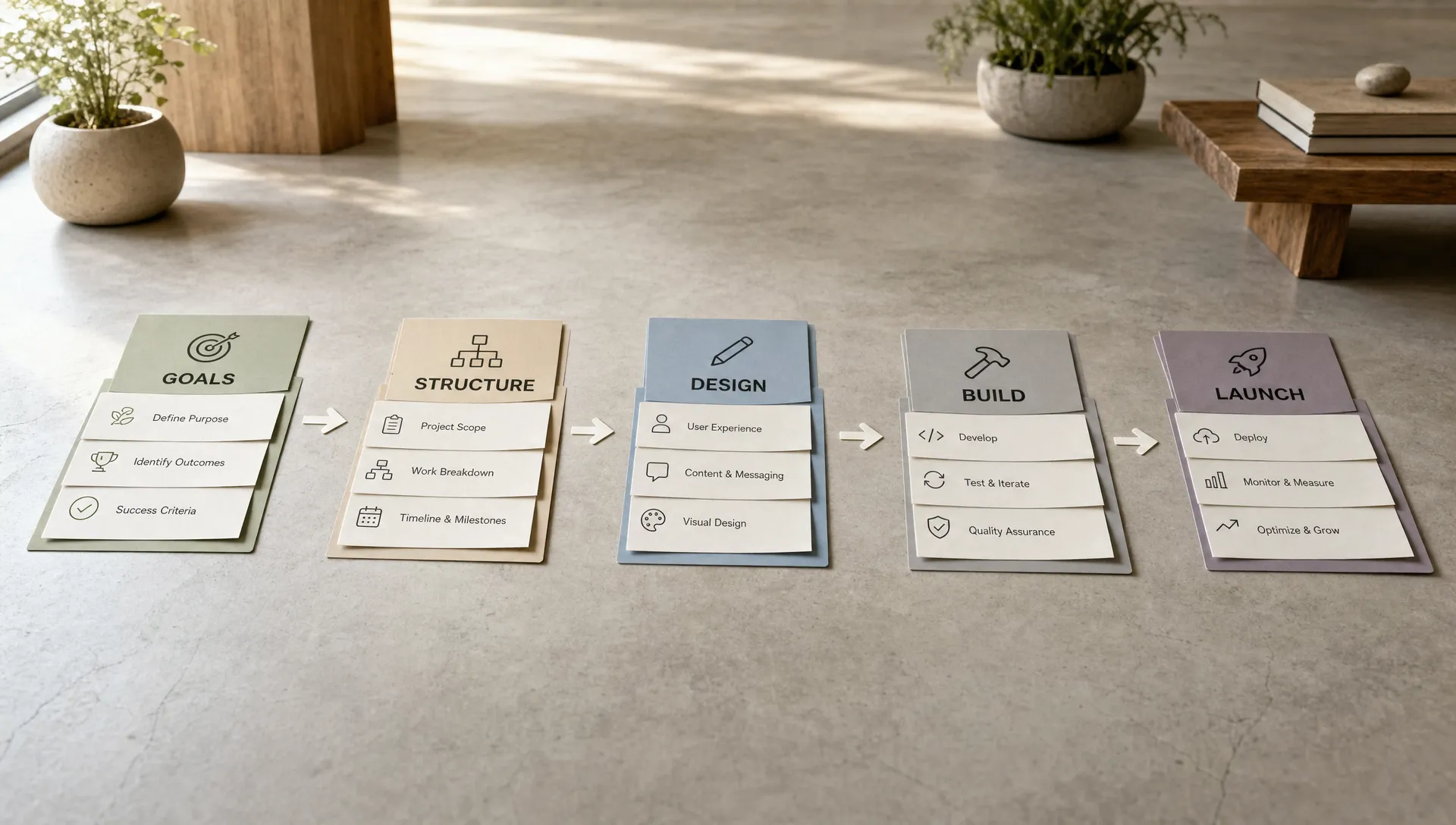
A simple way to evaluate a website project is to look at five phases: define, structure, design, develop and launch. Each phase should produce decisions, not just files.
| Phase | What the provider should deliver | What your team should decide |
|---|---|---|
| Define | Business objectives, target audience, conversion goals and success criteria | Which outcomes matter most and which audiences take priority |
| Structure | Sitemap, page hierarchy, user journeys and CMS architecture | Which pages are needed now and which can wait |
| Design | Wireframes, visual direction, responsive layouts and design system basics | Which brand direction supports credibility and clarity |
| Develop | Webflow, Framer or other platform build, CMS setup, integrations and technical SEO setup | Which tools need to connect to the website |
| Launch | Quality assurance, redirects, analytics checks, handover and support plan | When to publish and who owns updates after launch |
This framework helps you avoid judging the service by visuals alone. Good design matters, but a business website also needs clear structure, reliable editing workflows, clean technical foundations and a launch process that does not depend on improvisation.
The early phase should turn unclear expectations into a workable project scope. This is where many website projects succeed or become difficult.
Your provider should ask what the website is expected to do. The answer may be lead generation, product education, investor credibility, hiring support, partner enablement or a combination of several goals.
A strong website creation service translates those goals into conversion paths. That means defining the main actions visitors should take, such as booking a call, requesting a demo, downloading a resource, applying for a role or contacting sales.
Before design begins, the agency should help you decide which pages are needed and how they fit together. This includes the homepage, service pages, industry pages, case studies, pricing pages, contact pages, legal pages and blog or resource sections when relevant.
The sitemap should not be created only from internal preferences. It should reflect how buyers research, compare and build confidence before taking action. A smaller but clearer website often performs better than a larger site with overlapping pages and diluted messaging.
Technical questions should appear early. The provider needs to know which domain will be used, whether redirects are needed, what CMS content must be migrated, which tools need integration and whether the site must support multiple languages or regions.
SEO should also be scoped before build. At minimum, this includes indexability, metadata, headings, URL structure, image alt text, redirects, sitemap generation and performance considerations. Google Search Central’s SEO starter guide is a useful reference for the basics that should not be ignored. For a broader view of how development and SEO should be scoped together, see BeBranded’s guide on what website development and SEO services should cover.
A website creation service should produce visible progress and practical assets. You should never be left guessing what has been approved or what is still pending.
Common deliverables include the following:
If you want a structured way to prepare the inputs this list depends on, BeBranded’s guide on how to write an effective website requirements document provides a reusable template for goals, audience notes and page requirements before the first call.
Not every project needs the same depth in every area. A lean landing page does not require the same planning as a multi page website with CMS collections and integrations. The proposal should make those differences explicit.
If the service includes many design iterations, use them to refine decisions rather than reopen the entire direction every week. Iteration works when feedback is tied to goals, audience needs and conversion clarity.
A good provider should manage the process, but your team still needs to make timely decisions. Website projects slow down when feedback is unclear, late or spread across too many stakeholders.
Your team should expect to approve the main message, sitemap, visual direction, important page content, tool integrations and launch timing. The agency should prepare recommendations, but it cannot replace internal judgment on positioning, offer accuracy or commercial priorities.
Keep the decision group small. For most business websites, one internal owner should gather feedback, resolve disagreements and return consolidated comments. This avoids scattered reviews that create rework without improving the final site.
Timeline depends on scope, content readiness and decision speed. A focused marketing website can move quickly when pages, content and stakeholders are clear, while complex CMS work, migrations or integrations need more planning.
At BeBranded, focused custom Webflow and Framer projects are planned around a 2 to 4 week delivery window when the scope is clear. That kind of timeline requires fast decisions, prepared content and a provider that works with a structured process.
Communication should be predictable. You should know when reviews happen, what feedback is needed, who validates each step and what happens if the scope changes. A simple weekly rhythm is often enough if the work is well framed.

A website creation service is not always the right option. The right choice depends on the level of strategy, execution control and long term flexibility you need.
A template can be enough for a very early company that needs a quick presence and has a simple offer. A freelancer can be effective when the scope is narrow and you already have strategy, content and structure prepared. AI site builders can help generate first drafts, but they still need human decisions around positioning, UX, SEO and brand quality.
A full website creation service makes more sense when your website affects pipeline, hiring, investor perception or sales enablement. In that case, the value is coordination. Strategy, design, development, SEO setup, CMS structure and launch support need to work as one system.
The table below summarizes the trade-offs at a glance.
| Option | Best fit | Control and flexibility | Main limitation |
|---|---|---|---|
| Template | Very early stage company with a simple offer | Low, limited to template patterns | Hard to differentiate, limited SEO control |
| Freelancer | Small, well defined scope with strategy already set | Medium, depends on individual availability | Coordination falls on you, capacity risk |
| AI site builder | Fast first draft or prototype | Low to medium, still needs human review | Positioning, UX and SEO still need expert input |
| Full website creation service | Business critical sites tied to pipeline or hiring | High, coordinated across disciplines | Higher cost and longer timeline than a template |
If you are leaning toward an independent freelancer, BeBranded’s guide on how to choose a custom web developer for a Webflow project covers what to check before committing. If you are comparing agencies instead, how to choose a web design agency that fits your growth stage walks through the fit criteria.
Cost is one of the first questions any team asks, and it is also one of the hardest to answer with a single number. A website creation service spans a wide range of scope, from a short marketing page to a multi page platform with CMS collections and integrations, and price follows scope rather than the other way around.
Instead of anchoring on one figure, it helps to understand the bands most projects fall into and what typically pushes a project from one band to the next. The table below summarizes common ranges for a Webflow or Framer build. A provider should be able to explain where your project sits and why.
| Project type | Typical scope | What drives the price |
|---|---|---|
| Landing page or campaign site | One page, a few sections, light content | Copy readiness, custom animation, integrations |
| Focused marketing site | 5 to 12 pages, light CMS such as a blog | Number of templates, CMS structure, migration needs |
| Multi page business site | Service pages, case studies, CMS collections | Content volume, integrations, localization |
| Complex or multilingual platform | Multiple locales, advanced CMS, custom logic | Locale count, integration count, custom development |
For a full breakdown of what drives redesign pricing specifically, see BeBranded’s guide on website redesign cost in 2026. If you are comparing several proposals, how to compare web design packages beyond the page count explains which line items actually matter. Cost does not stop at launch either. Ongoing updates, hosting and monitoring should be budgeted separately, as covered in website maintenance pricing.
Most website project problems come from unclear decisions, not from the build tool itself. The mistakes below are common and preventable.
The table below groups these mistakes with why each one hurts the project.
| Mistake | Why it hurts |
|---|---|
| Choosing a provider based only on visual style | Ignores process, scope and strategic clarity, the factors that actually predict project success |
| Starting design before the offer, audience and core message are defined | Forces rework once positioning becomes clear |
| Treating SEO as something to add after launch | Technical debt and lost indexability are harder to fix after launch than during build |
| Ignoring CMS structure until content starts | Leads to inconsistent fields, duplicate work and a CMS that fights the design |
| Reviewing pages individually | Misses journey level issues, since a page can look right in isolation and still break the flow |
| Adding integrations late | Forces structural rework once forms, tracking and CMS fields are already built |
| Letting too many stakeholders comment without consolidation | Produces conflicting feedback and slows every review cycle |
| Launching without redirects, analytics checks and responsive testing | Creates avoidable traffic loss, broken tracking and visual bugs right after go live |
The practical way to avoid these issues is to force clarity early. Ask what will be delivered, what is excluded, what happens if scope changes and who owns each decision.
Before choosing a website creation service, use this checklist to pressure test the proposal. If several items are missing, ask for clarification before you commit.
This checklist is for provider selection. Once the build is nearly complete, use a separate pre launch process. BeBranded’s guide on setting up a website before launch explains the checks that should happen before publication.
A good proposal should make the project easier to understand. If it creates more ambiguity, it is not ready to sign.
Use a simple scoring method. Give each area a score from 0 to 2: business understanding, scope clarity, design process, development detail, SEO setup, CMS planning, communication rhythm and launch support. A proposal does not need to be long, but it should be concrete enough to score without guessing.
Also look at how the provider handles constraints. A serious partner will tell you what can be done now, what should wait and which requests may create unnecessary complexity. Saying no to the wrong ideas is part of the service.
What does a website creation service include? A website creation service usually includes discovery, sitemap planning, UX and visual design, development, CMS setup, technical SEO basics, responsive testing, launch support and sometimes maintenance.
How long does it take to create a business website? The timeline depends on scope, content readiness, integrations and decision speed. A focused website can take a few weeks, while a larger site with migration, CMS complexity or multiple stakeholders usually needs more time.
Do I need to provide all content before the project starts? You do not need every final sentence on day one, but you do need a clear offer, priority messages and ownership for content decisions. Design and structure become difficult when content responsibility is unclear.
Should I choose Webflow, Framer or WordPress? The right platform depends on your editing needs, design requirements, internal skills, SEO goals and integration stack. Webflow and Framer are often strong options for marketing sites that need fast iteration and clean visual control.
How do I know if an agency is the right fit? Ask the agency to explain its process, scope, review rhythm, SEO setup, CMS planning and launch support. If the answers are specific and easy to understand, the project is more likely to stay controlled.
A website creation service should be a structured business project, not just a production task. The outcome should be a clear website that reflects your positioning, supports conversion, gives your team a manageable editing workflow and launches without avoidable technical issues.
Your next step is to write a one page scope with your goals, required pages, content owner, CMS needs, integrations and target launch date. If you want a focused Webflow or Framer build with strategy, design, development and SEO setup handled in one process, map the scope with BeBranded.