Landing page: examples, structure and mistakes
Conversion
•
X min
•
Published on
18.03.2026
•
Updated on
02.08.2026
A landing page is a page designed with a single objective: getting the visitor to take a specific action (sign up, purchase, book a call, download). It differs from a standard page by eliminating distractions and focusing entirely on conversion. An effective landing page relies on a proven structure: a clear headline that expresses the value proposition, user-oriented benefits, trust elements (testimonials, client logos, reviews), a single visible CTA, and a clean design with no unnecessary navigation. The most common mistakes are slow loading times, cluttered design, inconsistency with the source ad, overly long forms, and missing social proof. Webflow is particularly well suited for building high-performing landing pages thanks to its custom design capabilities, native performance, and the autonomy it gives marketing teams.
Every ad campaign, every marketing email, every sponsored post sends traffic to a page. The quality of that page determines whether the traffic converts into leads, sales, or bookings, or whether it bounces without taking any action. In many cases, the problem is not traffic volume or campaign targeting. The problem is the landing page itself.
A landing page is a web page designed for a single objective: getting the visitor to take a specific action. It is not a homepage with ten menus and twenty links. It is a focused, distraction-free page built to convert. Yet many marketing teams still send paid traffic to generic pages or overloaded pages that scatter the visitor's attention.
This article covers what separates a good landing page from a bad one: the structure that works, concrete examples by objective type, the mistakes that kill conversion, and how to create a landing page that actually converts. The goal is to give you an operational framework, not a list of tools.
A landing page is a web page designed with a single, specific objective: getting the visitor to take one particular action. That action might be signing up for a newsletter, making a purchase, downloading a resource, requesting a quote, or booking a call. It is the destination to which ad campaigns (Google Ads, Meta Ads, LinkedIn Ads), marketing emails, and sponsored social media posts direct their traffic.
The fundamental difference with a standard page is focus. A homepage offers multiple navigation paths: menu, links to services, to the blog, to the about page, to the contact form. A landing page removes these distractions. It concentrates the visitor's attention on a single proposition and a single path to action. This focus is what allows it to achieve higher conversion rates than a generic page.
Several types of landing pages exist, each suited to a different objective. Lead generation landing pages (common in B2B and SaaS) aim to collect visitor contact information in exchange for a resource or access. Sales landing pages (e-commerce, online courses) target a direct purchase. Appointment booking landing pages (agencies, consultants) point toward a scheduling form. Event landing pages (webinars, product launches) target registration. App landing pages aim to trigger a download.
In short, a landing page is a page centered on a single objective, free of distractions, designed to maximize the conversion rate of a campaign or marketing funnel. Its quality has a direct impact on advertising ROI. For a deeper look at the role of landing pages in an acquisition strategy and their impact on conversion, our dedicated article covers the topic in detail.
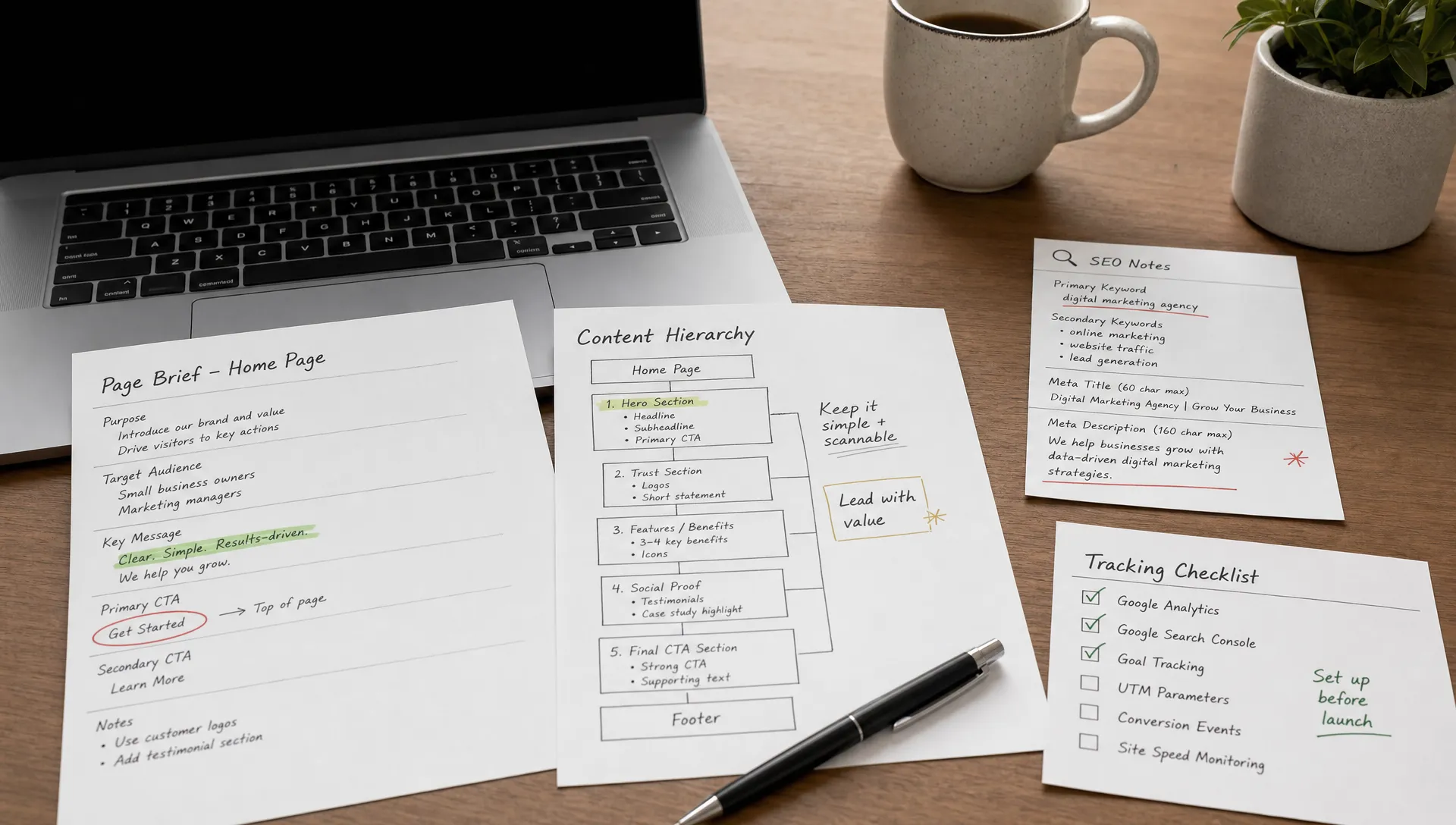
An effective landing page is not a matter of unbridled creativity. It is a matter of structure. The highest-converting pages all share the same fundamental elements, arranged in an order that guides the visitor toward the action.
The headline is the most important element on the page. It is the first thing the visitor reads, and it is this sentence that determines whether they stay or leave. A good headline expresses the value proposition in one phrase: what the visitor will get, and why it matters to them. It must be concrete, specific, and benefit-oriented. A vague headline like "The solution for your business" gives no reason to stay. A headline like "Build your website in 48 hours, no developer needed" immediately delivers a clear, verifiable promise.
The subtitle completes the headline by adding a level of detail. If the headline delivers the promise, the subtitle explains how it is fulfilled or who it is for. It should stay short (one to two sentences) and reinforce the main message without contradicting or diluting it. The headline/subtitle combination should allow the visitor to understand the offer in under five seconds.
The hero visual (image or video) must serve the message, not be decorative. A generic stock photo adds nothing. A visual that shows the product in action, the result achieved, or the context of use strengthens both comprehension and credibility. If the offer is a software tool, an annotated screenshot often works better than an abstract illustration. If it is a service, a visual showing the concrete result for the client is more effective than a generic office photo.
Benefits are not product features. Features describe what the product does. Benefits describe what the visitor gets. "Our tool sends automated emails" is a feature. "Save 5 hours per week on your email marketing" is a benefit. The benefits section should be short (three to five points), result-oriented, and framed from the visitor's perspective. It appears just after the headline/subtitle/visual block to reinforce motivation before the CTA.
Trust elements answer the visitor's implicit question: "Why should I trust you?" The most common forms are client testimonials (with name, photo, and role for greater credibility), recognizable client logos, ratings and reviews, and usage numbers. Social proof is a powerful conversion lever because it replaces sales arguments with concrete evidence. A landing page without any trust element must compensate with an extremely strong value proposition, which is difficult in a competitive market.
The CTA (call to action) is the button or link that triggers the desired action. On a landing page, it must be singular: one action offered, not three buttons pointing to three different destinations. The CTA must be visually contrasted against the rest of the page (distinct color, sufficient size), placed above the fold (visible without scrolling), and repeated further down the page for visitors who scroll. The button text should be benefit-oriented ("Book my free audit", "Download the guide") rather than generic ("Submit", "Click here"). For more on CRO principles and conversion rate optimization, our guide covers the full methodology.
If the landing page collects information (lead generation, registration), the form must be as short as possible. Each additional field reduces the conversion rate. For an initial contact, name and email are sufficient in most cases. Additional information can be collected at a later stage of the funnel. The form should be visible, well integrated into the design, and its submit button should carry the same benefit-oriented CTA text.
An effective landing page removes everything that could divert the visitor's attention from the main action. This means no full navigation menu, no footer with ten links, no sidebar, no pop-ups unrelated to the offer. Every element on the page must serve a single objective: convincing the visitor to take the action. If an element does not contribute to that goal, it should be removed.
Each type of landing page has its own specifics in terms of structure and content. Here are four archetypes covering the most common use cases.
The typical scenario is a SaaS company offering a free trial or a whitepaper in exchange for the visitor's contact information. The structure that works: a headline centered on the problem the tool solves ("Cut your reporting time in half"), a subtitle that specifies the means ("Our platform automates data collection and formatting"), a screenshot or short demo video, three key benefits in short sentences, recognizable B2B client logos, a form limited to two or three fields, and a benefit-oriented CTA ("Start my free trial").
This type of landing page relies above all on the clarity of the value proposition and the reduction of friction at the point of conversion. The short form is critical: asking for a phone number, company name, and job title at the first point of contact is often excessive friction for a simple free trial.
The typical scenario is an online course or an e-commerce product sold through an ad campaign. The structure that works: a result-oriented headline ("Master technical SEO in 4 weeks"), a subtitle that qualifies the audience ("For marketers who want to understand what their agency does"), a visual of the product or course content, a detailed benefits section (what the customer learns or gets), testimonials with concrete results, a transparent pricing section with options, a purchase CTA repeated at multiple points on the page, and a FAQ that addresses final objections.
This type of landing page is generally longer than the others, because the visitor needs to be sufficiently convinced to make a purchase. The length is justified only if every section contributes to conversion. Unnecessary sections dilute the message and increase the abandonment rate.
The typical scenario is a digital agency or consultant offering a discovery call or free audit. The structure that works: a headline centered on the result for the client ("A Webflow site that turns visitors into customers"), a subtitle that builds credibility ("Over 50 projects delivered for startups and SMBs"), a visual showing examples of completed work, three to five benefits of working with the agency, client testimonials, an integrated scheduling tool (Calendly or equivalent), and a single CTA ("Book a 30-minute slot").
The specificity of this type of page is that the visitor is committing to a human interaction, which raises the trust threshold. Trust elements (completed projects, testimonials, certifications) are even more important here than on a resource download page. Our portfolio concretely illustrates what can be achieved with this approach.
The typical scenario is an upcoming webinar or a new product launch. The structure that works: a headline that announces the event and its value ("How to cut your landing page launch time in half"), the date and time displayed prominently, speakers with their name and title, what the participant will learn (three to four points), a short registration form (name, email), and an action-oriented CTA ("Reserve my spot").
The specific constraint of this type of page is time urgency. The event has a date, which naturally creates a sense of scarcity. The design should highlight this time dimension without resorting to artificial pressure. A subtle countdown can help, but it does not replace the quality of the promise.
The first mistake is slow loading time. When a visitor clicks on a paid ad, they expect to see the content in under three seconds. Beyond that, the abandonment rate increases rapidly, and the ad budget is wasted. The technical performance of the landing page is not a developer detail: it is a direct conversion factor. Performant hosting and clean code make a measurable difference.
The second mistake is a cluttered design. Too many visual elements, too many colors, too much text, and too many animations dilute the message and tire the visitor. A landing page is not a homepage or a brochure. The design must serve conversion, not aesthetics for its own sake. Every visual element must have a functional justification: guiding the eye toward the CTA, illustrating the benefit, or reassuring the visitor.
The third mistake is inconsistency between the ad and the landing page. If the ad promises "a free SEO audit within 24 hours" and the landing page talks about "our digital consulting services," the visitor loses trust and leaves the page. The landing page message must mirror the ad's promise exactly, with the same terms and the same angle. This consistency is one of the most underestimated factors in campaign optimization.
The fourth mistake is offering too many CTAs or positioning them confusingly. Two buttons with different texts ("Learn more" and "Request a quote") create hesitation. A single CTA, repeated at multiple points on the page with the same text, guides the visitor toward the action without ambiguity.
The fifth mistake is an overly long form. Each additional field adds friction. Asking for name, email, phone, company, job title, budget, and timeline at the first point of contact is an effective way to drive visitors away. The right approach is to collect the minimum at first contact, then qualify progressively.
The sixth mistake is the absence of trust elements. A visitor arriving on a landing page via an ad often does not know the company. Without testimonials, without client logos, without proof of credibility, the page asks for a leap of faith that few visitors are willing to make. Social proof is not a bonus: it is a structural element of conversion. Our complete guide to CRO details how to optimize every element of a page to maximize conversions.
The seventh mistake is not optimizing for mobile. A significant share of ad traffic comes from mobile devices. A landing page that displays poorly on a smartphone, with buttons that are too small, text that overflows, or a form that is difficult to fill in, loses a significant portion of its potential conversions. Responsive design is not optional. It is a prerequisite.
The tool you choose to build a landing page has a direct impact on three factors: speed to launch, quality of the result, and the team's autonomy to iterate. Webflow checks all three boxes better than most alternatives, and the reasons are concrete.
The first advantage is 100% custom design. Webflow does not limit you to rigid templates. The design team creates exactly the page they envisioned, with no compromises on layout, typography, spacing, or interactions. This fidelity between the mockup and the final result is difficult to achieve on WordPress without custom development, which means additional time and budget.
The second advantage is native performance. Webflow hosts sites on its global CDN with automatic SSL and clean, optimized code. Landing pages load fast, which reduces abandonment rates and improves Google Ads Quality Scores. There are no unstable plugins weighing down the page, no server to configure, and no cache to set up manually.
The third advantage is native responsive design. Webflow allows precise control over the display at each breakpoint (desktop, tablet, mobile). Responsive adjustments are made visually in the Designer, ensuring the landing page displays correctly on all devices with no surprises at launch.
The fourth advantage is marketing autonomy. Once the landing page is built, the marketing team can modify texts, images, CTAs, and forms directly in the Editor, without going through a developer. This is a considerable time saver when iterating on A/B tests or adapting the message to a new segment. For teams that want to push engagement further, GSAP animations integrated into Webflow allow adding advanced effects without external dependencies.
The fifth advantage is integrated SEO and tracking management. Webflow gives native control over title tags, meta descriptions, Open Graph tags, and tracking scripts (Google Analytics, Meta Pixel, LinkedIn Insight Tag). Everything is configured in the interface, without plugins and without conflict risks. For organic landing pages (non-paid), this is a structural advantage. For paid campaigns, easy tracking integration ensures reliable conversion monitoring.
A landing page that converts is not a matter of luck or unbridled creativity. It is a matter of structure, clarity, and consistency. The fundamental elements are well established: a headline that expresses the value proposition, user-oriented benefits, social proof, a single visible CTA, and a distraction-free design. The most common mistakes (slow loading, cluttered design, inconsistency with the ad, overly long forms) are avoidable when you know the method.
Webflow is today one of the best-suited tools for building high-performing landing pages: custom design, native performance, built-in responsive, marketing autonomy, and easy tracking. It is the platform we use at BeBranded for all our site creation and landing page projects.
If you have an upcoming campaign and want a landing page designed to convert, you can get in touch with us for an initial conversation about your project. We will start from your goals and your campaign to build a page that maximizes your ROI.