GSAP: complete guide to web animation in 2026
Design
•
X min
•
Published on
05.03.2026
•
Updated on
17.08.2026
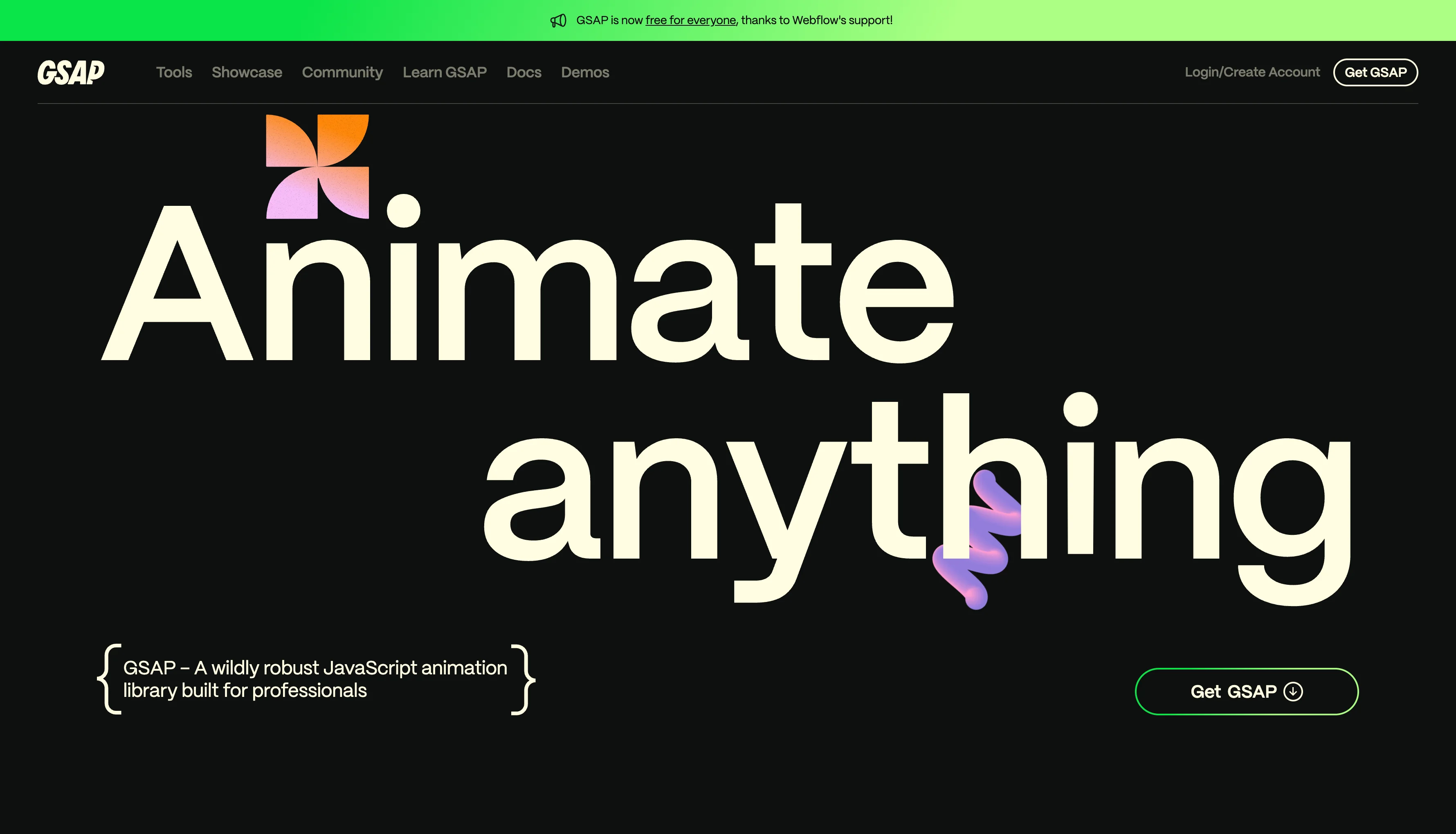
GSAP (GreenSock Animation Platform) is the leading JavaScript library for advanced web animations. Acquired by Webflow in October 2024, GSAP is now entirely free, including all formerly premium plugins (ScrollTrigger, SplitText, MorphSVG, and more). Native integration into the Webflow Designer is under active development. In the meantime, GSAP can already be activated in any Webflow project and used through custom code. This article covers what GSAP enables, which plugins to prioritize, how to integrate it into a Webflow project, and where to start.
GSAP is a term that comes up in virtually every conversation about web animation. If you have ever seen a site with text that reveals itself on scroll, elements that reposition fluidly, or SVG illustrations that transform in real time, there is a strong chance GSAP is behind it.
Since Webflow acquired GreenSock in October 2024, the landscape has shifted. GSAP became 100% free (premium plugins included), and a native integration into the Webflow Designer is in progress. For teams that use Webflow, or are considering it, understanding GSAP is no longer optional. It is the tool that determines what is possible in terms of animation and interaction on a site.
This article covers the essentials: what GSAP is, why it dominates web animation, which plugins to know, how to use it concretely in Webflow, when to choose it over CSS animations or native interactions, and how to get started without getting lost.
GSAP (GreenSock Animation Platform) is a JavaScript library specialized in web animation. It provides precise control over the movement, transformation, and transition of any DOM element: text, images, SVGs, interface components.
Unlike CSS animations, which work declaratively (you define a start state and an end state, the browser handles the transition), GSAP offers full programmatic control. You can chain animations in a timeline, synchronize sequences, react to scroll position, animate CSS properties that are not natively animatable, and adjust behavior in real time.
The basic syntax is deliberately simple. To move an element 200 pixels to the right over one second, the code looks like this:
gsap.to(".box", { x: 200, duration: 1 });This simplicity is deceptive: under the hood, GSAP handles render optimization, cross-browser compatibility, GPU-accelerated transforms, and the sequencing of dozens of simultaneous animations. It is a tool that remains approachable for a simple animation but holds up on complex projects with hundreds of animated elements.
Compared to Webflow's native interactions, GSAP operates in a different category. Webflow interactions cover common use cases (hover, scroll-based appearances, click) without code. GSAP comes in when you need complex sequences, precise timing control, or types of animations that native interactions cannot achieve (SVG morphing, letter-by-letter text animation, sophisticated scroll-driven timelines).
Several factors explain GSAP's dominant position in the web animation ecosystem.
The first is performance. GSAP is optimized for browser rendering and leverages GPU-accelerated transforms wherever possible. Benchmarks show significantly better results compared to jQuery-based approaches or direct style manipulation. On pages with many animated elements, this difference translates directly into perceived smoothness for the user.
The second is compatibility. GSAP works across all modern browsers, including mobile versions. It is framework-agnostic: it works with React, Vue, Next.js, Svelte, or vanilla JavaScript. This means investing time in learning GSAP does not lock you into a specific tool or framework.
The third is the plugin ecosystem. ScrollTrigger, SplitText, MorphSVG, ScrollSmoother, Flip, DrawSVG, MotionPathPlugin. Each plugin addresses a specific use case and integrates into the same system of timelines and easing. Together, they form a complete toolkit where most alternatives only cover part of the need.
The fourth is the community and documentation. GSAP's official documentation is considered one of the best in the front-end ecosystem. Interactive examples on CodePen number in the tens of thousands, and video tutorials (Finsweet, Timothy Ricks, among others) specifically cover integration with Webflow.
GSAP is used on over 12 million sites. It is not a niche tool reserved for animation specialists: it is a de facto standard.
GSAP on its own handles basic animations (movement, opacity, scale, rotation, color). Plugins extend its capabilities to address specific use cases. Since the Webflow acquisition, all plugins are free, including those that were previously reserved for paying Club GreenSock members.
ScrollTrigger is the most widely used plugin. It lets you trigger animations when an element enters the viewport, synchronize an animation with scroll position (scrub), and pin an element to the screen while the user scrolls. It is the plugin that makes possible the scroll-driven storytelling experiences seen on product sites and landing pages.
SplitText splits a text block into individually animatable characters, words, or lines. It was recently rewritten from scratch (lighter, faster, with new options like autoSplit and improved accessibility handling). It is the tool behind titles that reveal letter by letter or word by word.
ScrollSmoother adds smooth scrolling to an entire page, with the ability to create parallax and differential speed effects between elements. It works alongside ScrollTrigger.
MorphSVG transforms one SVG shape into another fluidly. It is useful for icon transitions, animated illustrations, and graphic elements that change state.
DrawSVG animates the drawing of an SVG path, as if a line were being drawn in real time. It appears in icon animations, explanatory diagrams, and signature effects.
Flip handles repositioning animations within the DOM. When an element changes position (for example in a grid filter or layout rearrangement), Flip creates a smooth transition between the previous state and the new one.
MotionPathPlugin lets you animate an element along a defined SVG path. It is useful for journey animations, progress indicators, or elements that follow complex trajectories.
Here is a summary table:
| Plugin | Core function | Typical use case |
|---|---|---|
| ScrollTrigger | Trigger and synchronize animations on scroll | Scroll-driven storytelling, progressive reveals, pinned sections |
| SplitText | Animate individual characters, words, or lines | Letter-by-letter title animations, text reveal effects |
| ScrollSmoother | Smooth scrolling + parallax | Immersive pages, depth effects, differential scrolling speeds |
| MorphSVG | Morph between SVG shapes | Icon transitions, animated illustrations, state changes |
| DrawSVG | Animate the drawing of an SVG path | Animated icons, progressive diagrams, signature effects |
| Flip | Layout repositioning animations | Grid filters, dynamic rearrangements, layout transitions |
| MotionPathPlugin | Animate an element along an SVG path | Progress indicators, complex trajectories, journey animations |
In October 2024, Webflow acquired GreenSock, the company behind GSAP. This was not a minor acquisition: over 100,000 Webflow sites were already using GSAP through custom code before the deal.
The most immediate change is full, unrestricted access. Before the acquisition, the most powerful plugins (SplitText, MorphSVG, ScrollSmoother, DrawSVG, among others) required a paid Club GreenSock membership. Since the acquisition, everything is free, including for commercial use, including outside of Webflow. GSAP remains a publicly available library accessible to all developers, regardless of their tech stack.
The GreenSock team, including Jack Doyle (GSAP's creator) and Cassie Evans, joined Webflow. The stated goal is to integrate GSAP natively into the Webflow Designer, allowing users to create GSAP animations directly in the visual interface without writing code. This full visual integration (GSAP timeline in the Designer) is still under development.
In the meantime, GSAP can already be activated in any Webflow project directly from the Designer. A Webflow designer can use GSAP today in two ways. The first: activate GSAP in the project settings and write custom code in the head or body sections (or in an embed code block). The second: use third-party tools like Finsweet Attributes or community-shared snippets that encapsulate common GSAP patterns.
For teams evaluating site-building platforms, this integration strengthens Webflow's position compared to alternatives like Framer, which offers its own animation tools but without the GSAP ecosystem. It is also a factor to consider when choosing a no-code platform for projects that require advanced animations.
Three approaches coexist for animating a website, and they are not interchangeable. Each has a scope where it is the most relevant.
CSS animations are native to the browser, require no external library, and are well suited to simple transitions: hover effects, fade-ins, color changes, subtle movements. They are performant and lightweight. Their limit: as soon as you need to sequence multiple animations, synchronize with scroll position, or animate non-standard properties, they become difficult to maintain and control.
Webflow interactions are the built-in tool in the Designer. They allow you to create animations triggered by events (scroll, click, hover, page load) without writing code. They cover a wide range of common cases and are accessible to non-developers. Their limit: they do not offer the same level of control over timing and sequencing as GSAP, and certain types of animations (SVG morphing, letter-by-letter text animation, complex scroll-driven timelines) are not achievable with native interactions alone.
GSAP offers the finest control: complex timelines, custom easing, scroll synchronization, advanced CSS property animations, SVG morphing, text animations, physics. It requires JavaScript (or at minimum custom code in Webflow), which means a steeper learning curve.
In practice, these three approaches combine well. CSS animations handle micro-interactions (hover, focus). Webflow interactions cover scroll-based appearances and simple transitions. GSAP takes over for complex sequences, immersive pages, and effects that define a site's visual identity.
| Criteria | CSS animations | Webflow interactions | GSAP |
|---|---|---|---|
| Code required | CSS only | None (visual interface) | JavaScript |
| Learning curve | Low | Low to medium | Medium to high |
| Timing control | Basic | Moderate | Full (timelines, sequences, custom easing) |
| Scroll-based animations | Limited (recent scroll-driven) | Yes (scroll into view) | Advanced (ScrollTrigger, scrub, pin) |
| SVG morphing | No | No | Yes (MorphSVG) |
| Text animation | No (not natively) | Limited | Yes (SplitText) |
| External dependency | None | None (built into Webflow) | JS library (~25 KB min.) |
| Best for | Micro-interactions, hover, simple transitions | Scroll appearances, common UI interactions | Complex sequences, immersive pages, custom effects |
The GSAP learning curve is real, but it is gentler than many expect. The basic syntax (gsap.to, gsap.from, gsap.fromTo) is readable and results are visible immediately.
The best resource to start with is the official GSAP documentation (gsap.com/docs). It contains interactive examples for every method and every plugin. The "Getting Started" section covers the fundamentals in under an hour.
For Webflow users specifically, videos by Timothy Ricks and Finsweet tutorials show how to integrate GSAP into a Webflow project step by step, with concrete examples tailored to the Designer workflow.
A suggested progression for a first project:
The most common mistake is trying to learn everything at once. GSAP is a vast ecosystem. The right approach is to master the fundamentals (to, from, timeline, ScrollTrigger), then add plugins as projects require them.
GSAP is a powerful tool, but it is not without pitfalls. Here are the mistakes and limitations to be aware of before integrating it into a project.
The first mistake is animation overload. The fact that GSAP makes animations easy to create does not mean everything should be animated. A site where every element moves on scroll ends up tiring the user and losing readability. The best practice: reserve GSAP animations for elements that serve comprehension, visual hierarchy, or conversion. Everything else can rely on basic CSS animations or nothing at all.
The second is neglecting mobile performance. Complex animations (particularly with ScrollSmoother and heavy parallax) can become resource-intensive on mobile devices. It is common to simplify or disable certain animations on mobile breakpoints, using the matchMedia features built into ScrollTrigger.
The third is ignoring accessibility. Animations can be problematic for users who enable "prefers-reduced-motion" in their system settings. GSAP does not handle this automatically. It is the developer's responsibility to detect this preference and adapt or disable animations accordingly.
The fourth is underestimating the JavaScript learning curve. GSAP simplifies many things, but it remains a JavaScript library. For a Webflow designer accustomed to working exclusively in the visual interface, the shift to custom code represents a real step. It is achievable, but it requires a time investment in learning that should be planned for.
Finally, GSAP adds weight to the page. The core is lightweight (around 25 KB minified), but each plugin added increases the bundle size. On a project where load time is critical, you should load only the plugins actually used and avoid importing the entire library "just in case."
GSAP is particularly well suited to certain types of pages and experiences. Here is where it delivers the most value.
Scroll-driven storytelling pages are the most visible use case. A SaaS product that breaks down its features into animated sections as the user scrolls, a brand that walks through its manufacturing process with elements that appear, move, and transform. ScrollTrigger and SplitText are the primary tools for this type of page.
High-conversion landing pages benefit from targeted animations: a heading that reveals fluidly, a CTA that draws attention with subtle motion, social proof that appears progressively. The goal is not to make things "pretty" but to guide attention toward the elements that matter for conversion.
Text animations on scroll have become a modern design standard. A title that reveals word by word as the user scrolls, paragraphs that appear line by line. SplitText combined with ScrollTrigger makes this achievable in a few lines of code.
Parallax effects (elements moving at different speeds during scroll) create a sense of depth and immersion. ScrollSmoother handles this performantly.
Animated preloaders (loading screens with a transition animation before content appears) use GSAP timelines to coordinate the loader's disappearance and the page elements' appearance.
Navigation micro-interactions (menus opening with fluid animation, indicators following the cursor, page transitions) leverage GSAP's fine control over timing and easing.
GSAP is the most complete and most widely used web animation library on the market. Since its acquisition by Webflow and its shift to full, free access, it is also the most accessible. For teams using Webflow, it is a tool that pushes the boundaries of what is achievable in terms of animation and interaction, well beyond native interactions.
The starting point is simple: activate GSAP in your Webflow project, master the fundamentals (to, from, timeline), add ScrollTrigger and progress step by step toward specialized plugins based on the concrete needs of your projects.
If you have a Webflow project that requires advanced animations, whether immersive product pages, scroll-driven storytelling, or brand animations, and you want support with design and integration, you can get in touch with our team for an initial conversation.