


The essentials · 30-second read
Magic (magic.link) gives your app embedded crypto wallets behind a simple login. Free: 1,000 monthly active wallets. Startup: $99 a month for 2,500. Enterprise on quote.
- Embedded, non-custodial wallets created behind an email, SMS, social or passkey login, plus server wallets via API.
- Developer plan free with 1,000 monthly active wallets and 50,000 signatures; Startup at $99 a month with 2,500 wallets; Enterprise on quote.
- Keys are split and used inside trusted execution environments; Magic states SOC 2 Type 2 and ISO 27001:2022.
- Our verdict: a sound choice when your product truly needs on-chain wallets; unnecessary for a classic login.
Summarize this page with AI
Magic is one of the tools that make web3 usable by people who have never owned a crypto wallet. Instead of asking users to install an extension and store a seed phrase, your app gives them a wallet behind an email, SMS, social or passkey login. This review explains what Magic (magic.link) does in 2026, what it costs, how it secures keys, and when you do not need it at all.
01What is Magic?
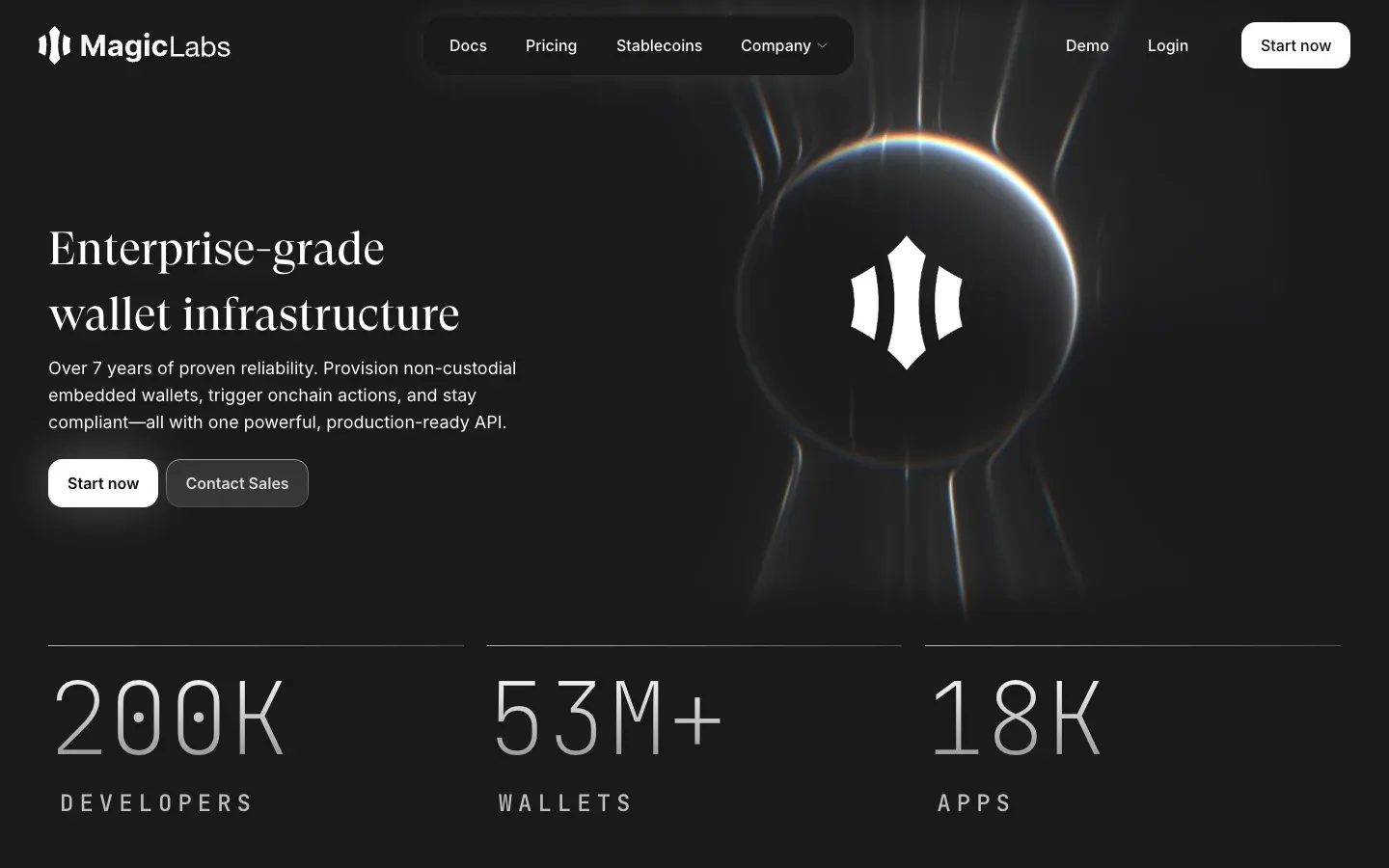
Magic is a developer platform from Magic Labs, a San Francisco company that has operated since 2018. It provides wallet and authentication infrastructure for web3 apps: embedded wallets that users unlock with a familiar login, server wallets that your backend controls through an API, and tools such as token gating and a fiat on-ramp. Its site claims 200,000 developers, more than 53 million wallets and 18,000 apps.
The name is ambiguous, so to be clear: this page is about Magic at magic.link. It is not Magic Eden (an NFT marketplace), nor the many other products with "Magic" in their name. People who search for "magic web3" or "magic crypto website" are usually looking for this one.
Magic is also the company behind the Newton Protocol, a policy protocol "led by Magic Newton Foundation and developed by Magic Labs" that aims to verify that on-chain actions stay within predefined rules, and it now promotes stablecoin payments. The core product most developers use remains the embedded wallet.
02How Magic works
- The user signs in with email (one-time code), SMS, a social account, a passkey, Farcaster or an external wallet. You can use Magic's own authentication or bring a provider such as Auth0, Firebase or NextAuth.
- Magic provisions a wallet for that user, or retrieves the existing one, in roughly 50 to 100 milliseconds according to Magic.
- The app asks the wallet to sign a message or a transaction. Keys are split and encrypted across isolated services, and reconstruction and signing happen inside trusted execution environments (TEEs).
- The user can export the key if they want to leave, which is what makes the wallet non-custodial in Magic's model.
For backend use cases (agents, payouts, treasury), server wallets follow the same logic through an API: the Express API for quick development with JWT authentication, and the Core API with AWS Nitro TEEs and JWT-bound key management for more control.
03How we look at Magic at BeBranded
We do not use Magic in our own stack, and we do not build crypto products every month. We come across it when a client wants to add blockchain features to a web app or an MVP, and our role is to say whether it is needed.
- We consider Magic when users must own on-chain assets (tokens, NFTs, stablecoins) or prove ownership to unlock content, and when those users are not crypto natives. A login they already understand removes the main drop-off point.
- We advise against it when the "web3" part is only a marketing idea. If nobody needs a wallet, a standard login with Supabase or Firebase is simpler, cheaper and easier to explain to users.
- We compare it with thirdweb and similar wallet providers on three points: the chains you need, the pricing unit at your expected volume, and who controls the key shares.
Whatever the choice, the wallet is one brick of the product. The rest (accounts, payments with Stripe, admin, emails) is ordinary integration and API work.
04Key features
- Embedded wallets: non-custodial wallets for users and agents, with transaction signing, personal signatures, key export and white-label UI options.
- Login methods: email one-time codes, SMS, social logins, passkeys, Farcaster, SSO and external wallets.
- Server wallets: wallets controlled by your backend through the Express API or the Core API.
- Multi-chain: more than 30 networks for embedded wallets; EVM chains, Solana and Bitcoin for server wallets.
- Token gating: unlock pages or features for holders of a given token or NFT.
- Fiat on-ramp: let users buy crypto with a card inside the flow.
- Wallet UI widgets: ready-made interface components to show balances and actions.
- SDKs: web, iOS, Android, React Native, Node.js and Python.
- Security and compliance: TEEs, configurable sharding, customer-supplied encryption context, SOC 2 Type 2 and ISO 27001:2022, with CCPA and GDPR commitments.
05Use cases
Onboarding mainstream users to a web3 app
A marketplace or a game wants players to own items on-chain but loses most of them at the "install a wallet" step. With Magic, the player signs in with email and has a wallet straight away. What to know: you still need to explain gas fees, or sponsor them, and plan what happens when a user loses access to their email.
Token-gated content and communities
A creator or a brand wants holders of an NFT to access a private page, a discount or a community. Magic's token gating checks ownership after login. Keep the gated content on your own site or app, and test what non-holders see.
Loyalty and digital collectibles
Brands use on-chain collectibles as loyalty rewards. Magic creates the wallet silently, so the customer only sees "your rewards". The legal and tax treatment of tokens depends on your country: check it before launch.
Stablecoin payments and payouts
Apps that pay creators or freelancers in stablecoins can create a server wallet per recipient or per treasury through the API. Magic now promotes stablecoin payments on its site; compliance (KYC, sanctions screening) remains your responsibility.
AI agents that hold wallets
Magic markets wallets "for users and agents". An AI agent that must pay or sign on-chain can use a server wallet with policies. This is still a young use case: limit amounts and log every signature.
06Magic pricing in 2026
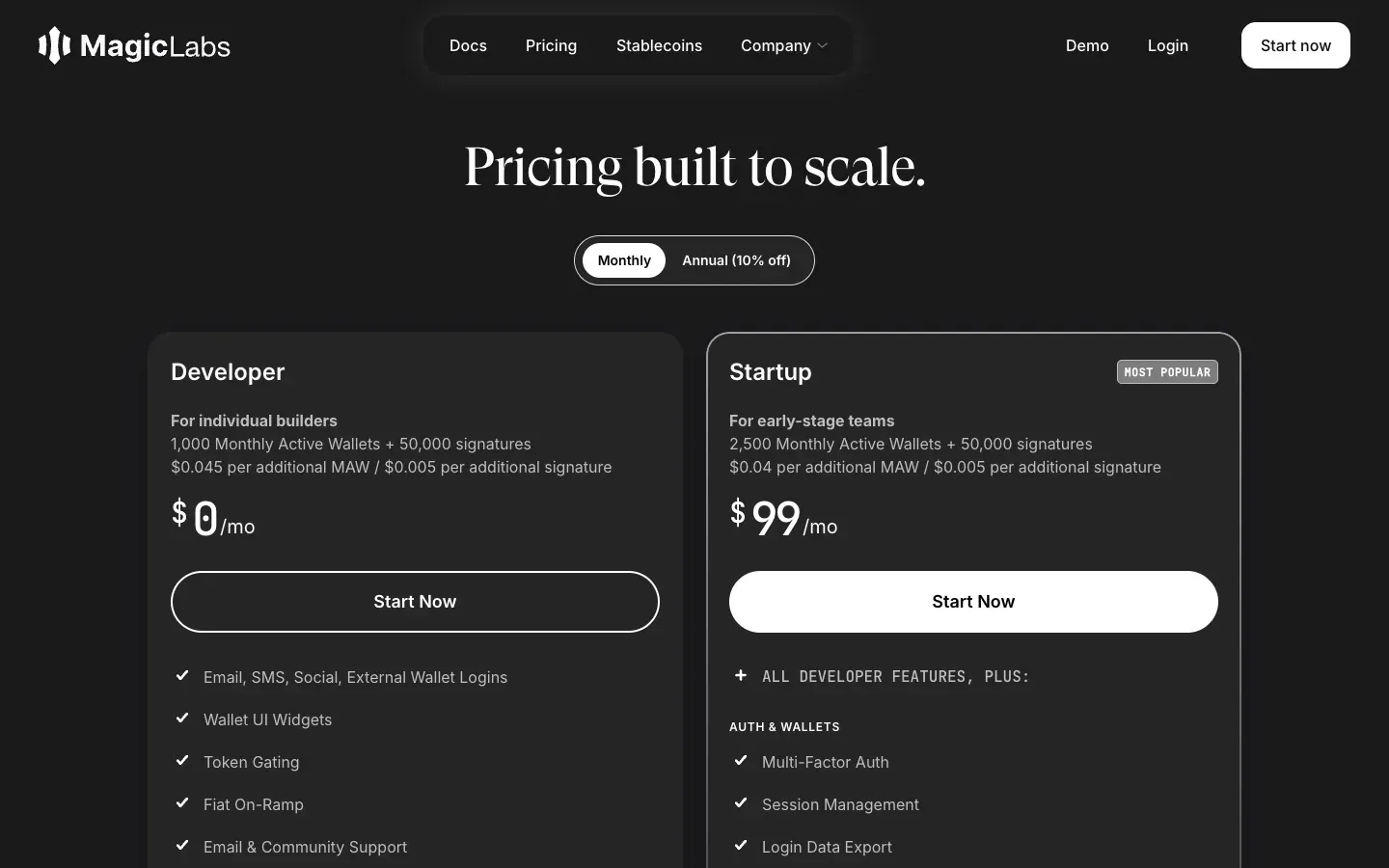
Prices checked on magic.link/pricing on 17 November 2026, in US dollars. The page has a switch between monthly and annual billing ("10% off") but only displays monthly prices.
| Plan | ||||
|---|---|---|---|---|
| Developer | Price $0 | Included each month 1,000 monthly active wallets, 50,000 signatures | Extra usage $0.045 per wallet, $0.005 per signature | Main features Email, SMS, social and external wallet logins, wallet widgets, token gating, fiat on-ramp, email and community support |
| Startup | Price $99 a month | Included each month 2,500 monthly active wallets, 50,000 signatures | Extra usage $0.04 per wallet, $0.005 per signature | Main features Everything in Developer, plus multi-factor authentication, session management, login data export, prioritised support, up to 5 team seats |
| Enterprise | Price On quote | Included each month Custom | Extra usage Custom | Main features Custom volumes, own SMTP provider and email templates, white-labelled wallet widget, dedicated Slack channel and SLAs, advanced MFA |
Signatures are counted per team and shared across all your apps and wallets.
Is Magic free? Yes, for building and for small launches: the Developer plan includes 1,000 monthly active wallets and 50,000 signatures with no fee. A product with 5,000 active wallets would pay $99 plus 2,500 extra wallets at $0.04 on Startup, so model your expected volume before you commit.
07Pros and cons
Advantages
- Users get a wallet behind a login they already know, without extensions or seed phrases.
- A real free tier to build and test.
- Non-custodial model with TEEs, key export and configurable sharding.
- Embedded and server wallets in one platform, across more than 30 networks.
- SOC 2 Type 2 and ISO 27001:2022 stated, which helps with security reviews.
- A long track record (since 2018) and large web3 projects among the logos on its site.
Drawbacks
- Billing per active wallet grows with success; costs must be modelled early.
- Your onboarding depends on a third-party provider for a critical step.
- MFA, session management and team seats require the paid Startup plan.
- White-label UI, custom email templates and SLAs are Enterprise features.
- Web3 itself adds complexity (fees, recovery, regulation) that Magic does not remove.
08Our verdict
Who it's for
- Teams building web3 apps for mainstream users: games, marketplaces, loyalty, collectibles.
- Products that need token gating or on-chain proof of ownership.
- Fintech and stablecoin products that need wallets created by API.
- Developers who want to avoid building key management themselves.
Who it's not for
- Apps that only need passwordless login, with no wallet: use a classic auth service.
- Crypto-native audiences who already have their own wallet and prefer to connect it.
- Teams that require full in-house control of keys with no third party at all.
- Projects without a clear reason to be on-chain.
09Magic alternatives
| Tool | |||
|---|---|---|---|
| Magic | Best for Embedded wallets behind email, SMS or social login | Free plan 1,000 monthly active wallets | Paid from $99 a month |
| thirdweb | Best for Full web3 development toolkit, wallets and contracts | Free plan Yes | Paid from Paid plans |
| Privy, Dynamic, Web3Auth | Best for Embedded wallets and wallet connection | Free plan Varies by vendor | Paid from Varies by vendor |
| Supabase Auth | Best for Classic login for apps without wallets | Free plan Yes | Paid from From $25 a month (Pro) |
| Firebase Authentication | Best for Classic login in the Google ecosystem | Free plan Yes | Paid from Pay as you go |
Our rule: if your users must hold on-chain assets and are not crypto natives, compare Magic and thirdweb on chains and price per active wallet. If they only need to sign in, skip web3 and use Supabase or Firebase.
10Getting started with Magic
- Write down why the product needs a wallet. If you cannot, you probably do not need Magic.
- Check the networks you need in Magic's documentation, for embedded and server wallets.
- Start on the Developer plan and build the login and one signing flow end to end.
- Decide on gas fees (user pays or you sponsor) and on account recovery before launch.
- Estimate monthly active wallets at 3, 6 and 12 months and compare the bill with alternatives. If you want a second opinion on the architecture, our project scoping work covers exactly this kind of decision.