


The essentials · 30-second read
Hunter.io finds and verifies business emails and sends cold sequences. Free: 50 credits a month. Starter €49 a month, or €34 billed yearly; Growth €104 and Scale €209 yearly.
- Finds a professional's email from a name and a company, lists the public addresses of a domain, verifies deliverability and sends cold email sequences.
- Free plan: 50 credits a month, 1 connected mailbox. Billed yearly: Starter €34, Growth €104, Scale €209 a month (monthly: €49, €149, €299). Unlimited users everywhere.
- 1 credit per email found, 0.5 credit per email verified; searches with no result are free. Yearly plans give the whole year's credits upfront.
- Our verdict: the reference tool for finding and checking one email at a time; for large list building or multichannel sequences, look at Apollo or Reply.io.
Summarize this page with AI
Hunter.io is the tool many people open when they need one thing: the right email address for the right person, checked before sending. In 2026 it also searches a B2B lead database and sends cold email sequences. This page explains what Hunter does, how its credits really work, what each plan costs, how it compares with Apollo, lemlist and Reply.io, and when we recommend it to clients. Prices were read on the official pricing page on 17 November 2026.
01What is Hunter.io?
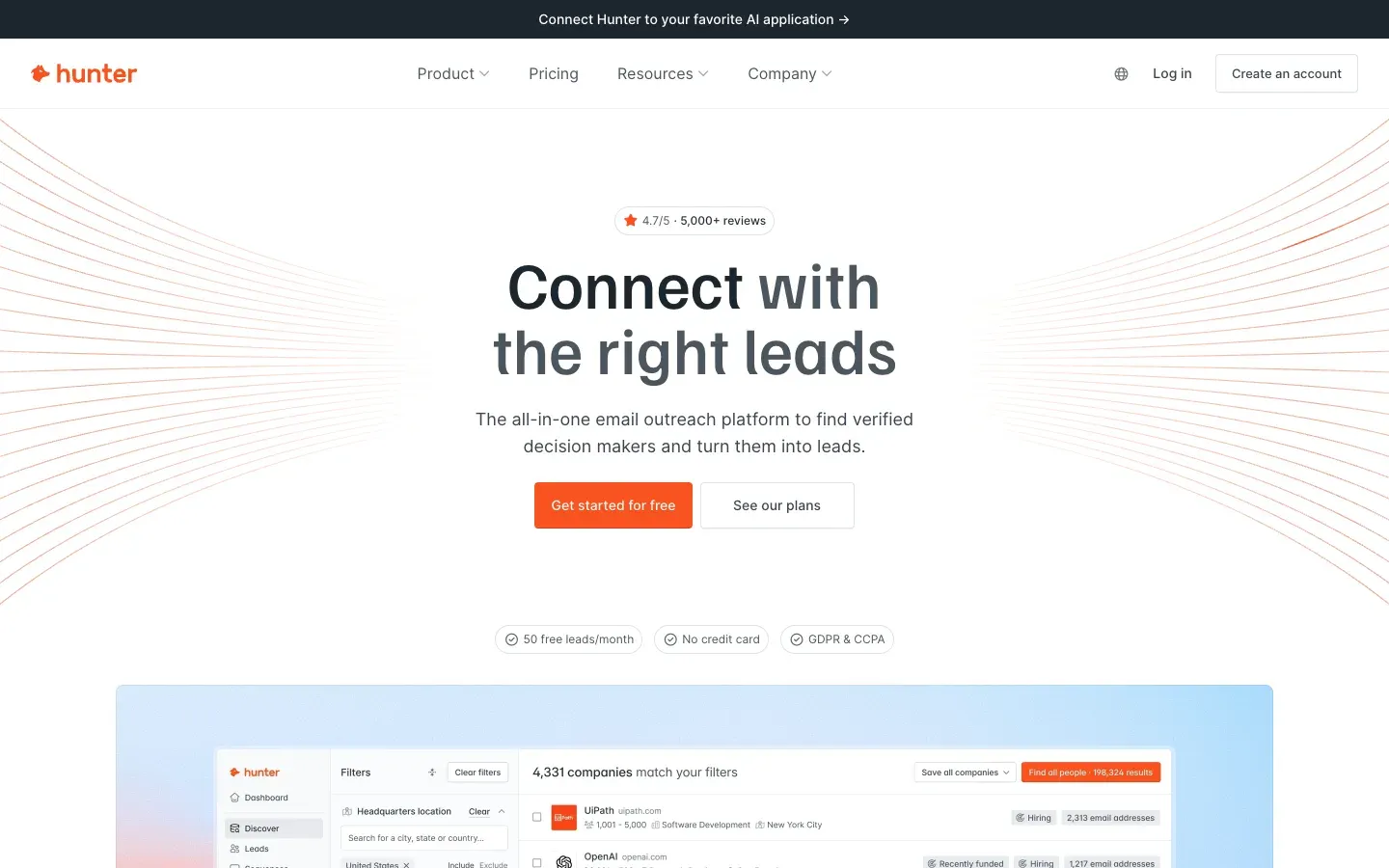
Hunter.io is a B2B email platform built around a simple question: what is this person's professional email, and is it valid? You type a company domain and Hunter lists the public addresses it has found for that domain, with a confidence score and the web pages where each one appeared. You type a first name, a last name and a company, and Hunter returns the most likely address. Then a verifier checks whether it can receive email.
Hunter's about page says the company was created in 2015 by Antoine Finkelstein and François Grante, first as Email Hunter, and has worked remotely from the start, with a small team spread over Europe, America and Asia. It claims more than 7 million user accounts. The brand is a registered trademark of Hunter Web Services, Inc.
Around that core, the product has grown into four blocks: finding leads (Discover, a B2B company and lead search with an AI assistant, and Signals based on intent data), enriching and verifying, engaging (Sequences, its cold email tool, with an AI writing assistant), and connecting (extensions, Google Sheets, CRM integrations, API and MCP). A separate Data Platform sells search and verification credits in bulk, through the API only.
02How we look at Hunter.io at BeBranded
Hunter is not part of our own stack, and we do not run cold email campaigns for clients. It comes up when a client's sales team, a founder or a marketing team asks how to find the right contact at a target company, or when we connect a prospecting tool to a CRM. Our position:
- We recommend Hunter to founders and small teams that already know which companies they want to reach and need reliable addresses, to marketers doing link building or PR outreach, and to recruiters. The free plan is enough to test, and unlimited users make it easy to share.
- We advise against it as the main tool for large outbound programmes across email, LinkedIn and phone: Reply.io or lemlist cover more channels, and Apollo is stronger when lists come from filters rather than from a known account list.
- Our usual job is the connection: contacts found in Hunter pushed to HubSpot or Pipedrive without duplicates, verification added to a form or an import, alerts in Slack. That is what our CRM integrations and automation services cover.
03Key features
- Domain Search: all the public email addresses Hunter found for a domain, with name, position, confidence score and sources.
- Email Finder: the most likely address of a person from their name and company, with a confidence score.
- Email Verifier: a deliverability check that flags valid, risky and invalid addresses; disposable addresses are skipped.
- Discover: a B2B search with filters (advanced on paid plans), an AI assistant and weekly lead suggestions.
- Signals and TechLookup: prospects found from intent data, and lists of websites by technology used.
- Sequences: cold email sequences from your own Gmail, Outlook or SMTP mailboxes, with rotation, link and open tracking, A/B tests, evergreen sequences and an AI writing assistant.
- Bulk tasks, extensions and add-ons: bulk finding and verification, Chrome, Firefox and Edge extensions, and a Google Sheets add-on.
04Use cases
A founder preparing account-based outreach
A founder has a list of 50 target companies and wants to write to the head of marketing at each one. Domain Search shows who is visible at each company, Email Finder gets the address, and the verifier confirms it. The free plan's 50 credits are enough for a first pass. What to know: the quality of the message matters more than the number of addresses.
Link building and digital PR
An SEO or PR team needs the editor of each site it pitches. The browser extension shows the addresses linked to a site while you visit it, which is faster than searching contact pages. Combined with a careful, personalised pitch, it saves hours on each campaign.
Recruiters sourcing candidates
A recruiter wants to contact a profile directly rather than through a social network inbox. Email Finder gives the professional address from a name and a company. Keep the message relevant and offer an easy way to say no: the same data protection rules apply as for sales.
Cleaning a list before a campaign
A marketing team inherits an old export or a trade show list. Running it through Bulk Email Verifier before the first send lowers bounces and protects the sending domain. At 0.5 credit per verification, the Starter plan's 2,000 credits verify up to 4,000 addresses a month.
Feeding a CRM automatically
Each new lead saved in Hunter can create a contact or a lead in HubSpot, Salesforce, Pipedrive or Zoho CRM. Through the API, Zapier or Make, a form submission on your site can also be enriched or verified before it reaches the sales team.
05Integrations
Hunter lists native CRM integrations with HubSpot, Salesforce, Pipedrive and Zoho CRM, and connections to Close, Copper, Airtable and Excel through Zapier. Sequences send from Gmail or Google Workspace, Outlook or Microsoft 365, or any SMTP and IMAP mailbox. For automation, Hunter names Zapier, Make and Clay, plus third-party tools such as PhantomBuster. It also offers a remote MCP server with ready-made connections for Claude, ChatGPT and Gemini, and a daily export to Snowflake. The API is available on every plan.
06Hunter.io pricing in 2026
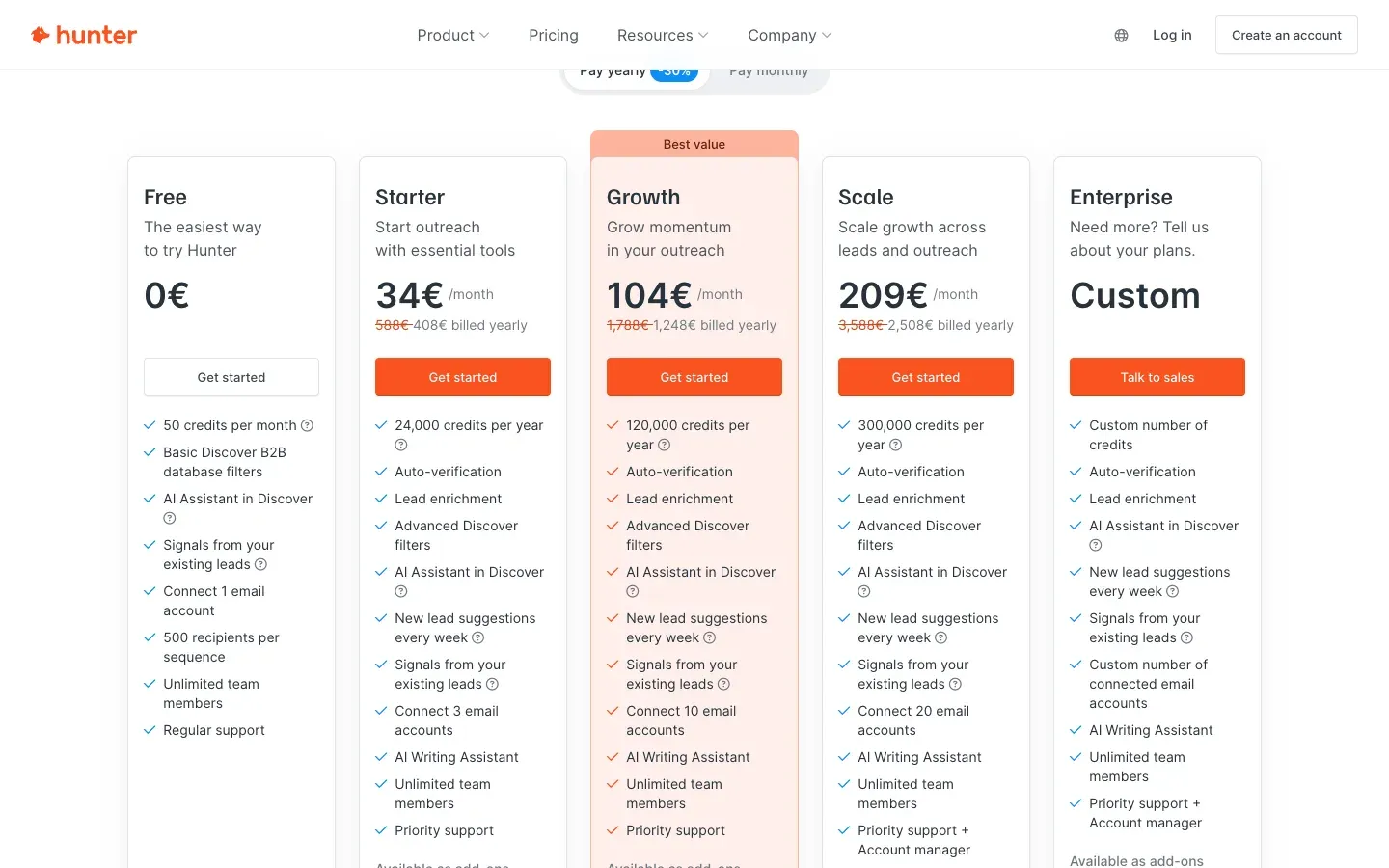
Prices checked on hunter.io/pricing on 17 November 2026. The page displayed prices in euros when we checked and does not say whether taxes are included. Yearly billing saves 30% and gives all the year's credits upfront; monthly credits reset each month and do not roll over.
| Plan | |||||
|---|---|---|---|---|---|
| Free | Billed monthly €0 | Billed yearly €0 | Credits 50 a month | Connected mailboxes 1 | Recipients per sequence 500 |
| Starter | Billed monthly €49 a month | Billed yearly €34 a month (€408 a year) | Credits 2,000 a month, or 24,000 a year | Connected mailboxes 3 | Recipients per sequence 2,500 |
| Growth | Billed monthly €149 a month | Billed yearly €104 a month (€1,248 a year) | Credits 10,000 a month, or 120,000 a year | Connected mailboxes 10 | Recipients per sequence 5,000 |
| Scale | Billed monthly €299 a month | Billed yearly €209 a month (€2,508 a year) | Credits 25,000 a month, or 300,000 a year | Connected mailboxes 20 | Recipients per sequence 15,000 |
| Enterprise | Billed monthly On quote | Billed yearly On quote | Credits Custom | Connected mailboxes Custom | Recipients per sequence Custom |
Every plan includes unlimited team members, who share the credit pool, plus the API, extensions, Google Sheets add-on, CRM integrations and MCP. Paid plans add auto-verification, lead enrichment, advanced Discover filters, weekly lead suggestions, the AI writing assistant and priority support (with an account manager on Scale). Add-ons: extra mailboxes from €10 a month each, domains and managed mailboxes, Inbox Protection, and credit packs. Registered non-profits get 30% off monthly plans. The Data Platform sells API credits in bulk: the example on the page is $6,500 for 1,000 search credits and 200,000 verification credits, valid 12 months.
Is Hunter.io free? Yes: 50 credits a month with no time limit, which means 50 emails found or 100 verifications, plus one mailbox for sequences of up to 500 recipients. For regular prospecting, Starter at €34 a month billed yearly gives 2,000 credits a month.
07Pros and cons
Advantages
- Very fast for finding and checking one address, with sources you can open.
- Credits are only used when a result is found, and repeats in a period count once.
- Unlimited users on every plan, including Free.
- A broad ecosystem: three browser extensions, Google Sheets, native CRMs, API and MCP.
- Clear, public pricing with a usable free plan.
Drawbacks
- Coverage depends on what exists on the public web, so some people or small companies return nothing.
- Credits are shared by the whole team and monthly credits do not roll over.
- Sequences are email only: no LinkedIn, calls or SMS steps.
- Phone numbers and deep firmographic data are not its focus.
- Monthly billing costs about 40% more than yearly.
08Our verdict
Who it's for
- Founders and small sales teams prospecting a known list of accounts.
- SEO, link building and PR teams contacting editors.
- Recruiters who want to reach candidates directly.
- Marketing teams cleaning lists before a campaign.
Who it's not for
- Outbound teams that need multichannel cadences: see Reply.io or lemlist.
- Teams that build lists from filters on hundreds of thousands of contacts: Apollo is designed for that.
- Newsletter senders writing to opted-in subscribers, a job for tools like EmailOctopus or Brevo.
- Anyone planning to send bulk emails without targeting or consent rules.
09Hunter.io alternatives
| Tool | |||
|---|---|---|---|
| Hunter.io | Best for Finding and verifying emails, simple sequences | Free option 50 credits a month | Paid from €34 a month billed yearly |
| Apollo | Best for Large B2B database plus outreach | Free option Free plan | Paid from $49 a month (Basic) |
| lemlist | Best for Personalised multichannel campaigns | Free option 14-day trial | Paid from Paid plans per user |
| Reply.io | Best for Multichannel outreach at volume | Free option 14-day trial | Paid from $49 per user a month billed yearly |
| PhantomBuster | Best for LinkedIn and web data extraction | Free option Trial | Paid from Paid plans |
Our rule: Hunter when you know who you want to reach and need the right address, verified. Apollo when you need to build the list itself, lemlist or Reply.io when the sequence must mix email, LinkedIn and calls. Many teams combine two: Hunter to find and verify, an outreach tool to send. Our guide on how to select the right no-code tools lists the questions to ask before you commit.
10Hunter.io vs Apollo, lemlist and Reply.io
The four tools overlap but start from different places. Hunter starts from the email address: find it, prove where it comes from, verify it. Its sequences are a useful extension for simple cold email from your own mailboxes. Apollo starts from the database: you filter by industry, size and role, and outreach comes after. lemlist and Reply.io start from the sequence: they run multichannel cadences with deliverability tools, and finding data is an add-on.
Pricing logic follows the same split. Hunter charges by credits with unlimited users, which suits a team where several people look up a few addresses each. Apollo and Reply.io mostly charge per user or per volume of contacts, which suits dedicated sales reps. For a team that writes 50 carefully chosen emails a week, Hunter is usually the most economical. For an SDR team sending thousands of steps a month, a dedicated outreach platform is a better base.
11Getting started with Hunter.io
- Define the target first: a list of companies and the roles you want to reach. Hunter is precise, not magic.
- Install the browser extension and test on a few target sites with the free credits.
- Verify before sending. Turn on auto-verification on a paid plan, or run your list through the verifier, and drop invalid or risky addresses.
- Use a separate sending domain for cold email and warm it up before using Sequences at volume.
- Connect the CRM so every contact and reply lands in one place, and write down your legal basis and opt-out process for European prospects.