


The essentials · 30-second read
Callingly calls new leads within seconds with an AI agent or by ringing your reps. From $100 a month ($80 billed yearly) with usage credit; AI calls from $0.35 to $0.50 each.
- Speed-to-lead software: a new lead triggers a call within seconds, either from its AI voice agent (Carl), which qualifies and warm-transfers, or by ringing your reps first.
- In US dollars: Starter $100 a month ($80 billed yearly), Growth $250 ($200), Scale $750 ($600), Business $2,000 ($1,600), each with the same amount of monthly usage credit.
- Usage is billed per AI call ($0.50 down to $0.35) and per SMS segment ($0.12 down to $0.06). Unlimited users and leads, every feature on every plan, 14-day trial.
- Our verdict: worth it for teams with steady inbound leads by form or ads, mainly in the US and Canada; overkill for a few leads a week.
Summarize this page with AI
Callingly sells one idea: call a new lead while they are still interested, within seconds rather than hours. In 2026 the product has changed a lot since its first version, which rang your sales reps. It now leads with an AI voice agent that calls, texts, qualifies and hands over to a human. This page explains what Callingly does today, what it costs in practice, which integrations it offers, what to check before using it outside North America, and when we recommend it. Prices were read on the official pricing page on 17 November 2026.
Product note (17 November 2026): Callingly is active (copyright 2026, live pricing and help center). Its positioning has moved from automatic calls to your reps to an AI voice agent named Carl that calls and texts leads first, then warm-transfers qualified ones. The original rep-calling mode still exists as "dispatch calls". Pricing is now based on monthly plans with usage credit and unlimited users.
01What is Callingly?
Callingly is speed-to-lead software for sales teams. It connects to your lead sources (website forms, landing pages, Facebook Lead Ads, your CRM) and starts a phone conversation as soon as a lead arrives. Its home page headline sums up the promise: "Never dial a lead again."
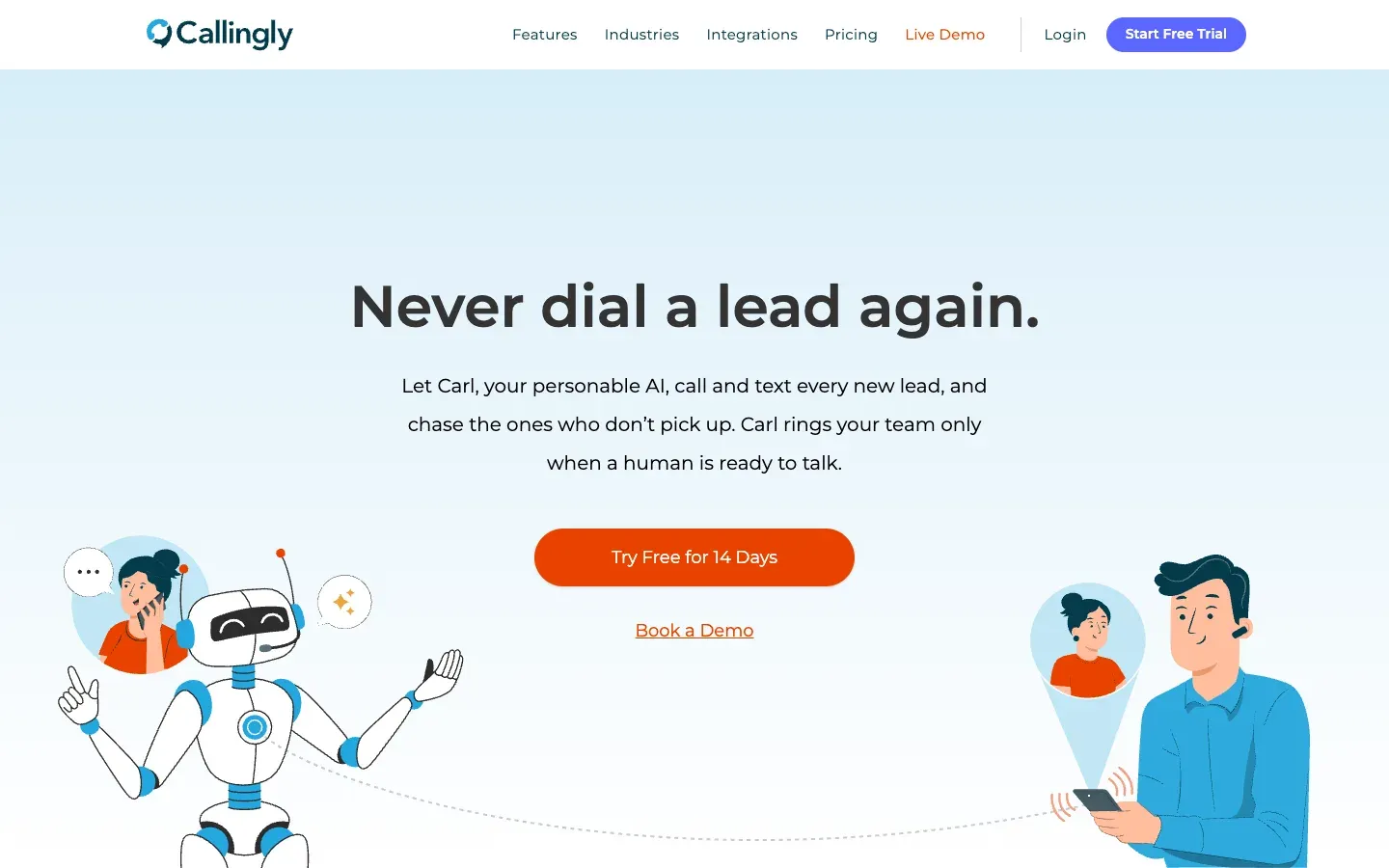
The process described on the site has five steps. A lead comes in and matches your rules. Carl, the AI agent, calls within seconds, after a text telling the lead to expect the call. Carl asks basic qualifying questions, then warm-transfers: your team's phones ring until someone answers, and Carl briefs the rep first. If the lead does not pick up, Carl leaves a voicemail, calls back on your schedule or books a callback. Finally, an automated SMS sequence keeps following up until the lead responds.
Callingly targets real estate, mortgage and lending, insurance, home services and auto dealers, and also mentions healthcare, legal and financial services. Every number includes spam-label protection from ArmorHQ, which registers numbers with US carriers.
02How we look at Callingly at BeBranded
Callingly is not part of our stack, and we do not run call centres. It comes up when a client generates inbound leads through the site or ads we build, and the sales team calls them back too late. Our position:
- We recommend Callingly to teams with a steady flow of inbound leads (several per day) where the first company to call usually wins: real estate, brokers, insurance, home services. It is quick to plug into a form or a CRM, and the trial lets you measure the effect before paying.
- We advise against it for low lead volume, for complex B2B sales where a first call within seconds is not what the buyer expects, and for European teams until coverage and rates are confirmed. Automated and AI calls are also regulated: call only people who asked to be contacted, and check local rules.
- Our usual job is the plumbing: website forms that send clean leads (with consent recorded) to the CRM and to Callingly, routing rules, and call outcomes sent back to the pipeline. That is what our CRM integrations, automation and AI agents services cover.
03Key features
- AI voice agent: calls each new lead, qualifies with your questions, gets past AI call screeners according to Callingly, leaves voicemails and books callbacks.
- AI SMS agent and sequences: an automated text before the call, then multichannel follow-up (calls and SMS) until the lead answers.
- Dispatch calls: ring one rep or the whole team, with a spoken "whisper" briefing and press-1-to-accept, so a lead never lands on voicemail.
- Warm transfer: to a rep or a team, with the AI agent briefing the human before connecting.
- Routing and rules: smart lead routing, schedule rules, scheduled callbacks, IVR menus, number pools, local presence and custom caller IDs.
- Call intelligence: recordings, transcriptions, AI call summaries and outcomes, real-time reporting and CSV exports.
- Developer tools: webhooks, REST API and an MCP server for AI assistants; mobile and desktop apps.
04Use cases
Real estate agents answering portal leads
A buyer fills in a form on a listing portal and contacts several agents at once. Callingly lists integrations with real estate CRMs such as Follow Up Boss, Brivity and CINC. The AI agent calls within seconds, qualifies budget and timing, and transfers to the agent on duty. What to know: tune the qualifying questions with your best agent, or the transfer will bring unqualified calls.
Mortgage and insurance quotes
Rate and quote requests lose value fast. Callingly's page for these industries is built on reaching borrowers or buyers before a competitor does. Calls are recorded and transcribed, which helps managers review compliance and coaching. Check what your regulator requires for recorded and automated calls.
Home services booking jobs
A homeowner asks for a plumber or a roofer through a form or a lead marketplace such as Angi, which appears in the integrations list. The AI agent calls, confirms the need and the address, and either transfers to the office or books a callback. Schedule rules keep calls inside your opening hours.
Protecting paid ad spend
Leads from Facebook Lead Ads or Google Ads cost money each. Connecting them to Callingly (natively for Facebook Lead Ads, or through Zapier or Make) means each paid lead gets a call within seconds instead of waiting in a list. Measure contact rate and booked meetings before and after, not just call volume.
A website contact form that calls back
On a site we build, a contact or quote form can send the lead to Callingly through a webhook or the API, and to the CRM at the same time. The form should ask for consent to be called and a phone number in a valid format, or the calls will fail.
05Integrations
Callingly's directory listed 42 integrations when we checked. CRMs: HubSpot (an action in a HubSpot workflow), Salesforce (through a Salesforce Flow), Pipedrive (a chosen pipeline stage triggers the call), Keap, ActiveCampaign and GoHighLevel. Real estate: Follow Up Boss, Brivity, CINC. Lead sources and forms: Facebook Lead Ads, Jotform, ClickFunnels, Angi, an email integration, plus mortgage lead providers. Phone: Aircall. Calendar: Google Calendar. Automation: Zapier and Make, which open 1,000+ apps, plus webhooks, a REST API and an MCP server. We did not find a native Webflow integration: a Webflow form connects through Zapier, Make, n8n or a webhook.
06Callingly pricing in 2026
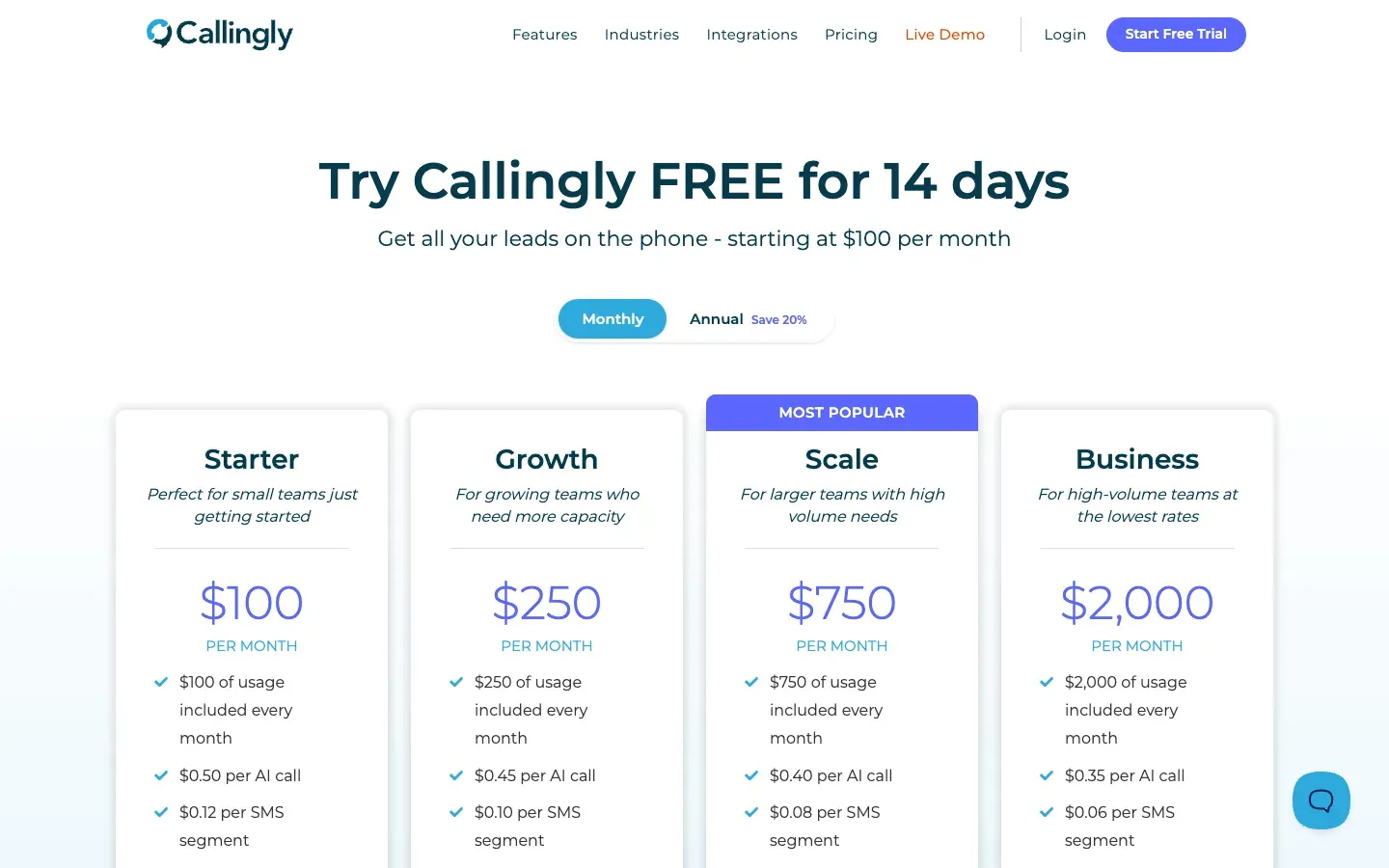
Prices checked on callingly.com/pricing on 17 November 2026, in US dollars. The page does not mention taxes; its usage estimates use USA and Canada rates. Every plan includes every feature, unlimited users and unlimited leads; the difference is the monthly usage credit and the rates per call and per text.
| Plan | |||||
|---|---|---|---|---|---|
| Starter | Billed monthly $100 a month | Billed yearly $80 a month ($960 a year) | Usage credit included $100 a month | AI call $0.50 | SMS segment $0.12 |
| Growth | Billed monthly $250 a month | Billed yearly $200 a month ($2,400 a year) | Usage credit included $250 a month | AI call $0.45 | SMS segment $0.10 |
| Scale | Billed monthly $750 a month | Billed yearly $600 a month ($7,200 a year) | Usage credit included $750 a month | AI call $0.40 | SMS segment $0.08 |
| Business | Billed monthly $2,000 a month | Billed yearly $1,600 a month ($19,200 a year) | Usage credit included $2,000 a month | AI call $0.35 | SMS segment $0.06 |
| Enterprise | Billed monthly From $5,000 a month | Billed yearly On quote | Usage credit included Custom | AI call Custom | SMS segment Custom |
Other costs: $5 per local or toll-free number, and $0.10 extra per branded call. Unused credit does not roll over. Enterprise adds custom integrations, custom terms, priority phone support and an SLA. An agency console manages several client accounts and their billing.
The page's own estimator gives a useful example: 500 new leads a month, one AI call and one text each, comes to $310 a month on Starter ($100 plan plus $210 of usage beyond the credit) and $275 a month on Growth ($250 plus $25). At that volume, the bigger plan is cheaper.
Is Callingly free? No. There is a 14-day free trial with no credit card, then the cheapest plan is Starter at $100 a month, or $80 a month billed yearly, with $100 of usage credit included.
07Pros and cons
Advantages
- Leads are called within seconds, day and night, without a rep watching the inbox.
- Two modes: AI agent first, or reps first with a whisper briefing and press-1-to-accept.
- Unlimited users and leads, and every feature on every plan.
- Recordings, transcripts and summaries synced to the CRM.
- Many lead-source and CRM integrations, plus webhooks, API and MCP.
Drawbacks
- Usage-based billing makes the monthly cost harder to predict.
- Unused credit is lost at the end of each month.
- Built and priced for the US and Canada; European coverage is not documented on the pricing page.
- An AI agent on the phone is not right for every brand or every buyer.
- Automated calling carries legal obligations (consent, recording notices) that you must handle.
08Our verdict
Who it's for
- Inbound sales teams with several new leads a day.
- Real estate, mortgage, insurance, home services and auto businesses in North America.
- Marketing teams that pay per lead and want every lead contacted fast.
- Agencies managing lead response for several clients.
Who it's not for
- Businesses with a few leads a week: a CRM task and a quick human call are enough.
- Long B2B sales cycles where buyers expect a scheduled meeting, not an instant call.
- Teams outside North America until local coverage and rates are confirmed.
- Companies looking for a full phone system for every call: see Aircall.
09Callingly alternatives
| Tool | ||
|---|---|---|
| Callingly | Best for Calling inbound leads within seconds, with an AI agent | Main difference with Callingly 14-day trial, from $80 a month billed yearly |
| Aircall | Best for Cloud phone system for sales and support teams | Main difference with Callingly Handles all calls, no automatic first call to new leads |
| HubSpot | Best for CRM with calling, workflows and sequences | Main difference with Callingly Calls start from tasks and workflows, made by reps |
| Pipedrive | Best for Pipeline CRM with calling and automations | Main difference with Callingly Calls made by reps; 14-day trial |
| Twilio + n8n or Make | Best for A custom calling workflow built on APIs | Main difference with Callingly Full control, pay as you go, you build and maintain it |
Our rule: Callingly when inbound volume is high and speed decides the deal. A CRM's own calling and tasks (HubSpot, Pipedrive) when volume is modest. Aircall when you need a phone system for the whole team. A custom build on Twilio with an automation tool when your process or your country does not fit an off-the-shelf product. Our guide on how to select the right no-code tools lists the questions to ask before you commit.
10Callingly vs a custom calling workflow
Callingly packages what a team could assemble itself: a trigger on new leads, a call API, an AI voice model, routing rules, SMS, recording and CRM sync. Building it on Twilio with n8n or Make gives full control over the script, the countries and the data, and pays only for usage. It also means maintaining the workflow, the AI prompts, carrier registration and spam protection yourself.
For a North American team that wants results this month, Callingly is the faster path. For a European company, or a process with unusual rules (several brands, strict data residency, a specific CRM), a custom workflow is often the more realistic option. Our AI agents service builds that kind of workflow.
11Getting started with Callingly
- Start the 14-day trial with one lead source only, ideally the form with the most volume.
- Write the qualification script: three to five questions your best salesperson asks, and the rule for when to transfer.
- Set schedule and routing rules, so calls go out only during hours when someone can take a transfer.
- Check consent and compliance: the form must ask permission to call, and recorded calls may require a notice.
- Measure for two weeks: contact rate, transfers, booked meetings and cost per contacted lead, then choose the plan whose credit matches your real usage.