Claude AI: complete guide to use it effectively (2026)
No-Code
•
X min
•
Published on
19.02.2026
•
Updated on
23.08.2026
Claude is the AI assistant built by Anthropic. Since late 2025, it has established itself as one of the top-performing tools for long-form writing, document analysis, and structured web work.
The problem: most users treat it like a simple chatbot (ask a question, get an answer). The result is generic output, an underused tool, and the classic takeaway that "it's no better than ChatGPT."
This article gives you a concrete method for using Claude effectively in a marketing, content, or web context. You'll find the most useful use cases, ready-to-use prompts, an honest comparison with ChatGPT, and the mistakes to avoid.
Claude excels at long-form writing, synthesis, and structured work. To get the most out of it, you need to provide context (goal, audience, constraints, examples). This article shows you how, step by step.
Claude is a large language model (LLM) created by Anthropic, a company founded in 2021 by former OpenAI researchers. Its approach is built on "Constitutional AI": a training framework designed to produce more reliable, more nuanced responses with fewer hallucinations than the market average. The name is a nod to Claude Shannon, the founder of information theory.
In practice, Claude is available through a web interface (claude.ai), a mobile app (iOS / Android), a desktop app, and an API for developers. No credit card required to get started: the free plan gives you access to the main model (Sonnet).
Anthropic offers five active models, organized into three families (Opus, Sonnet, Haiku). Each serves a different purpose.
| Model | Release Date | Positioning | Best For | Access |
|---|---|---|---|---|
| Opus 4.6 | Feb 5, 2026 | Most advanced, 1M token context (beta) | Complex reasoning, autonomous agents, advanced code | Pro, Max, Team, Enterprise |
| Opus 4.5 | Nov 24, 2025 | High intelligence, large documents | Deep analysis, synthesis, premium writing | Pro, Max, Team, Enterprise |
| Sonnet 4.6 | Feb 17, 2026 | Hybrid reasoning, ideal for agents | Daily use, agents, writing, code, projects | All (including the free plan) |
| Sonnet 4.5 | Sep 29, 2025 | Balanced performance and speed | Writing, code, long-running tasks | All |
| Haiku 4.5 | Oct 15, 2025 | Fastest and most affordable | Simple tasks, high volume, sub-agents | All (API, Claude Code) |
For marketing or content work, Sonnet 4.6 (the latest model, released February 17, 2026) is the default. It's the model that runs on the free plan and what most professionals use day to day. Anthropic positions it as a "hybrid reasoning" model: it can respond instantly or take time to reason step by step depending on how complex the task is.
Opus (4.5 or 4.6) is useful for work that requires deeper reasoning: analyzing a very long document, rethinking a content strategy, or working through a complex brief. Haiku is mainly relevant for developers who need speed and volume through the API.
Claude isn't the only AI tool on the market. But it has specific strengths that make it particularly useful for marketing teams, founders, and freelancers working on content, SEO, or web projects.
This is where Claude stands out the most. Blog posts, guides, white papers, sales pages: whenever content exceeds 1,000 words and requires a clear structure, Claude produces output that reads more naturally and is better organized than most competitors.
The difference comes down to three things. The tone is less "robotic" (fewer AI clichés like "in today's fast-paced landscape" or "it's crucial to"). Logical structure holds better over length. And the model follows style instructions more faithfully when given a detailed brief.
Example: you need to produce a 2,000-word article on a technical topic. Instead of writing a vague prompt ("write an article about technical SEO"), you provide a complete brief (persona, angle, H2/H3 structure, expected tone, examples to include). Claude produces a usable V1 that needs editing but not a complete rewrite. If you want your content to perform in AI-powered search as well, see our guide to optimizing content for AI.
Claude can process long documents (PDFs, text files, datasets) thanks to its 200,000-token context window (roughly 150,000 words). That's enough to load a full annual report, a detailed specification document, or a set of marketing briefs, and extract an actionable summary.
Example: you receive a 40-page SEO audit. You upload it to Claude and ask: "Identify the 5 priority issues, rank them by estimated traffic impact, and propose a 3-month action plan." Within minutes, you have a structured working draft.
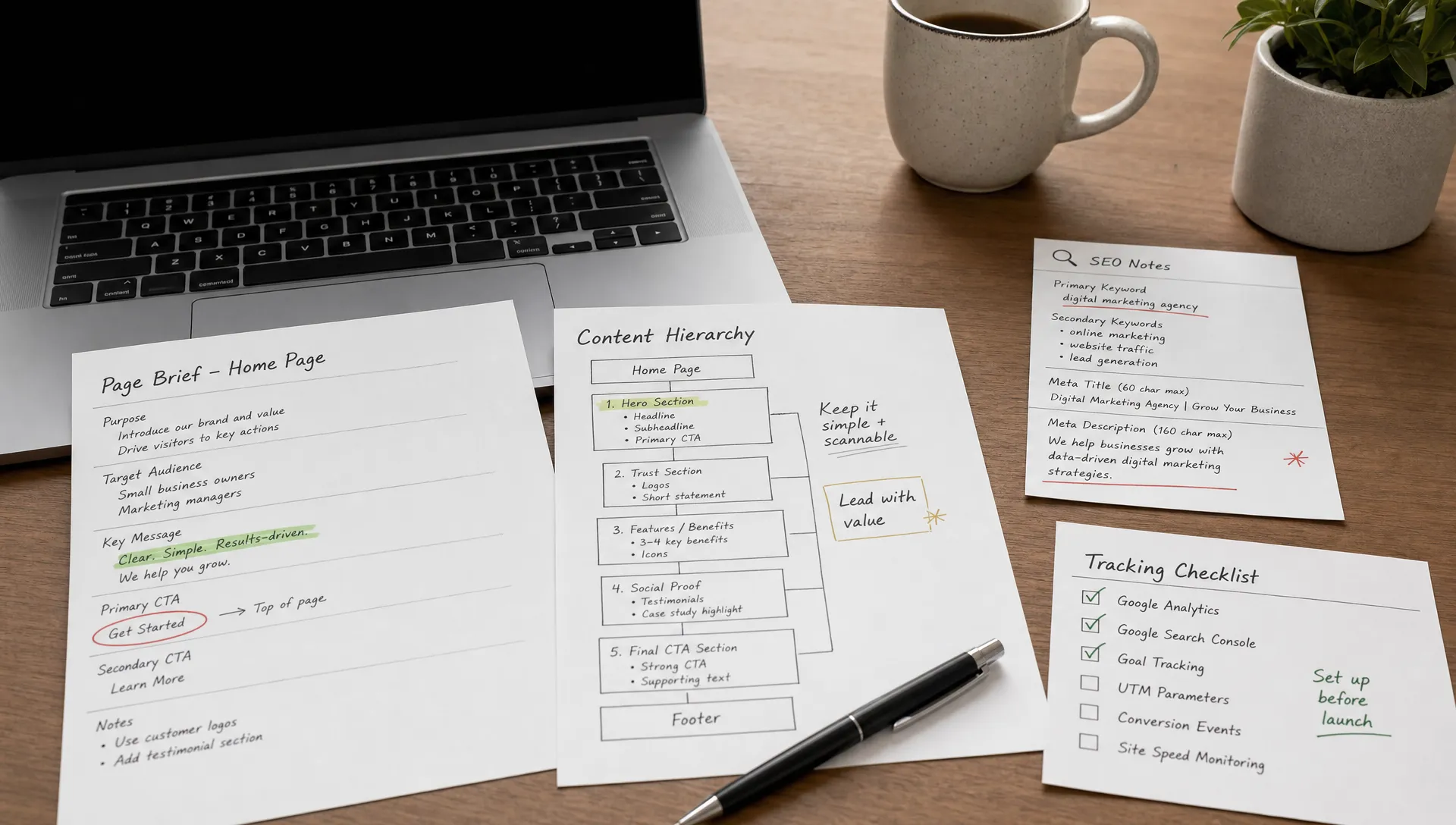
For teams working on web content (product pages, landing pages, service pages), Claude is a solid co-pilot when the request is well-defined. It can suggest a page structure, write conversion-focused content blocks, and rewrite existing copy to improve clarity or SEO.
Example: you're redesigning your "Services" page. You load the current version into Claude, add your value proposition and personas, and ask for a rewrite that prioritizes client benefits over features. Claude produces an alternative version you can compare and iterate on. For a broader look at what AI can and cannot do for a full website build, see our guide to creating a website with AI.
Both tools are strong. The question isn't "which one is better" but "which one fits your main use case best." Here's a comparison focused on marketing and content work.
| Criteria | Claude | ChatGPT |
|---|---|---|
| Long-form writing (articles, guides, pages) | More natural tone, better coherence over length, fewer AI-sounding phrases | Decent but tends toward a more "corporate" tone and repetitive phrasing |
| Brainstorming and ideation | Solid, but fewer creative variations | Faster at generating many variations in a short time |
| Document analysis | 200K token context window (1M in beta via API), strong synthesis capabilities | Good capabilities, more limited context on very long documents |
| Image generation | Not available natively | Built-in (DALL-E), handy for marketing visuals |
| Code and development | Industry leader in 2026 (top SWE-Bench score), Claude Code built in | Very good, broader ecosystem (plugins, custom GPTs) |
| Instruction following | Very good when the prompt is structured (tone, format, constraints) | Good, but tends to "interpret" instructions more loosely |
| Ads in the interface | None (Anthropic confirmed its anti-ad stance in early 2026) | Being tested in the US since early 2026 |
| Price (individual paid plan) | $20/mo (Pro), $100–200/mo (Max) | $20/mo (Plus), $200/mo (Pro) |
Bottom line: if your primary use is structured content writing, document analysis, or working from detailed briefs, Claude is often the better choice. If you need versatility (images, voice, plugins, broad ecosystem), ChatGPT is still more complete. Many professionals use both in parallel, each for its strengths.
The difference between mediocre output and usable output rarely comes down to the model. It comes down to prompt quality.
Claude works best when it knows who it's talking to, what the goal is, and what the constraints are. A vague prompt produces a vague answer. A structured prompt produces a structured answer.
Here are the elements to include systematically in any content or marketing prompt:
Copy and adapt this prompt to your topic. It works as-is with Claude.
You are an expert writer in [field]. You're writing a [1,500–2,500] word blog post for [persona: e.g., a marketing manager at a mid-sized company].
Topic: [title or angle of the article]
Goal: [SEO / education / conversion]
Tone: professional, clear, direct. No unnecessary jargon, no dramatic phrasing.
Expected structure:
Constraints:
You are a copywriter specializing in conversion-focused web pages.
Here is the current content of my [services / product / landing] page:
[paste text]
Rewrite this page following these rules:
My target: [persona]
My goal: [e.g., booking a call / requesting a quote]
I'm uploading a document [type: SEO audit / marketing report / project spec].
Analyze it and produce:
Format: short sections, no excessive bullet points. I want to be able to copy-paste this plan into Notion or Google Docs.
Claude is more than a chat window. The interface offers several features that change how you work with the tool.
Projects let you create a dedicated workspace around a topic. You upload files (brand guidelines, editorial charter, briefs, data), and Claude uses them as context in every conversation within the project. This is the single most useful feature for recurring marketing work.
Example: you create a "BeBranded Blog" project with your tone guidelines, editorial rules, and sample articles. Every time you request a new article in this project, Claude already knows the framework. You don't have to re-explain everything.
Projects are available on the free plan since early 2026.
Artifacts are standalone content blocks that Claude generates alongside the conversation: documents, code, tables, interactive visualizations. They appear in a separate panel and can be copied, edited, or shared.
This is especially useful for producing directly usable deliverables: a checklist, a comparison table, a structured brief, or even a web component in HTML/React that you can embed in Webflow or another tool.
Claude has memory that retains information across conversations: your tone preferences, your industry, your ongoing projects. Memory builds progressively as you interact. You can also edit it manually.
This saves you from repeating your context at the start of every new conversation. If you use Claude regularly for the same type of task, memory noticeably improves output quality over time.
The Model Context Protocol (MCP) is an open standard that lets you connect Claude to external tools: Google Drive, Notion, Slack, Asana, GitHub, and many more. Once a connector is enabled, Claude can read and write in those tools directly from the interface.
For marketing teams, the most useful connectors are Google Drive (direct document access), Notion (reading and editing databases), and Slack (thread summaries, message drafting). If you work with Webflow, there is also an official Claude connector for Webflow that lets you edit your site and CMS directly from the conversation.
Connectors are available on paid plans (Pro, Team, Enterprise).
Claude can run web searches to supplement its responses with recent information. This feature is available on all plans, including the free tier.
It's useful for tasks that require up-to-date data (competitive monitoring, fact-checking, sourcing for an article). It doesn't replace a dedicated monitoring tool, but it complements a writing or research workflow well.
Here are the plans available for individuals and small teams. All prices are in US dollars.
| Plan | Price | Models Included | Key Features | Best For |
|---|---|---|---|---|
| Free | $0 | Sonnet 4.6 | Projects, Artifacts, web search, connectors. ~15 messages per 5-hour window | Testing, occasional use |
| Pro | $20/mo ($17/mo annual) | Sonnet 4.6, Opus 4.6, Opus 4.5 + Haiku | 5x more usage, Claude Code, Cowork, memory, unlimited projects, Claude in Chrome/Excel | Regular professional use |
| Max 5x | $100/mo | All models | 5x more usage than Pro, priority access, Claude in PowerPoint | Power users, heavy daily use |
| Max 20x | $200/mo | All models | 20x more usage than Pro, maximum priority, early access to new features | Developers, researchers, AI teams |
| Team | $25/seat/mo (annual) | All models | Shared projects, admin console, SSO, 5-seat minimum | Marketing teams, agencies, SMBs |
For most marketing or web professionals, the Pro plan at $20/month is the right starting point. It gives you access to all models (including Opus), Claude Code, advanced connectors, and persistent memory. The free plan is enough to test the tool and for occasional use, but message limits become frustrating quickly once you're working in it several hours a day.
The Max plans ($100 or $200/month) are mainly relevant for developers or users who spend their entire day in Claude and regularly hit Pro plan limits.
Claude is a language model, not a search engine. If you ask "what are the best SEO tools in 2026," it will produce an answer that looks complete but may contain outdated or fabricated information. Even with web search enabled, results don't replace human verification.
Best practice: use Claude for structuring, writing, and analyzing. For factual research, always cross-reference with reliable sources.
This is the most common mistake. A prompt like "write me an article about branding" produces generic output. Claude doesn't know who you're writing for, in what context, or with what goal.
Best practice: every prompt should include at minimum the audience, the goal, the expected format, and the constraints. The more specific the brief, the better the output.
Claude rarely produces a perfect deliverable on the first try. The V1 is a working draft, not a finished product. The best outputs come from an iterative process: V1, feedback, correction, V2.
Best practice: after a V1, ask Claude to self-review with specific criteria. For example: "Re-read this article. Remove repetitions, tighten paragraphs that run too long, and check that each H2 section delivers clear value."
If you use Claude for the same type of task (writing, SEO, page creation), not using Projects means starting from scratch every conversation. You waste time re-explaining the context.
Best practice: create one Project per task type or per client. Upload reference documents (charter, tone guide, examples). Claude references them automatically.
Claude can fabricate statistics, product names, or studies. It rarely does so in an obvious way, but often enough that verification is non-negotiable, especially for published content.
Best practice: if a specific statistic or factual claim appears in the output, verify it. If you can't find the source, remove it.
Run through these points before every work session with Claude.
Claude is a powerful tool, but like any tool, it only works well when used correctly. The key isn't mastering every feature: it's providing context, structuring your requests, and iterating.
Three steps to get started. First, create a free account at claude.ai and test it with a real use case (not "tell me a joke"). Second, create a Project with your reference documents so Claude knows your context. Third, use the prompts in this article as a starting point and adapt them to your needs.
Getting cited by assistants like Claude is exactly what GEO is about. See our guide to generative engine optimization (GEO) to make your content quotable by AI.
If you're looking to integrate AI into your marketing workflow or web content strategy and need hands-on guidance, you can book a call with our team. We'll help you identify the right use cases and set up an efficient process.